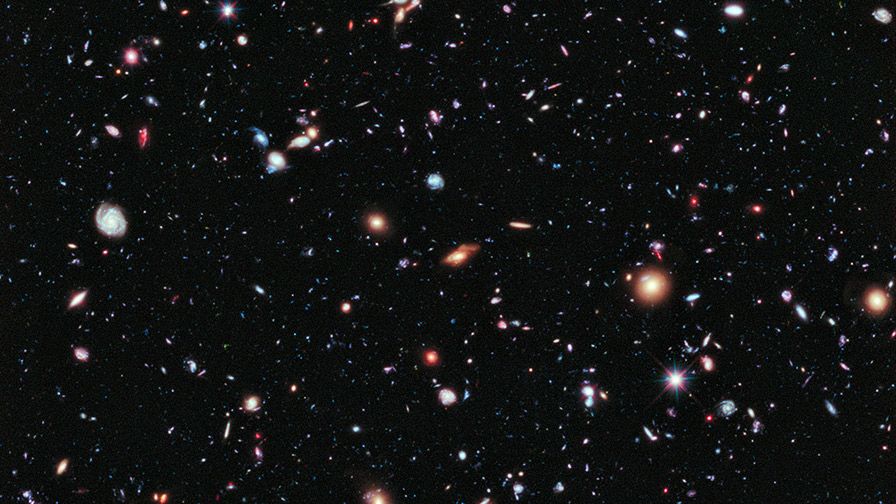
The night sky has always inspired wonder. On a clear evening, we can look up and see thousands of stars, each shining across unimaginable distances. With powerful telescopes, astronomers have discovered billions of galaxies beyond our own Milky Way, revealing a universe so vast that it stretches the limits of human imagination. Yet even this breathtaking cosmic view hides an extraordinary truth: everything we can observe is only a small part of the entire universe.
The most distant galaxies ever detected lie near the edge of what scientists call the observable universe. Beyond that boundary lies a region that no telescope—not even the most advanced ever built—can currently see. This raises one of the most fascinating questions in modern science: What is beyond the observable universe?
The honest answer is both exciting and humbling. Scientists do not know for certain what lies beyond this cosmic horizon. However, based on the laws of physics, astronomical observations, and the best cosmological models available today, researchers have developed several scientifically grounded ideas about what may exist beyond the edge of our observable universe.
Understanding the Observable Universe
Before asking what lies beyond the observable universe, it is important to understand what the observable universe actually is.
The observable universe is not the entire universe. Instead, it is the portion of the universe whose light has had enough time to reach Earth since the universe began about 13.8 billion years ago.
At first glance, this might suggest that the observable universe has a radius of 13.8 billion light-years. However, the universe has been expanding throughout cosmic history. As light traveled across space, the space itself continued to stretch, carrying galaxies farther away.
Because of this expansion, the radius of the observable universe is now approximately 46.5 billion light-years, giving it a diameter of about 93 billion light-years.
Everything within this immense sphere can, in principle, be observed because light or other signals from those regions have reached us.
Everything beyond it remains invisible—not because it does not exist, but because its light has not yet had enough time to arrive.
The Cosmic Horizon Is Not a Physical Wall
It is natural to imagine the observable universe ending at some kind of edge or boundary, but this picture is misleading.
The observable universe has no physical border.
There is no giant wall in space where galaxies suddenly stop.
Instead, the observable universe is defined by a limit in what information has reached us.
Imagine standing in the middle of a dense forest during a foggy morning. You can only see as far as the fog allows. Trees beyond that distance still exist, but they remain hidden simply because your view is limited.
The observable universe works in much the same way.
Our “cosmic fog” is created by the finite speed of light and the finite age of the universe.
Why Can’t We See Beyond It?
The reason is surprisingly simple.
Light travels at a finite speed—about 299,792 kilometers per second (186,282 miles per second). Although this speed is incredibly fast, the universe is unimaginably large.
If a galaxy is so distant that its light has not had enough time to reach Earth since the beginning of the universe, then we cannot observe it today.
In other words, seeing farther into space also means looking farther back in time.
When astronomers observe a galaxy located 10 billion light-years away, they are seeing it as it appeared roughly 10 billion years ago.
Eventually, we reach a distance where no older light has yet arrived.
That limit marks the observable universe.
Does Anything Exist Beyond the Observable Universe?
According to the standard model of cosmology, the answer is almost certainly yes.
Most physicists believe that the universe continues far beyond the region we can observe.
In fact, there is no evidence suggesting that space suddenly ends just outside our observable horizon.
Instead, observations indicate that the universe appears remarkably similar in every direction.
Its large-scale structure looks nearly uniform, with galaxies distributed throughout space in patterns shaped by gravity over billions of years.
This remarkable uniformity suggests that the regions beyond our view are probably much like the regions we can already observe.
There may be more galaxies, more stars, more planets, and perhaps countless cosmic structures extending far beyond our cosmic horizon.
Could the Universe Be Infinite?
One of the biggest unanswered questions in cosmology concerns the overall size of the universe.
Current observations show that space is extremely close to being geometrically flat.
A flat universe can be either infinite or extraordinarily large.
If the universe is truly infinite, then the observable universe represents only an unimaginably tiny region within an endless expanse of space.
In such a universe, galaxies would continue forever without any ultimate edge.
No matter how far someone traveled, there would always be more universe ahead.
Although scientists cannot yet prove that the universe is infinite, current observations remain consistent with this possibility.
If the Universe Is Finite, What Happens Beyond Its Edge?
Interestingly, even a finite universe would not necessarily have an edge.
This idea seems difficult to imagine because our everyday experience involves objects having boundaries.
However, geometry allows different possibilities.
A common analogy is the surface of Earth.
The Earth’s surface is finite because it has a limited area.
Yet someone walking across Earth’s surface never encounters an edge.
Eventually, they return to where they started.
Similarly, some cosmological models describe a universe that is finite but unbounded.
In such a universe, space curves back on itself in higher dimensions, meaning there would be no physical border where the universe suddenly stops.
Although this concept is mathematically possible, current observations have not yet determined whether our universe has this kind of geometry.
Inflation and the Vast Universe Beyond
One of the strongest scientific ideas supporting an enormous universe comes from the theory of cosmic inflation.
According to inflation, the universe underwent an incredibly rapid expansion during an extremely brief moment shortly after the Big Bang.
In less than a tiny fraction of a second, space expanded by an enormous factor.
This rapid growth explains several important observations, including why the observable universe appears remarkably smooth and uniform.
Inflation also suggests that the universe beyond our observable region could be vastly larger than the portion we can see.
Some models predict that the entire universe may be hundreds, millions, or even infinitely larger than our observable universe.
Our cosmic neighborhood could simply be one tiny patch within an unimaginably enormous cosmos.
Could There Be More Galaxies Like Ours?
If the universe continues beyond our observable horizon, then the answer is almost certainly yes.
Beyond the galaxies we can observe may lie trillions upon trillions more galaxies.
Many could resemble the Milky Way.
Some might contain billions of stars.
Others may host planetary systems with rocky worlds similar to Earth.
Because the laws of physics appear to operate uniformly throughout the observable universe, astronomers expect those same laws to apply beyond it as well.
Stars would form.
Galaxies would evolve.
Planets would orbit suns.
Gravity would shape cosmic structures.
The hidden universe may simply be more of the same astonishing cosmic landscape.
Could There Be Other Versions of Earth?
If the universe is infinite, an extraordinary possibility emerges.
Given infinite space and a finite number of ways particles can be arranged within a limited region, some physicists have suggested that identical arrangements of matter could eventually repeat.
In principle, this could mean that somewhere unimaginably far away, there may exist planets nearly identical to Earth—or even versions of Earth with histories remarkably similar to our own.
However, these ideas remain speculative.
No observations currently support the existence of such duplicate worlds, and they lie far beyond anything humanity could ever verify with present-day technology.
The Multiverse Hypothesis
Some theories go even further.
According to certain versions of cosmic inflation and some interpretations of quantum mechanics, our observable universe may be only one of many universes.
Together, these universes would form what scientists call a multiverse.
In some multiverse models, each universe has different physical properties.
Some may contain different particles.
Others may have different strengths of gravity.
Some might never produce stars.
Others could evolve in ways completely unlike our own universe.
Although the multiverse is a fascinating scientific hypothesis, it remains unconfirmed.
There is currently no direct observational evidence proving that other universes exist.
For this reason, most scientists treat the multiverse as an active area of theoretical research rather than an established scientific fact.
Can We Ever Observe Beyond the Observable Universe?
Unfortunately, the answer is probably no.
The expansion of the universe creates a fundamental limit on what information can reach us.
Some regions are so distant that even light traveling forever may never arrive.
In fact, because the expansion of space is accelerating, many galaxies are gradually moving beyond our ability to observe them.
This does not mean they disappear.
Instead, the space between us expands so rapidly that their light can never overcome the growing distance.
In this sense, parts of the universe permanently remain beyond our observational reach.
The Cosmic Microwave Background
The oldest light we can directly observe is known as the Cosmic Microwave Background (CMB).
This faint glow fills the entire sky.
It was emitted approximately 380,000 years after the Big Bang, when the universe cooled enough for light to travel freely through space.
Before that time, the universe was filled with hot, dense plasma that scattered light in every direction.
As a result, ordinary light cannot reveal earlier events.
Scientists instead study subtle patterns in the CMB to learn about the early universe.
Although the CMB marks the limit of what we can see using light from that era, it does not represent the edge of the universe itself.
Instead, it is another observational horizon.
Could Gravitational Waves Reveal More?
Unlike light, gravitational waves interact only weakly with matter.
This means they can travel through regions that light cannot escape.
Scientists hope that future gravitational-wave observatories may detect signals originating from extremely early moments in cosmic history.
Such observations could provide new clues about inflation and the conditions that existed shortly after the Big Bang.
However, even gravitational waves cannot necessarily reveal regions forever beyond our cosmic horizon.
Some parts of the universe may remain permanently inaccessible.
Why the Universe Appears So Uniform
One of the great puzzles of cosmology is that distant parts of the observable universe have nearly identical temperatures and properties despite appearing too far apart to have exchanged information.
Inflation provides the leading explanation.
Before inflation, these regions were close together and could interact.
Then inflation stretched space enormously, carrying them far apart while preserving their nearly identical conditions.
If inflation is correct, the universe beyond what we observe is likely part of the same much larger structure.
What Do Current Observations Suggest?
Modern telescopes, satellites, and astronomical surveys have produced an astonishingly consistent picture of the universe.
Large-scale observations indicate that the universe is homogeneous and isotropic on the greatest scales, meaning it looks broadly similar in every direction when averaged over vast distances.
This consistency strengthens the idea that the regions beyond our observable universe probably resemble the regions within it.
There is no observational evidence that space suddenly changes character just beyond our horizon.
Instead, everything points toward continuity.
The Limits of Human Knowledge
One of the most remarkable aspects of science is its willingness to distinguish between what is known, what is likely, and what remains unknown.
Scientists know that the observable universe has a finite size determined by the age of the universe and the speed of light.
They have strong evidence that the universe extends beyond what we can currently observe.
They also have well-supported theories suggesting that the hidden universe may be vastly larger than our observable region.
However, they do not know whether the universe is truly infinite.
They do not know whether the multiverse exists.
They do not know the complete shape of the universe.
Recognizing these uncertainties is not a weakness of science—it is one of its greatest strengths.
Why This Question Matters
At first glance, wondering about regions forever beyond our reach may seem like pure curiosity.
Yet history shows that curiosity has always driven scientific progress.
Questions about the stars led to astronomy.
Questions about motion led to physics.
Questions about atoms led to quantum mechanics.
Asking what lies beyond the observable universe pushes the boundaries of cosmology and deepens our understanding of space, time, gravity, and the origin of everything we know.
Even if some answers remain forever hidden, the search itself continues to transform our understanding of the cosmos.
Conclusion
The observable universe is not the entire universe. It is simply the portion of space whose light has reached us since the universe began 13.8 billion years ago. Beyond this cosmic horizon almost certainly lies more universe—perhaps countless galaxies, vast cosmic structures, and regions that closely resemble the universe we already know.
Whether the universe is infinite, finite but unbounded, or part of an even larger multiverse remains one of the greatest unanswered questions in science. Current evidence strongly suggests that space continues beyond what we can see, but the exact nature of those hidden regions remains uncertain.
In the end, the observable universe reminds us of both the incredible power and the natural limits of human knowledge. Every new telescope expands our cosmic view, yet every discovery also reveals that there is always more to explore. Beyond the observable universe lies not just unseen space, but one of the greatest mysteries ever contemplated—a mystery that continues to inspire scientists and dreamers alike as they seek to understand the true scale of reality itself.