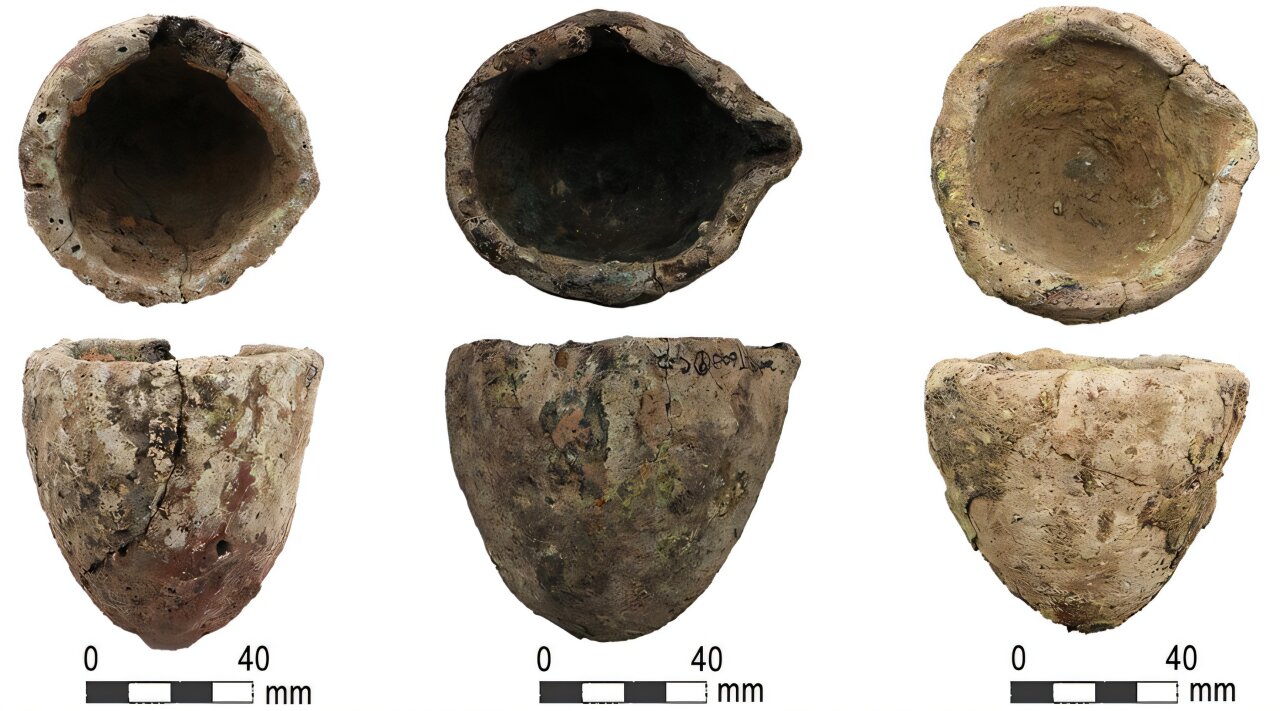
Tiny droplets of brass trapped inside three ancient crucibles in Guangzhou have pushed the physical evidence for brass-making in China back to the ninth and 10th centuries A.D., nearly 600 years earlier than the previously known evidence. The finding connects an archaeological workshop to Chinese written accounts describing brass production during the same period and raises the possibility that the technology reached southern China through maritime trade.
The discovery began with an unexpected chemical signal.
Archaeologist Hongyan Xiao of Peking University and colleagues were examining nearly 80 crucibles and crucible fragments recovered from an ancient metalworking workshop in Guangzhou. The site had been uncovered through excavations carried out between 1975 and 2007 and contained furnaces, crucibles and other remains of metalworking.
The workshop appears to have been operated by the local government and remained active for more than a millennium. It produced metallic objects ranging from bronze to silver between the third and 18th centuries A.D.
When the researchers analyzed the crucibles using a portable X-ray technique, they noticed that zinc levels suddenly increased in material dating to the ninth and 10th centuries.
That timing stood out because written accounts had described brass production in China during roughly the same period.
“We find an anomalous increase in zinc contents since the 9th–10th century, a time close to the time when written accounts claimed the commencement of brass production in China,” Xiao said. “That’s the first time we started to think it might be related to brass-making.”
The zinc signal provided a clue, but it was not enough by itself to establish what had happened inside the crucibles. The researchers brought samples back to the laboratory for closer examination.
There, they found what they were looking for. Tiny droplets of brass remained trapped on the surfaces of three crucibles dating to the ninth and 10th centuries.
According to the researchers, these crucibles are the earliest physical evidence of brass-making found anywhere in East Asia.
Evidence from a long-running workshop
The crucibles came from a workshop in Guangzhou, a major city in southern China that had long been involved in trade and administration.
The city had once been home to the Royal Palace of the Nanyue Kingdom, which existed from 204 to 111 B.C. After the kingdom fell, Guangzhou continued as an international center of trade and commerce as well as a regional administrative center for nearly two millennia.
The metalworking remains provide a record of that long history.
The researchers’ examination of the crucibles showed that the ninth- and 10th-century containers had several features associated with medieval Islamic brass-making. They were lidless and had been fired at temperatures above copper’s melting point, reaching around 1,980 degrees Fahrenheit. The brass produced in them also contained only a modest amount of zinc.
Taken together with the brass droplets preserved inside three crucibles, those characteristics provide the physical evidence linking the workshop to brass production during this early period.
The finding also helps resolve a gap between written evidence and archaeological evidence. Historical accounts had pointed to brass production in China around the ninth and 10th centuries, but the earliest physical evidence had previously dated to the 16th century.
The Guangzhou crucibles now fill part of that gap.
How brass-making may have reached Guangzhou
The researchers also considered how the technology might have arrived in China.
Large-scale brass production had appeared in Europe and the ancient Near East more than 2,000 years ago. It had long been assumed that brass-making knowledge traveled gradually overland along the Silk Road.
But China’s connection to those routes changed in the eighth century A.D., when the Tang dynasty lost control of the Silk Road. Sea routes then became the primary channel connecting China with the wider world.
For the researchers, Guangzhou’s position as a major maritime trading center makes that history relevant to the origin of the city’s early brass-making.
Xiao described medieval Guangzhou as “an oriental version of Dubai or Singapore.” Ancient texts describe thousands of trading ships arriving in the city each year and a foreign quarter that was home to as many as 20,000 residents, including Arab merchants.
That international setting provides one possible route for the transmission of brass-making knowledge.
The researchers consider the Islamic world a strong candidate for the origin of Chinese brass-making, based in part on the similarities between the Guangzhou crucibles and medieval Islamic brass-making practices. But Xiao emphasized that this connection remains a hypothesis.
The crucibles establish that brass was being made in Guangzhou during the ninth and 10th centuries. They do not by themselves establish exactly where the knowledge originated or how it reached the workshop.
The beginning of China’s later brass industry
Brass production in China expanded substantially centuries later during the Ming dynasty. The newly identified crucibles provide evidence for a much earlier stage in that history.
For Xiao, the discovery also points to questions extending beyond the individual workshop, including how technological knowledge moved between societies, how specialized crafts developed and how economic activity was shaped by long-distance exchange.
The three crucibles provide the earliest physical evidence so far for brass-making in East Asia and place that activity in Guangzhou during the ninth and 10th centuries A.D.
The study was published in Antiquity.