Look up at the night sky on a clear evening, and you will see what appears to be a peaceful blanket of stars. To our eyes, the sky seems almost small, as if the stars are scattered across a giant dome overhead. Yet that familiar view hides a reality so vast that it challenges the limits of human imagination.
The universe is larger than anything we experience in daily life. It contains hundreds of billions of galaxies, each filled with billions or even trillions of stars. The light from some of those stars began its journey toward Earth long before humans existed, long before dinosaurs walked the planet, and in some cases, not long after the universe itself was born.
So, how big is the universe? The honest scientific answer is both fascinating and surprising: we know the size of the part we can observe, but the total size of the entire universe remains one of the greatest mysteries in science.
What Do Scientists Mean by “the Universe”?
The universe is everything that exists. It includes all matter, all energy, all planets, stars, galaxies, black holes, gas clouds, dust, radiation, space, and time itself.
It is not simply a collection of objects floating in empty space. Space itself is part of the universe. Time is part of the universe. Every physical law we know operates within it.
When scientists ask how big the universe is, they are asking about the size of everything that exists—not just the stars we can see.
The Observable Universe
Although the universe may be unimaginably large, humans can observe only a limited portion of it. This region is called the observable universe.
The observable universe includes everything whose light has had enough time to reach Earth since the universe began about 13.8 billion years ago.
At first, you might think this means the observable universe should have a radius of 13.8 billion light-years. Surprisingly, it is much larger.
Because the universe has been expanding while light has been traveling through it, the most distant objects we can observe today are now much farther away than 13.8 billion light-years.
Current measurements show that the observable universe has a radius of approximately 46.5 billion light-years, giving it a diameter of about 93 billion light-years.
This enormous size reflects the expansion of space itself, not objects moving through space faster than light.
What Is a Light-Year?
The distances in the universe are so enormous that kilometers or miles quickly become impractical.
Instead, astronomers use a unit called the light-year.
A light-year is the distance that light travels in one year.
Light moves through a vacuum at about 299,792 kilometers per second (186,282 miles per second). At that incredible speed, it circles Earth more than seven times in a single second.
Over an entire year, light travels approximately 9.46 trillion kilometers, or about 5.88 trillion miles.
When astronomers say a star is 100 light-years away, they mean the light reaching us tonight left that star 100 years ago.
Looking into space is therefore also looking back in time.
Looking Back Through Cosmic History
Imagine receiving a postcard that was mailed thousands of years ago. The farther away the sender lives, the older the postcard becomes by the time it arrives.
Light works in much the same way.
The Moon appears as it was about 1.3 seconds ago.
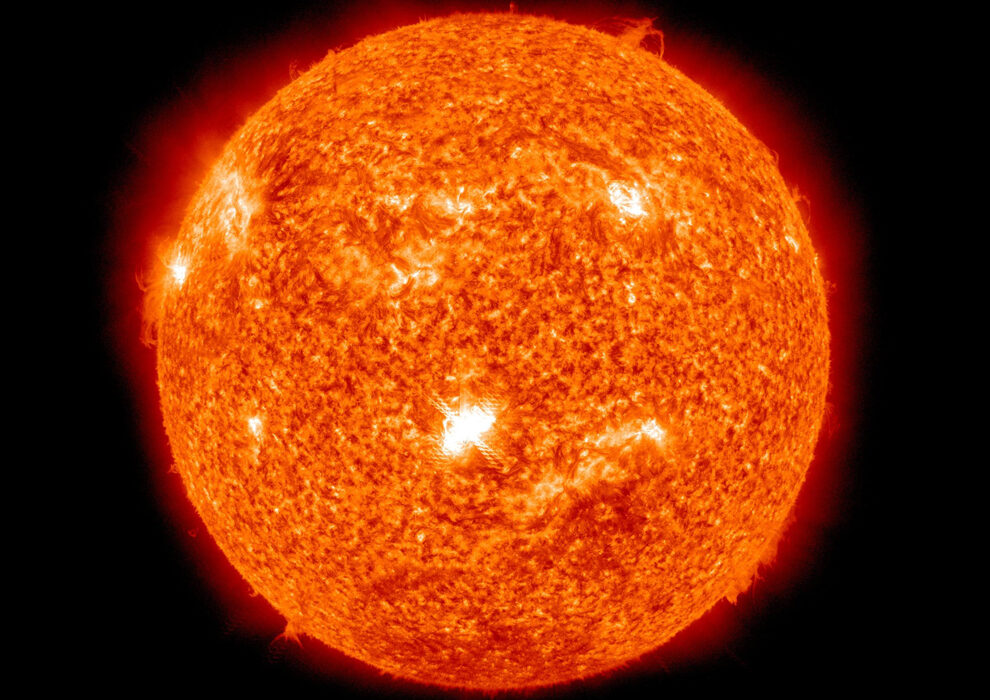
The Sun appears as it was about 8 minutes ago.
The nearest star beyond the Sun, Proxima Centauri, appears as it was more than 4 years ago.
The Andromeda Galaxy appears as it was about 2.5 million years ago, long before modern humans existed.
Some of the most distant galaxies observed by powerful space telescopes appear as they existed more than 13 billion years ago, allowing astronomers to study the early universe.
Every telescope is, in a sense, a time machine.
The Universe Is Expanding
One of the greatest discoveries in modern astronomy is that the universe is expanding.
Nearly a century ago, astronomers found that distant galaxies are moving away from us. Even more remarkably, galaxies that are farther away are generally moving away faster.
This does not mean Earth sits at the center of the universe.
Instead, space itself is stretching everywhere.
A helpful analogy is raisins inside rising bread dough. As the dough expands during baking, every raisin moves farther from every other raisin. No raisin occupies the center of the expansion.
The universe behaves in a similar way. Galaxies are carried apart because the fabric of space itself is expanding.
The Big Bang Did Not Happen at One Place
The phrase “Big Bang” often creates the misleading image of a giant explosion occurring somewhere in space.
In reality, the Big Bang was not an explosion into empty space.
Instead, it marked the beginning of the expansion of space itself.
Every region of today’s universe was once much closer together. As time passed, space expanded, carrying galaxies farther apart.
There is no known center of the universe from which everything is flying outward.
Expansion happens throughout space.
How Many Galaxies Are There?
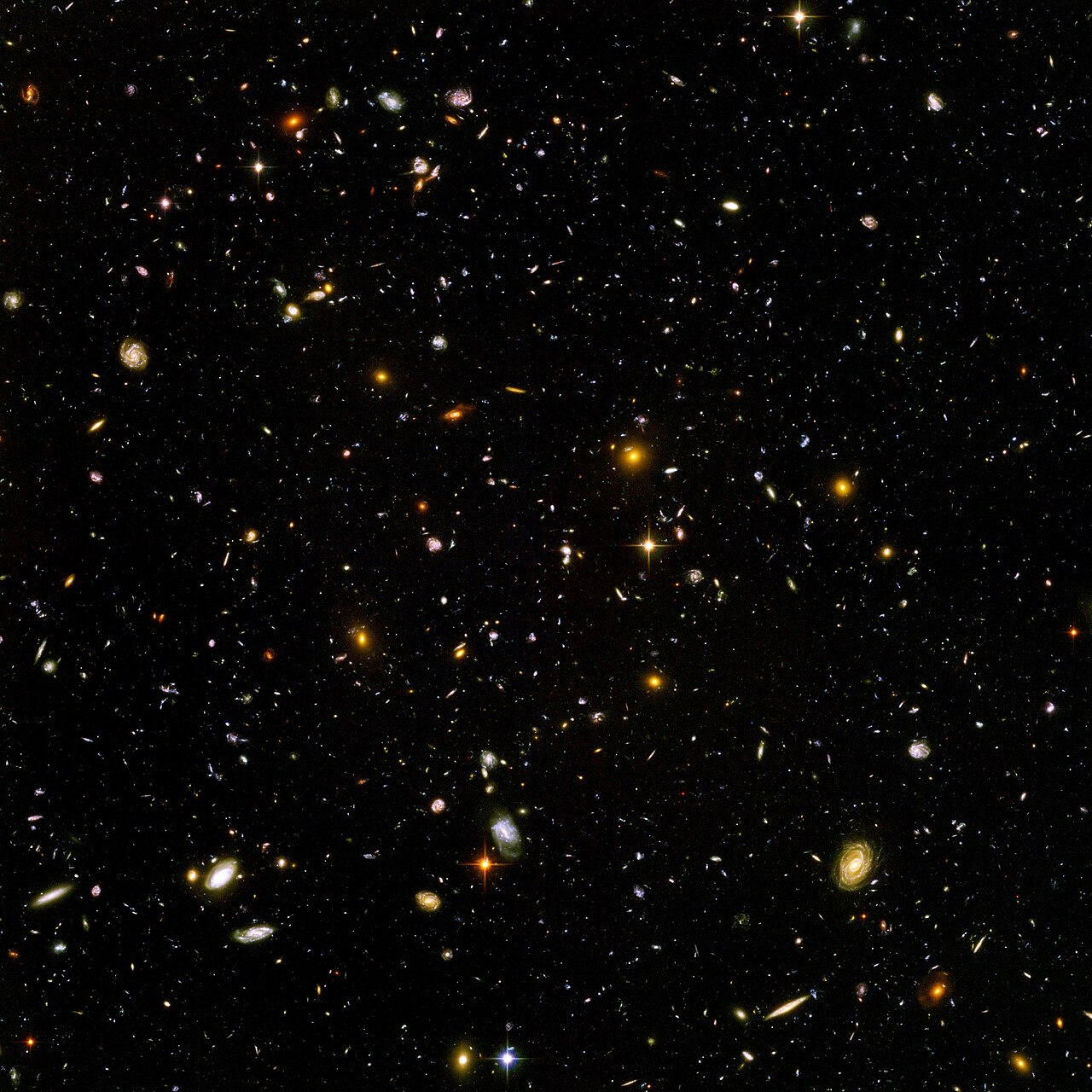
For many years, astronomers estimated that the observable universe contained around 100 billion galaxies.
More recent studies suggest the true number could be hundreds of billions, although the exact figure remains uncertain because many extremely faint galaxies are difficult to detect.
Each galaxy is an enormous collection of stars, gas, dust, dark matter, and often a supermassive black hole at its center.
Some galaxies contain only a few million stars.
Others contain more than a trillion.
Even the smallest galaxies are unimaginably vast by human standards.
Our Home: The Milky Way Galaxy
Earth is part of the Milky Way, a spiral galaxy that stretches roughly 100,000 to 120,000 light-years across.
The Milky Way contains hundreds of billions of stars, including our Sun.
Our Solar System lies about 26,000 light-years from the galaxy’s center.
If the Milky Way were reduced to the size of North America, our Solar System would be much smaller than a grain of sand.
This comparison illustrates just how tiny our cosmic neighborhood really is.
Our Nearest Galactic Neighbor
The closest large galaxy to the Milky Way is the Andromeda Galaxy, located about 2.5 million light-years away.
Its light began traveling toward Earth when early human ancestors had not yet evolved.
Astronomers know that the Milky Way and Andromeda are slowly moving toward one another.
In about 4 to 5 billion years, they are expected to merge, forming a much larger galaxy.
Fortunately, the enormous distances between individual stars make direct stellar collisions extremely unlikely.
Galaxies Form Vast Cosmic Structures
Galaxies are not scattered randomly throughout space.
Gravity gathers them into groups and clusters.
Clusters combine into superclusters.
These immense structures are connected by gigantic filaments of galaxies, separated by enormous cosmic voids containing relatively few galaxies.
Together they form what astronomers call the cosmic web.
Viewed on the largest scales, the universe resembles a three-dimensional network stretching across billions of light-years.
The Largest Known Structures
Some of the largest known cosmic structures extend across more than a billion light-years.
These include enormous galaxy walls, filaments, and superclusters.
Even these gigantic formations represent only tiny portions of the observable universe.
The universe is so immense that light itself requires hundreds of millions or even billions of years to travel across some of these structures.
How Small Are We?
Thinking about the universe naturally invites reflection on our own place within it.
Earth has a diameter of about 12,742 kilometers.
Compared with the Sun, Earth is tiny.
Compared with the Milky Way, the Solar System is tiny.
Compared with the observable universe, even the Milky Way becomes almost unimaginably small.
If the observable universe were reduced to the size of Earth, our entire galaxy would be far smaller than a single grain of sand.
Yet every human being who has ever lived has existed on one small planet orbiting one ordinary star within one ordinary galaxy.
Is the Universe Infinite?
One of the deepest unanswered questions in cosmology is whether the universe has an edge.
Current observations show that space appears remarkably flat on the largest observable scales.
A flat universe could be infinite, extending forever in every direction.
Alternatively, the universe could be finite but so enormous that we cannot detect its overall shape.
At present, scientists simply do not know.
The observable universe represents only the part whose light has reached us.
Beyond that horizon may lie vastly more galaxies, perhaps extending without end.
Does the Universe Have an Edge?
People often imagine reaching the “edge” of the universe and looking beyond it.
According to current scientific understanding, this idea is probably misleading.
The observable universe has a limit because light has had only 13.8 billion years to travel since the Big Bang.
That boundary is not necessarily the edge of all existence.
It is simply the limit of what we can currently observe.
Beyond it, space almost certainly continues, although we cannot yet see those distant regions.
What Lies Beyond the Observable Universe?
Because light from regions beyond the observable universe has not had enough time to reach us, scientists cannot directly observe what lies there.
The simplest assumption, based on current cosmological models, is that the universe beyond our observable horizon is broadly similar to the part we can see.
It may contain more galaxies, more stars, more planets, and more cosmic structures.
However, because these regions are beyond our observational reach, their exact nature remains uncertain.
Science distinguishes carefully between evidence-based conclusions and ideas that have not yet been tested.
Measuring Such Incredible Distances
Astronomers use several methods to measure cosmic distances.
Nearby stars can be measured through parallax, which relies on Earth’s changing position as it orbits the Sun.
For more distant objects, astronomers use certain stars and exploding stars known as standard candles, whose intrinsic brightness is well understood.
At even greater distances, they measure the redshift of galaxies. As space expands, light from distant galaxies stretches toward longer, redder wavelengths.
By combining these techniques with observations from powerful telescopes, scientists can estimate distances across billions of light-years.
Powerful Telescopes Reveal the Early Universe
Modern observatories have transformed our understanding of the universe’s size.
The Hubble Space Telescope revealed thousands of previously unseen galaxies in tiny patches of sky, demonstrating that galaxies fill the universe in astonishing numbers.
The James Webb Space Telescope is now observing some of the earliest known galaxies, allowing astronomers to study cosmic history closer to the beginning of the universe than ever before.
Ground-based observatories equipped with advanced technology continue to map billions of galaxies, helping scientists better understand the large-scale structure of the cosmos.
Can Humans Ever Explore the Entire Universe?
Given our current understanding of physics, exploring the entire universe is impossible.
Even traveling at the speed of light—the fastest speed allowed for information through space—crossing the observable universe would require about 93 billion years.
Since no spacecraft carrying matter can reach the speed of light according to modern physics, such journeys remain far beyond today’s technological possibilities.
Instead, humanity explores the universe through telescopes, robotic spacecraft, mathematics, and increasingly sophisticated scientific instruments.
Why Understanding the Universe Matters
Studying the size of the universe is not simply an exercise in curiosity.
It helps scientists understand how galaxies formed, how stars evolve, how planets develop, and ultimately how life became possible.
Research into cosmology also improves our understanding of gravity, dark matter, dark energy, and the fundamental laws of nature.
Every new observation brings us closer to answering questions that humans have asked for thousands of years: Where did we come from? How did the universe begin? What is our place within it?
Conclusion
The universe is so vast that ordinary numbers struggle to describe it. The observable universe alone stretches about 93 billion light-years across and contains hundreds of billions of galaxies, each filled with countless stars and planets. Yet this immense region may represent only a small portion of the entire cosmos, whose true size remains unknown.
Although humanity occupies a tiny corner of one galaxy, our ability to understand the universe is extraordinary. Through physics, astronomy, mathematics, and technology, we have learned that space is expanding, that light allows us to look back billions of years in time, and that the cosmos is far larger and more intricate than anyone once imagined.
Every new discovery reminds us that the universe is not only vast in size but also rich in mystery. The more we learn about its incredible scale, the more it inspires wonder, humility, and a deeper appreciation for the remarkable place we call home.