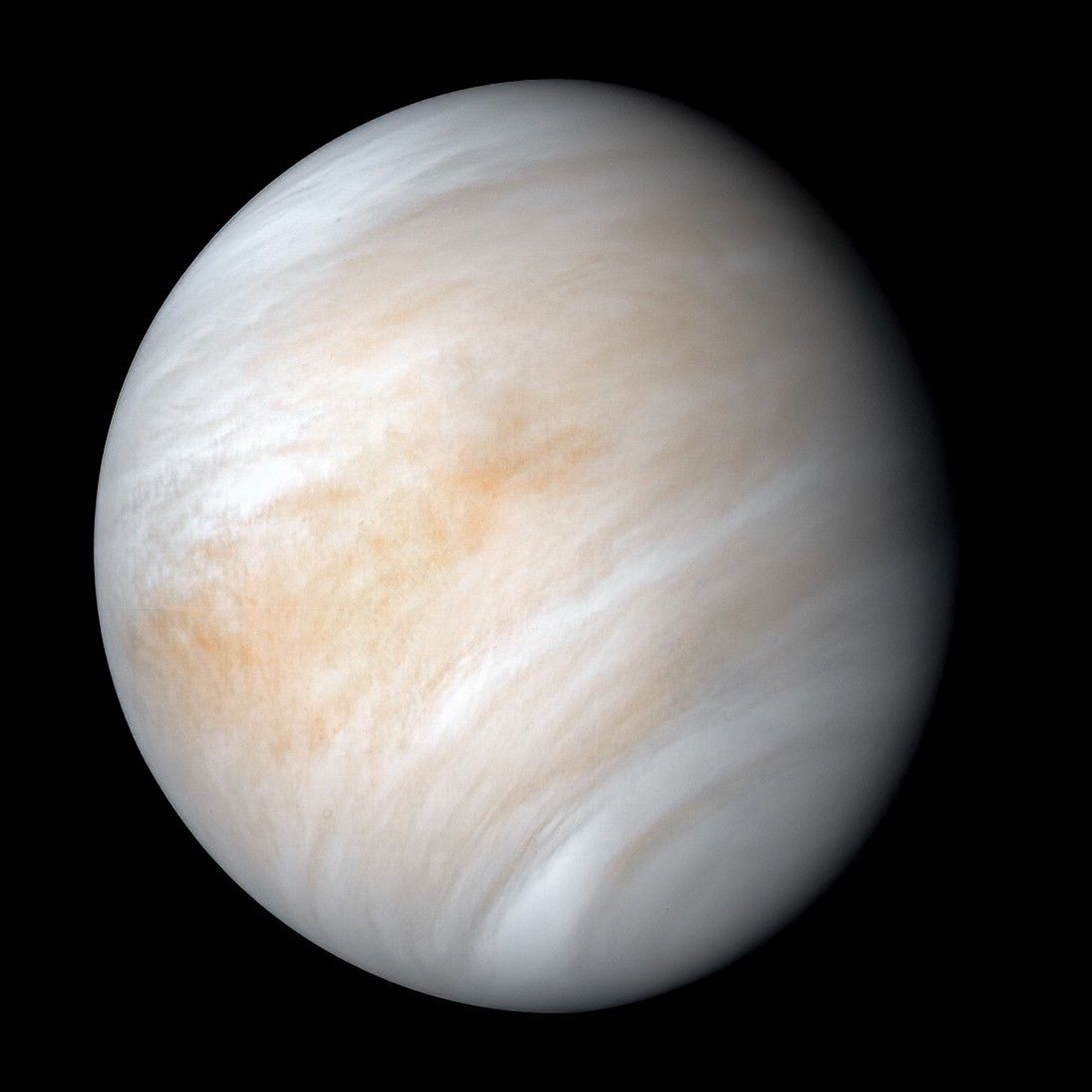
At first glance, Venus appears almost like Earth’s twin. It is nearly the same size, has a similar mass, and formed from the same cloud of gas and dust that gave birth to the Solar System about 4.6 billion years ago. Yet beneath this superficial resemblance lies one of the most hostile worlds ever discovered. Hidden beneath thick clouds is a planet so hot that it can melt lead, with crushing atmospheric pressure and a landscape shaped by volcanoes and ancient lava flows.
Understanding what Venus is made of reveals much more than the composition of a single planet. It helps scientists uncover how rocky planets form, why some worlds remain habitable while others become inhospitable, and even what Earth’s distant future might look like.
Venus is not made of a single material. Like Earth, it is built from several distinct layers: a metallic core, a rocky mantle, a solid crust, and an extraordinarily dense atmosphere. Each layer plays an important role in making Venus the remarkable—and extreme—planet it is today.
Venus Is a Rocky Planet
Venus belongs to the group of planets known as the terrestrial planets. These include Mercury, Earth, Mars, and Venus itself. Unlike the giant planets such as Jupiter and Saturn, terrestrial planets have solid surfaces composed mainly of rock and metal.
Scientists believe Venus formed from countless collisions between small rocky bodies called planetesimals in the early Solar System. Over millions of years, gravity pulled these objects together until they formed the planet we know today.
The building materials that created Venus were rich in elements such as oxygen, silicon, magnesium, iron, aluminum, calcium, and nickel. These are among the most abundant elements found in rocky planets throughout the Solar System.
Although spacecraft cannot directly drill into Venus’s interior, measurements of its mass, density, gravity, and surface rocks strongly suggest that its internal composition is remarkably similar to Earth’s.
The Crust Is Made Mostly of Volcanic Rock
The outermost solid layer of Venus is its crust.
Scientists believe the crust is primarily composed of volcanic rocks, especially basalt. Basalt is a dark, dense rock formed when molten lava cools and solidifies. It is also common on Earth, particularly beneath the oceans and in volcanic regions.
Radar images collected by spacecraft reveal enormous volcanic plains stretching across much of Venus’s surface. These plains are thought to have formed from repeated lava eruptions over hundreds of millions of years.
Unlike Earth, Venus does not appear to have active plate tectonics that constantly recycle its crust. Instead, much of the surface may have been reshaped by widespread volcanic activity in the past.
The crust contains minerals rich in silicon, oxygen, magnesium, iron, aluminum, calcium, sodium, and potassium, much like volcanic rocks found on Earth.
Beneath the Crust Lies a Massive Rocky Mantle
Below the crust is the mantle, which makes up most of Venus by volume.
The mantle consists mainly of silicate rocks rich in magnesium and iron. These rocks remain solid over much of the mantle but can slowly flow over geological timescales because of the immense heat and pressure deep inside the planet.
Heat from the interior causes material within the mantle to rise and sink in enormous convection currents. These slow-moving currents transport heat toward the surface and are believed to have driven much of Venus’s volcanic history.
Scientists suspect that the mantle remains extremely hot today, possibly feeding volcanoes that may still be active.
Recent observations have provided evidence that some volcanic regions on Venus may have experienced relatively recent geological activity, although confirming active eruptions remains an active area of research.
The Core Is Rich in Iron and Nickel
At the center of Venus lies a large metallic core.
Based on the planet’s overall density and comparisons with Earth, scientists believe the core is composed mainly of iron and nickel.
The core may also contain smaller amounts of lighter elements such as sulfur.
Unlike Earth’s outer core, which is liquid and generates our planet’s powerful magnetic field, Venus does not currently possess a global magnetic field generated by internal convection.
Researchers are still investigating why.
One possibility is that the core has cooled differently than Earth’s. Another is that the internal circulation needed to generate a magnetic field has weakened or stopped. It is also possible that parts of the core remain liquid but are not moving in a way that sustains a global magnetic field.
Understanding the interior of Venus is one of the major goals of future planetary missions.
The Atmosphere Is the Most Extraordinary Part of Venus
While the rocky interior resembles Earth’s, the atmosphere of Venus is dramatically different.
It is one of the thickest planetary atmospheres in the Solar System.
The atmosphere is composed of about 96.5% carbon dioxide, with about 3.5% nitrogen making up most of the remainder.
Tiny amounts of other gases are also present, including sulfur dioxide, argon, water vapor, carbon monoxide, helium, neon, and traces of other compounds.
Although water vapor exists in the atmosphere, Venus is extremely dry overall. Compared with Earth, it contains only a tiny fraction of the water needed to support oceans or rainfall.
The enormous concentration of carbon dioxide creates an extreme greenhouse effect that traps heat very efficiently.
As a result, the average surface temperature reaches approximately 465°C (869°F), making Venus even hotter than Mercury despite being farther from the Sun.
The Clouds Are Made of Sulfuric Acid
One of Venus’s most recognizable features is its brilliant white cloud cover.
These clouds are not made of water.
Instead, they consist primarily of tiny droplets of concentrated sulfuric acid suspended high in the atmosphere.
The sulfuric acid forms through chemical reactions involving sulfur dioxide, water vapor, and sunlight.
Although the clouds are highly acidic, they never reach the surface because the lower atmosphere is so hot that the droplets evaporate before falling very far.
The thick clouds reflect about 75% of the sunlight that reaches Venus, making it the brightest planet visible from Earth.
Ironically, despite reflecting so much sunlight, the dense carbon dioxide atmosphere traps enough heat to maintain the planet’s extreme temperatures.
Venus Has Very Little Water
One of the biggest differences between Earth and Venus is water.
Today, Venus is almost completely dry.
Only trace amounts of water vapor remain in its atmosphere.
Scientists believe Venus may once have possessed significantly more water billions of years ago.
As the young Sun gradually became brighter, increasing temperatures likely caused much of that water to evaporate.
Ultraviolet radiation from the Sun then split water molecules into hydrogen and oxygen.
Because hydrogen is extremely light, much of it escaped into space. Oxygen either escaped as well or reacted chemically with surface rocks.
Over immense spans of time, Venus lost nearly all of its original water.
This transformation played a crucial role in turning Venus into the scorching world we observe today.
Surface Rocks Reveal a Volcanic World
Radar observations and data collected by spacecraft suggest that Venus’s surface is dominated by volcanic materials.
Gigantic lava plains cover nearly 80% of the planet.
Thousands of volcanoes have been identified, ranging from small volcanic cones to enormous shield volcanoes hundreds of kilometers across.
Some mountains are composed of rocks that may have been altered by the planet’s intense heat and pressure.
The high temperatures at the surface also influence how minerals behave. Certain metallic minerals become more chemically stable at high elevations where temperatures are slightly cooler, creating unusual patterns that scientists continue to study.
The Atmosphere Presses Like the Deep Ocean
Venus’s atmosphere is not only thick but also incredibly heavy.
The atmospheric pressure at the surface is about 92 times greater than Earth’s sea-level pressure.
Standing on Venus would be roughly equivalent to experiencing the pressure found nearly 900 meters (about 3,000 feet) beneath Earth’s oceans.
This crushing pressure affects everything on the planet.
Spacecraft that have landed on Venus survived only a short time before the extreme heat and pressure caused their systems to fail.
Chemical Elements That Build Venus
Like Earth, Venus is built from a relatively small group of chemical elements.
Oxygen is the most abundant element in the rocky parts of the planet because it combines with many other elements to form minerals.
Silicon is a major ingredient of silicate rocks.
Magnesium and iron are abundant within both the mantle and crust.
Iron and nickel dominate the core.
Aluminum, calcium, sodium, potassium, titanium, and smaller amounts of other elements are incorporated into the planet’s rocks and minerals.
In the atmosphere, carbon and oxygen combine to form carbon dioxide, while sulfur and oxygen form sulfur dioxide and sulfuric acid.
Together, these elements create the unique environment that defines Venus today.
Why Venus Became So Different From Earth
Given their similar sizes and compositions, scientists have long wondered why Earth became a world filled with oceans and life while Venus evolved into an intensely hot, dry planet.
The answer appears to involve a combination of distance from the Sun, atmospheric evolution, volcanic activity, and the long-term greenhouse effect.
Being slightly closer to the Sun meant Venus received more solar energy than Earth.
This additional heating likely caused increasing evaporation of surface water early in the planet’s history.
As water disappeared, there was no longer enough rainfall or liquid water to remove carbon dioxide from the atmosphere through geological processes.
Volcanoes continued releasing carbon dioxide over time, causing the atmosphere to grow thicker.
The stronger greenhouse effect trapped even more heat, accelerating the planet’s warming in a self-reinforcing cycle known as a runaway greenhouse effect.
This process ultimately transformed Venus into one of the hottest places in the Solar System.
How Scientists Know What Venus Is Made Of
Studying Venus is remarkably challenging because its thick clouds completely hide the surface in visible light.
Scientists rely on several techniques to investigate its composition.
Radar can penetrate the clouds and map mountains, volcanoes, valleys, and lava plains.
Orbiting spacecraft measure gravity, allowing researchers to estimate the distribution of mass inside the planet.
Spectrometers analyze sunlight and thermal radiation to identify atmospheric gases and surface minerals.
Landers that briefly reached the surface directly measured atmospheric conditions and analyzed nearby rocks before succumbing to the harsh environment.
Laboratory experiments on Earth also help scientists understand how minerals behave under Venus-like temperatures and pressures.
Together, these methods provide a remarkably detailed picture of a planet that remains difficult to explore.
Future Missions Will Reveal More
Despite decades of exploration, many questions about Venus remain unanswered.
Scientists hope future missions will determine whether volcanoes are active today, measure the exact thickness of the crust, investigate the structure of the core, and better understand how the atmosphere evolved over billions of years.
Advanced radar systems, atmospheric probes, and next-generation landers are expected to provide unprecedented insights into the planet’s geology, chemistry, and climate.
Each new discovery will not only deepen our understanding of Venus but also improve our knowledge of rocky planets throughout the universe.
Conclusion
Venus is made of many of the same materials as Earth, including a metallic iron-rich core, a vast silicate mantle, and a crust dominated by volcanic rocks. Yet surrounding this familiar rocky planet is an extraordinarily thick atmosphere composed mostly of carbon dioxide, topped by clouds of sulfuric acid that create one of the most extreme environments in the Solar System.
The combination of rock, metal, carbon dioxide, sulfur compounds, and intense heat has shaped Venus into a world unlike any other. Studying its composition allows scientists to explore the forces that transform planets over billions of years, offering valuable clues about Earth’s history, the evolution of rocky worlds, and the countless planets orbiting distant stars. Although Venus may seem harsh and unwelcoming, it remains one of the most important planets for understanding how worlds are built—and how dramatically they can change over time.