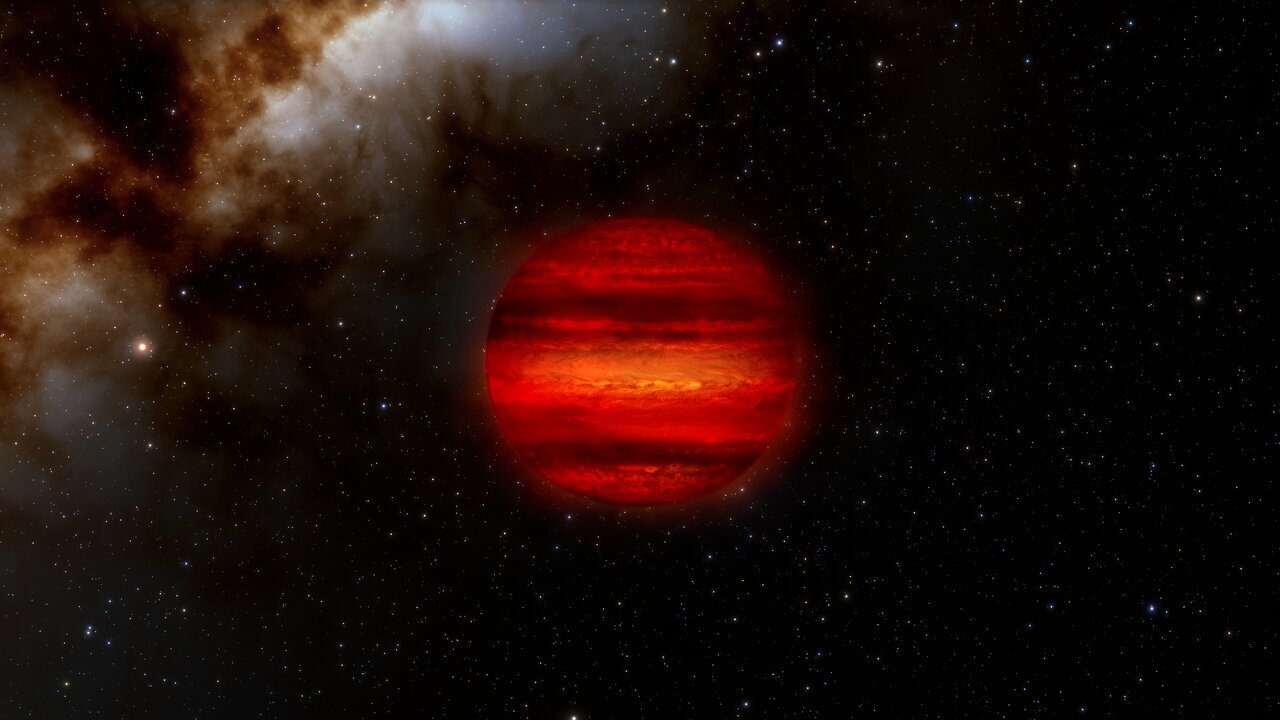
HIP 61637 b is a 48-Jupiter-mass brown dwarf orbiting an aging star nearly three times as massive as the Sun, giving astronomers an unusually well-characterized system for investigating how brown dwarfs form.
Brown dwarfs occupy an unusual middle ground. They are too small to become stars but more massive than planets, and their mass alone does not explain how they came to exist.
One possible route resembles star formation. A cloud of gas and dust collapses under its own gravity but does not gather enough mass to start nuclear fusion in its core. Another possibility is more similar to planet formation, with material gradually accumulating inside the disk of gas and dust around a massive young star.
Those processes are expected to produce different orbital patterns. Objects formed through cloud collapse tend to have more elongated, or eccentric, orbits, while formation through disk accretion favors more circular ones.
There is a complication, however. A brown dwarf orbiting close to its star can experience tidal forces that gradually make an eccentric orbit more circular. That can erase one of the clues astronomers could otherwise use to determine how the object formed.
TESS helps characterize an unusual system
Astronomers led by Nino Ephremidze at Harvard University used observations from NASA’s Transiting Exoplanet Survey Satellite, or TESS, together with detailed spectroscopy to study HIP 61637 b.
TESS monitors changes in the brightness of nearby stars. When an orbiting object passes across the face of its star from Earth’s perspective, the star appears to dim slightly. Those changes can be used to determine properties including the transiting object’s size and orbit.
HIP 61637 b stands out because it lies in the so-called brown dwarf desert, a mass range in which brown dwarfs on close orbits around their stars are notably uncommon.
Its host star is unusual as well. It is an aging A-type star with nearly three times the Sun’s mass and is the brightest and most massive star known to host a transiting brown dwarf.
The star’s age also provides an important piece of information. Because it is approaching the end of its hydrogen-burning lifetime, the researchers were able to estimate the system’s age at roughly 396 million years. That makes HIP 61637 b only the seventh brown dwarf with a reliably known age.
Its size raises a question about its origin
The brown dwarf’s size, considered together with the unusually high mass of its host star, points toward the possibility that HIP 61637 b accumulated gradually inside a disk in a process more like planet formation.
But the object’s mass makes that interpretation difficult to settle. At 48 times the mass of Jupiter, HIP 61637 b is near the limits of what disk accretion is thought to be capable of producing.
That leaves its formation pathway unresolved. The system provides an unusually precise combination of measurements, but the evidence does not establish whether the brown dwarf formed through disk accretion or through the collapse of a gas cloud.
The observation adds another well-characterized system to the small number of transiting brown dwarfs whose ages are well defined. Further measurements of similar objects could provide more opportunities to distinguish between the different ways brown dwarfs may form.
The study was posted to the arXiv preprint server.