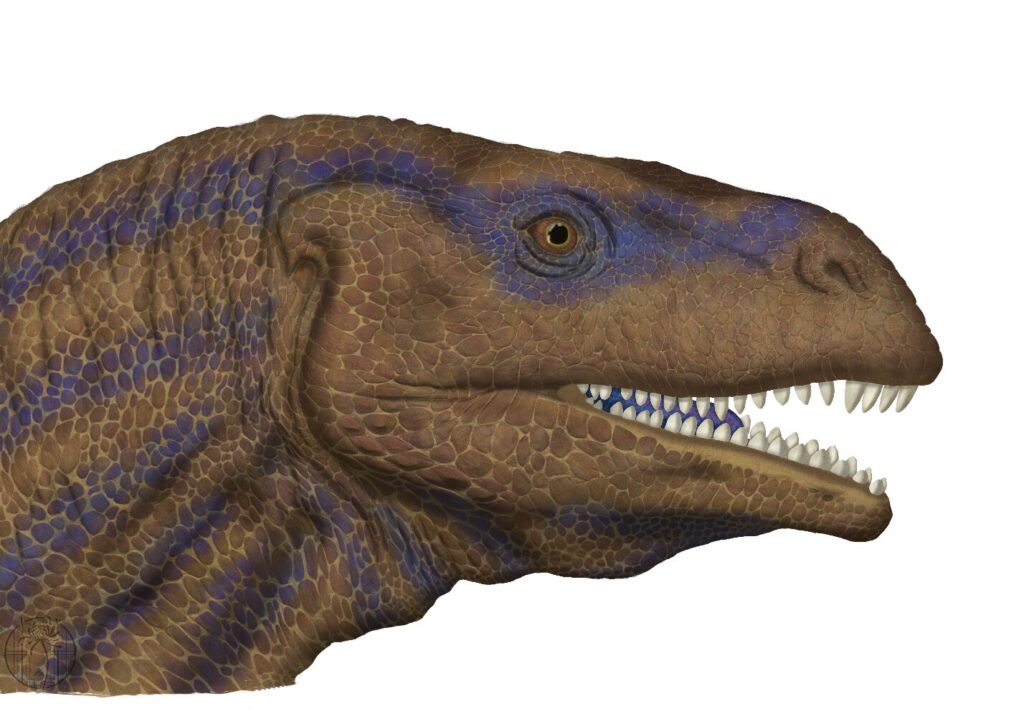
A small, bird-like dinosaur that lived in North America near the end of the Cretaceous had an unusual way of processing food. Rather than relying on powerful up-and-down bites, it appears to have moved its lower jaw back and forth, bringing specially shaped surfaces on its upper and lower beaks together to mash and shear soft plant material. Its skull was so unusually adapted for this kind of feeding that it closely resembles the feeding apparatus of certain modern parrots. The discovery of this dinosaur, named Infernogallus jamesi, provides some of the strongest anatomical evidence yet that a group of meat-eating dinosaur relatives evolved specialized diets involving fleshy fruits.
The discovery also offers a new perspective on a long-standing question in dinosaur evolution: how closely were the diversification of flowering plants and the evolution of plant-eating dinosaurs connected?
Flowering plants, or angiosperms, diversified extensively during the Cretaceous Period. Their fruits became increasingly varied, and some developed larger, fleshy structures surrounding their seeds. At roughly the same time, several groups of herbivorous dinosaurs were diversifying. However, establishing a direct connection between these evolutionary changes has been difficult.
Although some dinosaurs clearly ate plants, the exact foods consumed by many herbivorous theropods remain uncertain. Oviraptorosaurs, a group of bird-like theropod dinosaurs, have been particularly difficult to classify. Their toothless beaks could have supported different feeding behaviors, and previous interpretations of their diets have ranged from eating eggs and small animals to consuming seeds, other plant material, and fruit.
A nearly complete skull of Infernogallus jamesi has now provided an opportunity to investigate this question in unusual detail. Its bones preserve a combination of features that reveal how the animal’s jaws and associated muscles were organized. When researchers reconstructed those structures and compared them with living birds and other dinosaurs, they identified a feeding system unlike that of other non-avian theropods.
The findings suggest that its evolutionary relatives, known as caenagnathids, were specialized herbivores adapted to process soft plant foods. The researchers propose that fleshy fruit probably formed a substantial part of their diet, although the precise foods they consumed cannot yet be established directly.
An unusually complete skull from the Hell Creek Formation
Infernogallus jamesi belonged to Caenagnathidae, a group of oviraptorosaurs known primarily from the Late Cretaceous fossil record. Caenagnathids were characterized by toothless lower jaws, often with elaborate ridges and grooves along the surfaces where the upper and lower jaws met.
Their remains are relatively uncommon and frequently consist of isolated bones. Their delicate, elongated limbs and highly air-filled skeletons may have made them less likely to survive preservation in many depositional environments. Consequently, scientists have had limited opportunities to reconstruct their skull anatomy and investigate how their jaws worked.
The new species comes from the Hell Creek Formation, a Late Cretaceous geological formation in North America. The researchers examined five specimens from Montana, South Dakota, and North Dakota. These included an articulated partial skeleton, isolated jaw bones, and other cranial elements.
The most important specimen, designated ROM VP 65050, preserves the skull alongside portions of the vertebral column, shoulder girdle, forelimb, pelvis, and hindlimb. It is the first nearly complete, articulated skull known for a caenagnathid.
The specimen was collected in Montana in 2011 and subsequently acquired by the Royal Ontario Museum. Its skull had been compressed during fossilization, making several internal structures difficult to examine directly.
To overcome this problem, the researchers used high-resolution micro-computed tomography, or micro-CT, to examine the fossil. This technique produces detailed images of internal structures without requiring the bones to be physically separated. The researchers digitally reconstructed individual bones, allowing them to examine the skull’s internal anatomy and the relationships between its different components.
They also digitally corrected some of the deformation caused by fossilization. The reconstruction relied on better-preserved skulls of related oviraptorosaurs and caenagnathids as anatomical guides.
The resulting model exposed a remarkably unusual arrangement of bones around the jaws, palate, and regions where the jaw muscles attached.
The dinosaur was relatively small. Its femur, or thigh bone, measured approximately 185 millimeters in length. Based on the bone’s circumference, the researchers estimated its body mass at approximately 12 kilograms, with a range of 9–15 kilograms.
Importantly, this was not simply a juvenile dinosaur whose unusual proportions might have changed as it grew. Thin sections taken from its femur, fibula, and second metatarsal revealed multiple growth marks in the bone. The closely spaced marks near the outer surfaces formed an external fundamental system, a pattern associated with skeletal maturity.
The researchers estimated that the animal was at least six years old when it died, and probably around seven. Its small body size therefore represented its mature condition.
A jaw built for movement rather than powerful biting
One of the most distinctive features of Infernogallus was the organization of its jaw muscles.
In most non-avian theropod dinosaurs, the muscles responsible for closing the lower jaw were organized largely to produce powerful upward movements. These muscles generated the forces needed to bring the jaws together during biting.
Infernogallus had a substantially different arrangement.
The researchers identified major changes in the position and orientation of the muscles associated with its palate. In particular, the pterygoideus muscles, which connect structures in the palate with the lower jaw, had unusually large attachment areas and were oriented predominantly from front to back.
This arrangement suggests that these muscles were adapted to generate substantial forward-and-backward movements of the lower jaw rather than simply pulling it upward.
The difference was not limited to the orientation of individual muscles. The temporal region of the skull, which accommodates several important jaw-closing muscles, was also unusually reduced.
This meant that the animal had a relatively small area for the temporal musculature and a reduced contribution from muscles responsible for conventional up-and-down biting movements.
The researchers reconstructed the jaw muscles in three dimensions and compared their orientations with those of other dinosaurs and living birds. Their comparison included 19 taxa, representing different feeding habits and evolutionary groups.
The results placed Infernogallus well outside the main cluster formed by non-avian theropods. Its muscle arrangement emphasized front-to-back movement while reducing the relative contribution of up-and-down muscle forces.
The researchers interpreted this as evidence that caenagnathids had considerably weaker vertical bite forces than other oviraptorosaurs and probably weaker forces than other herbivorous non-avian theropods more generally.
However, the reconstruction describes muscle orientation rather than directly measuring the animal’s actual bite force. The researchers did not scale the muscle vectors to estimate force, and the available fossil evidence did not allow them to reconstruct all muscle attachment sites with sufficient confidence.
The important finding is therefore the unusual direction and organization of the jaw musculature, not a precise measurement of how strongly the dinosaur could bite.
The lower jaw could slide as much as 15 millimeters
The arrangement of the muscles makes sense when considered alongside another unusual feature: the structure of the joint connecting the lower jaw to the skull.
In many dinosaurs, this joint primarily stabilizes the lower jaw during biting. In Infernogallus, the joint had a distinctive ridge-and-saddle arrangement that appears to have permitted extensive movement along the front-to-back axis.
The articular bone at the back of the lower jaw formed a prominent, rounded ridge. Its corresponding surface on the quadrate bone of the skull contained a groove, creating a saddle-like structure that accommodated the ridge.
This configuration allowed the lower jaw to slide forward and backward while remaining in contact with the skull.
By virtually articulating the bones, the researchers estimated that the joint could permit as much as 15 millimeters of front-to-back movement. That distance represents approximately 14% of the skull’s length.
The estimate assumes that the bones remain in contact throughout the movement. Actual mobility would also have depended on soft tissues, which cannot be reconstructed completely from the fossils.
Nevertheless, the joint’s shape, combined with the unusually oriented jaw muscles, provides strong evidence that forward-and-backward jaw movement was an important part of the animal’s feeding mechanics.
The palate also appears to have been adapted to accommodate this movement.
In Infernogallus, the pterygoid bones extended unusually far downward into the mouth. Their shape included a prominent lateral buttress, a reinforced projection that would have helped support the sliding movement of the lower jaw along the palate.
This arrangement is particularly interesting because it resembles, in some respects, structures found in crocodilians. The researchers noted the similarity but also emphasized an important difference: the buttress in Infernogallus was oriented primarily from front to back, rather than predominantly vertically as in crocodilians.
That orientation is consistent with the proposed direction of jaw movement.
Together, the muscles, joint surfaces, and reinforced palate suggest a feeding system in which the lower jaw could move repeatedly along the length of the skull.
Grooves and ridges helped process food inside the mouth
The lower jaw provides another important clue to what this movement accomplished.
Like other caenagnathids, Infernogallus had a toothless beak formed by completely fused lower jaw bones. However, the surfaces where the upper and lower jaws met were far more complex than a simple cutting edge.
The lower jaw contained a central groove, longitudinal ridges, and lateral grooves bordered by additional ridges. Two prominent ridges were also present toward the front of the inner beak.
These structures had previously been recognized as distinctive features of caenagnathid anatomy. The newly reconstructed skull helps explain their possible function.
The upper palate contained a large projection formed where the maxilla and vomer met. In the reconstructed resting position, this projection fitted into the central groove of the lower jaw.
As the lower jaw moved forward and backward, the textured surfaces of the upper and lower jaws would have come into contact.
The researchers propose that this arrangement allowed the dinosaur to shear, mash, or crush soft food through repeated movements. The mechanism resembles the basic action of a mortar and pestle, in which two opposing surfaces work together to break down material.
This would have been very different from simply biting through food with a strong vertical closing motion.
The anatomy also suggests that the tongue played an important role. The lower jaw preserves a prominent attachment area for the genioglossus muscle, which helps move the tongue forward. Caenagnathids also had relatively long ceratobranchial bones, structures associated with tongue mobility in birds.
These features suggest that food positioning and manipulation inside the mouth were important parts of feeding.
The researchers therefore propose that caenagnathids did not merely pick up soft food and swallow it. Their jaws and associated structures appear to have supported substantial oral processing before swallowing.
Why modern parrots provide the closest comparison
To understand what kinds of food could have required such a specialized feeding system, the researchers compared the dinosaur’s skull and muscle arrangement with those of living birds and turtles.
No single modern animal possesses every feature found in Infernogallus. However, several of its adaptations have evolved independently in living groups that process plant material inside their mouths.
The closest overall comparison was with parrots, particularly the Pesquet’s parrot, Psittrichas fulgidus.
This species is an obligate frugivore, meaning that its diet depends on fruit. Unlike many other parrots that crack seeds to reach the nutritious material inside, Pesquet’s parrots consume fruit pulp and discard the seeds.
That feeding behavior makes the comparison particularly relevant.
The researchers found similarities between the skulls and jaw-muscle arrangements of Infernogallus and Psittrichas. Both have relatively long, low skulls and mandibles, prominent jaw-joint ridges, and muscle arrangements that emphasize front-to-back jaw movements.
Their muscle-vector comparisons also revealed similarities in the distribution of anteroposterior and dorsoventral components.
The distinction between different feeding behaviors among parrots is important here.
Many seed-eating parrots use strong jaw-closing movements to crack or remove the outer coverings of seeds. Their musculature retains substantial dorsoventral components, supporting powerful biting and crushing actions.
Pesquet’s parrots instead process fruit pulp while leaving the seeds behind. Their feeding mechanics place greater emphasis on movements that help manipulate and process soft fruit material.
The researchers found that this feeding arrangement provided a more convincing functional comparison for the unusual anatomy of Infernogallus than the seed-cracking behavior of other parrots.
They also considered ostriches, another bird with relatively reduced dorsoventral components in its jaw musculature. However, the similarities were less compelling. The researchers suggested that the ostrich’s muscle arrangement could be associated with broader changes in skull organization rather than the same specialized feeding behavior.
This comparison helped narrow the possible dietary interpretation.
The combination of reduced vertical biting forces, extensive front-to-back jaw movement, and complex opposing surfaces appears better suited to processing soft foods than to cracking hard seeds or breaking down tough plant material.
Why tough vegetation and seed-cracking are less likely
The unusual jaw mechanics also help researchers evaluate other possible diets.
Some herbivorous dinosaurs consumed fibrous plant material that required extensive mechanical breakdown. Others were adapted to process durable foods such as nuts, seeds, and shoots.
These feeding strategies often depend on structures that can withstand substantial forces. Teeth, specialized grinding surfaces, or a gastric mill can help break down resistant plant material. A gastric mill is a muscular stomach structure that mechanically grinds food, sometimes with the assistance of swallowed stones.
The researchers argued that caenagnathids lacked the expected adaptations for processing large quantities of tough, fibrous vegetation.
Their toothless beaks and unusual jaw musculature were poorly suited to generating the forces associated with this type of feeding. Their jaw joints were also configured for movement rather than the stable, high-force biting associated with crushing durable foods.
The researchers further noted that teeth and a gastric mill were present in ancestral oviraptorosaurs but had been lost in several later groups, including caenagnathids.
No potential gastroliths, or swallowed stones used in food processing, were found in the body cavity of the articulated Infernogallus specimen during preparation, despite the preservation of a complete gastral basket.
The absence of gastroliths in this specimen does not establish that all caenagnathids lacked them. However, it provides no support for a stone-assisted grinding system in this individual.
Taken together, these observations make high-fiber herbivory and hard-food processing less convincing explanations for the specialized anatomy.
Soft plant material appears to be a better fit.
That does not mean fruit was necessarily the only food available to these dinosaurs. The researchers acknowledge that other soft plant materials could also have formed a substantial part of their diet.
The evolutionary timing coincides with changes in flowering plants
The proposed connection with fruit becomes more interesting when the researchers examine the evolutionary history of caenagnathids.
To investigate their relationships and evolutionary timing, they developed an extensively revised phylogenetic dataset for oviraptorosaurs. The matrix included 42 taxa scored for 271 anatomical characters, covering the skull, lower jaw, vertebral column, forelimbs, and hindlimbs.
They used several approaches to reconstruct the evolutionary relationships of these dinosaurs, including maximum-parsimony analysis, Bayesian analysis, and Bayesian analyses incorporating a morphological clock.
The researchers also used fossilized birth-death models to estimate when important evolutionary groups originated and diversified.
The analyses placed the origin of caenagnathids in the Aptian–Albian interval of the Early Cretaceous, relatively soon after the origin of angiosperm fruits.
An important part of their investigation involved examining how the skull and jaw anatomy changed across the group.
The earliest known caenagnathid, Microvenator celer, already possessed early versions of some of the derived pterygoid and lower-jaw features seen in Infernogallus. This suggests that the anatomical foundations for more complex oral food processing appeared relatively early in the group’s evolutionary history.
The researchers also identified elevated rates of mandibular evolution in caenagnathids, suggesting that their lower jaws underwent relatively rapid evolutionary changes.
The more specialized group known as Eucaenagnathinae, which includes Infernogallus and other advanced caenagnathids, is estimated to have originated during the late Santonian to early Campanian.
This timing is important because the researchers identified a broadly corresponding period of change in the evolution of fleshy fruits.
Using previously compiled fossil data on angiosperm reproductive structures, they examined changes in fruit size and diversity through geological time. Their analysis showed that fleshy fruits increased in size and diversity during the Cretaceous.
Drupes, a type of fleshy fruit containing a single large seed surrounded by a fleshy layer, became larger, more abundant, and more diverse from the Coniacian onward.
The researchers found that the evolutionary timing of the specialized caenagnathid feeding apparatus broadly corresponded with these changes.
Caenagnathids underwent substantial diversification and range expansion from the Campanian onward, a period that also saw increases in the size and diversity of fleshy fruits.
This correspondence does not establish that the diversification of fruit directly caused caenagnathid diversification. Nor does it demonstrate that these dinosaurs were responsible for the evolutionary success of particular flowering plants.
However, the combination of their specialized feeding anatomy, similarities with modern fruit-pulp-eating parrots, and the timing of fruit diversification provides several independent lines of evidence supporting the possibility of a fruit-rich diet.
The researchers argue that the relationship is particularly interesting because previous studies examining broad patterns of dinosaur and flowering-plant diversity have generally found poor correspondence between the two groups.
The pattern identified in caenagnathids may therefore represent a more specific evolutionary association involving a particular group of herbivorous dinosaurs and a particular type of plant food.
Fruit pulp may have been more important than the seeds
If caenagnathids did consume substantial quantities of fleshy fruit, the researchers propose that their feeding behavior may have resembled that of Pesquet’s parrots.
Rather than swallowing entire fruits or cracking seeds to consume their contents, they may have removed and processed the fleshy outer portions while leaving the seeds behind.
This interpretation follows from the combination of their low-force jaw mechanics, extensive front-to-back movement, and complex oral surfaces.
The distinction matters because the term frugivory covers several different feeding behaviors.
Some fruit-eating animals swallow fruits whole. Others extract seeds and discard the pulp. Still others consume the fleshy portion and leave the seeds behind.
These behaviors place different mechanical demands on the skull and jaws. Simply identifying an animal as a fruit eater does not explain how it handled that food.
The researchers argue that the elaborate oral-processing structures of caenagnathids are more consistent with a feeding strategy that involved actively manipulating and removing fruit pulp.
However, this remains a hypothesis rather than a directly observed behavior. Fossil skull anatomy can reveal the mechanical capabilities of an animal, but it cannot establish exactly which foods an individual consumed.
The researchers identify several ways to investigate the possibility further, including the discovery of fossil stomach contents, more detailed biomechanical modeling of caenagnathid chewing, and improved comparisons between the feeding behaviors of living fruit-eating animals.
They also emphasize that modern birds do not provide a simple universal model for identifying frugivory. Different fruit-eating species use very different feeding strategies, making it difficult to identify a single anatomical signature that applies to all of them.
A small specialist near the end of the Cretaceous
The discovery of Infernogallus jamesi also adds information about the diversity of dinosaurs living in the Hell Creek ecosystem near the end of the Cretaceous.
The animal lived during the late Maastrichtian, close to the end of the Cretaceous Period. Its holotype was recovered approximately 15.5 meters below the Cretaceous–Paleogene boundary in the Hell Creek Formation. Another specimen used in the study came from a locality approximately 9.85 meters below that boundary.
Despite the extensive study of the Hell Creek Formation, the discovery of such a distinctive small-bodied dinosaur demonstrates that important aspects of its animal diversity and feeding adaptations remain incompletely documented.
The researchers point out that fossil preservation can be biased by body size. Smaller animals and their remains may be less likely to enter the fossil record or survive in recognizable form.
This bias can affect not only estimates of how many species lived in an ecosystem but also our understanding of the variety of ecological roles those species occupied.
Infernogallus is particularly interesting because its small size, herbivorous diet, and inferred avian-like metabolic characteristics overlap with some features proposed to have helped birds survive the end-Cretaceous mass extinction.
Its estimated body mass of approximately 12 ± 3 kilograms was also below a body-mass threshold previously proposed in discussions of extinction selectivity.
Nevertheless, caenagnathids, like other non-avian dinosaurs, did not survive the extinction.
The researchers suggest that its highly specialized feeding strategy may be relevant to this contrast. If a substantial part of its diet consisted of fleshy fruit, the animal may have depended on food resources that were sporadic or seasonal rather than on persistent resources such as seeds.
Previous work discussed by the authors suggests that access to persistent food sources may have been important when the resources supporting terrestrial food webs collapsed at the end of the Cretaceous.
Whether the specialized diet of Infernogallus affected its ability to survive environmental changes remains unresolved. The available evidence does not establish a direct connection between its feeding adaptations and its extinction.
The more immediate scientific question is how widely its unusual feeding system was shared among caenagnathids and precisely what foods these dinosaurs processed.
The nearly complete skull of Infernogallus jamesi provides the first detailed opportunity to investigate those questions through the anatomy of a member of the group. Its combination of specialized jaw muscles, a mobile jaw joint, and complex upper and lower oral surfaces points toward a distinctive form of herbivory, with fleshy fruit emerging as one of the most plausible major food sources.
The study was published in Nature Communications.