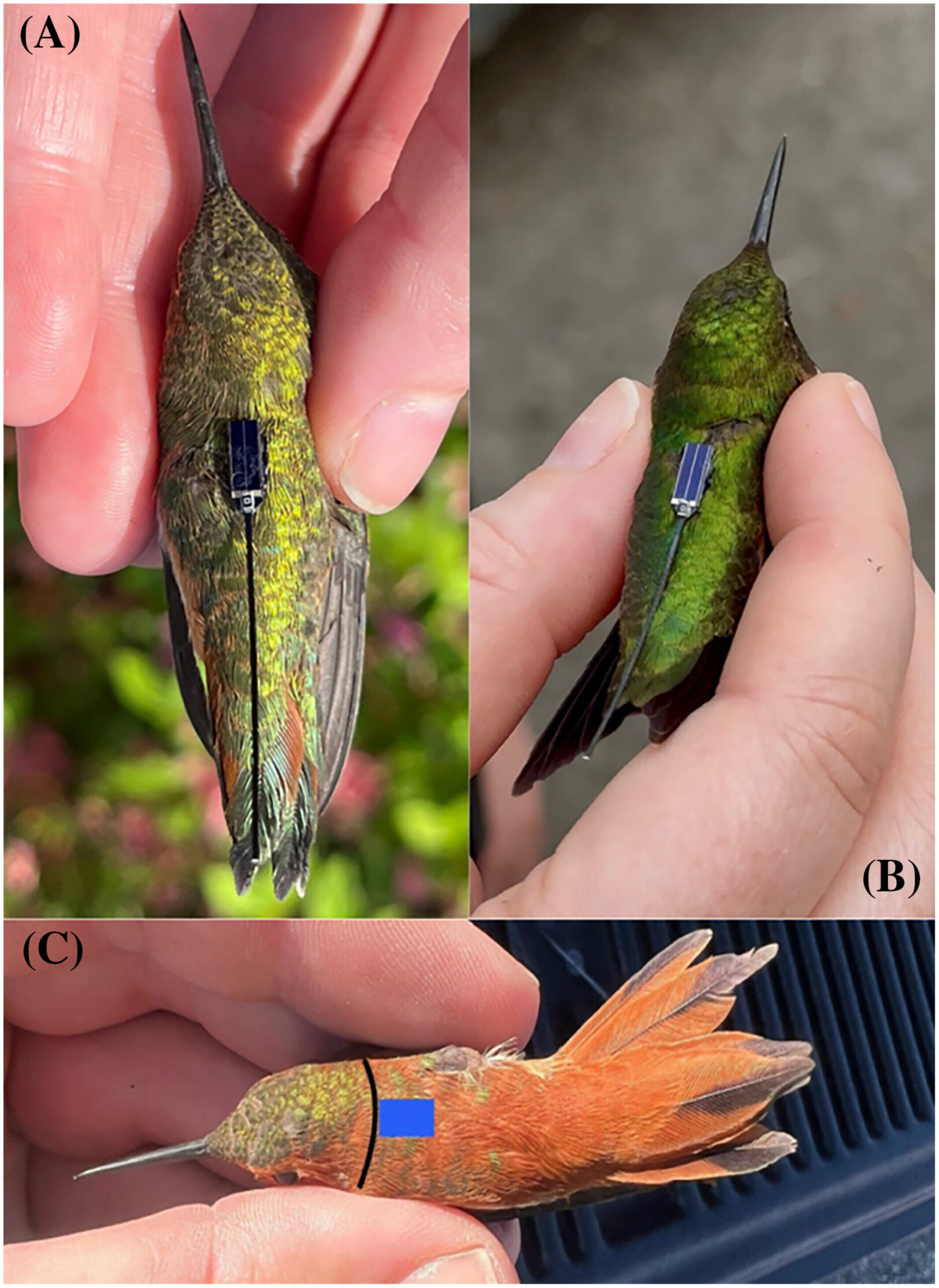
From Alabama’s Gulf Coast to Juneau, Alaska, one Rufous Hummingbird made an extraordinary northward journey spanning thousands of miles. Weighing just a few grams, the bird carried a solar-powered transmitter weighing roughly 0.06 grams—less than 3% of its body weight. Over 38 days, the tiny device recorded 6,526 kilometers (4,054 miles) of cumulative movement, marking the longest hummingbird migration track reported by the researchers. The remarkable journey highlights how lightweight tracking technology is beginning to reveal the movements of North America’s smallest migratory birds, which have long been difficult to follow because conventional tracking devices are often too heavy for them.
Hummingbirds are among the smallest birds researchers attempt to track over long distances. Some North American species weigh less than 5 grams, leaving little room for conventional tracking equipment. Devices that can transmit an animal’s location remotely have traditionally required batteries, adding weight that can make them unsuitable for very small birds.
Researchers have used other approaches, including lightweight geolocators and archival GPS devices, but these generally require scientists to recapture the birds to retrieve the stored information. That can be difficult when an individual travels hundreds or thousands of miles. Radio transmitters offer remote detection, but they often depend on networks of stationary receiving stations, limiting the locations where tagged animals can be detected.
A previous effort to track Ruby-throated Hummingbirds used radio transmitters weighing an average of 0.28 grams. Those devices had an approximate lifespan of 10 days and represented an average of 6.9% of the birds’ body weight. The researchers involved in that work also reported effects on flight and behavior.
A different approach uses a combination of solar power and Bluetooth communication. The BlūMorpho transmitter, developed by Cellular Tracking Technologies, weighs approximately 0.058–0.060 grams and has no onboard battery. Instead, it uses a solar-powered system to generate the energy needed to transmit its signal.
The device emits a unique 2.4-gigahertz Bluetooth signal every three seconds when it receives sufficient light. Compatible devices, including smartphones, tablets and computers, can detect the signal when they are within approximately 200 meters and have Bluetooth and location services enabled in the background.
When a compatible device detects a transmitter, it sends the detection and its own GPS location to an online database. The information includes a timestamp in Coordinated Universal Time, allowing researchers to follow an animal’s movements without physically recovering the transmitter. New detections are automatically uploaded to the tracking platform, which checks for them every five minutes.
The system does not require researchers to install and maintain a dedicated network of receivers across the entire migration route. Instead, it uses existing Bluetooth-enabled devices, along with compatible Motus receiving stations and the community-science Terra network.
This arrangement offers a way to collect location information across large geographic areas. It also introduces a limitation: a tagged bird can be detected only when it passes within range of a participating receiver.
Testing the technology on two hummingbird species
To evaluate the transmitter, researchers tracked two North American species, the Rufous Hummingbird (Selasphorus rufus) and the Ruby-throated Hummingbird (Archilochus colubris).
Fieldwork took place during March and April 2025, when spring migration was beginning along the northern Gulf of Mexico. The researchers worked at seven established hummingbird banding sites in coastal Alabama and the Florida Panhandle. These locations included residential properties with hummingbird feeders where the birds had previously been documented during the winter months.
They captured, banded and examined the birds before attaching the transmitters. Researchers recorded body weight, wing measurements, tail length, age, sex, fat reserves and muscle condition. Age was determined using bill corrugations and plumage, while sex was identified from plumage characteristics.
The attachment procedure was designed to keep the combined weight of the transmitter and its attachment materials at or below 3% of each bird’s body mass.
For attachment, researchers prepared a small area of feathers on the upper back, between the shoulders. They trimmed an approximately 3-by-10-millimeter section of feathers and placed the transmitter directly onto the prepared area using either cyanoacrylate adhesive or eyelash glue.
The transmitter’s antenna was positioned along the middle of the bird’s back, pointing toward its tail. Researchers held the device in place while the adhesive hardened, a process that typically took about 30 seconds. They then checked its stability and confirmed that it was transmitting using a handheld receiver.
The placement was important. The researchers avoided attaching the device too high on the nape because tension on the upper feathers could make it easier for birds to pull out the feathers and remove the transmitter.
After attachment, the birds were released at their capture locations and observed for signs of immediate recovery. Some initially kept their eyes closed or appeared reluctant to leave, but these behaviors lasted no more than one minute. All individuals eventually departed from the release sites.
In total, the team tagged 11 hummingbirds: four Rufous Hummingbirds and seven Ruby-throated Hummingbirds.
The Rufous Hummingbirds weighed an average of 3.7 grams, with individual weights ranging from 3.3 to 4.3 grams. The Ruby-throated Hummingbirds averaged 3.16 grams, with a range of 2.7 to 3.8 grams.
The researchers maintained the attachment-weight limit for every individual, demonstrating that the transmitter could be deployed on both species without exceeding the study’s 3% threshold.
More than 23,000 detections across North America
The tracking system generated 23,784 detections from the 11 tagged hummingbirds. All 11 individuals were detected after release, and the resulting records covered a much wider geographic area than the immediate capture locations.
The average detection period was 46.82 days, although individual records varied considerably, ranging from three to 128 days. The average distance between a bird’s release location and its last recorded detection was 1,032 kilometers, with a range extending from just 0.03 kilometers to 4,730 kilometers.
The researchers recorded detections across 23 U.S. states, northern Mexico, including Sonora, and parts of Canada, including British Columbia.
These records were not simply a collection of isolated sightings. Repeated detections allowed the researchers to reconstruct individual movements and examine how birds traveled through different regions.
Some transmitters produced thousands of detections while their birds remained in relatively small areas. Two Ruby-throated Hummingbirds provided particularly detailed examples.
One individual, F09545, was detected around Alligator Point in Florida’s Franklin County between April 11 and August 16, 2025. Its transmitter generated 5,175 detections during this period.
Another Ruby-throated Hummingbird, F09548, remained around Orange Beach in Alabama. Its transmitter produced 7,634 detections between April 19 and August 15, 2025.
These repeated records provided detailed information about local movements over several months. The detections were recorded whenever the solar-powered transmitters received enough light to operate, with signals emitted every three seconds under suitable conditions.
The results illustrate that the system could capture both large-scale migration and repeated movements within a relatively restricted area.
Migration routes that did not always follow the expected direction
The individual tracks revealed several different movement patterns. Some birds moved in directions consistent with spring migration, while others followed less predictable routes.
The most striking journey belonged to an adult male Rufous Hummingbird identified as F34926. Researchers tagged the bird in Lillian, Alabama, on March 27, 2025. Its transmitter continued to produce detections as the bird traveled westward across northern Mexico and then moved north along the Pacific coast.
By May 3, its signal had been detected in Juneau, Alaska.
The researchers calculated the bird’s cumulative migration distance by adding the distances between consecutive recorded locations. This produced a total of 6,526 kilometers. The straight-line distance between its release location and final detection was 4,730 kilometers.
The distinction between these measurements is important. The straight-line distance describes the separation between the two endpoints, while the cumulative distance accounts for the recorded route between successive detections. The bird’s actual recorded journey therefore covered substantially more ground than the distance separating Alabama and Alaska.
The researchers described this as the longest recorded hummingbird migration track to date.
Another Rufous Hummingbird, F34924, also initially moved westward. Its transmitter continued to be detected until the bird reached the Ozark Mountains in Arkansas, where the recorded track ended. The researchers could not establish its subsequent movements from the available detections.
A third Rufous Hummingbird, F34928, followed a particularly unusual route. Instead of moving steadily northward, it traveled through several eastern U.S. states over a 23-day period.
One part of its journey included a loop of approximately 345 kilometers. On April 2, the bird moved into eastern Tennessee and then continued northward toward Fredericktown, Missouri. It subsequently turned south before moving eastward, with this sequence of movements extending until April 14.
The tracking records captured a winding journey that would have been difficult to reconstruct using occasional observations or isolated recaptures.
Two Ruby-throated Hummingbirds traveled on nearly parallel routes
Among the Ruby-throated Hummingbirds, three individuals showed movements generally consistent with northward or northeastern spring migration.
Two adult males, F09546 and F09547, provided an especially interesting comparison. Researchers captured both birds at the same location in Okaloosa County, Florida, on April 11, 2025.
Their departure dates differed by three days. F09547 began moving on April 15, while F09546 departed on April 18.
Despite this difference, their recorded movements were remarkably similar. On April 19, both birds were traveling northward at nearly identical latitudes, although they were separated by approximately 83 kilometers in longitude.
Their tracks continued along nearly parallel paths.
F09546 reached Ludington, Ohio, where it was last detected on April 30. F09547 continued farther north into Ontario, Canada. Its recorded route included a corrective-looking loop around Hanover, Ontario, before it turned westward.
By May 9, F09547 had reached Minnewawa, Minnesota. Its transmitter continued producing detections in the same general area through May 13.
The similar movements of these two birds provide an individual-level example of how the tracking system can document migration routes from birds captured at the same location. However, the observations do not establish why their routes were similar or whether they were traveling together.
One bird moved south and east instead of north
Not every Ruby-throated Hummingbird followed the general northward pattern.
An individual identified as F34927 was captured in coastal Alabama but moved southeast into Florida rather than continuing north or northeast.
Its transmitter recorded the bird in Alachua County, Florida, where it was last detected on May 21, 2025. The researchers presumed that the bird was breeding there.
This movement differed from the routes of the other tracked Ruby-throated Hummingbirds that traveled northward. It also illustrates why individual tracking can provide information that broad migration models may not fully capture.
Two other tagged Ruby-throated Hummingbirds, F09544 and F09545, showed primarily local movements around their original capture locations rather than clearly documented long-distance spring migration.
The differences among individuals demonstrate that the 11 birds did not follow one uniform pattern. Some traveled across large portions of North America, others remained within relatively small areas, and at least one followed a direction different from the predominant northward movements recorded in the sample.
A substantial increase in tracking data compared with earlier methods
The researchers compared their results with previous hummingbird tracking efforts and historical banding records to put the number of detections into context.
Traditional bird banding provides information when a previously marked bird is captured again. However, long-distance recaptures are uncommon.
U.S. banding records collected between 1960 and 2024 showed recapture rates of approximately 0.14% for Rufous Hummingbirds, representing 209 recaptured individuals out of 151,772 banded birds. For Ruby-throated Hummingbirds, the rate was approximately 0.03%, with 151 recaptures among 501,916 banded individuals.
A previous radio-tracking study involving Ruby-throated Hummingbirds also produced relatively limited movement data. Researchers detected 29 of 55 tagged birds within an approximately 11-kilometer range. Only three individuals were detected around 50 kilometers from their original capture location.
That earlier study reported five detections for one adult male and 11 for an adult female within an approximately 11-by-11-kilometer area in coastal Alabama.
In comparison, the new tracking effort recorded more than 7,000 detections from a single hummingbird in coastal Alabama. Across all 11 individuals, the total reached 23,784.
The difference was not limited to the number of records. Eight of the 11 tagged birds were detected more than 100 kilometers from their original deployment locations, demonstrating the system’s ability to collect information across much larger geographic distances.
The earlier radio-tracking work also had a relatively short transmitter lifespan and reported detection periods of approximately three to four weeks. In the new study, the average detection duration was nearly 47 days.
These comparisons demonstrate the amount of movement information the solar-powered Bluetooth system collected under the conditions of this particular field study. They do not establish that every deployment or tracking environment will produce similar results.
Solar power comes with important limitations
Although the tracking results were extensive, the technology has several limitations that affect how researchers can interpret the data.
The first is its dependence on sunlight. Because the transmitter has no onboard battery, it can operate only when its solar panels receive enough light to generate the energy needed for transmission. This makes the system particularly suitable for studying daytime movements but limits its ability to record activity at night or in poorly illuminated environments.
The absence of a battery removes one potential restriction on transmitter lifespan. However, it does not guarantee that a device will remain attached to a bird for an extended period.
In this study, attachment retention was a more immediate limitation than the operating lifespan of the transmitter itself. The researchers noted that environmental exposure and molting could contribute to early detachment. They also observed that some hummingbirds appeared to spend time trying to remove the devices, sometimes using their feet to help pull them off.
To determine when a transmitter had probably detached, the researchers treated a period of 10 days without detections as evidence of possible tag loss. They also considered cases in which detections abruptly stopped moving geographically and continued to appear only at the same location, suggesting that the transmitter might have become stationary.
These criteria were practical ways to interpret the tracking records, but they could not establish the exact circumstances of every lost signal or transmitter.
The researchers suggested that improving attachment methods could extend the time devices remain on individual birds. A harness-based attachment might be one possibility, although existing harness approaches have been tested on larger hummingbirds, and thorough testing on species weighing less than 5 grams remains lacking.
Location accuracy and uneven detection coverage
Another important limitation comes from the way the Bluetooth network operates.
The transmitter does not independently determine the bird’s GPS coordinates. Instead, it sends a signal that is detected by a nearby compatible device, which supplies its own GPS location. The system therefore associates the receiver’s location with the bird’s detection.
Because the maximum estimated detection range is approximately 200 meters, the recorded position should not automatically be interpreted as the bird’s exact location.
The accuracy of a detection can depend on several factors, including the GPS accuracy of the receiving device, whether that device is moving or stationary, and the vegetation and infrastructure between the transmitter and receiver.
There is also the possibility that an incorrect GPS location from a receiving device could become associated with a genuine transmitter signal.
The researchers noted that the system provides a one-byte confidence score ranging from 0 to 255. However, the relationship between that score and actual positional error has not yet been established. Further work is needed to determine whether the score can reliably help researchers identify less accurate locations.
The system also depends on the geographical distribution of participating devices. Because Bluetooth detections are collected through existing Internet-connected devices, birds traveling through populated areas are more likely to encounter receivers than those passing through sparsely populated regions.
This creates an uneven detection landscape. A lack of recorded locations does not necessarily mean a bird stopped moving or was absent from an area. It may simply have traveled beyond the coverage of available receivers.
The researchers also noted that it remains unknown whether simultaneous detections by multiple Internet-connected devices could be used to estimate a transmitter’s position more precisely through triangulation, as is possible with some automated radio-tracking systems.
These uncertainties mean that the recorded routes provide valuable movement information, but their individual location estimates require careful interpretation.
The effects of the transmitters on the birds remain uncertain
Keeping the combined attachment weight below 3% of body mass was an important part of the study design. However, meeting that threshold does not establish that the devices have no effects on the birds.
The researchers did not design the study to measure potential behavioral, physiological or survival effects of transmitter attachment.
Their observations immediately after release provided information about short-term recovery, but they could not establish whether the devices affected flight performance, feeding, normal behavior or survival over subsequent weeks and months.
The researchers emphasized that future studies should investigate these possibilities systematically. Suggested approaches include recapturing tagged individuals, examining their body condition, assessing how long transmitters remain attached, and comparing survival and return rates across subsequent seasons.
The 3% attachment guideline itself also deserves careful consideration. Although it is commonly used in wildlife tracking, the researchers noted that its original threshold was not established through an initial empirical justification.
They discussed evidence from other research suggesting that attachment effects can depend on the individual animal and the equipment being used. Consequently, keeping a transmitter below a particular percentage of body mass should not be treated as proof that it is harmless.
The study establishes that the BlūMorpho can be attached to hummingbirds weighing less than 5 grams while meeting the specified weight threshold. Whether the attachment has longer-term effects remains an open question.
What the individual tracks reveal about migration research
One of the most important aspects of the work is the difference between recording isolated encounters and following individual birds over time.
Historical banding records have helped researchers understand hummingbird movements, but the small number of distant recaptures makes it difficult to connect particular wintering and breeding populations.
This problem is known as migratory connectivity. It concerns the geographical relationships between the locations where migratory animals spend different parts of their annual cycle.
For hummingbirds, understanding these relationships requires information about where individual birds travel, where they spend time, and where they eventually breed or overwinter.
Previous isotope-based approaches have provided some information about these connections, but the researchers noted that existing evidence has not fully resolved the movement patterns of either Rufous or Ruby-throated Hummingbirds.
Individual tracking records offer another way to investigate these questions.
The Rufous Hummingbird that traveled from Alabama to Alaska provides a particularly clear example. Its recorded route connected a Gulf Coast location with a distant northern destination, documenting a movement that would have been difficult to reconstruct through occasional recaptures.
The tracks also included movements that were not necessarily predictable from broader migration models. The winding route of F34928 and the southeastern movement of F34927 illustrate the kinds of individual differences that can emerge when researchers collect repeated location records rather than relying only on population-level estimates.
However, the 11 tagged birds represent a relatively small sample. Their movements cannot establish the full range of migration strategies used by either species, and the study does not determine how common these unusual routes are across their populations.
The researchers also pointed out that the current results primarily cover the period following spring migration deployments. Although some individuals were detected for several months, the study did not establish complete annual migration cycles for the tagged birds.
Longer retention periods and additional tracking across seasons would be necessary to connect individual breeding, wintering and stopover locations more completely.
The technology could therefore provide a useful means of investigating these questions, but the present findings are an initial demonstration rather than a complete account of either species’ annual movements.
For now, the longest recorded track remains that of the adult male Rufous Hummingbird F34926, whose transmitter documented 6,526 kilometers of cumulative movement between its release in Alabama and its last detection in Juneau, Alaska.
The study was published in Ecology and Evolution.