On a plateau overlooking the Sitna River valley in northeastern Romania, a building far larger than the surrounding houses stood in a conspicuous position near what appears to have been an entrance to the settlement. Its excavation has now produced an unusual combination of evidence: a roughly 350-square-meter structure, a substantial foundation system and radiocarbon dates placing its construction in the 40th or 39th century BC, even though its pottery belongs to the Cucuteni A3 phase that is generally placed earlier. The result does not establish what the building was used for, but it raises a more fundamental possibility: that large communal or socially important structures may have appeared earlier in the development of Cucuteni-Trypillia communities than their conventional chronology suggests.
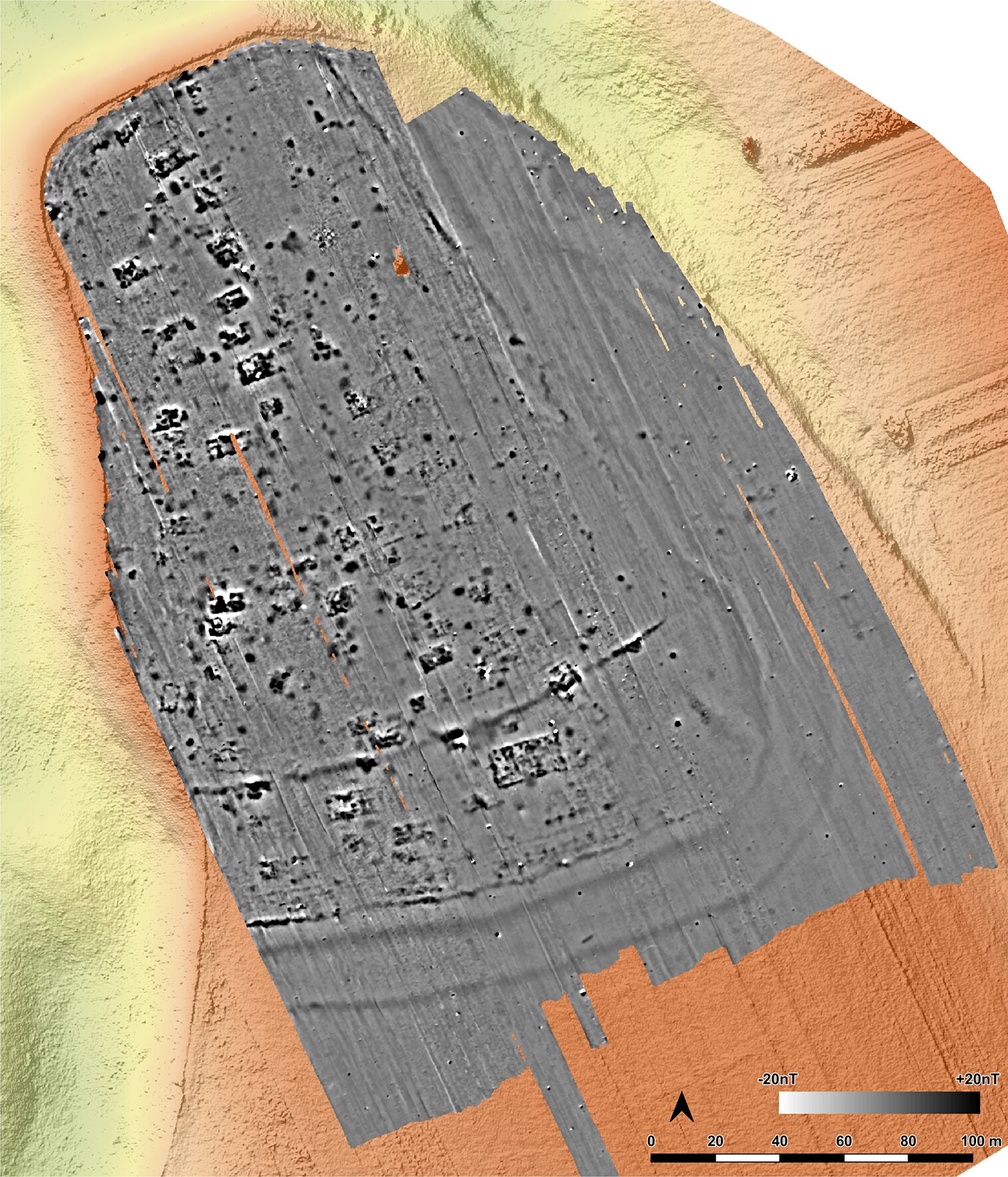
The structure, designated house plot 5/6 at Stăuceni-‘Holm’ in Botoşani County, emerged during geophysical surveys conducted in 2021 and 2022. The surveys mapped a settlement of at least 45 buildings on a plateau of about 4 hectares. Most of the house plots were relatively similar in size, but two were substantially larger. One of them measured about 35 by 10 meters, or roughly 350 square meters. The other houses had areas of approximately 70 to 120 square meters, with a median of 91 square meters.
That difference in scale is central to why the researchers classify house 5/6 as a “mega-structure.” Their definition emphasizes rectangular constructions that are larger than ordinary houses and occupy prominent or relatively open positions. At Stăuceni-‘Holm’, the structure lies between settlement ditches and is directly behind one of them, apparently near an entrance. The researchers therefore regard its size and location as sufficient to classify it as a mega-structure even though Stăuceni-‘Holm’ does not have the ring-shaped settlement plan in which many other examples occur.
The broader archaeological problem is what such buildings meant. Cucuteni-Trypillia settlements can be very large, yet archaeologists have not identified obvious systems of writing, markets or consistently visible wealth differences that would straightforwardly explain how they were governed. Mega-structures have consequently been interpreted in different ways, including as communal buildings, assembly places or structures associated with ritual activity.
Stăuceni-‘Holm’ offers a chance to examine that problem through excavation rather than relying only on a magnetic map.
Excavation exposed a substantial foundation
In 2023 and 2024, archaeologists excavated the southwestern corner of the mega-structure through four trenches. The excavation revealed a rectangular foundation ditch at least 15 centimeters wide. Pits were placed within it at intervals of roughly 70 to 90 centimeters to hold posts. The posts were wedged with debris from older buildings, including large pieces of burnt clay. The researchers could not determine whether a wall originally stood between the posts.
The structure also had a carefully constructed floor. Halved stems from small trees were laid flat within the building, leaving spaces for posts, and a layer of clay was placed over them to produce a smoother surface. Burnt clay preserved impressions of the wooden elements after the structure was destroyed by fire.
Two large postholes were found along the building’s longitudinal centerline. The researchers suggest they probably belonged to the structure because they correspond to circular areas without daub in the floor. If another comparable post is found in the unexcavated northern portion, the three could form a line dividing the building into western and eastern halves. That remains a hypothesis rather than an established reconstruction.
The excavation also uncovered evidence that may indicate an entrance or associated installation. In the northwestern corner, an “annex” contained a concentration of small daub fragments bearing impressions of branches. Deep, narrow posts in the foundation ditch and a small ceramic vessel found broken inside one of the postholes may also relate to access to the building, although the researchers present this cautiously.
The building appears to have had a roof, at least in the researchers’ preliminary reconstruction, because of the posts in the foundation ditch and the large posts along its centerline. But the walls and roof cannot be reconstructed with certainty. The amount of burnt clay was small compared with ordinary Cucuteni houses, consisting mainly of a layer associated with the floor plaster. The researchers note that wooden walls could have burned without leaving substantial traces.
The magnetic map was more misleading than expected
One of the most consequential results came not from what the researchers saw in the excavation, but from what they discovered their earlier geophysical map could not tell them.
The magnetogram appeared to contain several internal anomalies that suggested the presence of hearths, platforms, pits, posts or other installations. Excavation showed that, in the portion examined so far, most of those anomalies were not actual internal structures. Instead, they were produced by variations in the concentration of burnt daub from the collapsed walls and floor plaster. Once the burnt clay was removed, the anomalies largely disappeared.
This means the magnetic image cannot currently be used to reconstruct the internal arrangement of the building. Only a small amount of burnt clay resembling material from hearth foundations was identified, and fragments of a probable small oven were found in one trench, but it was not preserved in place. About 25 percent of the mega-structure has been excavated so far, leaving open the possibility that later work will alter the picture.
The result is particularly important because interpretations of other mega-structures have partly relied on differences in their magnetic signatures. The Stăuceni excavation demonstrates that such anomalies can have a less direct explanation. The authors therefore caution against interpreting geomagnetic results without excavation.
The dating creates the central puzzle
The pottery from Stăuceni-‘Holm’ indicates a single occupational phase, Cucuteni A3. The same cultural attribution applies to the excavated material from the mega-structure. But two radiocarbon samples taken from archaeobotanical remains preserved between the wooden stems of the floor produced dates in the 40th and 39th centuries BC. One sample, a fragment of a Prunus fruit stone, produced a calibrated range of 3975–3962 cal. BC at one standard deviation. The second, a mixed sample containing a Polygonum convolvulus seed, feather-grass awns and twig fragments, produced a range of 3955–3807 cal. BC at one standard deviation.
The samples came from protected positions beneath the floor, where the researchers considered them relatively safe from modern plowing and biological disturbance. They were also from short-lived, annually growing plants, so the researchers concluded that an old-wood effect could be excluded. On that basis, they state that they must currently rely on the absolute dates.
That creates a direct chronological tension. Pottery typology places the structure in Cucuteni A3, but the radiocarbon results place its construction in the 40th or 39th century BC. The researchers note that Cucuteni A3 has generally been placed earlier than 4000 cal. BC, whereas material from Cucuteni AB would normally be expected for the 40th and 39th centuries BC.
The authors do not simply discard the radiocarbon results. Instead, they argue that the discrepancy raises questions about the existing chronology itself. They point out that the absolute chronology of Cucuteni A3 already varies considerably between studies and regions, while some existing dates rely on relatively few samples or materials whose relationship to diagnostically dated pottery is unclear. For the Upper Siret-Prut region, they note that the chronological framework has depended heavily on a small number of radiocarbon measurements.
At Stăuceni-‘Holm’, the connection between the dated material and the construction is unusually direct. The dated plant remains came from the floor construction, while a characteristic Cucuteni A3 vessel was found inside a posthole in the foundation ditch. The researchers therefore regard the dates and the pottery as connected to the construction of the mega-structure.
They nevertheless stress that more absolute dates from secure contexts are needed before the broader chronology can be resolved. If the Stăuceni dates are accepted, the chronology of Cucuteni A3, and potentially the wider chronology built around it, would have to be reconsidered.
What happened inside the building remains unclear
The objects recovered from the mega-structure do not provide a straightforward answer about its function.
Only relatively few pottery vessels were found. Among the notable finds were a vessel with a bull-head protome, three spoon fragments and a clay object commonly called a “conical idol.” No anthropomorphic figurines were found inside the excavated portion. There were also 87 flint artifacts, about half of them burned.
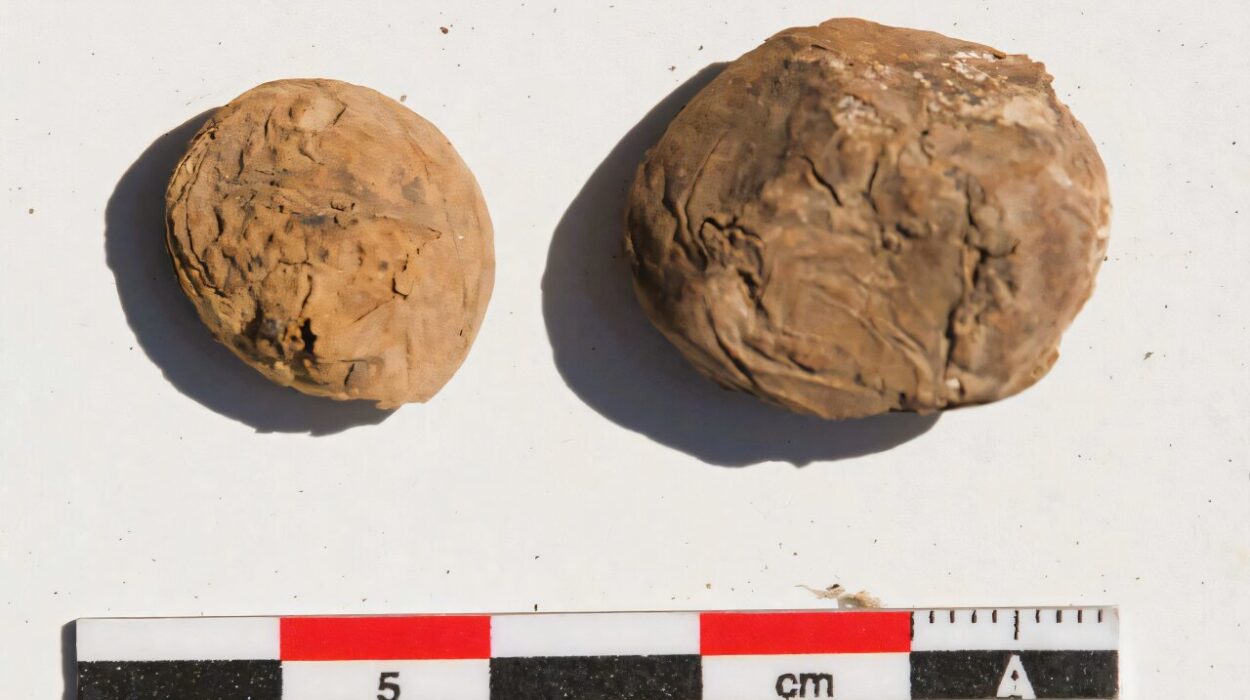
The botanical remains were similarly varied but limited in quantity. The researchers identified poorly preserved cereal grains, weeds associated with crops, and remains of gathered fruits including cornelian cherry, plums, elder and hawthorn. Carbonized fruit stones can be associated with food consumption, so the evidence indicates that crops and gathered fruits were consumed in the building.
A mineralized fragment of henbane was also recovered. The authors say it could eventually be related to medicinal or ritual uses. Feather-grass awns may have been used for insulation, mattresses or similar purposes, although their exact role cannot be established. Tiny pieces of flint found during wet sieving could indicate the reshaping of tools or even flint production within the structure.
The evidence does not support a secure identification of the building as a storage facility or communal food-consumption area. Nor are there clear indications of a cult function. The authors therefore leave several possibilities open: it could have been a larger house for a larger family, a communal building used for decision-making, or a meeting place for people of elevated status. The last possibility is presented specifically in connection with a possible shift toward a more hierarchical organization of the community, not as an established interpretation.
Its position may matter as much as its size
Stăuceni-‘Holm’ is not one of the enormous ring-shaped mega-sites that dominate discussions of Cucuteni-Trypillia settlement organization. The plateau contains at least 45 buildings, and the settlement is enclosed by several ditch and palisade systems. The mega-structure stands between the ditches and appears to be close to the southern entrance area, where the surrounding terrain would have provided visibility toward the structure.
The researchers propose that the settlement may have developed in stages. The inner ditches and palisades appear to have been crossed or overbuilt by houses with a different orientation, which could indicate that the occupied area later expanded southward. The outer ditches and palisade may therefore have enclosed a larger settlement in a later phase. This sequence remains a hypothesis based on the arrangement of the features.
The position of the mega-structure is consequently difficult to interpret with certainty, particularly because the researchers cannot yet establish whether all of the surrounding ditches were contemporary with it. But its location outside the main concentration of houses and near the probable entrance makes it comparable in position to one category of mega-structures identified at larger Cucuteni-Trypillia settlements.
A possible clue to how communities were organized
The broader significance of Stăuceni-‘Holm’ lies in the possibility that mega-structures were not confined to the largest settlements or to their later stages.
Previous research has identified roughly 140 mega-structures at 19 sites, mainly in Ukraine and Moldova. Their positions vary, as do their dimensions and internal arrangements. Some have been interpreted as communal or assembly buildings, while other interpretations have emphasized ritual activity.
At Stăuceni-‘Holm’, the structure is particularly interesting because the settlement itself is relatively small compared with the mega-sites. The authors estimate a population of approximately 320 to 350 people, based on seven people per household. They argue that such a community would not obviously require a mega-structure, yet because buildings of this kind occur repeatedly across the Cucuteni-Trypillia settlement tradition, the Stăuceni structure remains the best candidate at the site for a building connected with governing the community.
That interpretation remains deliberately tentative. The excavation has not produced evidence that identifies the building as a government center, and its exact function remains unresolved. The authors instead place it within a larger debate over whether these unusually large buildings reflect communal decision-making, changing social organization or the emergence of more strongly differentiated groups.
The chronology may ultimately be the more disruptive part of the discovery. If the radiocarbon dates are correct, Stăuceni-‘Holm’ belongs among the earliest known mega-structures. The authors suggest it could be, together with the mega-structure at Ripiceni-‘Holm’, the second-oldest known example after the Pre-Cucuteni structure at Baia, or it could be broadly contemporary with mega-structures at Nebelivka and Dobrovody.
That possibility also changes how the proposed development of these buildings might be viewed. The authors’ initial hypothesis was that, if Stăuceni-‘Holm’ proved to be among the oldest examples, the concept of a mega-structure as a governing element might have developed in the Romanian Cucuteni region and later spread across the wider Cucuteni-Trypillia area. The excavation does not prove that sequence, but the early date is why the possibility is being raised.
For now, the structure remains only partly excavated, its function remains uncertain, and the conflict between pottery chronology and radiocarbon dating remains unresolved. What the excavation has established is a large, architecturally distinctive building with a substantial post-supported foundation, a prepared wooden-and-clay floor, sparse but varied remains of activity, and dates that place its construction in a period that challenges the conventional chronological position assigned to its Cucuteni A3 material.
The study was published in PLOS One.