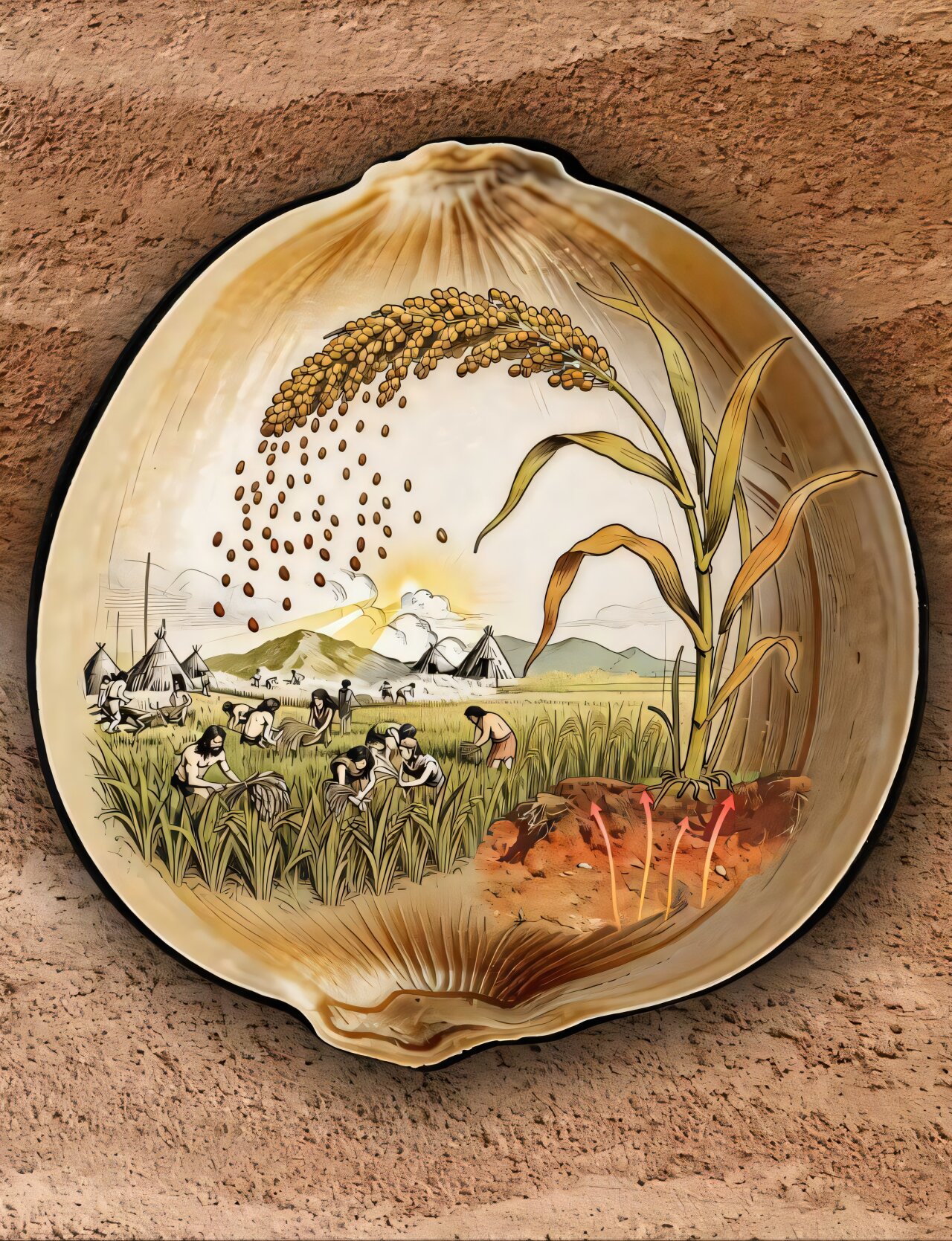
Changes in growing-season soil temperature may have helped determine where millet could be reliably grown in East Asia, with a period of cooling between about 7,500 and 6,000 years ago linked to a southward shift in millet farming and a delay in its wider expansion.
Millet was an important crop in East Asia during much of the Holocene, which began about 11,700 years ago. To examine how environmental conditions affected its development, researchers studied ancient loess deposits from the Chinese Loess Plateau.
The team focused on the Longgugou section of the plateau. They combined 14 radiocarbon dates with 18 optically stimulated luminescence dates to build a detailed chronology covering roughly 12,300 to 2,800 years ago.
They then analyzed 114 samples for biomarkers that could be used to reconstruct growing-season soil temperature and vegetation conditions. Those reconstructions were compared with archaeological evidence for millet farming and with transient climate simulations.
The resulting record points to substantial changes in soil conditions over the Holocene.
Soil temperatures changed as farming developed
From about 12,300 to 7,500 years ago, soil temperatures were relatively high. The period also had comparatively low moisture and sparse vegetation.
Between about 7,500 and 6,000 years ago, soil temperatures gradually fell as conditions became wetter and vegetation became denser.
After about 6,000 years ago, soil temperatures recovered rapidly and then remained relatively stable for thousands of years. During the same period, moisture and vegetation cover declined.
The researchers compared these environmental changes with archaeological evidence to examine how they corresponded with the changing distribution of millet agriculture.
Cooler soils coincided with a shift in millet farming
Between about 8,000 and 7,500 years ago, relatively warm soils may have supported early millet cultivation in the Yanshan-Liaoning region. The researchers suggest that communities there may have been experiencing greater subsistence pressure.
Farther south, including the Chinese Loess Plateau and lower-latitude areas, millet use appears to have been more limited. It likely existed alongside hunting, gathering and other forms of subsistence.
That pattern changed during the subsequent period of soil cooling.
From about 7,500 to 6,000 years ago, cooler soils occurred together with wetter conditions and denser vegetation. The researchers suggest that these conditions may have reduced the areas where millet could be cultivated reliably, particularly because frost-sensitive millets have lower thermal limits.
Millet farming appears to have shifted southward toward the Chinese Loess Plateau and nearby regions during this interval.
Farming expanded as temperatures recovered
After about 6,000 years ago, soil temperatures recovered and became more stable. At the same time, vegetation cover declined.
Between about 6,000 and 4,000 years ago, these conditions, together with advances in cultivation practices, might have helped millet farming expand more broadly and contributed to wider late Neolithic agricultural development.
The researchers interpret the sequence as evidence that growing-season soil temperature was an important climatic constraint on the development and geographic distribution of early millet agriculture. They suggest that large changes in soil temperature helped modulate when and where millet farming expanded across Neolithic East Asia.
The study was published in Proceedings of the National Academy of Sciences.