An ancient shell midden on Velanai Island provides the earliest scientifically confirmed evidence of prehistoric human occupation in northern Sri Lanka, with people living there about 3,460 years ago despite a landscape long considered poorly suited to human settlement.
Northern Sri Lanka has long been considered a difficult place for prehistoric people to live. The region is semi-arid, freshwater is scarce, vegetation is limited, and suitable stone for making tools is hard to find. Those conditions helped support the idea that people did not occupy the area until agro-pastoralists arrived from India in the 5th century BCE.
Excavations on Velanai Island, in the Jaffna Peninsula, now provide evidence of a much earlier presence.
Researchers found an extensive shell midden, a deposit made up largely of discarded shells and other remains from human activity. The oldest marine deposit at the site dates to roughly 6,300 to 5,970 calibrated years before present. Evidence of human occupation dates to about 3,460 calibrated years before present, making it the earliest scientifically confirmed prehistoric occupation yet identified in northern Sri Lanka.
That date also adds to a more uneven archaeological record across the island. Human occupation in Sri Lanka is known from sites such as Pathirajawela as far back as about 25,000 years ago. Shell middens are also well documented in the wetter south, including occupations dating to around 5,300 and 3,400 calibrated years before present. Comparable evidence had been lacking in the north.
Shellfish were central to the diet
The remains at Velanai indicate that people living there made extensive use of marine resources.
Mollusks were particularly important. One species, Gafrarium pectinatum, accounted for nearly 60% of the mollusk assemblage. The foragers also used seabreams, deer, wild boar, dugongs and dolphins.
The shell remains provide another clue about how people used the local environment. During a period identified as L4, the shells became smaller. One possible explanation is that people harvested the mollusks so intensively that the average size of the animals declined. Another possibility is that the pattern reflects a local environmental change.
A gradual reduction in the size of G. pectinatum shells over time has also been observed at Velanai and at Punguduthivu, beginning in the 4th millennium BCE. Researchers consider this pattern a possible indicator of increasing human exploitation and environmental pressure.
Evidence for hunting pressure on dugongs and rays has also been proposed, although direct archaeological evidence for that exploitation remains limited.
Stone had to be brought to the island
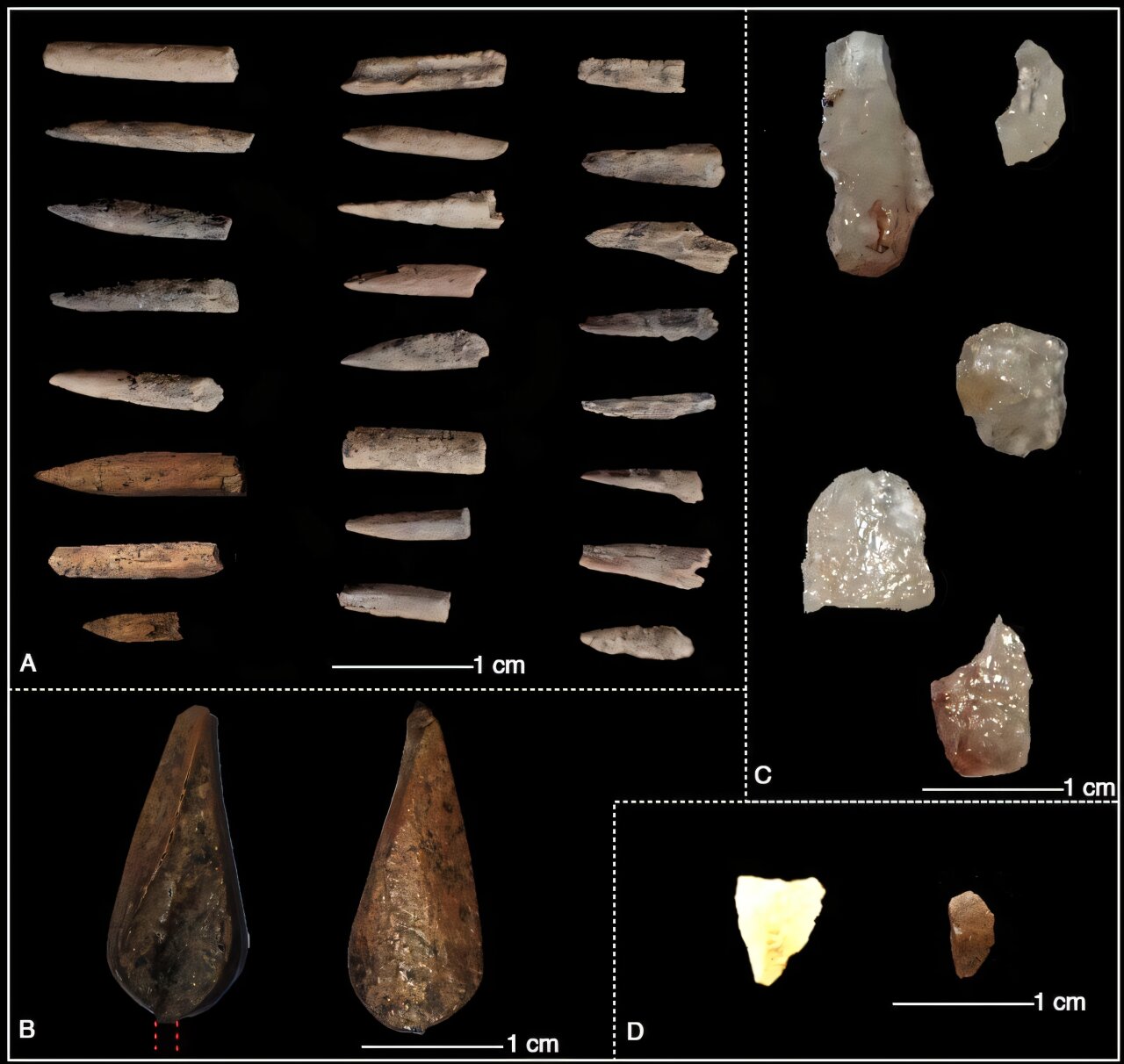
The site also contains flakes of quartz and chert that did not come from Velanai. Their likely sources were on the mainland nearly 60 kilometers away.
Moving these materials to the island indicates that people deliberately transported stone over a substantial distance. Because Velanai is separated from the mainland by more than 5 kilometers of sea, the finding also suggests the possibility of short-distance seafaring.
The combination of marine and terrestrial resources at Velanai resembles patterns documented in shell middens in southern Sri Lanka. Those sites indicate flexible foraging that combined intensive shellfish collection with the use of nearshore and terrestrial resources.
Earlier settlements may be underwater
The discovery also raises a question about why prehistoric occupation has been so difficult to identify in northern Sri Lanka.
The researchers argue that the apparent gap between evidence from southern and northern Sri Lanka may reflect preservation rather than an absence of suitable habitat. During the Late Pleistocene, lower sea levels exposed larger coastal plains. People in the semi-arid north may have lived closer to shorelines that were active at the time.
As sea levels rose during the Holocene, those landscapes were progressively submerged. Earlier settlements could therefore have disappeared from the visible archaeological record.
The Velanai evidence may represent settlement along shorelines that formed after this submergence rather than the first human occupation of the region.
Researchers are looking beyond visible sites
Future work will examine places where traces of earlier coastal occupation might still survive.
One possibility is the study of uplifted coastal terrains, which can preserve evidence of ancient shorelines and shell middens. Researchers also plan to look at inland archaeological sites for marine-derived materials that could indicate earlier reliance on coastal resources even when the original shoreline sites can no longer be reached.
The most difficult approach would be direct investigation of submerged landscapes, particularly in lagoons and low-energy coastal environments where archaeological evidence may be better preserved.
Researchers do not currently plan to re-excavate the CB/Ex1 site unless new analytical techniques become available. Instead, they intend to pursue several complementary lines of research, including long-term ecological analysis of shell assemblages.
The study was published in the Journal of Island and Coastal Archaeology.