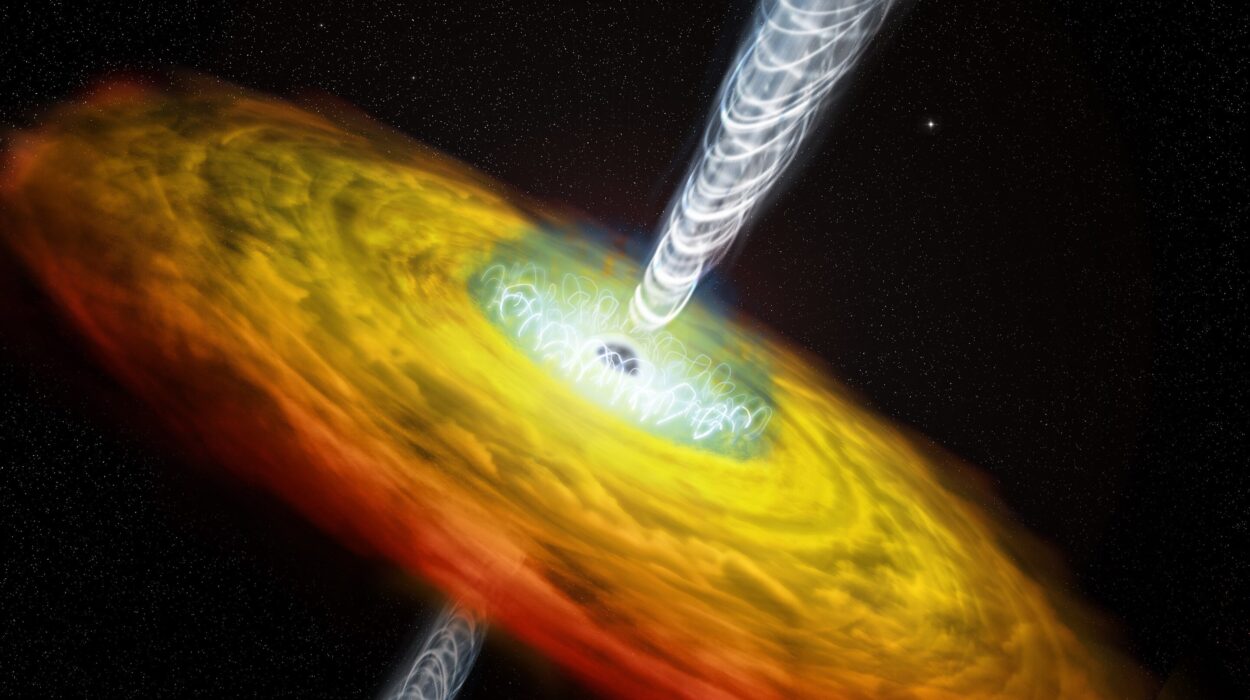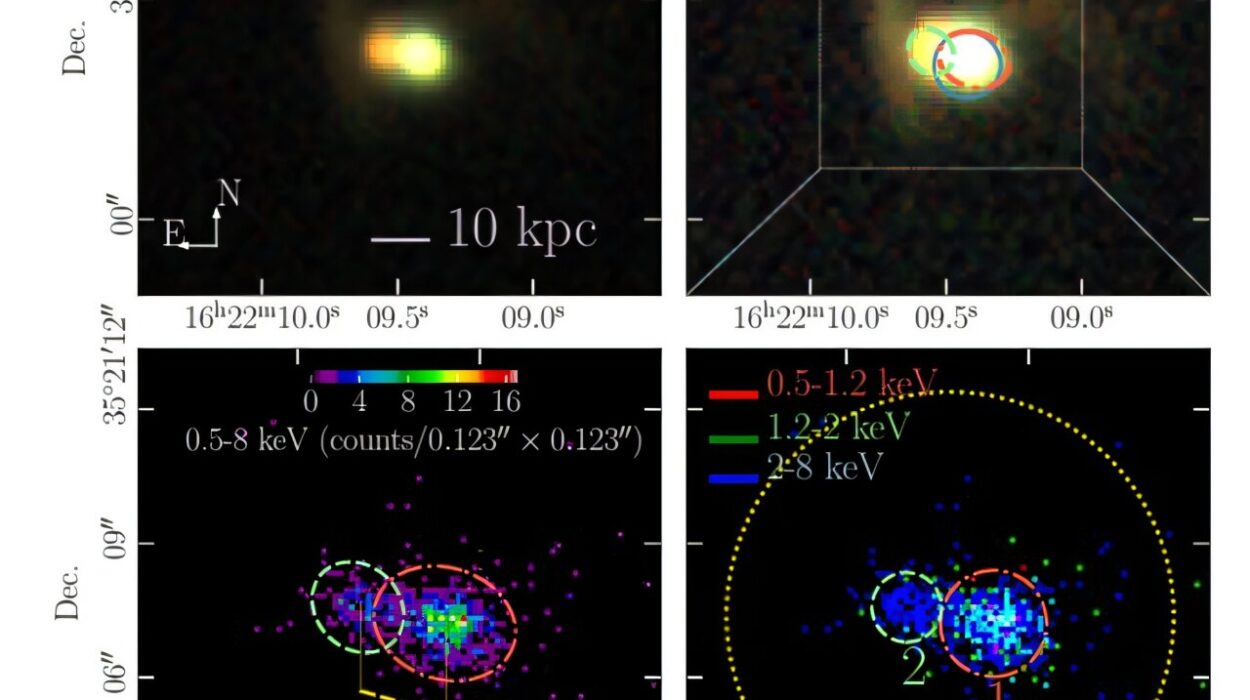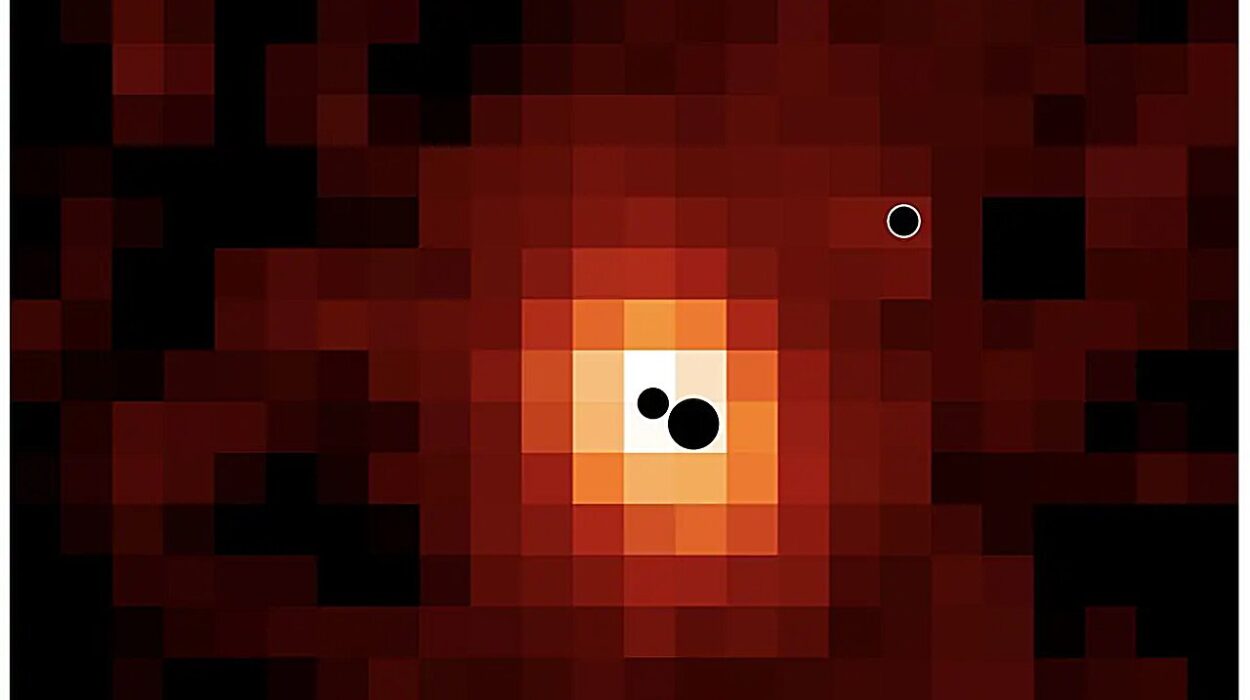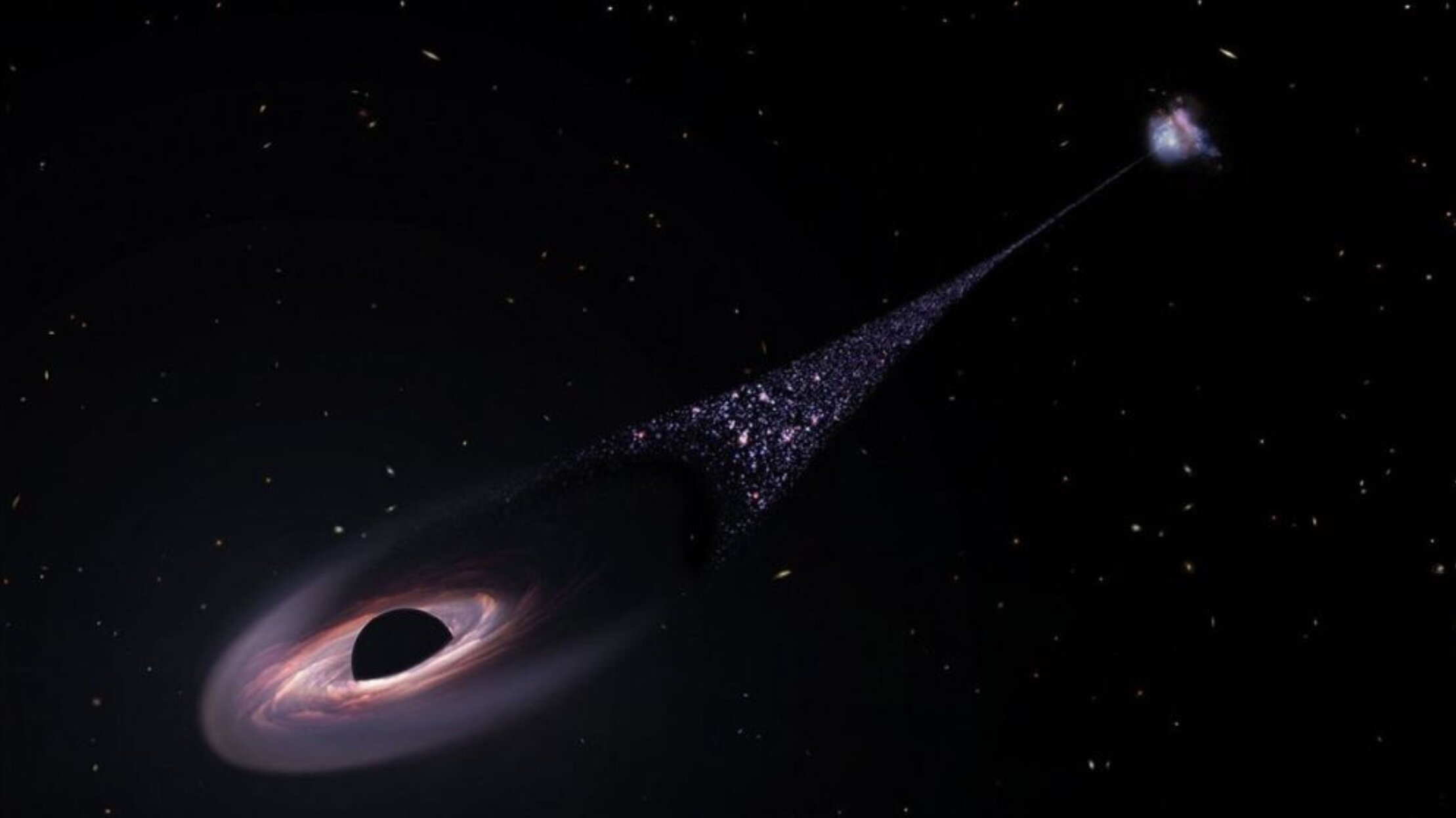
A supermassive black hole known as RBH-1 appears to be racing through space at nearly 1,000 km/s, and researchers have traced that extreme motion to a possible collision between two other supermassive black holes about 70 million years ago.
Supermassive black holes can contain millions to billions of times the mass of the Sun and are typically found at the centers of galaxies. RBH-1 is unusual because observations from the James Webb Space Telescope and Hubble Space Telescope indicate that it was traveling through space at almost 1,000 km/s, or about 620 miles per second.
Researchers at the Kavli Institute for Theoretical Physics at the University of California, Santa Barbara, and the University of Texas at Austin investigated how a black hole could have acquired such a high speed.
Their analysis points to a violent event in RBH-1’s past: the merger of two supermassive black holes.
The idea is based on gravitational-wave recoil. When two black holes merge, the gravitational waves they emit can carry momentum away unevenly. Under the right conditions, the merged black hole can receive a powerful kick in the opposite direction.
Earlier work by the researchers found that such a kick could reach as much as 5,000 km/s, or about 3,100 miles per second. That is high enough, in some cases, to eject the newly merged black hole from its galaxy.
The researchers worked backward from the black hole’s speed
To investigate RBH-1, the team treated its unusually high velocity as the key piece of evidence.
They used observations from Hubble and Webb together with theoretical models of binary black hole mergers. Those models were developed using highly accurate numerical-relativity simulations, which solve Einstein’s equations on supercomputers, along with black hole perturbation theory.
The models describe how the masses and spins of two merging black holes affect the mass, spin and recoil velocity of the black hole left behind.
The researchers then compared millions of possible pairs of merging supermassive black holes with the observed properties of RBH-1. This allowed them to identify which combinations were most consistent with the observations.
The analysis suggests that the two original black holes had a mass ratio below about 6:1. The larger black hole was spinning rapidly, and the pair was likely precessing before the merger.
Those properties could have produced the strong recoil needed to explain RBH-1’s motion.
Reconstructing a merger that can no longer be seen
The proposed merger would have occurred around 70 million years ago. The researchers therefore cannot observe the merger itself directly, but they used the present-day properties of RBH-1 to work backward toward the conditions that produced it.
That approach could allow astronomers to reconstruct aspects of a past black hole merger from the properties of a recoiling black hole.
The researchers say the same method could be applied to other recoiling supermassive black holes found by Webb, the Nancy Grace Roman Space Telescope and other observatories. As more such systems are identified, their merger histories could potentially be reconstructed as well.
The work could also complement future direct observations of supermassive black hole mergers through gravitational waves by the Laser Interferometer Space Antenna, or LISA, a space-based observatory being built by the European Space Agency in partnership with NASA.
For now, the researchers are working to improve their theoretical models of binary supermassive black hole mergers using Einstein’s theory of general relativity.
The study was published in Physical Review Letters.