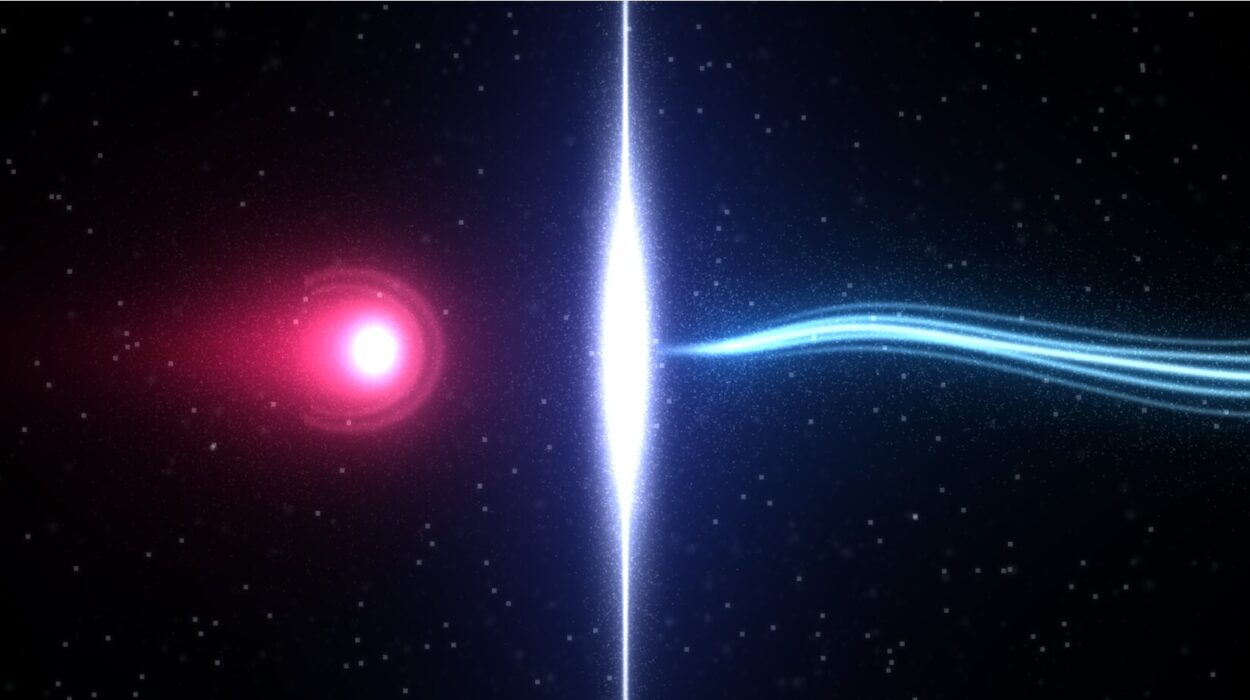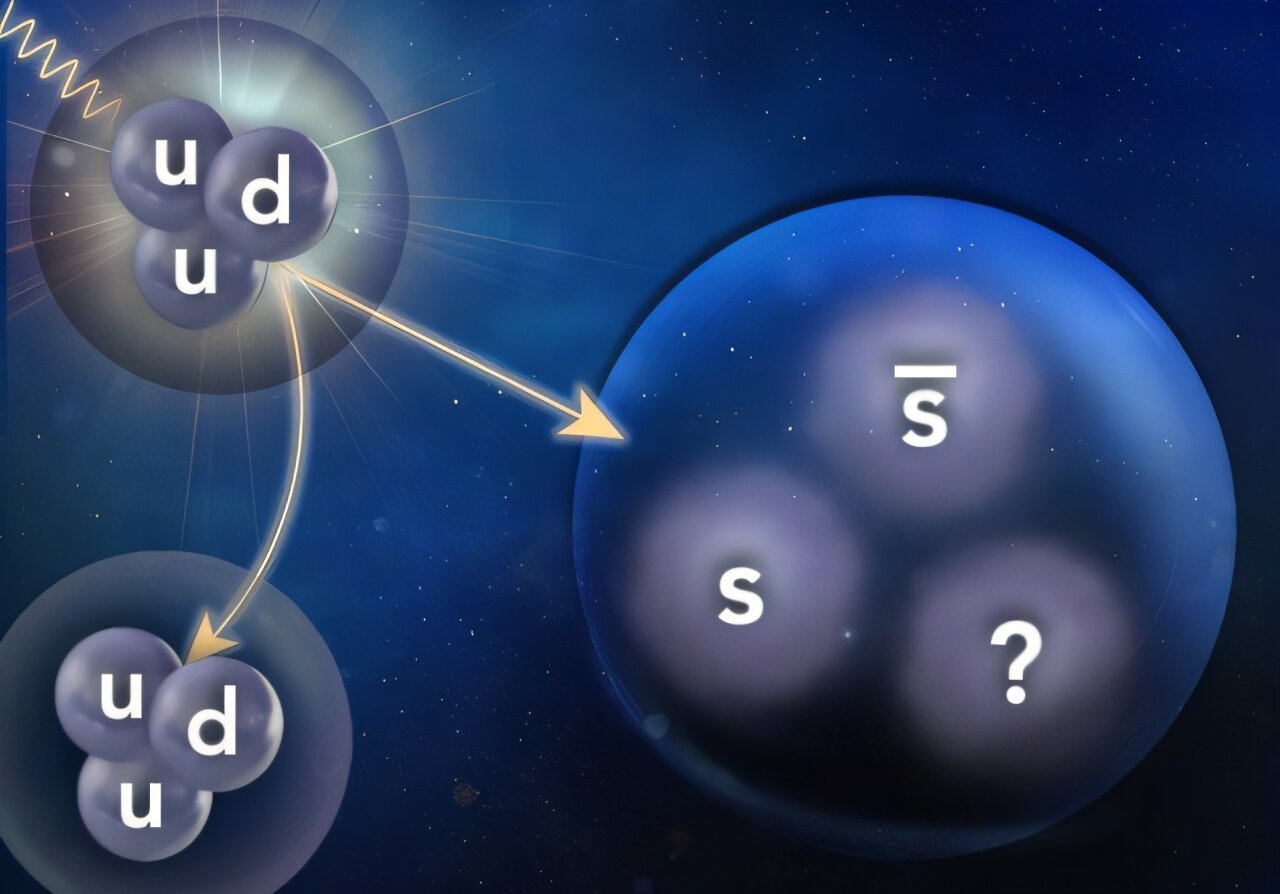
Physicists looking for evidence of a puzzling particle instead found two different structures that had not been seen in this type of experiment, adding new pieces to the difficult problem of understanding exotic hadrons.
The GlueX Collaboration at the U.S. Department of Energy’s Thomas Jefferson National Accelerator Facility set out to investigate Y(2175), an unusual particle candidate first reported in 2006.
Y(2175) belongs to a group of short-lived particles known as XYZ states. These particles do not fit neatly into the traditional picture of hadrons as combinations of quarks and antiquarks. Scientists have proposed several possible structures for them, including states involving four quarks, molecule-like combinations of other composite particles, and hybrid states in which excited gluons contribute to the particle’s structure.
Y(2175), with a mass of about 2.16 billion electron volts, was originally produced in experiments that collide electrons with their antimatter counterparts, positrons. Other electron-positron experiments later confirmed it, but it had not been observed through photoproduction.
That made it a target for GlueX, which uses a different process. Instead of colliding electrons and positrons, the experiment sends a high-energy photon beam into a proton target.
The search did not produce the expected Y(2175) signal.
Instead, the data contained evidence for two other structures nearby.
Two structures emerge from the data
One structure has a mass of about 2.24 billion electron volts and was named Y(2240). GlueX observed it with a statistical significance of about five sigma, or 99.9994% confidence.
The second structure, called X(1830), has a mass of about 1.82 billion electron volts. Its measured significance was three sigma, corresponding to about 99.7% confidence.
The two signals appeared in a region of the hadronic spectrum associated with particles containing strange quarks and their antimatter partners.
“We went searching for a confirmed XYZ candidate with a photon beam but instead found two other structures,” said Malte Albrecht, a staff scientist at Jefferson Lab. “It’s new information.”
Finding the structures does not by itself establish what they are made of. Their existence provides measurements that theoretical physicists can use when considering possible exotic configurations.
“The next step is to figure out which exotic quark configurations nature might have realized here,” said Frank Nerling, a Jefferson Lab collaborator from Germany’s GSI Helmholtz Center for Heavy Ion Research and Goethe University Frankfurt.
Why these particles are difficult to classify
Physicists have long used the quark model to organize hadrons. Hadrons are composite particles made from quarks bound together by the strong nuclear force. Mesons, one type of hadron, typically contain a quark and an antiquark.
The original quark model, developed in 1964, included three types, or flavors, of quarks: up, down and strange. The later discovery of the charm quark and additional quark flavors helped establish the framework that became part of the Standard Model of particle physics.
As particle accelerators became more powerful and sensitive, experiments began finding hadrons with quantum properties outside the original picture. Many of these discoveries came after the turn of the century, and the particles became known collectively as XYZ states.
Some of these states occupy regions where particles have similar masses, making it difficult to determine whether signals seen in different experiments represent the same particle or different ones.
“The challenge is that you have many measurements around the world in very different experiments that have to find consensus about what they are seeing,” said Klaus Goetzen, a GSI physicist conducting research at Jefferson Lab. “It’s more complicated than it sounds, because there are states that are close by in mass and might or might not be the same thing.”
GlueX uses a different way to produce the particles
GlueX is designed in part to search for hybrid mesons. In these proposed particles, excited gluons could contribute directly to their structure. Gluons are the carriers of the strong force.
The experiment uses the Continuous Electron Beam Accelerator Facility, or CEBAF, to produce its photon beam. Electrons from CEBAF pass through an ultrathin diamond wafer, which converts them into high-energy photons with parallel spins. Millions of photons then strike protons inside a liquid hydrogen target every second, producing other particles that are recorded by a large spectrometer.
That setup gives GlueX a way to study hadrons through photoproduction rather than electron-positron annihilation.
The researchers searched through the resulting data for Y(2175). The experiment generates such large amounts of information that the data can fill an average laptop hard drive every few minutes.
Instead of confirming Y(2175) through photoproduction, the analysis produced the Y(2240) and X(1830) signals.
“One of the interesting things about this result is that we didn’t observe Y(2175) at the place we were searching,” Albrecht said. “We found something new using a completely different physics process, and that’s really intriguing. But now that these have been observed, that doesn’t mean we’re done.”
More measurements will be needed
The strong statistical significance of Y(2240) provides evidence for the structure, while the lower significance of X(1830) leaves more work to be done.
The results also establish an upper limit on the probability that Y(2175) is produced through photoproduction. That measurement can help guide future experiments.
For theorists, the newly observed structures provide new information to incorporate into models of exotic hadrons. Future measurements could help determine which possible quark configurations correspond to the structures seen by GlueX.
“It really opens the door for a whole new set of hadron spectroscopy measurements we can make with GlueX,” said Justin Stevens, a William & Mary physics professor and GlueX spokesperson. “We’ve got much more data to sort through, so this is just the beginning of the story.”
The study was published in Physical Review Letters.