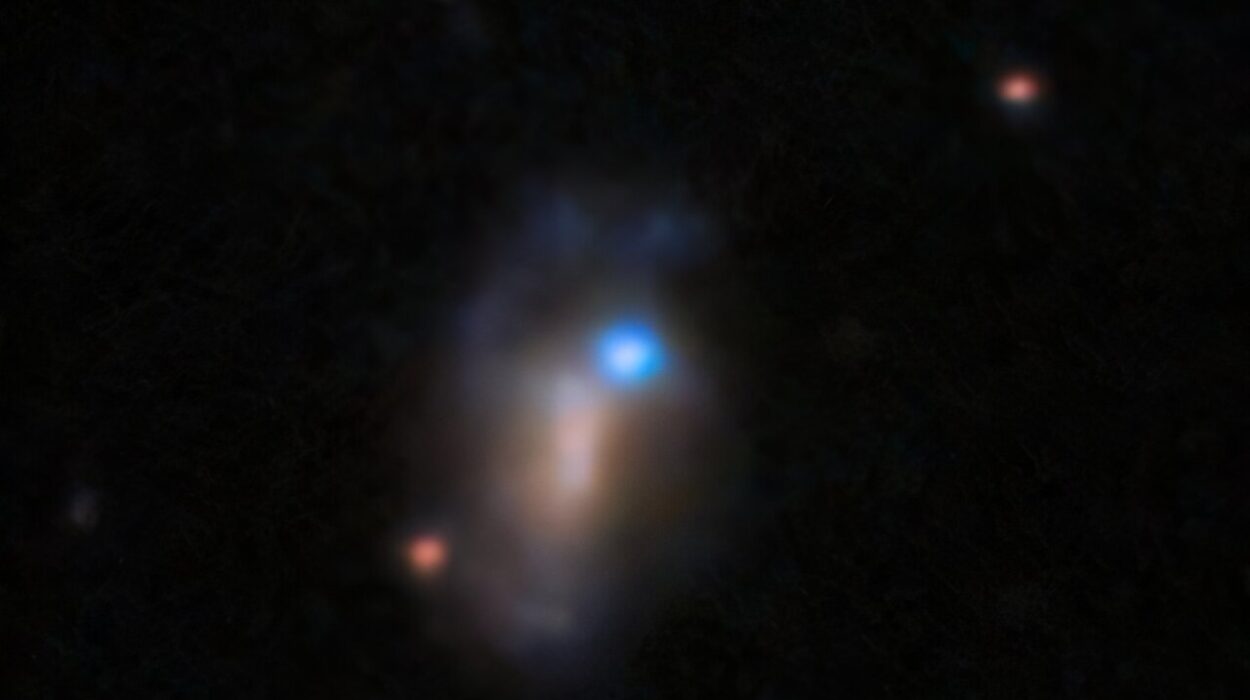
A previously uncataloged, unusually elongated galaxy has emerged from archival James Webb Space Telescope data, but its true distance is still being worked out. The object, called A1, was initially estimated to lie in the universe’s first billion years, before a more careful measurement placed it much closer.
A1 was identified in observations of the galaxy cluster MACS J0308.9+2645, where the cluster’s enormous gravity can bend and magnify light from galaxies behind it. This effect, known as gravitational lensing, can make distant galaxies appear stretched into curved shapes.
Astrophysicist Homer Dávila Gutierrez found A1 while examining publicly available Near-Infrared Camera data from Webb’s General Observation 5293 program. He searched 54 JWST/NIRCam fields and evaluated 1,591 possible candidates. A1 was the only one he considered a robust candidate for a gravitational arc associated with the very early universe.
Several features made the object stand out. Its shape is extremely elongated, with an axis ratio of about 6.5, and it is aligned almost tangentially to the center of the cluster. It was also the brightest highly elongated source at that distance from the cluster, making it possible to measure. And it was absent from published catalogs of the cluster and from SIMBAD, NED and VizieR.
The team behind the original Webb observations also confirmed that A1 did not overlap with the lensing systems they were analyzing.
A first distance estimate pointed much farther away
An initial multi-band analysis using the EAZY photometric tool gave A1 a redshift of about 4.4. That would place the galaxy within the first billion years of the universe.
Gutierrez then used another analysis to constrain the mass of MACS J0308.9+2645. The resulting estimate indicated that the cluster magnified A1’s light by a factor of seven.
But the distance estimate did not hold up after the object’s photometry was corrected.
The original measurements relied on catalog aperture magnitudes, which captured only a small portion of the light from the extended source. With corrected photometry, A1’s estimated redshift became about 1.4. That places it roughly 9 billion years in the past rather than in the universe’s first billion years.
A1 still fits the gravitational-lensing picture
At its revised redshift, A1 appears to be a galaxy behind MACS J0308.9+2645, whose redshift is 0.356. Its light passed close to the cluster before reaching Earth, allowing the cluster’s gravity to stretch and modestly magnify the galaxy.
The current interpretation, shared by lensing experts on the observing program’s team, is that A1 is a singly lensed image. In other words, the cluster’s gravity appears to have distorted and magnified the galaxy without producing multiple visible images of it.
A1 lies about 51 arcseconds from the cluster’s X-ray center, and its elongated shape is oriented tangentially to the cluster. Both features are consistent with that interpretation.
But the interpretation has not yet been confirmed. An updated lens model using the new Webb data is being developed, and follow-up observations are needed.
Another candidate is even less certain
The search also produced a second possible lensing candidate, A2. It has a geometry similar to A1 and lies at a similar projected distance from the cluster’s center.
A2, however, is considerably fainter and smaller than A1. It is also more elongated, and its photometric measurements are less constrained. The same problem that affected A1’s original redshift estimate is even more significant for such a faint, extended source.
For now, the nature and redshift of A2 remain open questions pending a corrected analysis.
The case of A1 also highlights a limitation in relying on automated catalog measurements for extended objects. In this instance, the initial photometry pointed to a substantially higher redshift than the corrected measurements did.
Gutierrez and the GO-5293 team are now working with an updated lens model to determine A1’s nature more definitively.
The study was published on the arXiv preprint server.