Material expelled by a dying star in the Helix Nebula is being gradually torn apart and mixed into the space between stars, giving astronomers an unusually direct view of how stellar debris can return to the galaxy.
The finding came from observations of the Helix Nebula, a planetary nebula about 650 light-years from Earth. A team led by Yale astronomer Pieter van Dokkum was not originally looking for this phenomenon. The researchers had selected the well-known nebula to calibrate a new telescope called MOTHRA.
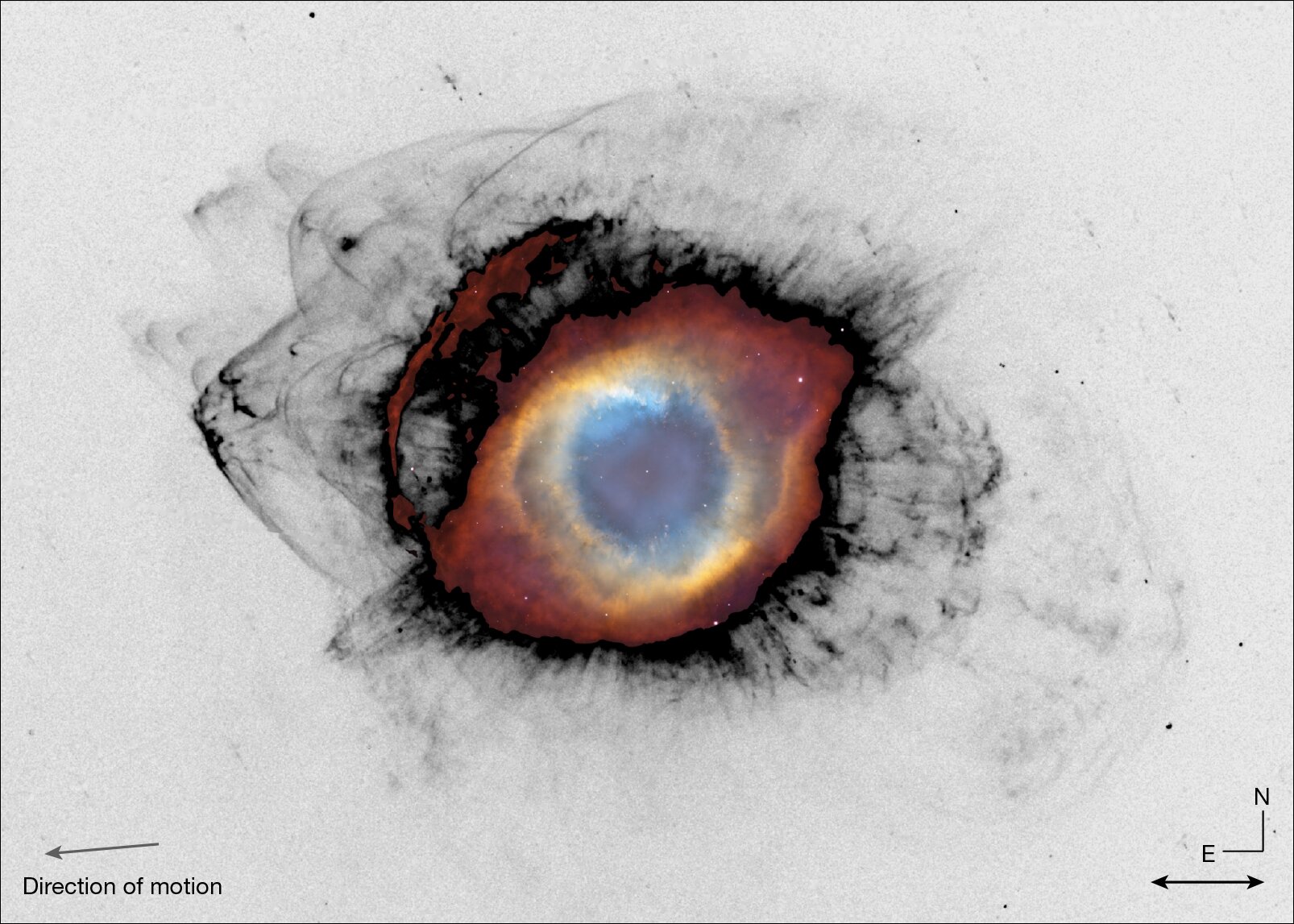
Instead, their images revealed 22 complete or partial bow-shaped structures in an extremely faint region beyond the nebula’s bright inner ring.
The structures provide evidence of material shed late in a star’s life being broken down and dispersed into interstellar space.
“We are seeing material shed near the end of a star’s life being broken apart and returned to the galaxy,” van Dokkum said.
Faint structures outside the bright nebula
At the center of the Helix Nebula is a white dwarf surrounded by a bright ring of material expelled by the dying star. The new observations looked much farther out, reaching into the nebula’s faint outer halo.
On the eastern side, the researchers found the 22 bow-shaped features. They are known as bow shocks because of their curved shape.
The shocks form around clumps of stellar debris moving rapidly through the thin gas between stars. As the debris collides with that surrounding gas, the collisions produce glowing arcs.
The structures are not all alike. Those closer to the central star are relatively large, thin and sharply defined. Farther away, they become smaller and less distinct, with increasing fragmentation.
That change with distance is important to the researchers’ interpretation of what is happening to the debris.
The debris appears to erode as it travels
The researchers interpret the progression of the bow shocks as evidence that the stellar clumps are gradually being eroded as they move through the surrounding gas.
They estimate that an individual fragment stays coherent for only about 10,000 years after it becomes exposed to the surrounding gas. After that period, its material is largely shredded and mixed into interstellar space.
The observations therefore capture different stages of the same process, from relatively intact debris closer to the star to increasingly dispersed material farther away.
Van Dokkum described the transition from recognizable stellar debris to diffuse material between stars as a stage that has been difficult to observe.
The researchers also note that the sun is expected to undergo a similar process far in the future, with its material eventually entering the same cycle.
The discovery came from a telescope calibration image
The team was using MOTHRA, short for the Modular Optical Telephoto Hyperspectral Robotic Array, when it made the observation.
MOTHRA is being built at the El Sauce Observatory in Chile’s Rio Hurtado Valley. The telescope combines images from hundreds of telephoto lenses to detect and study diffuse ionized gas between galaxies. When completed, it will use 1,140 telephoto lenses.
The Helix Nebula was chosen as a calibration target because it is one of the best-known nebulae in the sky.
Instead of simply providing a reference image, the observation exposed the faint outer structures.
“We thought we were taking a calibration image of one of the best-known nebulae in the sky,” said study co-author Roberto Abraham of the Dragonfly Focused Research Organization and the University of Toronto. “Instead, we found this extraordinary network of bow-shaped structures.”
MOTHRA builds on an earlier telescope concept developed by van Dokkum and Abraham. Their Dragonfly Telescope in the mountains of New Mexico combines images from multiple lenses to detect the dim glow of faint stars and galaxies.
MOTHRA expands that approach with many more lenses, along with new filters and additional computational power.
The study was published in Nature.