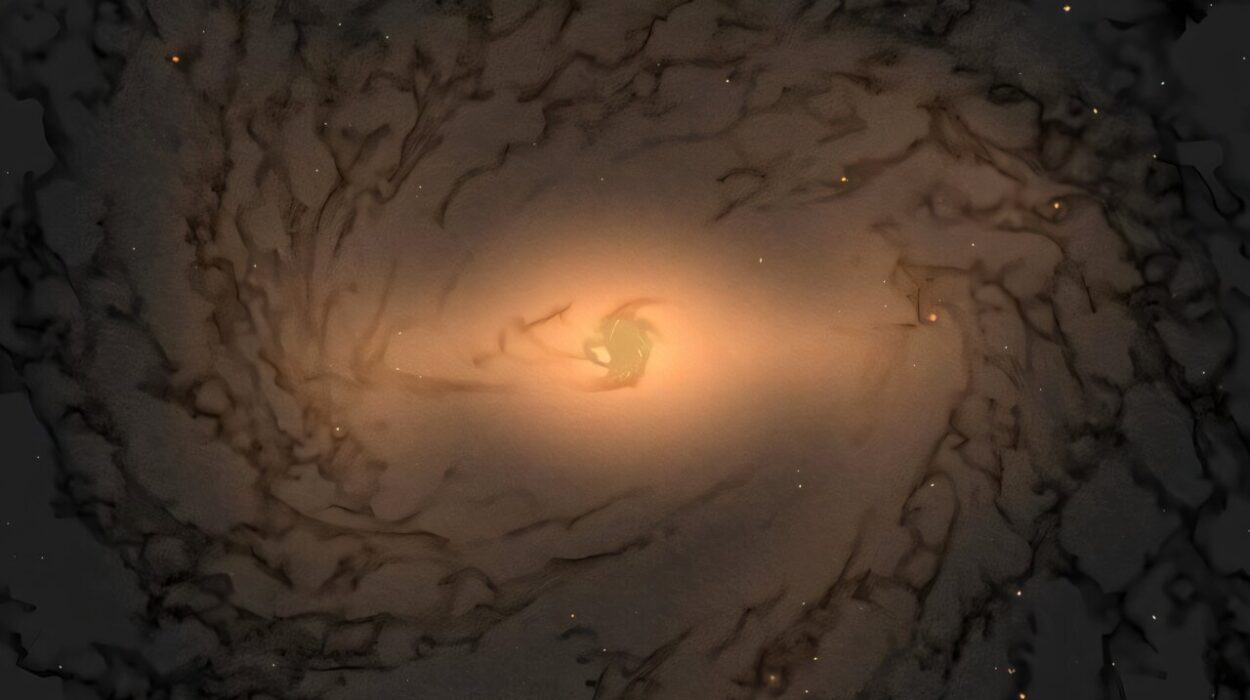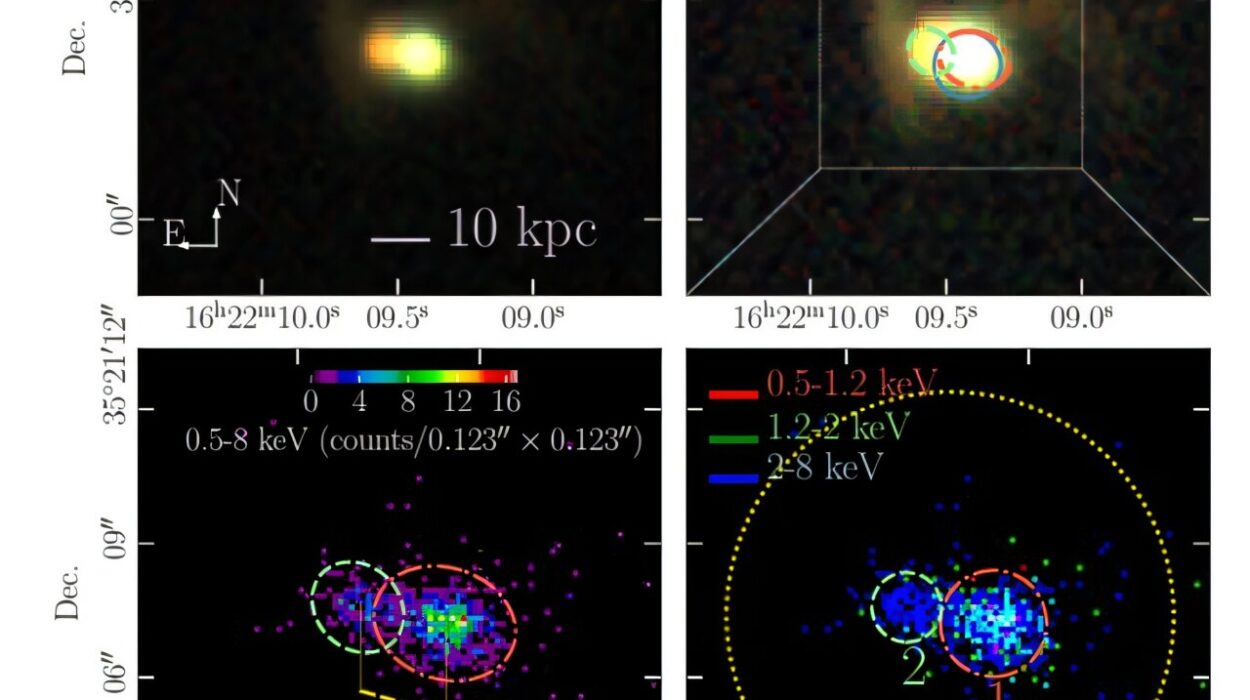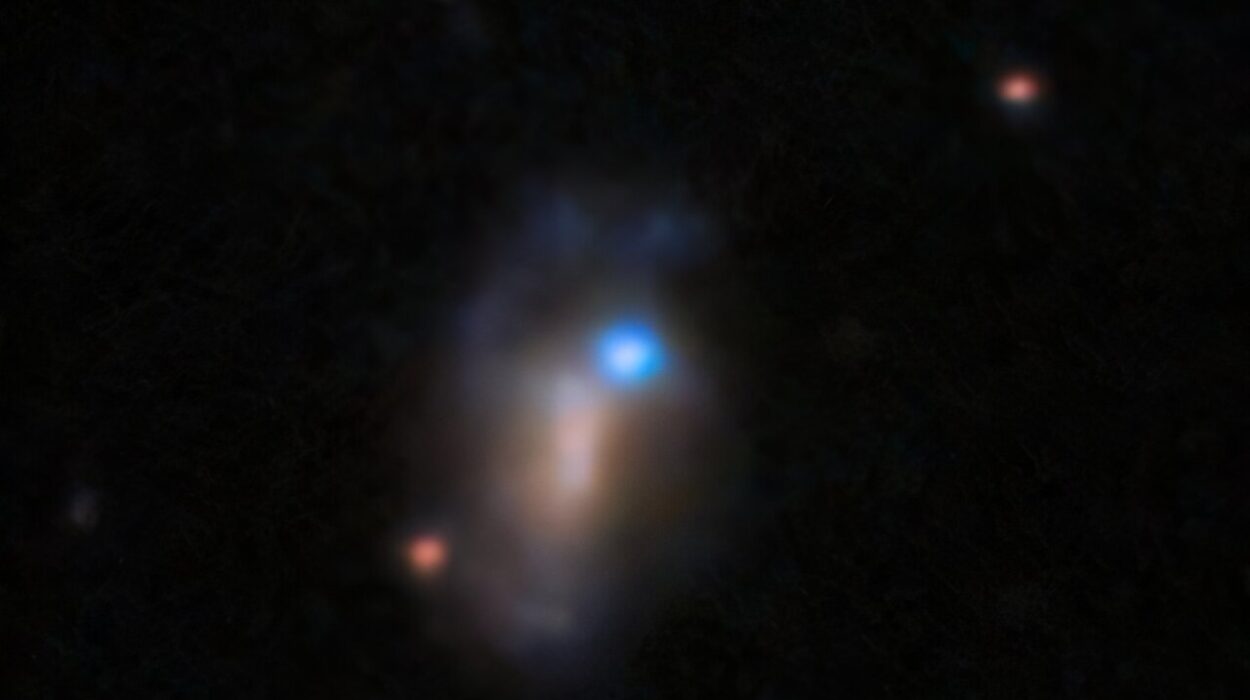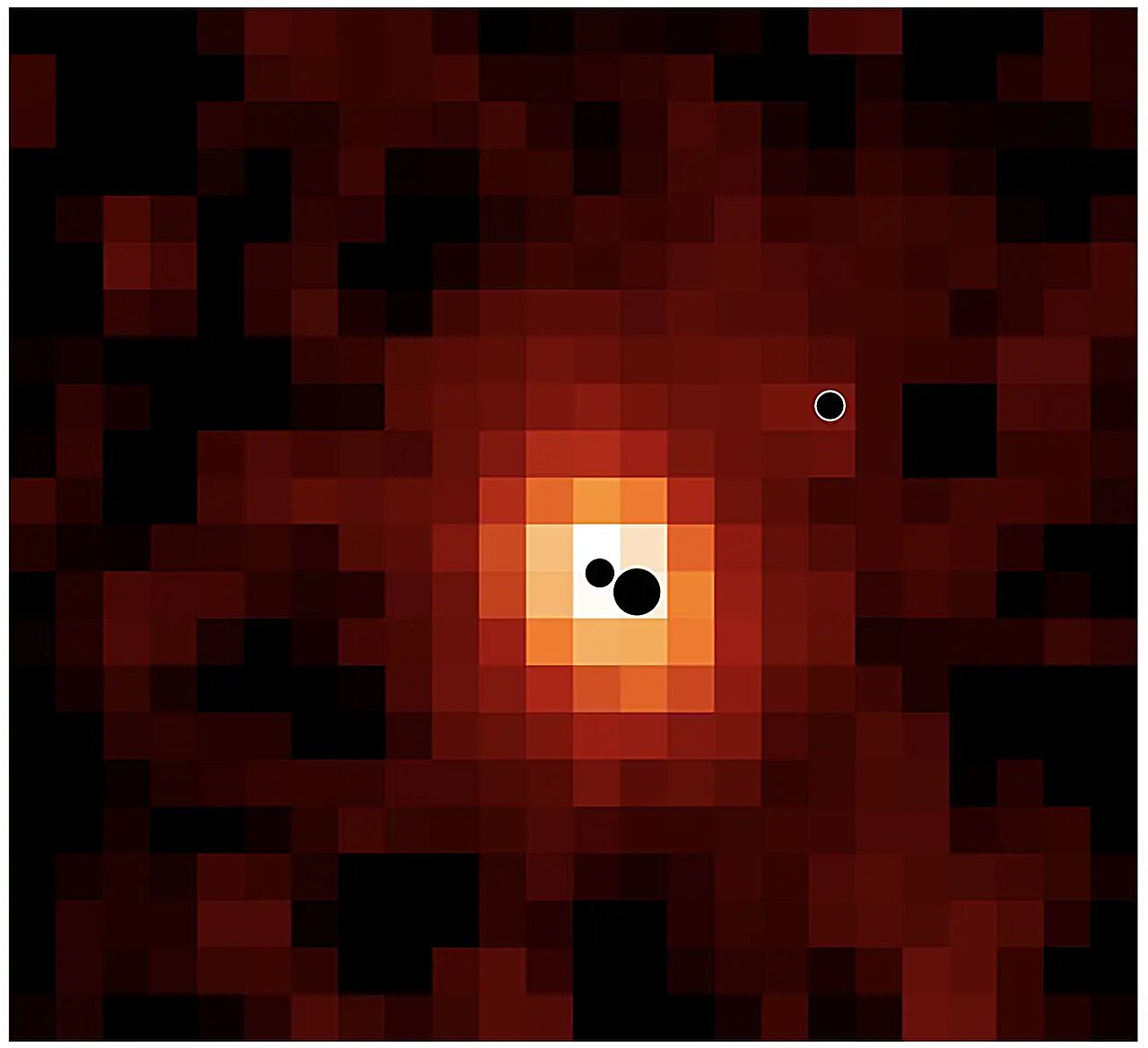
Three actively feeding supermassive black holes are packed into the distant galaxy J0148-4214, with two near its center and a third thousands of light-years away. The finding provides the first evidence for three active black holes in a single galaxy in the distant universe.
The galaxy lies more than 12.5 billion light-years from Earth, at a redshift of 5.02. Its light has taken about 12.5 billion years to reach us, so astronomers are observing J0148-4214 as it appeared roughly 1.2 billion years after the Big Bang.
An international team led by astronomers at the Max Planck Institute for Extraterrestrial Physics identified the three black holes using observations from the James Webb Space Telescope. All three are actively accreting matter from surrounding disks.
“This is the first evidence of three active black holes in a single galaxy in the distant universe,” says Hannah Übler, a research group leader at the Max Planck Institute for Extraterrestrial Physics and lead author of the study.
Two black holes are close to the galaxy’s center
The two central black holes are separated by only about 620 light-years in projection. A third lies in the galaxy’s outer region, approximately 5,500 light-years from the center.
The black holes could not simply be seen as three separate point-like objects. Instead, the researchers identified them through spectral signatures produced by hydrogen atoms moving at high speeds in the gravitational fields around the black holes.
The central region produced a particularly complicated spectrum. The researchers found that the structure was best explained by two nearby black holes rather than one.
To separate their contributions, the team used a technique called spectro-astrometry. It measures tiny changes in the apparent position of emission from different spectral lines. This allowed the researchers to determine where the two central sources were located even though they could not be spatially resolved as separate point sources.
The same observations revealed the third active black hole farther from the center.
The three black holes have very different masses
The analysis estimates masses of about 80 million, 2 million and 0.6 million times the mass of the Sun.
The most massive black hole is accreting matter at a lower rate than the nearby black hole with a mass of 0.6 million solar masses. That smaller black hole is actively feeding at a rate that even exceeds the maximum predicted by basic theories of black hole growth, known as the Eddington limit.
The observations also allowed the researchers to estimate the stellar mass of the galaxy, which is about 1.3 billion solar masses.
“The JWST data allowed us not only to identify the three black holes, but also to estimate their masses, accretion rates and the stellar mass of the galaxy,” says Giovanni Mazzolari, second author of the study and a researcher at the Max Planck Institute for Extraterrestrial Physics. “We find a total stellar mass of about 1.3 billion solar masses, and the black holes represent a significant fraction of that.”
The central pair is expected to merge
The two black holes near the center are expected to merge within the next few hundred million years.
The researchers connect the system to models of how galaxies and their central black holes developed early in cosmic history. Observations underlying theories of galaxy evolution indicate that galaxies could come close together and merge early in the universe. When that happens, their central black holes can also merge, producing a more massive black hole at the center of the resulting galaxy.
The presence of three active black holes in J0148-4214 suggests that processes in the early universe were efficient at bringing massive black holes together, according to Übler. The researchers say this could have contributed to the conditions leading to massive black hole mergers that future gravitational-wave observatories are expected to detect.
“The results are extremely exciting,” says Roberto Maiolino, a professor at the University of Cambridge and a co-author of the study. “They suggest that black hole merging may be an additional, fast route for their rapid growth in the early universe.”
The third black hole has a less certain history. It may be the remnant of an earlier merger, it may have been displaced from the galaxy’s center by a gravitational recoil kick, or it may currently be moving inward toward the center.
Spatially resolved spectroscopy was crucial
The observations also demonstrate the value of integral field spectroscopy for finding multiple active black holes in distant galaxies.
Without the spatially resolved information provided by the James Webb Space Telescope’s NIRSpec integral field unit, the researchers say that only one of the three black holes would likely have been detected.
The study was published in Astronomy & Astrophysics.