Long before many people with chronic kidney disease realize anything is wrong, tiny filtering structures inside their kidneys are already losing the specialized cells that keep waste out of the bloodstream while retaining essential proteins. A new scientific review argues that one of the body’s own cannabinoid signaling systems—better known for its roles in the brain and throughout the body—may also be deeply involved in deciding whether damaged kidneys continue to deteriorate or begin to recover. Yet the same signaling network that appears promising as a therapeutic target is proving far more complicated than scientists first imagined.
Chronic kidney disease (CKD) has become one of the world’s most significant health challenges. According to the review, it affects about 9.1% of the global population—roughly 850 million people—and its death rate has risen substantially over the past two decades. Diabetes, obesity, high blood pressure, and an aging population continue to drive that increase, creating an urgent need for treatments that can do more than simply slow the disease.
When CKD progresses to end-stage renal disease, patients often depend on dialysis or kidney transplantation. Both options carry major limitations. Dialysis increases the risk of infection and premature death while dramatically reducing life expectancy, and kidney transplantation is constrained by a severe shortage of donor organs and requires lifelong immune-suppressing medication. The review also notes that although only a small fraction of CKD patients reach end-stage disease, their treatment consumes a disproportionately large share of healthcare spending.
Against that backdrop, the authors examine whether manipulating cannabinoid signaling inside the kidney could offer new ways to interrupt disease progression before irreversible damage occurs.
The kidney contains its own cannabinoid signaling system
The review focuses on the endocannabinoid system, a collection of naturally occurring signaling molecules, enzymes, and receptors distributed throughout the body.
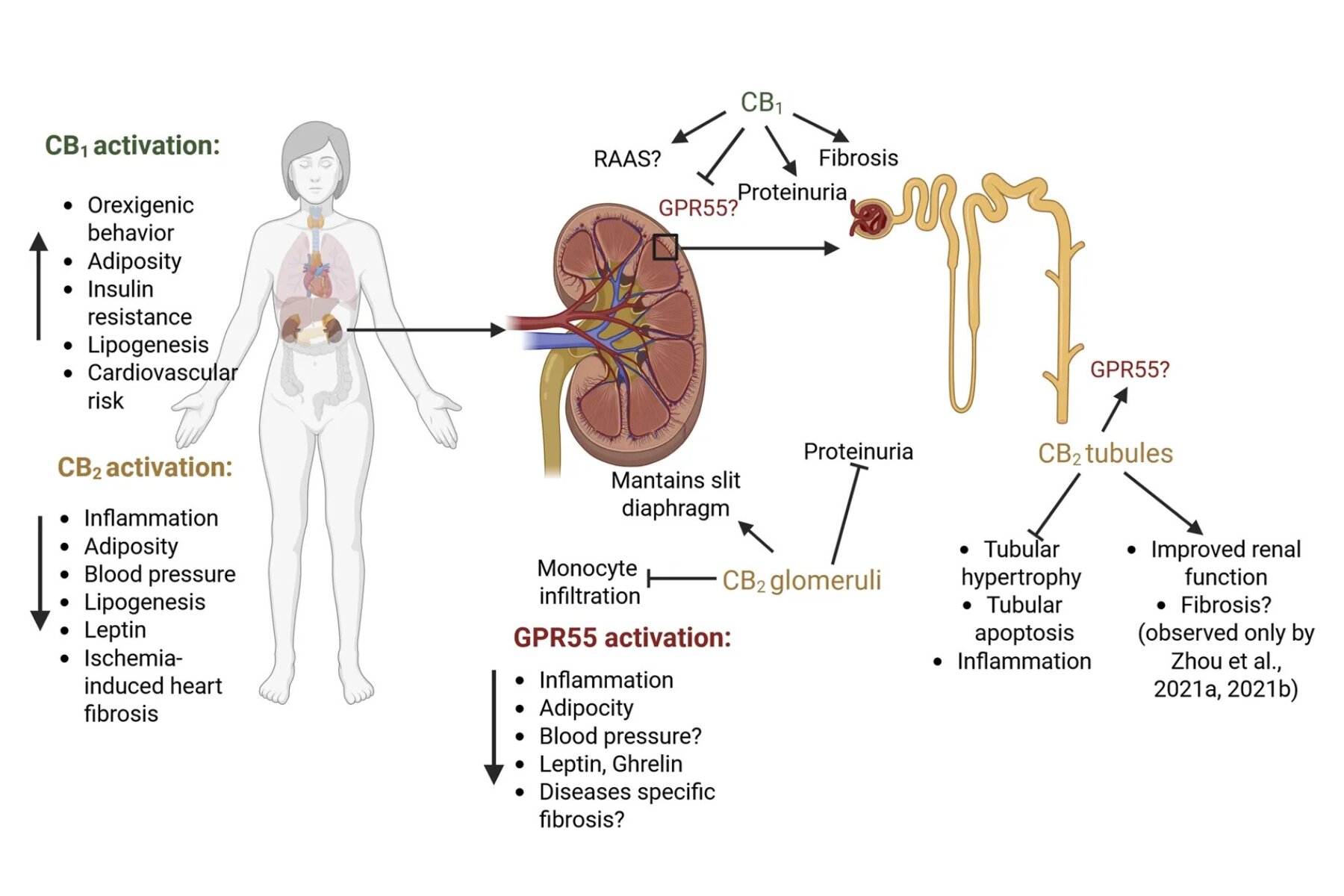
The two best-known receptors are called CB1 and CB2. Their natural activating molecules include anandamide and 2-arachidonoylglycerol (2-AG). Together, these components influence a remarkably wide range of biological functions, including metabolism, blood pressure regulation, inflammation, oxidative stress, immunity, and cell survival.
But the review emphasizes that the story has become increasingly complicated.
Scientists have identified additional receptors—including GPR55, GPR18, and GPR119—that may also respond to cannabinoids or participate in related signaling pathways. These receptors can interact with one another, form receptor complexes, share signaling molecules, and even regulate entirely different biological systems, including the renin-angiotensin-aldosterone system that already plays a central role in kidney disease.
Rather than acting as isolated switches, cannabinoid receptors appear to function as an interconnected signaling network whose behavior changes depending on disease stage, cell type, and surrounding biological conditions.
Damage begins in the kidney’s microscopic filters
The review explains that CKD progressively injures both the glomeruli—the tiny filtering units of the kidney—and the kidney tubules.
Within the glomeruli, highly specialized cells called podocytes help maintain the filtration barrier. As CKD advances, these cells are gradually lost. Their supporting structures become damaged, filtration proteins disappear, the filtering membrane deteriorates, and scarring develops.
Tubular injury adds another layer of damage. Excess proteins filtered into the tubules, elevated glucose levels, increased metabolic demands, oxygen shortages, oxidative stress, and inflammation all contribute to progressive tissue injury and fibrosis.
Acute kidney injury (AKI) and chronic kidney disease are also closely connected. People who recover incompletely from AKI face a greater risk of developing CKD later, partly because damaged tubules often fail to repair themselves completely.
Because cannabinoid receptors are expressed throughout these kidney structures—and because their expression changes after injury—the authors argue that they deserve careful attention as potential therapeutic targets.
One receptor repeatedly appears to drive kidney damage
Across numerous experimental models, CB1 consistently emerged as a receptor whose excessive activity was associated with worsening kidney disease.
In diabetic nephropathy, several animal studies reported increased CB1 activity within the kidney. Blocking this receptor improved kidney function in multiple ways, including reducing albumin leakage into the urine, preserving proteins that maintain the filtration barrier, improving glomerular filtration, and lowering markers of inflammation.
Some experiments strengthened that conclusion by deleting CB1 only from podocytes. Even without removing the receptor elsewhere in the body, kidney function improved in diabetic animals, suggesting that CB1 activity within these specialized filtration cells directly contributes to disease.
Other studies extended these observations beyond diabetes.
In mouse models of kidney scarring caused by ureteral obstruction, blocking CB1 reduced fibrosis. In obese Zucker rats, CB1 inhibition improved kidney structure and function while also lowering blood glucose, triglycerides, cholesterol, and other metabolic abnormalities.
The review notes that these broader metabolic improvements make it difficult to separate direct kidney effects from indirect benefits. Lower blood pressure, improved glucose control, reduced body weight, and healthier lipid levels could all independently help protect the kidneys.
Researchers have also proposed several mechanisms through which CB1 activation may damage kidney tissue. Experimental work has linked it to disrupted mitochondrial function, increased production of reactive oxygen species, inflammatory signaling, altered glucose transport, lipid accumulation, fibrosis, and tubular cell death.
Taken together, the authors conclude that CB1 inhibition remains one of the strongest therapeutic strategies emerging from preclinical kidney research.
CB2 tells a far more complicated story
The second major cannabinoid receptor, CB2, does not fit into such a straightforward pattern.
In many diabetic kidney disease models, activating CB2 protected the filtration barrier, reduced albumin loss, limited inflammation, decreased fibrosis, and preserved kidney structure.
One particularly notable study combined a CB1 blocker with a CB2 activator. Compared with either treatment alone, the combined approach more effectively reduced inflammatory and fibrotic markers, decreased monocyte infiltration, limited mesangial expansion, and better preserved kidney function.
Experiments using mice lacking CB2 produced additional evidence that the receptor can protect against diabetic kidney damage. Those animals developed more severe structural and functional injury than normal diabetic mice, while transplant experiments suggested that CB2 signaling in immune cells may play an important role during kidney disease.
Yet the evidence is far from unanimous.
Other studies, particularly in models involving kidney fibrosis and tubular injury, found that CB2 activation appeared to promote fibrosis, oxidative stress, lipid accumulation, and tissue damage. Blocking CB2 sometimes improved kidney outcomes in those experimental settings.
The review carefully examines possible reasons for these conflicting findings.
Different disease models may activate distinct biological pathways. Genetic deletion of CB2 may alter the entire cannabinoid signaling environment rather than eliminating only one receptor’s activity. Natural signaling molecules such as 2-AG can activate multiple receptors simultaneously, including CB1 and GPR55. CB1 and CB2 may also physically interact with one another, making it difficult to isolate the contribution of either receptor alone.
Because of these complexities, the authors conclude that CB2’s role likely depends heavily on disease type, disease stage, experimental design, and the balance of signaling throughout the broader endocannabinoid system.
Scientists are beginning to investigate a new generation of cannabinoid receptors
Beyond CB1 and CB2, several lesser-known receptors have begun attracting attention.
Among them, GPR55 appears especially intriguing.
Experimental studies in obesity-related kidney disease produced unexpectedly mixed results. Activating GPR55 reduced weight gain and urinary albumin excretion, but blocking the receptor also improved albuminuria and kidney inflammation.
Rather than interpreting these contradictory findings as evidence that one result must be wrong, the review suggests that current drugs may interact with multiple receptors simultaneously or that GPR55’s effects depend on interactions with CB1 and CB2.
Laboratory studies have already demonstrated direct communication between GPR55 and both classical cannabinoid receptors.
The review also highlights GPR18, which has shown increased expression in one kidney injury model, although its biological role remains almost entirely unknown. Even less information exists for several other orphan receptors that are structurally related to cannabinoid signaling pathways.
According to the authors, these poorly understood receptors represent one of the largest unanswered questions in kidney cannabinoid research.
The benefits may extend beyond the kidney itself
One reason cannabinoid pathways have generated so much interest is that CKD rarely develops in isolation.
Approximately 30% of chronic kidney disease cases are attributed to diabetes, while another third are linked to high blood pressure. Obesity frequently overlaps with both conditions.
Because cannabinoid signaling influences glucose metabolism, fat storage, inflammation, blood pressure regulation, and cardiovascular function, therapies targeting this system might improve kidney health both directly and indirectly.
Experimental studies summarized in the review describe CB1 blockade increasing glucose uptake in skeletal muscle, improving lipid metabolism, reducing body weight, activating fat oxidation, and improving several metabolic abnormalities associated with obesity.
CB2 activation has also reduced inflammatory responses, lowered body weight, improved insulin resistance, and decreased markers of kidney fibrosis in some experimental models.
The review additionally discusses epidemiological observations reporting lower rates of metabolic syndrome and obesity among marijuana users compared with non-users. However, the authors caution that marijuana contains many different cannabinoids capable of acting on numerous receptors simultaneously, making those observations difficult to interpret. They also note that chronic cannabis use may alter receptor availability, further complicating interpretation.
Clinical translation has already encountered obstacles
Despite encouraging results in animal studies, turning these discoveries into treatments has proven difficult.
The review describes a Phase 1 clinical trial of the anti-CB1 antibody GFB-024, which demonstrated favorable safety and pharmacokinetic results, with additional studies planned in overweight individuals with type 2 diabetes.
By contrast, a Phase 2 clinical trial evaluating the CB1 antagonist INV-022 in patients with diabetic nephropathy failed to improve clinical outcomes and was associated with neuropsychiatric side effects.
These early experiences underscore one of the review’s central themes: promising biology does not automatically translate into successful medicines.
Many of the most important questions remain unanswered
Rather than presenting cannabinoid signaling as an established treatment strategy, the review repeatedly emphasizes how much remains uncertain.
Researchers still need to determine exactly where different cannabinoid receptors are expressed within the kidney during various stages of disease, how they interact with one another, and how their signaling changes over time.
The authors also argue that future studies should examine multiple organs simultaneously because cannabinoid-targeted therapies are unlikely to affect only the kidneys. Changes in metabolism, cardiovascular function, inflammation, and obesity may all contribute to kidney protection or injury.
Another important challenge will be designing drugs capable of activating beneficial signaling pathways while avoiding unwanted effects elsewhere in the body. The review notes that different synthetic cannabinoids may preferentially trigger distinct intracellular signaling pathways, potentially offering opportunities to improve therapeutic precision.
For now, the evidence points toward an increasingly intricate biological network rather than a single therapeutic switch. Cannabinoid signaling appears deeply woven into the processes that govern kidney injury, repair, metabolism, and inflammation, but exactly how those pathways should be manipulated remains one of the field’s biggest unanswered questions.
Publication details
Ricardo Romero-Guevara et al, Emerging roles of cannabinoid pathways in renal injury and repair, Frontiers in Pharmacology (2026). DOI: 10.3389/fphar.2026.1777644