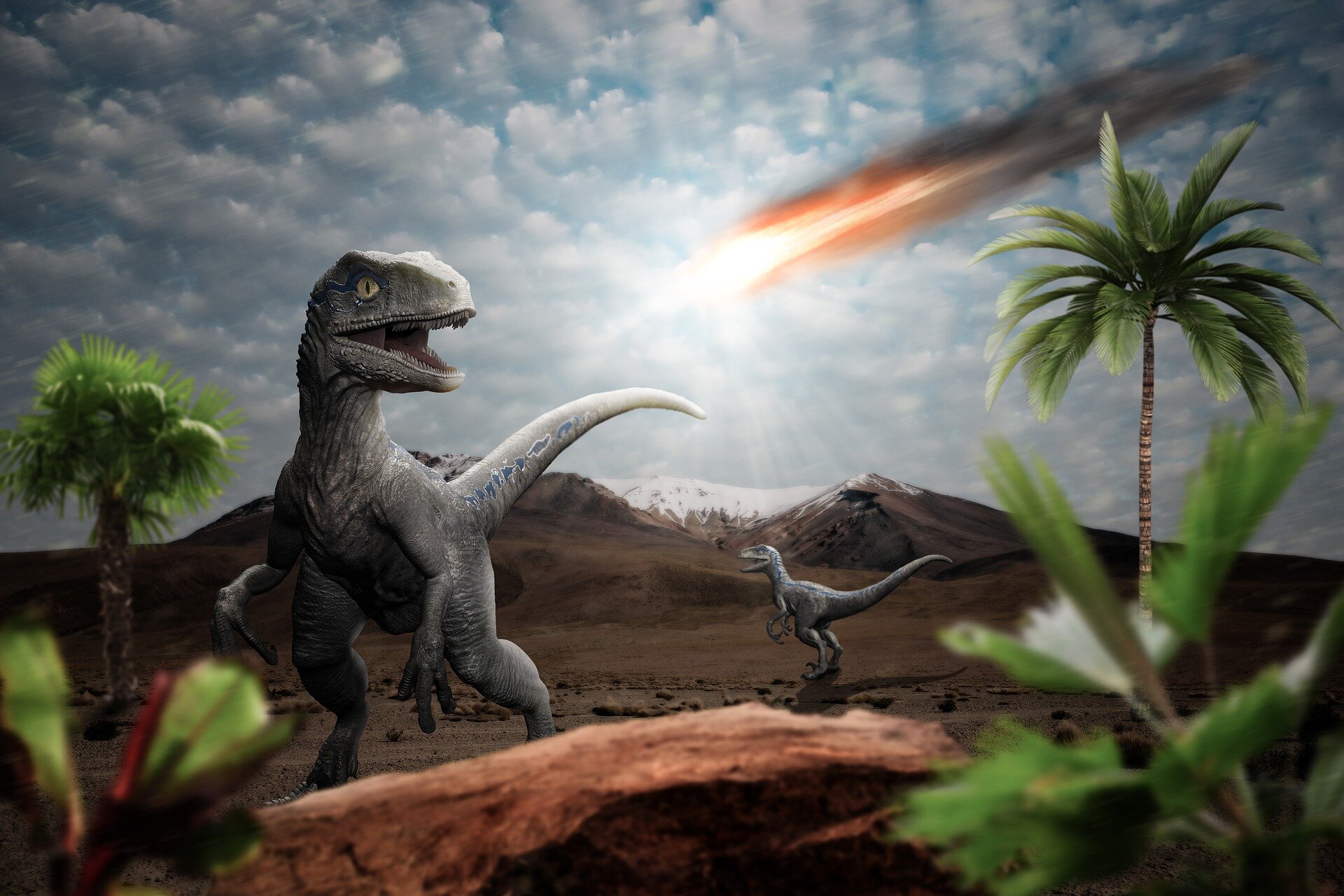
High above Earth, billions of tiny molten droplets were falling back through the atmosphere only hours after the asteroid impact that ended the age of the dinosaurs. As they slowed, they released enormous amounts of heat. Now, a new analysis argues that another, nearly invisible ingredient—vast quantities of fine dust suspended overhead—may have dramatically intensified that global heat pulse, increasing the likelihood of widespread wildfires and making the planet even more lethal for life on land.
For decades, scientists have debated exactly what killed so many species at the end of the Cretaceous Period around 66 million years ago. The impact that created the Chicxulub crater is widely accepted as the trigger for the mass extinction, but the specific mechanisms responsible for the deaths of terrestrial organisms have remained controversial.
One longstanding idea proposes that the asteroid’s ejecta produced an intense pulse of heat capable of scorching the planet and igniting fires. Yet later studies questioned whether the heat generated by material reentering Earth’s atmosphere was powerful enough to produce global wildfires or act as the primary cause of death on land.
The new study revisits that debate by combining impact modeling with evidence preserved in rocks at the Cretaceous–Paleogene (K–Pg) boundary. Rather than focusing only on the glowing spherules—tiny glassy droplets that condensed from the expanding impact plume—the researchers argue that a second component, fine silicate dust formed from vaporized rock, fundamentally changes how the atmosphere handled the returning heat.
Two kinds of debris took very different paths
Immediately after the asteroid impact, enormous amounts of rock were vaporized and blasted away from the growing crater. As this expanding cloud cooled, some of the material condensed into molten droplets roughly 250 micrometers across. These droplets eventually became glassy spherules preserved in K–Pg boundary deposits around the world.
Earlier work estimated that about 44% of the vaporized rock did not condense during this initial expansion because the plume expanded too rapidly. That left a large amount of uncondensed vapor that would also eventually return to Earth.
The researchers argue that both the spherules and the remaining vapor were launched globally on ballistic trajectories above the atmosphere. However, once they encountered Earth’s atmosphere, they no longer behaved the same way.
The heavier spherules continued traveling at high speed before slowing through aerodynamic drag, while the vapor decelerated much more quickly. This difference caused the two components to separate spatially rather than remaining mixed together.
To examine this process, the researchers developed a dimensionless “decoupling parameter” that compares how quickly spherules slow down relative to the thickness of the vapor layer surrounding Earth.
Using estimates appropriate for the Chicxulub impact, they calculated a decoupling value of 0.565. According to the study, that value indicates substantial separation between the falling spherules and the remaining rock vapor.
That distinction matters because it changes what ultimately happened to the uncondensed vapor.
Ancient rock layers preserve clues about what happened next
If the vapor separated from the spherules, it still had to cool and condense somehow.
The study argues that geological evidence increasingly points toward the formation of abundant fine silicate dust rather than simply producing another generation of similar-sized spherules.
One of the strongest pieces of evidence comes from the Tanis fossil site.
Fish buried there during the day of the impact contain spherules trapped inside their gills, indicating that these droplets were falling while the fish were still alive. Above that deposit lies another layer enriched in iridium—the extraterrestrial chemical signature associated with the impact—but this upper layer lacks spherules.
Instead, previous analyses identified abundant fine silicate dust with a median grain size of 2.88 micrometers.
The researchers interpret this sequence as evidence that the dust condensed later from the remaining vapor after the original spherules had already formed.
They also point to another expanded K–Pg boundary site in the Raton Basin, where meteoritic material appears to be confined to a fine dust layer deposited years to decades after the impact, providing additional support for the same interpretation.
At more distant K–Pg sites, the researchers propose that this fine dust became part of the clay matrix surrounding impact spherules that has long been observed in boundary deposits worldwide.
Tiny dust particles could have transformed the heat pulse
The importance of the dust is not simply that it existed.
According to the study, its optical properties would have dramatically altered how thermal radiation behaved during the hours after the impact.
Using estimates based on a globally averaged 3-millimeter layer of spherules, the researchers calculated that roughly 1.6 × 10¹⁵ kilograms of fine dust would ultimately have formed.
Assuming dust grains with a typical size of 2.88 micrometers and a density of 2,700 kilograms per cubic meter, they calculated an optical depth of approximately 620.
That value corresponds to an almost completely opaque layer, allowing essentially none of the upward thermal radiation to escape into space. The calculated transmittance for escaping radiation was approximately 10⁻²⁶⁸, effectively trapping the heat.
The study notes that another interpretation of the dust size distribution suggests even smaller typical grains around 0.125 micrometers. Under that assumption, the optical depth would increase to about 14,000, making the atmosphere even more opaque. Because of this, the researchers describe their estimate using the larger grain size as conservative.
Instead of allowing heat to radiate away into space, the dust would have reflected thermal radiation back toward Earth’s surface.
A hotter atmosphere could have made fires far more likely
Earlier computer simulations had already examined how reentering spherules heated the atmosphere. Those simulations also explored what would happen if an upper reflective layer trapped additional heat.
The new study argues that the geological evidence for abundant fine dust now makes that reflective scenario much more plausible.
Even with the extra trapped heat, the modeled radiation alone may still have been insufficient to ignite dry wood directly using conservative ignition thresholds discussed in previous work.
However, the researchers emphasize that the surface heat flux exceeds the ignition thresholds for grass, lichen, and pine needles.
Those fuels could then have started broader wildfires indirectly.
The authors also note that the radiation estimates remain conservative because they do not include heat contributed directly by the fine dust itself, even though the dust initially carried kinetic energy comparable to that of the reentering spherules.
Nor do the simulations account for uneven ejecta distribution, which could have produced locally higher heat fluxes, particularly closer to the impact site.
Taken together, the researchers argue that abundant fine dust substantially strengthens the case that widespread fires followed the Chicxulub impact.
The heat may have been deadly even without flames
The study also considers what such an intense heat pulse might have meant for animals living on land.
Because no direct measurements exist for the thermal tolerance of Cretaceous organisms, the researchers use studies of thermal radiation effects on humans only as a reference point.
Those studies indicate that exposure to 10 kilowatts per square meter for 150 seconds is completely lethal to humans.
According to the study’s calculations, when the effects of fine dust are included, terrestrial organisms would have experienced roughly 17 times that lethal thermal dose.
The authors therefore argue that the infrared heat pulse produced after the impact was likely fatal for non-sheltering terrestrial organisms, including relatively thick-skinned animals.
They suggest that dinosaurs may have suffered severe skin burns, while heat stroke could also have contributed to their deaths.
The work reshapes an ongoing debate rather than ending it
The study addresses a scientific question that has remained unsettled for years.
Some previous work argued that the heat pulse generated by reentering ejecta would not have been strong enough to ignite global fires, while other studies questioned whether ballistic transport of ejecta occurred on the required scale.
The authors contend that current impact simulations underestimate how much rock became part of the vapor plume because commonly used equations of state predict too little vaporization. By incorporating laboratory shock experiments, they estimate substantially more vaporized material than those simulations produce, bringing their calculations into closer agreement with the amount of globally distributed K–Pg ejecta preserved in the geological record.
The researchers also argue that recent discoveries from expanded K–Pg boundary sites provide independent geological evidence that abundant fine dust formed from the remaining vapor after the impact.
Even so, they acknowledge that further work is needed. They specifically point to additional studies of expanded K–Pg boundary sites, including detailed measurements of fine dust grain-size distributions, as an important way to test whether this globally distributed dust layer formed as their model proposes.
Within the scope of their analysis, however, the authors conclude that heat and fire produced by the Chicxulub impact—and greatly amplified by an atmosphere loaded with fine silicate dust—remain a compelling explanation for why so much non-sheltering life on land disappeared at the end of the Cretaceous.
More information
Heat and wildfires during the K-Pg mass extinction enhanced by fine dust, Journal of Geophysical Research Biogeosciences (2026). DOI: 10.1029/2026JG009837