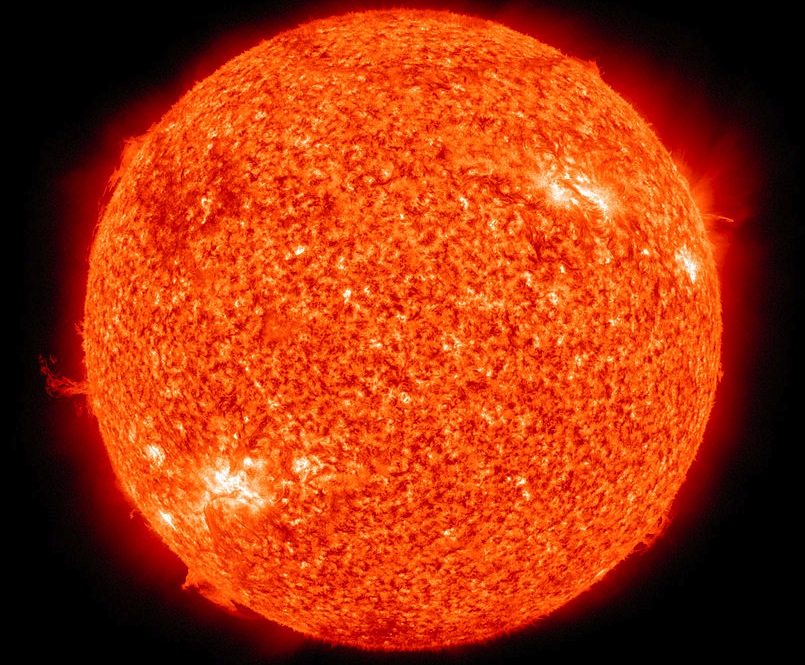
Every morning, the Sun rises without fail, filling the sky with light and warmth. It is so familiar that it is easy to forget just how extraordinary it is. This glowing star provides nearly all the energy that makes life on Earth possible. It drives our weather, powers photosynthesis in plants, shapes our climate, and keeps the entire Solar System together with its immense gravity.
But the Sun was not always there.
There was a time, more than 4.5 billion years ago, when our Solar System did not exist. There were no planets, no Moon, and certainly no Earth. Instead, there was only a vast, cold cloud of gas and dust drifting through our region of the Milky Way galaxy.
From that quiet cloud emerged a star that would eventually become the center of our cosmic neighborhood.
The story of how the Sun formed is one of gravity, heat, time, and the incredible power of nature. It is a story that scientists have pieced together through decades of observations, computer simulations, and studies of young stars forming elsewhere in our galaxy.
A Giant Cloud Floating Through Space
The Sun’s story began inside an enormous molecular cloud, sometimes called a stellar nursery.
These clouds are among the coldest places in the universe. Temperatures are often around −260°C (−436°F), only a few degrees above absolute zero. Despite their enormous size, they are surprisingly thin. Even the densest parts of these clouds contain far fewer particles than the air on Earth.
Most of the cloud consisted of hydrogen, the lightest and most abundant element in the universe. Smaller amounts of helium and tiny grains of dust were mixed throughout it.
For millions of years, this cloud drifted peacefully through the Milky Way.
Then something changed.
What Started the Collapse?
Scientists believe that some event disturbed part of the giant cloud, causing gravity to take over.
One leading idea is that a nearby supernova—a massive star exploding at the end of its life—sent powerful shock waves through space. As these shock waves traveled through the molecular cloud, they compressed parts of it.
Other possibilities include collisions between different clouds or the natural accumulation of enough material for gravity to become dominant.
Whatever the trigger, one region of the cloud became slightly denser than its surroundings.
That tiny difference changed everything.
Gravity began pulling more gas and dust toward the denser region. As more material gathered, the gravitational pull became stronger, attracting even more matter.
The collapse had begun.
Gravity Became the Master Builder
Gravity is one of the four fundamental forces of nature, and it played the leading role in creating the Sun.
As the cloud collapsed inward, countless particles moved closer together. The shrinking cloud became denser and denser.
As gravity squeezed the cloud, something remarkable happened.
The center began to heat up.
This may seem surprising, but it follows a basic law of physics. When gas is compressed, the particles collide more often and move faster, increasing the temperature.
The more gravity compressed the cloud, the hotter its center became.
Over hundreds of thousands of years, the cloud transformed from a cold, diffuse region into a glowing object that continued growing hotter and denser.
The Birth of a Protostar
Eventually, the collapsing cloud formed what astronomers call a protostar.
A protostar is not yet a true star.
Instead, it is a young object still gathering material from the surrounding cloud.
The growing protostar shone because of the heat generated by gravitational collapse, not because it was producing energy through nuclear fusion.
At this stage, the future Sun looked very different from the bright yellow star we know today.
It was wrapped in thick clouds of gas and dust that hid it from ordinary visible light. Modern telescopes that detect infrared radiation allow astronomers to observe similar young stars still forming throughout our galaxy.
These stellar nurseries provide valuable clues about our own Sun’s earliest years.
Why Did the Cloud Begin to Spin?
As the cloud collapsed, it also began spinning faster.
This happened because of a physical principle known as the conservation of angular momentum.
A familiar example is an ice skater. When the skater pulls in their arms, they spin faster without anyone pushing them.
The collapsing cloud behaved in much the same way.
As it shrank, its rotation speed increased.
Instead of remaining perfectly spherical, the cloud gradually flattened into a rotating disk surrounding the young protostar.
This spinning disk would eventually become the birthplace of the planets.
The Solar Nebula
The rotating disk surrounding the young Sun is called the solar nebula or protoplanetary disk.
It contained enormous amounts of gas, microscopic dust grains, and icy particles.
Inside this disk, countless tiny particles frequently collided.
Some collisions caused particles to stick together.
Small grains became larger clumps.
Those clumps became rocks.
The rocks collided to form larger bodies.
Over millions of years, these objects grew into planetesimals, then protoplanets, and eventually the planets we know today.
While the Sun was forming at the center, the entire Solar System was taking shape around it.
The Temperature Kept Rising
As gravity continued pulling material toward the center, the pressure inside the protostar became enormous.
Temperatures climbed into the millions of degrees.
Deep inside the core, hydrogen atoms were packed together under tremendous pressure.
Eventually, conditions became extreme enough for one of the most important processes in the universe to begin.
Nuclear fusion.
The Moment the Sun Truly Became a Star
Nuclear fusion marks the true birth of a star.
Inside the Sun’s core, hydrogen nuclei move at incredible speeds because of the intense heat.
Normally, positively charged hydrogen nuclei repel each other.
However, under the immense temperature and pressure in the core, some nuclei collide with enough energy to overcome this repulsion.
They fuse together to form helium.
A tiny amount of mass is converted into energy during this process, following Einstein’s famous equation:
E = mc²
This energy travels outward from the Sun’s core and eventually reaches space as light and heat.
Once nuclear fusion became self-sustaining, the young Sun officially entered the main sequence, the long and stable stage of a star’s life.
The Sun had truly been born.
How Long Did the Sun Take to Form?
The formation of the Sun was not a sudden event.
It was a slow process that unfolded over millions of years.
From the initial collapse of the molecular cloud to the beginning of sustained nuclear fusion, astronomers estimate that the Sun likely took somewhere between 10 million and 50 million years to fully develop.
Compared with the Sun’s current age of about 4.6 billion years, its birth happened relatively quickly.
The Young Sun Was Much More Active
The newborn Sun was not as calm as it is today.
Young stars are often extremely active.
They produce powerful stellar winds, intense magnetic fields, and frequent energetic eruptions.
The early Sun likely blasted surrounding space with streams of charged particles.
These powerful solar winds gradually swept away much of the remaining gas and dust from the protoplanetary disk.
This marked the end of the Sun’s formation and the beginning of a more stable Solar System.
How the Planets Formed Around the Sun
While the Sun dominated the center of the disk, leftover material continued evolving.
Close to the Sun, temperatures were extremely high.
Only metals and rocky materials could survive.
This region eventually produced Mercury, Venus, Earth, and Mars.
Farther away, temperatures were much lower.
Ice could remain solid, allowing much larger planetary cores to grow.
These massive cores captured enormous amounts of hydrogen and helium, forming Jupiter and Saturn.
Even farther out, Uranus and Neptune developed in the colder outer regions.
Countless smaller objects also remained, becoming asteroids, comets, and dwarf planets.
Everything in our Solar System shares this common origin.
How Scientists Know This Happened
No one witnessed the Sun forming.
Yet scientists have gathered overwhelming evidence supporting this picture.
Powerful telescopes observe young stars surrounded by protoplanetary disks throughout the Milky Way.
Some of these systems appear to be only a few million years old, offering snapshots of how stars and planets develop.
Computer simulations based on the laws of physics successfully recreate the processes of cloud collapse, disk formation, and stellar birth.
Meteorites also preserve clues from the earliest Solar System. Radiometric dating shows that many meteorites formed about 4.567 billion years ago, providing one of the most accurate estimates of the Solar System’s age.
Together, observations, laboratory measurements, and theoretical models create a remarkably consistent picture of the Sun’s origin.
The Sun Today
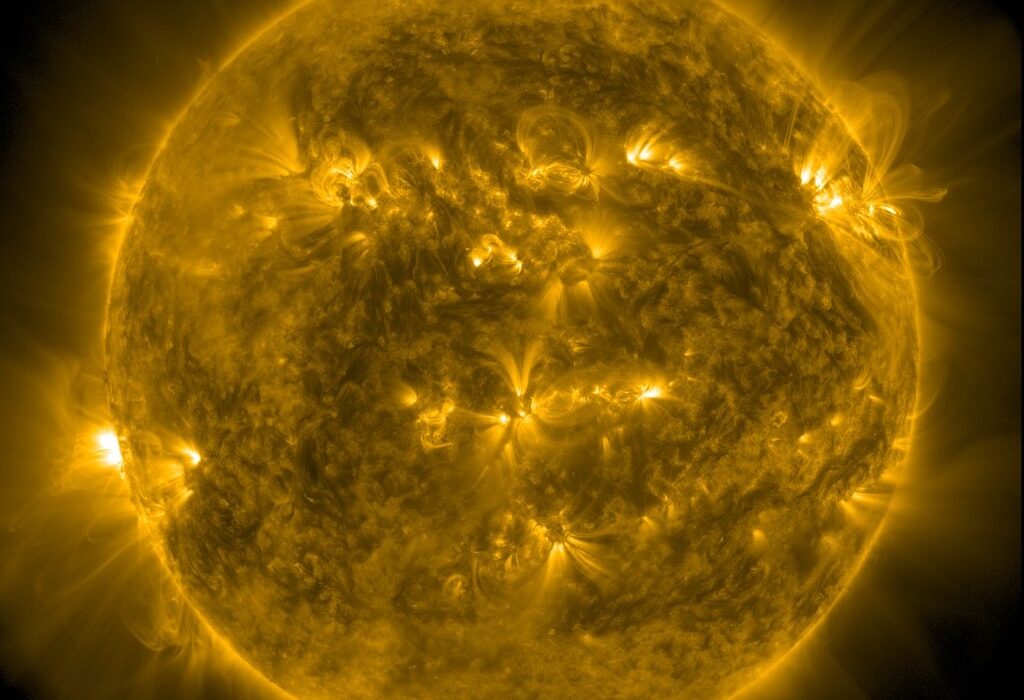
Today, the Sun is a stable G-type main-sequence star, often called a yellow dwarf.
It contains about 99.8% of all the mass in the Solar System.
Its diameter is about 1.39 million kilometers (864,000 miles).
Every second, the Sun converts roughly 600 million metric tons of hydrogen into helium through nuclear fusion.
This process releases an enormous amount of energy that radiates across space.
Only a tiny fraction of that energy reaches Earth, yet it is enough to power weather systems, drive ocean currents, support ecosystems, and make life possible.
The Sun has now spent about half of its expected main-sequence lifetime.
Astronomers estimate it will continue producing energy through hydrogen fusion for another 5 billion years before evolving into a red giant.
A Story Written in Gravity and Light
The Sun began as nothing more than a quiet cloud of gas and dust drifting through the Milky Way. Guided by gravity, shaped by the laws of physics, and fueled by nuclear fusion, that ordinary cloud transformed into the brilliant star that illuminates our world today.
Its birth also gave rise to the planets, the Moon, asteroids, comets, and ultimately Earth itself. Every atom in our bodies exists because stars like the Sun formed, lived, and enriched the universe with the ingredients needed for planets and life.
When you look at the Sun, you are seeing the result of a journey that began more than 4.6 billion years ago—a journey from a cold cloud in deep space to the life-giving star that continues to shine over our world. It is a reminder that even the brightest light in our sky had a humble beginning, born from the quiet power of gravity and the remarkable laws that govern the universe.