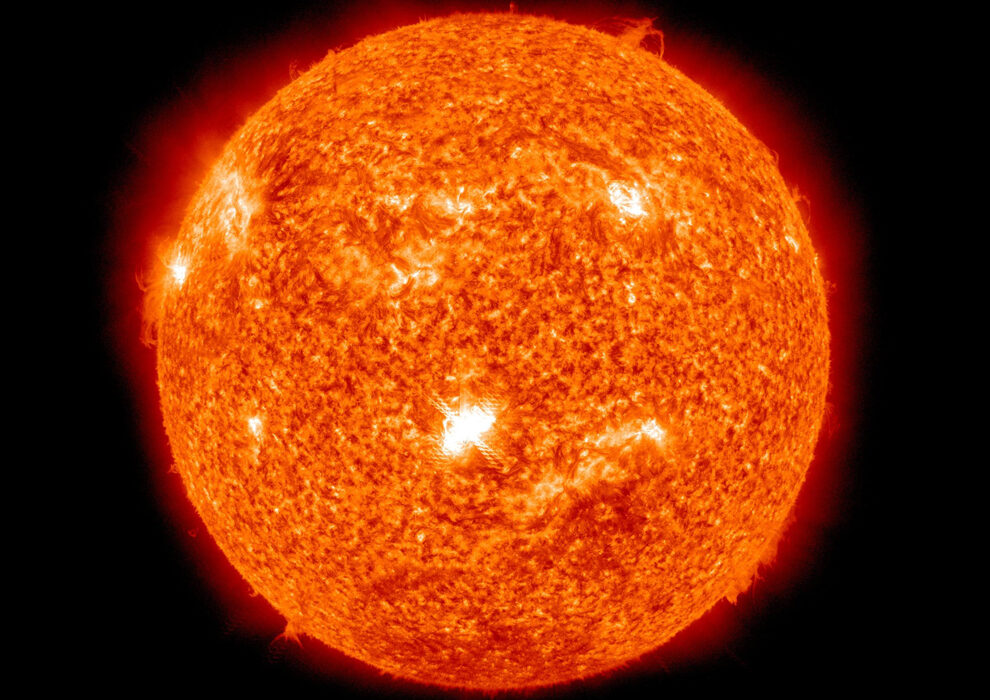
Every morning, the Sun rises above the horizon, filling the world with warmth and light. It feels familiar, almost ordinary. Yet the glowing surface we see is hiding an astonishing secret. The bright layer that shines across the Solar System is not actually a solid surface like the ground beneath our feet. Instead, it is a thin, glowing shell of hot gas called the photosphere.
The photosphere is the part of the Sun that our eyes see. It is where most of the Sun’s visible light escapes into space, making life on Earth possible. Every sunrise, every sunset, every shadow, and every ray of sunshine begins its journey from this remarkable layer.
Although it appears calm from millions of miles away, the photosphere is an incredibly active place where hot gases constantly move, magnetic fields twist and shift, and enormous dark sunspots can suddenly appear.
Understanding the photosphere helps us understand not only the Sun but also the countless other stars scattered across the universe.
What Does “Photosphere” Mean?
The word photosphere comes from two Greek words: photo, meaning “light,” and sphere, meaning “ball” or “globe.” Together, they describe the Sun’s “sphere of light.”
This name is fitting because the photosphere is the layer that produces nearly all the visible light we receive from the Sun. Without it, the Sun would not appear as the brilliant golden disk we see in the sky.
Although astronomers often call it the Sun’s “surface,” the photosphere is not a solid boundary. Instead, it is simply the depth where the Sun becomes transparent enough for light to escape into space.
Is the Photosphere Really the Sun’s Surface?
The answer is both yes and no.
When we look at the Sun through a properly filtered telescope, the photosphere appears to be a clear, well-defined surface. But if someone could somehow travel there, they would not find solid ground.
The entire Sun is made almost entirely of hot plasma—a state of matter in which atoms have been stripped of many of their electrons. Plasma behaves differently from solids, liquids, or gases because it is strongly influenced by magnetic fields.
The photosphere is simply the outermost layer of this glowing plasma where sunlight can finally leave the Sun without being repeatedly absorbed and scattered.
In other words, it is the visible “skin” of the Sun rather than a physical surface.
Where Is the Photosphere Located?
The photosphere sits between the Sun’s deeper interior and its outer atmosphere.
Below it lies the convection zone, where hot plasma rises toward the surface while cooler plasma sinks downward in giant circulating currents.
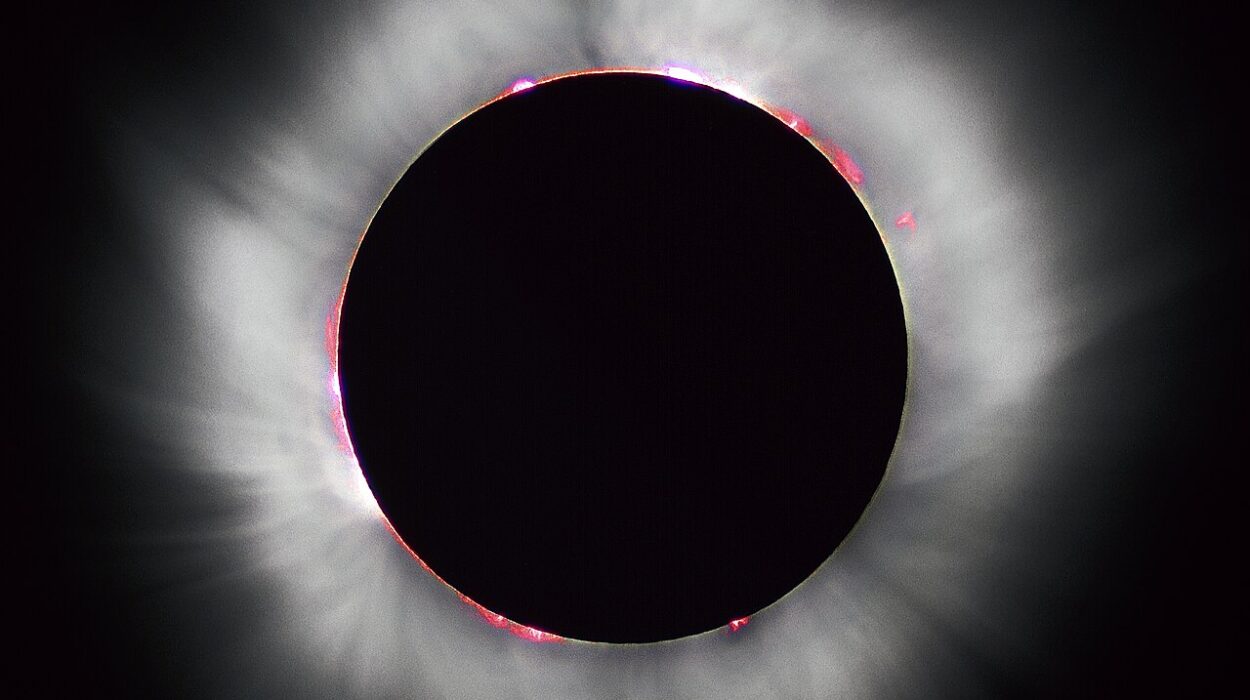
Above it are two much thinner layers known as the chromosphere and the corona. During a total solar eclipse, the Moon blocks the bright photosphere, allowing the faint chromosphere and the glowing white corona to become visible.
Although these upper layers stretch far into space, the photosphere remains the brightest part of the Sun.
How Thick Is the Photosphere?
Compared with the enormous size of the Sun, the photosphere is surprisingly thin.
It is roughly 500 kilometers (about 310 miles) thick. While that may sound enormous by Earthly standards, it is tiny compared with the Sun’s diameter of about 1.39 million kilometers (864,000 miles).
If the Sun were the size of a large beach ball, the photosphere would be thinner than the paint covering its surface.
This delicate layer is where the Sun’s visible appearance is created.
How Hot Is the Photosphere?
The photosphere is incredibly hot, but it is actually much cooler than the Sun’s core.
Its average temperature is about 5,500 degrees Celsius (9,900 degrees Fahrenheit), or roughly 5,800 kelvin.
At these temperatures, hydrogen and helium emit enormous amounts of visible light.
Interestingly, the temperature is not the same everywhere. Slight differences create brighter and darker regions across the Sun’s surface.
These temperature variations are important clues that help astronomers understand the Sun’s internal activity.
Why Does the Photosphere Shine?
The Sun generates its energy deep inside its core through nuclear fusion.
In the core, hydrogen atoms combine to form helium, releasing tremendous amounts of energy.
This energy begins an incredibly long journey outward.
Inside the dense interior, photons—the tiny particles of light—cannot travel freely. Instead, they are absorbed and re-emitted countless times by surrounding particles. A single photon may take tens of thousands to hundreds of thousands of years, or even longer in some models, to make its way from the core toward the outer layers because of this random, indirect journey.
Once the energy reaches the photosphere, however, the plasma becomes much less dense. Here, photons can finally escape into space.
Only about 8 minutes and 20 seconds later, some of those photons arrive at Earth, lighting our skies and warming our planet.
The Photosphere Is Always Moving
From a distance, the Sun looks peaceful.
Up close, the photosphere is constantly changing.
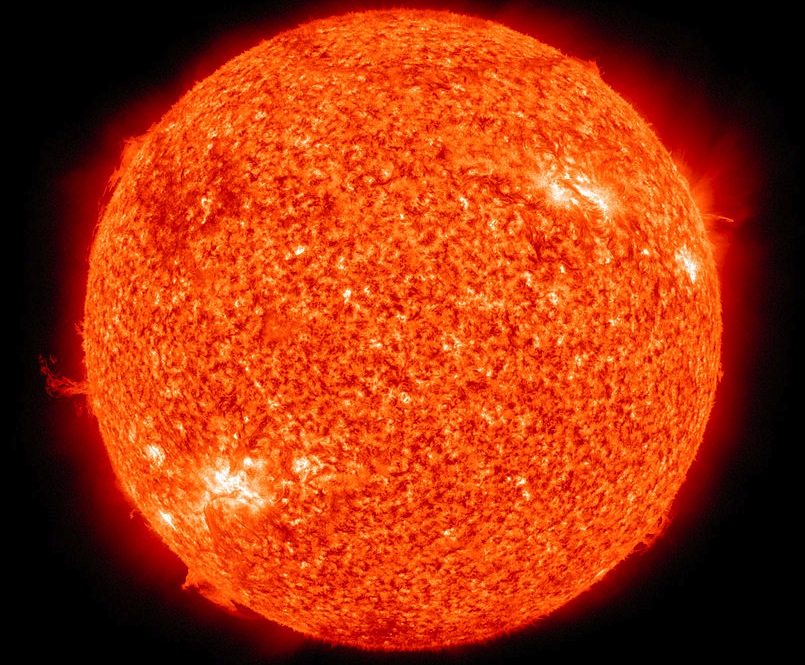
Hot plasma rises from below, cools as it reaches the surface, and then sinks again. This continuous movement creates a pattern called granulation.
Under powerful telescopes, the Sun appears covered with millions of tiny bright cells separated by darker boundaries.
Each granule is a bubble of hot plasma rising upward.
Most granules are about 1,000 kilometers (620 miles) across, making each one larger than many countries on Earth.
They usually last only a few minutes before disappearing and being replaced by new ones.
This endless bubbling gives the Sun a surface that is always alive with motion.
What Are Sunspots?
One of the most fascinating features of the photosphere is the appearance of sunspots.
Sunspots look dark because they are cooler than the surrounding photosphere.
While the nearby surface is about 5,500°C, the centers of sunspots are often around 3,500–4,500°C. Even at these “cooler” temperatures, they would glow brighter than almost anything on Earth. They only appear dark because the surrounding photosphere is much brighter.
Sunspots form where powerful magnetic fields interfere with the normal flow of heat rising from inside the Sun.
Some sunspots are larger than Earth.
They may exist for days or even several months before fading away.
The number of sunspots changes over an approximately 11-year solar cycle, reflecting changes in the Sun’s magnetic activity.
Tiny Bright Features on the Photosphere
Not every feature on the photosphere is dark.
Astronomers also observe small bright regions known as faculae.
These bright patches often appear near sunspots and become especially noticeable near the Sun’s edge.
Faculae are associated with strong magnetic fields that allow slightly hotter material to become visible.
Although they are less dramatic than sunspots, they play an important role in understanding the Sun’s changing brightness.
How Scientists Study the Photosphere
Because looking directly at the Sun can permanently damage eyesight, astronomers use specially designed solar telescopes with carefully engineered filters.
These instruments safely reveal the remarkable details of the photosphere.
Space missions have transformed our understanding even further.
Spacecraft such as NASA’s Solar Dynamics Observatory (SDO) continuously monitor the Sun, capturing high-resolution images of the photosphere every day.
Other missions, including the Parker Solar Probe and the Solar Orbiter, study the Sun from closer distances than ever before, helping scientists understand how activity on the photosphere affects the rest of the solar atmosphere.
Together, ground-based observatories and spacecraft allow researchers to watch the Sun almost continuously.
Why the Photosphere Matters to Earth
The photosphere does much more than make the Sun visible.
It provides nearly all the energy that supports life on Earth.
Plants use sunlight from the photosphere to perform photosynthesis, producing oxygen and forming the foundation of nearly every food chain.
The warmth from the Sun drives Earth’s weather, ocean currents, and climate.
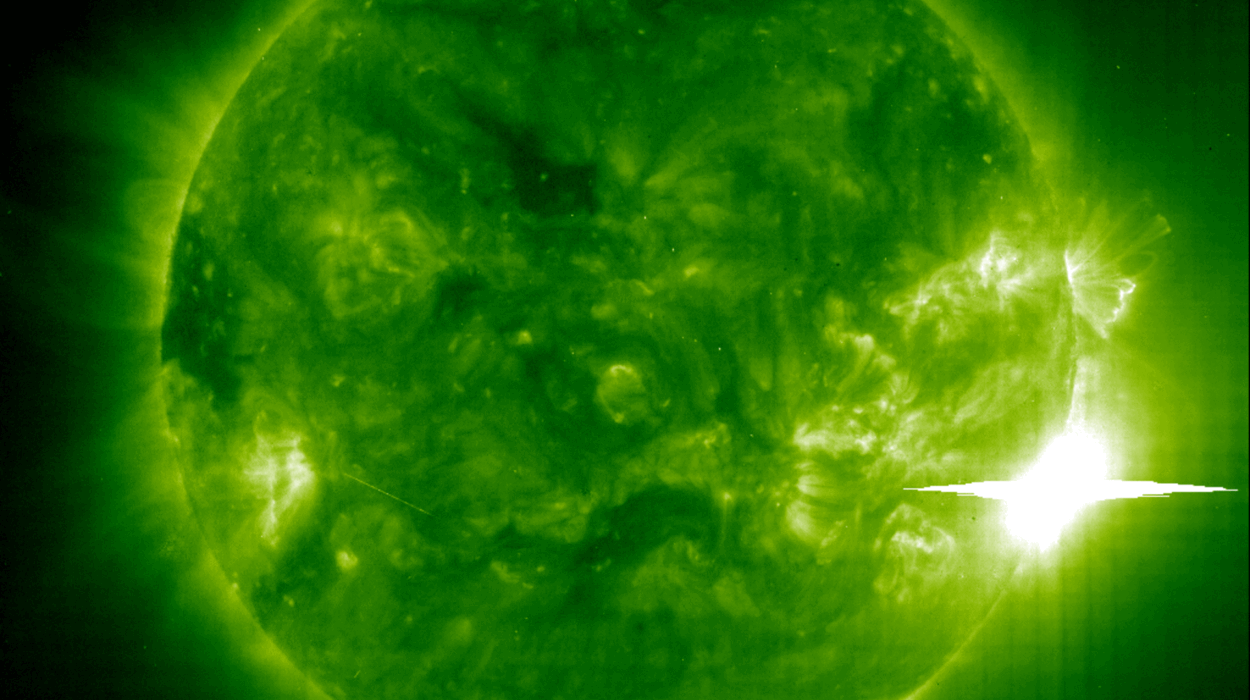
Activity in the photosphere is also linked to solar flares and coronal mass ejections. These powerful events are driven by the Sun’s magnetic field and can affect satellites, radio communications, GPS systems, and electrical power grids when directed toward Earth.
By studying the photosphere, scientists improve space weather forecasting, helping protect astronauts, spacecraft, and modern technology.
The Photosphere Is Not Unique to Our Sun
The Sun is only one star among hundreds of billions in the Milky Way.
Other stars also have photospheres.
When astronomers measure a star’s temperature, color, or brightness, they are usually studying light coming from its photosphere.
Different stars have different photosphere temperatures.
Cool red stars may have photospheres around 3,000°C, giving them a reddish appearance.
Hot blue stars can have photospheres exceeding 30,000°C, making them shine with a brilliant blue-white color.
By analyzing the light from a star’s photosphere, scientists can determine its chemical composition, temperature, motion, size, and even estimate its age.
What Can Light from the Photosphere Reveal?
The sunlight reaching Earth carries an incredible amount of information.
When astronomers pass this light through an instrument called a spectrograph, it spreads into a rainbow of colors known as a spectrum.
Dark absorption lines appear where specific elements in the photosphere absorb certain wavelengths of light.
Each chemical element leaves its own unique pattern.
By studying these spectral lines, scientists know that the Sun is made primarily of hydrogen and helium, along with small amounts of many heavier elements such as oxygen, carbon, iron, calcium, and sodium.
The same technique is used to study stars throughout the universe.
The Photosphere and Solar Eclipses
A total solar eclipse offers one of the few opportunities to glimpse the Sun’s outer atmosphere.
As the Moon gradually covers the photosphere, the sky darkens dramatically.
Just before and after totality, sunlight shining through valleys on the Moon’s edge creates brilliant flashes called Baily’s beads.
For a brief moment, the final bright flash forms the famous diamond ring effect.
Once the photosphere is completely hidden, the faint chromosphere and the ghostly white corona become visible.
These breathtaking sights remind us that the bright photosphere usually overwhelms everything around it.
A Thin Layer with an Enormous Role
The photosphere may be only a few hundred kilometers thick, but its importance is almost impossible to overstate.
It is the layer where sunlight begins its final journey across space. It powers Earth’s climate, fuels photosynthesis, provides the energy that supports nearly every ecosystem, and allows astronomers to study the Sun and distant stars.
Behind its golden glow lies a world of bubbling plasma, powerful magnetic fields, and ever-changing patterns that reveal the dynamic nature of our nearest star.
Every ray of sunshine that reaches your face has traveled from the photosphere—a thin, brilliant layer that connects our everyday lives to the extraordinary physics of the Sun and the vast universe beyond.