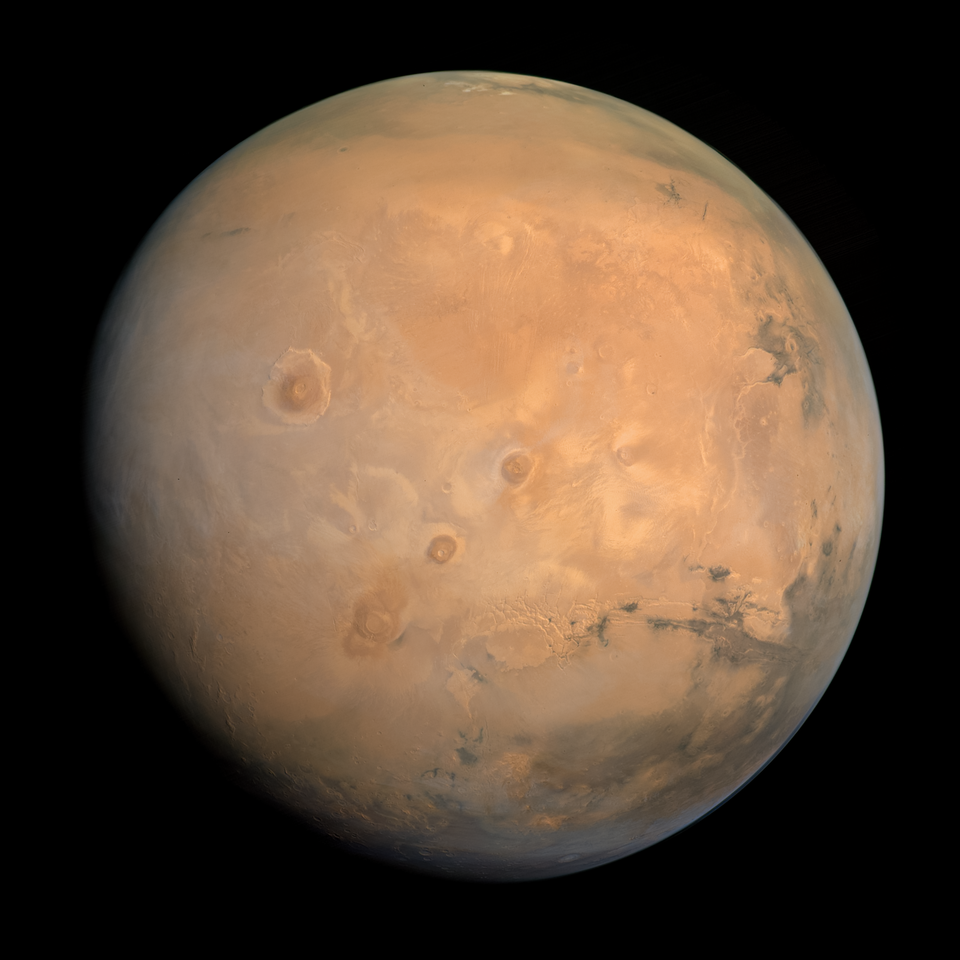
For centuries, Mars has fascinated humanity. Its reddish glow in the night sky inspired myths, legends, and dreams of another world. Today, thanks to powerful telescopes, orbiting spacecraft, and robotic rovers, we know Mars better than ever before. We have seen its towering volcanoes, enormous canyons, ancient river valleys, and frozen polar ice caps. We have even heard the whisper of Martian winds through the microphones of NASA’s Perseverance rover.
Yet despite being one of Earth’s closest planetary neighbors, Mars is an incredibly cold world.
Imagine stepping onto the Martian surface. Even on what might be considered a relatively warm afternoon near the equator, the air would still feel bitterly cold. As night falls, temperatures would plunge to levels far below those experienced in Earth’s coldest places. Water would freeze almost instantly, and without specialized protective equipment, no human could survive.
Why is Mars so cold? After all, it receives sunlight from the same Sun that warms Earth. The answer lies in a fascinating combination of distance, atmosphere, size, geological history, and the way planets store and lose heat.
Understanding why Mars is cold also helps scientists understand Earth’s climate, the evolution of planets, and the possibility of life elsewhere in the universe.
Mars Is Farther From the Sun
The most obvious reason Mars is colder than Earth is its greater distance from the Sun.
Earth orbits the Sun at an average distance of about 150 million kilometers (93 million miles). Mars, meanwhile, orbits at an average distance of about 228 million kilometers (142 million miles).
That extra distance makes an enormous difference.
The intensity of sunlight decreases rapidly with distance. Because Mars is farther away, it receives only about 43 percent as much solar energy per square meter as Earth.
Imagine moving farther away from a campfire. The fire remains just as hot, but you feel much less warmth because less heat reaches you. The same principle applies to planets orbiting the Sun.
With less incoming solar energy, Mars naturally begins at a colder temperature than Earth.
A Thin Atmosphere Cannot Hold Heat
Distance from the Sun is only part of the story.
One of the biggest reasons Mars is so cold is its incredibly thin atmosphere.
Earth’s atmosphere is thick enough to trap heat efficiently. It acts like a giant insulating blanket, helping keep daytime warmth from escaping too quickly into space.
Mars has almost no such blanket.
Its atmosphere is about 95 percent carbon dioxide, but despite carbon dioxide being a greenhouse gas, the atmosphere is extremely thin—less than 1 percent of Earth’s average surface atmospheric pressure.
Because there is so little gas surrounding the planet, very little heat is retained.
During the day, sunlight warms the ground.
As soon as the Sun sets, however, that heat escapes rapidly into space.
This is why temperatures on Mars change dramatically between day and night.
Near the equator, daytime temperatures during summer can briefly rise to around 20°C (68°F), but after sunset they often fall below –70°C (–94°F).
Such enormous daily temperature swings are almost impossible on Earth because our thicker atmosphere stores heat much more effectively.
Mars Has a Weak Greenhouse Effect
Earth remains comfortably warm largely because of its greenhouse effect.
Certain gases in Earth’s atmosphere—including water vapor, carbon dioxide, methane, and others—absorb some of the infrared radiation emitted by Earth’s surface and re-radiate part of that energy, slowing the escape of heat into space.
Mars has carbon dioxide too.
So why doesn’t it stay warm?
The answer is simple.
There is not enough atmosphere.
Although carbon dioxide dominates the Martian atmosphere, the atmosphere itself contains so little gas that its greenhouse effect is relatively weak. It raises the planet’s average temperature only modestly.
Without a strong greenhouse effect, most of the heat Mars receives during the day quickly disappears into space.
Mars Is Smaller Than Earth
Planetary size also plays an important role.
Mars has only about half Earth’s diameter and roughly one-tenth of Earth’s mass.
Smaller planets cool more quickly than larger ones.
A useful comparison is a cup of hot coffee and a large pot of soup.
The small cup loses heat much faster than the large pot because it contains less total thermal energy.
Similarly, Mars lost much of its internal heat earlier in its history.
Today, Mars is far less geologically active than Earth.
Its interior produces much less heat, and the planet cannot replenish warmth near the surface as effectively.
Although internal heat contributes only a small fraction of a planet’s surface temperature compared with sunlight, the cooling of Mars had profound effects on its long-term evolution.
Mars Lost Much of Its Magnetic Field
Billions of years ago, Mars appears to have been very different.
Evidence from orbiters and rovers suggests that rivers flowed across its surface, lakes existed, groundwater circulated underground, and perhaps even oceans covered parts of the northern hemisphere.
Many scientists believe early Mars had a thicker atmosphere capable of supporting warmer conditions.
One major reason this atmosphere disappeared is the loss of Mars’ global magnetic field.
Earth’s magnetic field is generated by the movement of molten iron in its outer core. It acts as a protective shield, deflecting much of the charged particle stream flowing outward from the Sun, known as the solar wind.
Mars once likely had a similar global magnetic field.
However, because the planet cooled relatively quickly, its internal dynamo shut down billions of years ago.
Without this magnetic shield, the solar wind gradually stripped away much of Mars’ upper atmosphere.
Over immense spans of time, the atmosphere became thinner and thinner.
As the atmosphere diminished, the greenhouse effect weakened, causing temperatures to fall even further.
Spacecraft observations, including measurements by NASA’s MAVEN mission, have shown that the solar wind continues to remove atmospheric particles from Mars today, although at a much slower rate than during the planet’s early history.
Little Water Means Less Heat Storage
Water is remarkably effective at storing heat.
Earth’s oceans absorb enormous amounts of solar energy during the day and release that heat gradually over time.
This moderates temperatures and prevents extreme swings between day and night.
Mars has almost no liquid water on its surface today.
Most of its water exists as ice beneath the ground or frozen within the polar ice caps.
Without vast oceans acting as thermal reservoirs, Mars heats and cools much more rapidly than Earth.
This contributes to the planet’s dramatic temperature variations.
The Surface Reflects Some Sunlight
Not all sunlight that reaches Mars is absorbed.
Some is reflected back into space.
The fraction of incoming sunlight reflected by a planet is called its albedo.
Mars has a moderate albedo, meaning it reflects a portion of the sunlight that falls on it.
Bright dust, clouds, and the polar ice caps all contribute to this reflection.
Although Mars absorbs enough sunlight to warm its surface somewhat during the day, the combination of limited solar energy and rapid nighttime heat loss keeps average temperatures extremely low.
Dust Changes the Climate
Mars is famous for its dust.
Fine reddish dust covers much of the planet.
Sometimes local dust storms grow into massive global storms that can envelop nearly the entire planet for weeks.
Dust has complex effects on Martian temperatures.
Suspended dust absorbs and scatters sunlight.
During large dust storms, less sunlight reaches the surface during the day, which can reduce daytime warming in some regions.
At the same time, dust suspended high in the atmosphere can absorb heat and alter atmospheric circulation, making certain layers of the atmosphere temporarily warmer.
Overall, however, these effects do not significantly change Mars’ long-term average climate.
The planet remains cold.
Carbon Dioxide Freezes at the Poles
One of the most unusual features of Mars is that part of its atmosphere actually freezes.
During winter at each pole, temperatures become so low that carbon dioxide gas condenses directly into solid dry ice.
Seasonal layers of frozen carbon dioxide accumulate over the polar ice caps.
When spring returns, sunlight causes the dry ice to sublimate, changing directly back into gas.
This seasonal freezing and thawing causes measurable changes in the atmospheric pressure across the entire planet.
Earth has nothing quite like this because our atmosphere is dominated by nitrogen and oxygen, which remain gaseous under normal Earth conditions.
The Average Temperature on Mars
The average surface temperature on Mars is about –63°C (–81°F).
However, temperatures vary enormously depending on location, season, time of day, elevation, and weather.
Near the equator during summer afternoons, temperatures can briefly climb above the freezing point of water.
At night, those same locations often become colder than Antarctica’s coldest winter days.
Near the poles during winter, temperatures can fall below –125°C (–193°F), making Mars one of the coldest places in the Solar System among the terrestrial planets.
Could Mars Ever Become Warmer?
Scientists have long wondered whether Mars could someday become warmer.
Some researchers have explored the idea of terraforming—altering a planet’s environment to make it more suitable for life.
In theory, increasing greenhouse gases could raise temperatures.
However, current scientific evidence suggests that Mars does not contain enough easily accessible carbon dioxide to produce an Earth-like atmosphere.
Even if all known carbon dioxide trapped in the polar caps and surface rocks were released, studies indicate it would still fall far short of creating a thick, warm atmosphere comparable to Earth’s.
With present-day technology, transforming Mars into a warm, habitable world remains far beyond our capabilities.
Was Mars Once Warmer?
One of the most exciting discoveries in planetary science is that ancient Mars appears to have been much wetter than it is today.
Orbiting spacecraft have photographed dried river channels stretching for hundreds of kilometers.
Rovers have found sedimentary rocks that formed in ancient lakes.
Minerals requiring long-term interaction with liquid water have been identified across many regions.
These discoveries strongly suggest that billions of years ago Mars had a thicker atmosphere and a climate capable of supporting stable liquid water on its surface for extended periods.
Exactly how warm ancient Mars became, and for how long, remains an active area of scientific research.
Understanding this ancient climate could reveal whether microbial life ever emerged there.
How Cold Mars Affects Future Human Missions
The intense cold of Mars presents one of the greatest challenges for future astronauts.
Habitats will require excellent insulation.
Space suits must protect explorers from freezing temperatures while allowing freedom of movement.
Machines and vehicles must be designed to operate through severe cold, where ordinary lubricants, batteries, and electronics can fail.
Water supplies will need protection from freezing, and energy systems must continue functioning during long, cold nights and powerful dust storms.
Every planned mission to Mars must account for its unforgiving climate.
What Mars Teaches Us About Earth
Studying Mars helps scientists appreciate just how special Earth is.
Earth’s distance from the Sun places it within the Solar System’s habitable zone, where temperatures allow liquid water to exist over much of the planet.
Our thick atmosphere traps enough heat to maintain a relatively stable climate.
Earth’s oceans store enormous amounts of thermal energy, reducing extreme temperature swings.
Its magnetic field protects the atmosphere from much of the solar wind.
Its active geology continuously reshapes the planet and helps regulate long-term carbon cycling.
Mars reminds us that even planets that once shared similarities can evolve along dramatically different paths.
Conclusion
Mars is cold because several powerful factors work together. It lies farther from the Sun than Earth, receives much less solar energy, possesses an extremely thin atmosphere that cannot retain heat effectively, has only a weak greenhouse effect, lacks vast oceans to store warmth, and lost the global magnetic field that once helped protect its atmosphere. Over billions of years, these processes transformed what may once have been a wetter, milder world into the frozen desert we see today.
Yet Mars remains one of the most fascinating planets in our Solar System. Beneath its icy surface and windswept landscapes lies a record of planetary evolution that continues to challenge and inspire scientists. Every new mission reveals another piece of its story, bringing us closer to understanding not only why Mars became so cold, but also how planets change over time—and what makes Earth such an extraordinary place to call home.