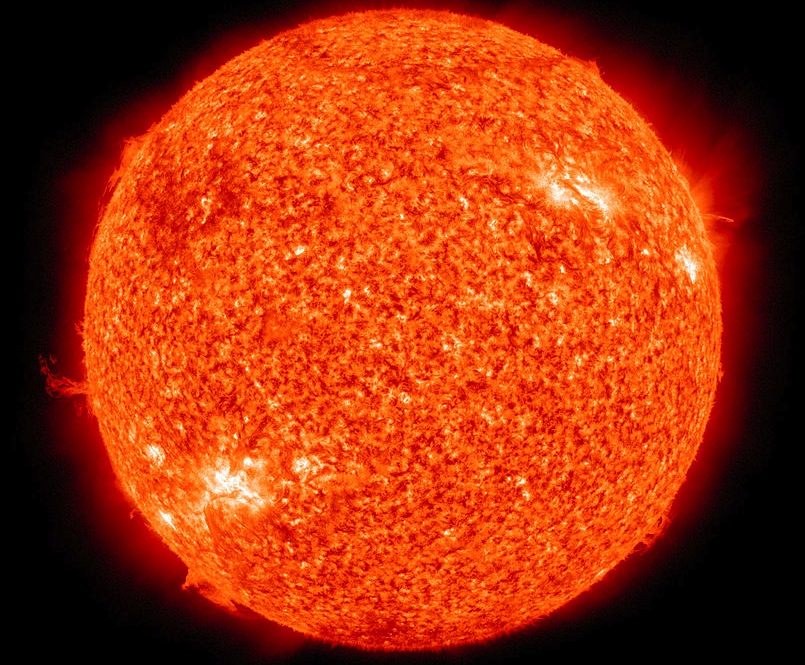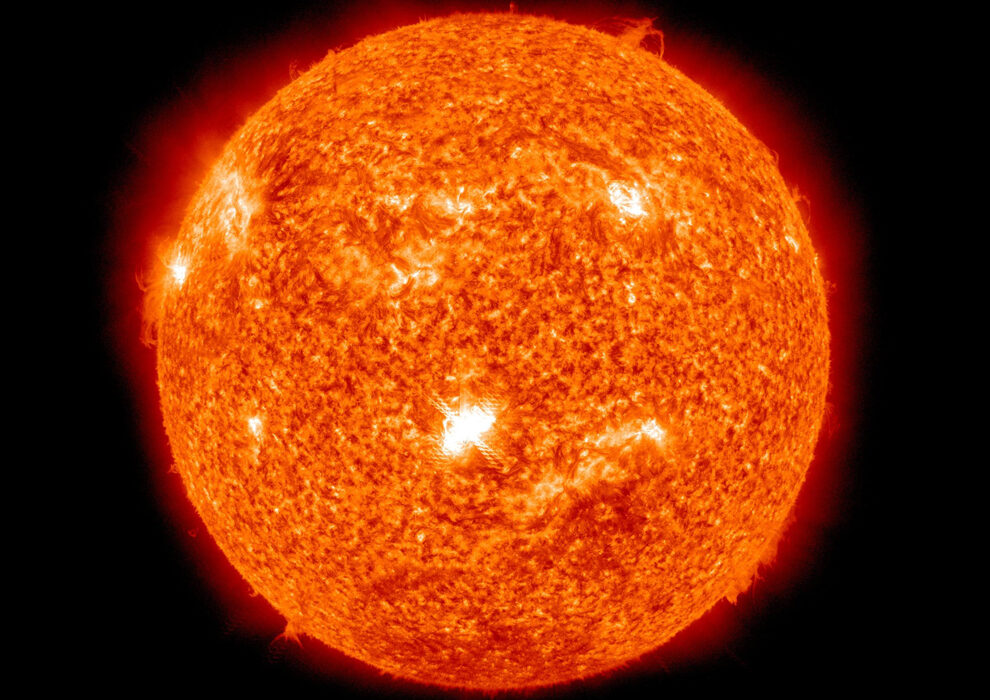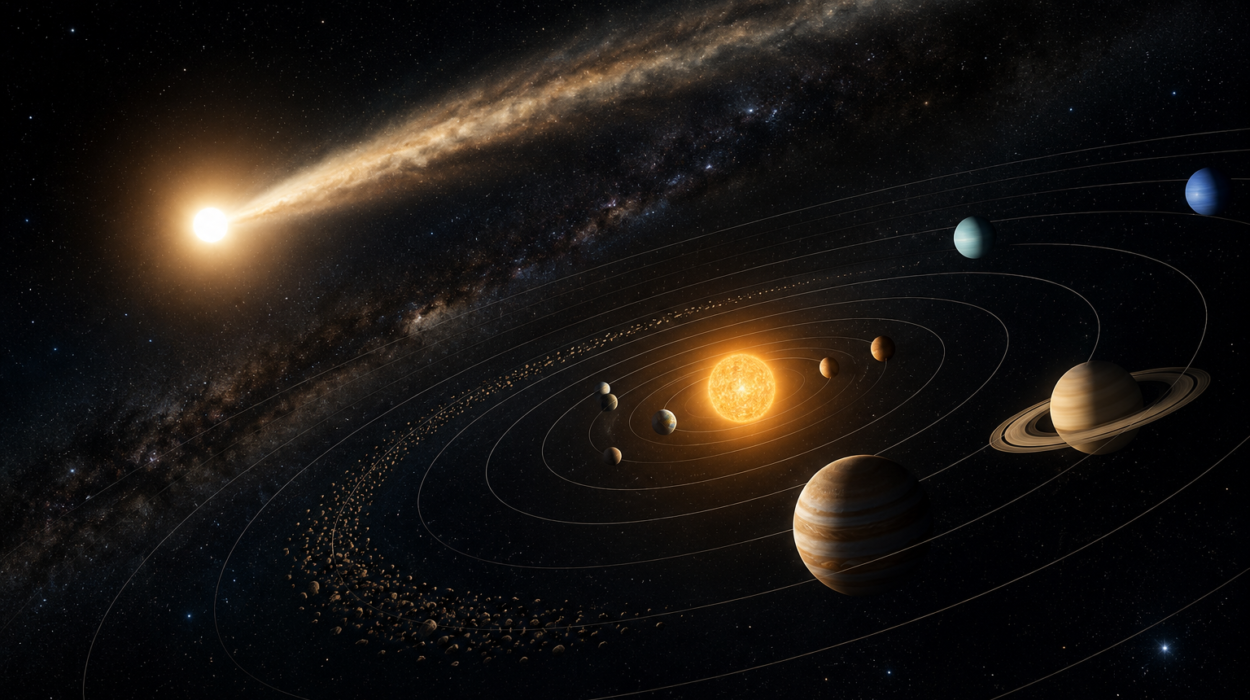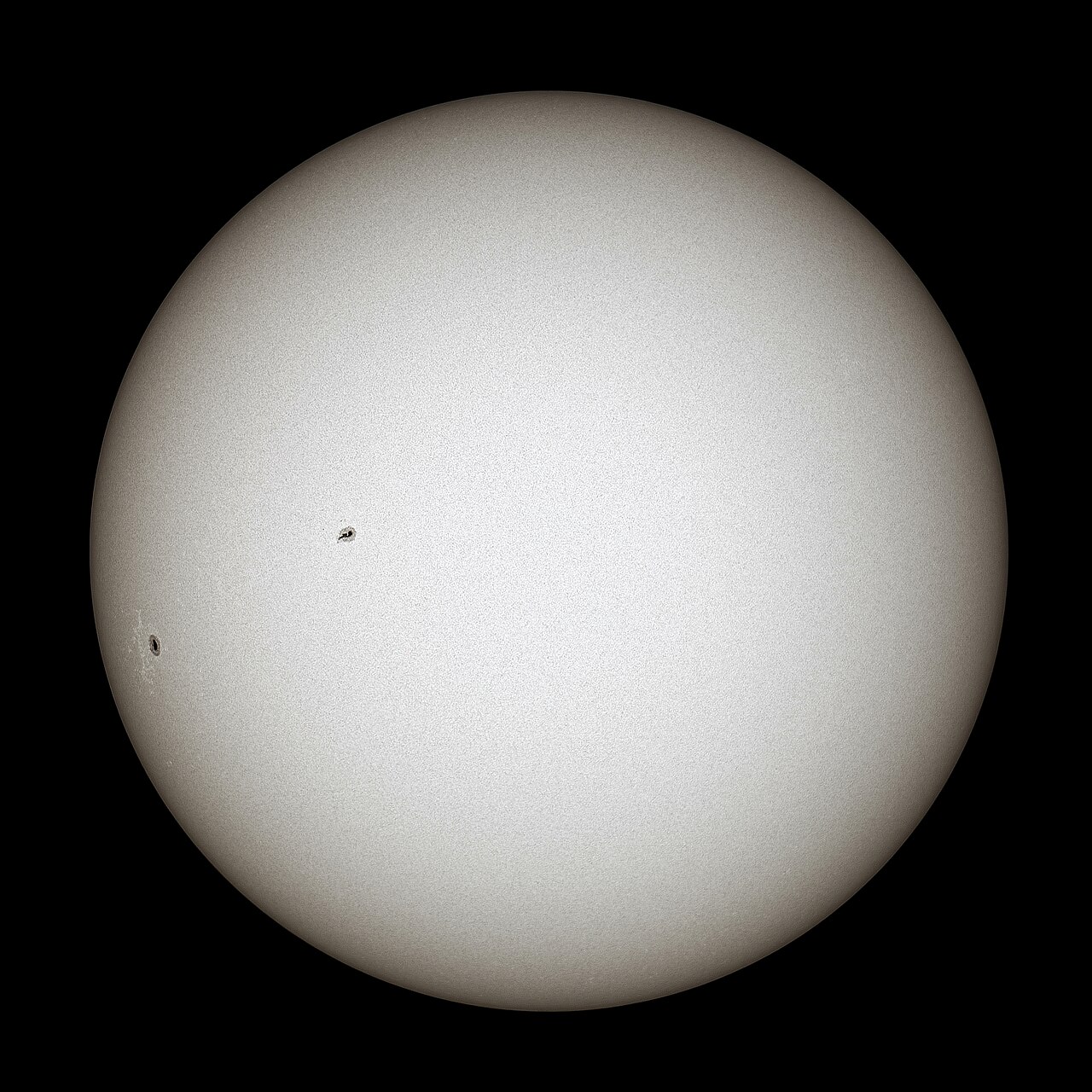
Every morning, the Sun rises as if it has always been there. It lights our skies, warms our planet, and makes life on Earth possible. For billions of people throughout history, it has been a symbol of life, hope, and renewal. Yet behind its familiar golden glow lies an astonishing story that stretches back billions of years—long before Earth existed and long before the first living organism appeared.
One of the most fascinating questions in astronomy is surprisingly simple: How old is the Sun?
The answer takes us on a journey through the birth of our Solar System, the lives of stars, and the future of our own cosmic neighborhood. Thanks to decades of scientific research, astronomers can now answer this question with remarkable precision.
The Sun Is About 4.6 Billion Years Old
Scientists estimate that the Sun is approximately 4.6 billion years old. More specifically, its age is about 4.57 billion years.
This number is not a rough guess. It is based on multiple lines of scientific evidence, including the ages of the oldest meteorites, computer models of stellar evolution, and our understanding of how stars form.
Although no human has witnessed the birth of the Sun, scientists have gathered enough evidence to reconstruct its history with extraordinary confidence.
To appreciate just how old the Sun is, consider this: if the Sun’s entire lifetime were compressed into a single calendar year, human civilization would appear only during the final few seconds before midnight on December 31.
How Scientists Know the Sun’s Age
Unlike a tree, the Sun does not have rings that reveal its age. Instead, astronomers use indirect but highly reliable methods to determine when it formed.
The most important evidence comes from ancient meteorites.
Meteorites are pieces of rock left over from the formation of the Solar System. Many have remained largely unchanged for billions of years, preserving a record of events that occurred when the Sun and planets were born.
Scientists analyze tiny radioactive elements trapped inside these rocks. Certain radioactive isotopes decay into other elements at predictable rates, acting like natural clocks. By measuring how much of the original material remains compared with the decay products, researchers can determine the age of the meteorite.
The oldest meteorites consistently date to about 4.57 billion years, indicating that the Solar System—and therefore the Sun—formed around the same time.
This technique, known as radiometric dating, has been tested extensively and is one of the most reliable methods in modern science.
Before the Sun Was Born
The Sun did not always exist.
More than 4.6 billion years ago, our Solar System was nothing more than a vast cloud of gas and dust drifting through the Milky Way Galaxy.
This enormous cloud, called a molecular cloud, consisted mostly of hydrogen and helium, along with tiny amounts of heavier elements produced by earlier generations of stars.
Something disturbed this quiet cloud. It may have been the shock wave from a nearby supernova or the gravitational influence of neighboring stars.
As gravity took over, the cloud began collapsing inward.
Over time, the collapsing material formed a dense, spinning center that would eventually become the Sun.
Around this growing young star, the remaining gas and dust flattened into a rotating disk. Within this disk, tiny particles collided, stuck together, and gradually built the planets, moons, asteroids, and comets we know today.
The birth of the Sun and the formation of the Solar System were part of the same extraordinary event.
The Moment the Sun Became a Star
During its early stages, the young Sun was known as a protostar.
As gravity pulled more material inward, the temperature and pressure at its center rose dramatically.
Eventually, the core became so hot—reaching about 15 million degrees Celsius (27 million degrees Fahrenheit)—that hydrogen atoms began fusing together to form helium.
This process, called nuclear fusion, released enormous amounts of energy.
At that moment, the Sun officially became a true star.
The outward pressure produced by fusion balanced the inward pull of gravity, creating a stable star capable of shining steadily for billions of years.
The sunlight reaching Earth today is powered by the same nuclear fusion that began more than 4.5 billion years ago.
The Sun Is Middle-Aged
Although the Sun seems ancient, it is actually considered a middle-aged star.
Stars spend most of their lives converting hydrogen into helium in their cores. Astronomers call this long period the main sequence.
The Sun has already spent about 4.6 billion years in this stage.
Scientists estimate it will remain a main-sequence star for roughly another 5 billion years.
In other words, our star is approximately halfway through the longest phase of its life.
This stability has been incredibly important for Earth.
A star that changed dramatically every few million years would make the evolution of complex life extremely difficult. Instead, the Sun has provided a relatively steady source of energy over billions of years, allowing life to emerge and flourish.
Has the Sun Always Been the Same?
Although the Sun has remained remarkably stable, it has not been completely unchanged.
When it first entered the main sequence, it was actually dimmer than it is today.
Astronomers estimate the young Sun produced only about 70 percent of its current brightness.
Over billions of years, the Sun has gradually become brighter as changes inside its core slowly altered the balance between gravity and nuclear fusion.
This increase happens so gradually that humans cannot notice it during a lifetime.
In fact, the Sun becomes roughly 10 percent brighter every billion years.
Despite these slow changes, the Sun has remained stable enough to support life on Earth for an incredibly long time.
How the Sun Produces Its Energy
Every second, the Sun performs an astonishing feat of physics.
Deep inside its core, hydrogen nuclei collide under enormous pressure and temperature.
Through nuclear fusion, these hydrogen atoms combine to create helium.
During this process, a tiny amount of mass is converted directly into energy according to Albert Einstein’s famous equation:
E = mc²
The result is extraordinary.
Every second, the Sun converts about 600 million metric tons of hydrogen into helium.
Around 4 million metric tons of mass are transformed directly into energy every second.
That energy travels outward through the Sun before eventually escaping into space as sunlight.
The sunlight reaching your face today began its journey deep inside the Sun long before it left the star’s visible surface.
The Sun Has Changed Earth Forever
Without the Sun, Earth would be a frozen, lifeless world.
Its energy powers weather systems, drives the water cycle, supports photosynthesis, and ultimately provides the energy for nearly every ecosystem on our planet.
Plants capture sunlight and convert it into chemical energy.
Animals depend on plants, either directly or indirectly.
Humans rely on both.
Even fossil fuels represent ancient sunlight stored in plants that lived hundreds of millions of years ago.
The Sun has shaped Earth’s climate, oceans, atmosphere, and the evolution of life itself.
Everything alive today owes its existence to the steady energy our star has provided over billions of years.
What Will Happen in the Future?
Although the Sun still has billions of years left, it will not shine forever.
As hydrogen in its core becomes depleted, nuclear fusion will gradually change.
The core will contract while the outer layers expand.
Eventually, the Sun will become a red giant.
During this phase, it will grow enormously larger than it is today.
Its outer atmosphere could extend close to Earth’s present orbit. Scientists continue studying exactly how Earth’s orbit and the Sun’s expanding atmosphere will interact, but the planet will almost certainly become far too hot to support life long before that stage.
The oceans are expected to evaporate, the atmosphere will undergo dramatic changes, and Earth’s surface will become uninhabitable.
This transformation will occur about 5 billion years from now.
Fortunately, that is an unimaginably distant future.
The Sun’s Final Chapter
After spending some time as a red giant, the Sun will begin shedding its outer layers into space.
These glowing clouds of gas will form a beautiful planetary nebula.
At the center, only the Sun’s incredibly hot core will remain.
This compact object is called a white dwarf.
A white dwarf no longer generates energy through nuclear fusion.
Instead, it slowly cools over billions—and eventually trillions—of years.
Because the universe is only about 13.8 billion years old, no white dwarf has yet cooled enough to become the hypothetical object known as a black dwarf.
Our Sun’s final evolution is therefore part of a much longer cosmic story that has not yet fully unfolded anywhere in the universe.
Is the Sun Older Than Earth?
Yes.
The Sun is slightly older than Earth.
The Sun began forming first as gravity pulled material toward the center of the collapsing cloud.
Only afterward did the leftover gas and dust surrounding the newborn Sun gradually assemble into planets.
Earth formed about 4.54 billion years ago, making it slightly younger than the Sun.
In a sense, Earth is one of the Sun’s children, born from the same cloud of cosmic material.
Is the Sun Older Than the Universe?
No.
The universe itself is much older.
Current scientific evidence indicates that the universe is approximately 13.8 billion years old.
The Sun formed roughly 9 billion years after the Big Bang.
This means countless generations of stars lived and died before our Sun was born.
Those earlier stars created many of the heavier elements found on Earth today, including the carbon in our bodies, the oxygen we breathe, the calcium in our bones, and the iron in our blood.
In a very real sense, we are made from material forged inside stars that existed billions of years before the Sun.
How the Sun Compares With Other Stars
The Sun is neither unusually young nor unusually old.
Across the Milky Way, astronomers observe stars at every stage of life.
Some stars are only a few million years old and are still forming inside giant clouds of gas.
Others are several billion years older than the Sun.
Some have already become white dwarfs, while the most massive stars end their lives in spectacular supernova explosions.
Compared with the vast population of stars in our galaxy, the Sun is an ordinary, medium-sized, middle-aged star.
Its ordinary nature may actually be one reason life has had enough time to develop on Earth.
Why Knowing the Sun’s Age Matters
Determining the Sun’s age is much more than satisfying curiosity.
It helps scientists understand how stars evolve over time.
It provides a timeline for the formation of Earth and the other planets.
It allows astronomers to compare our Solar System with newly discovered planetary systems around distant stars.
Knowing the Sun’s age also helps researchers estimate how much longer Earth’s environment may remain suitable for life and improves computer models that explain the evolution of stars throughout the universe.
Every new discovery about the Sun deepens our understanding of where we came from and where our cosmic future is leading.
The Remarkable Story of a 4.6-Billion-Year-Old Star
The Sun has been shining for approximately 4.6 billion years, quietly illuminating the Solar System since long before the first oceans formed on Earth. It witnessed the birth of every planet, the rise of the dinosaurs, the evolution of humanity, and every chapter of civilization.
Yet despite its immense age, the Sun is only halfway through its life.
It will continue warming Earth, lighting our skies, and powering life for billions of years to come before entering the final stages of its remarkable journey.
Every sunrise is more than the beginning of another day. It is light from a star that has endured for billions of years—a brilliant reminder that our place in the universe is connected to an extraordinary history stretching across deep cosmic time.