Gravity is one of the most familiar forces in our lives, yet it is also one of the most fascinating mysteries in science. It quietly shapes every moment of our existence. It keeps our feet firmly on the ground, guides rivers toward the sea, holds the Moon in orbit around Earth, and binds stars together into galaxies. Without gravity, there would be no planets, no stars, no galaxies—and no life as we know it.
Although we experience gravity every day, it is invisible. We cannot see it, touch it, or switch it off. Yet its influence extends across the entire universe. From an apple falling from a tree to the motion of distant galaxies billions of light-years away, gravity is always at work.
Understanding gravity has transformed the way humanity sees the universe. It has inspired some of the greatest scientific discoveries in history and continues to challenge physicists as they seek to uncover the deepest laws of nature.
Understanding Gravity
Gravity is a fundamental force of nature that attracts objects with mass toward one another. In simple terms, any object that has mass exerts a gravitational pull on every other object with mass.
Everything around you has gravity.
Your body has gravity.
A mountain has gravity.
The Earth has gravity.
The Sun has gravity.
Even tiny grains of sand attract one another through gravity, although their gravitational pull is far too weak for us to notice.
The more massive an object is, the stronger its gravitational attraction becomes. The farther apart two objects are, the weaker that attraction becomes.
Gravity acts across enormous distances. Unlike many other forces that require direct contact, gravity reaches across space, influencing planets, stars, and entire galaxies.
Why Do Things Fall?
When you drop a book, it falls to the floor. When rain falls from clouds, it eventually reaches the ground. When you jump into the air, you always come back down.
This happens because Earth pulls everything toward its center through gravity.
Many people think gravity “pulls things downward,” but scientifically, gravity pulls objects toward the center of mass of the Earth. No matter where you stand on Earth, “down” always means toward Earth’s center.
If gravity suddenly disappeared, everything not attached to the ground would float away. The atmosphere would drift into space, the oceans would escape Earth’s surface, and the Moon would no longer orbit our planet.
Gravity is the invisible force that keeps Earth’s entire system together.
Why Doesn’t the Moon Fall to Earth?
At first glance, it seems surprising that the Moon does not simply fall onto Earth.
The truth is that it actually is falling—but it is also moving sideways at a very high speed.
Imagine throwing a ball. The harder you throw it, the farther it travels before gravity pulls it down.
Now imagine throwing the ball so fast that as it falls, the Earth’s surface curves away beneath it. The ball would continue falling around Earth forever instead of hitting the ground.
That is essentially what the Moon is doing.
It constantly falls toward Earth because of gravity while moving sideways fast enough to remain in orbit.
The same principle keeps artificial satellites orbiting Earth and planets orbiting the Sun.
Gravity Holds the Solar System Together
Our solar system is a beautiful example of gravity in action.
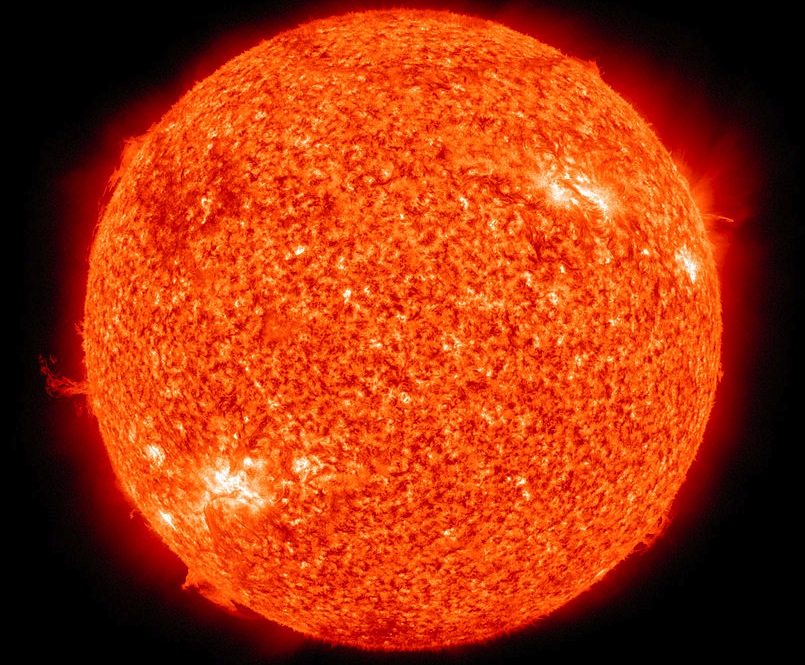
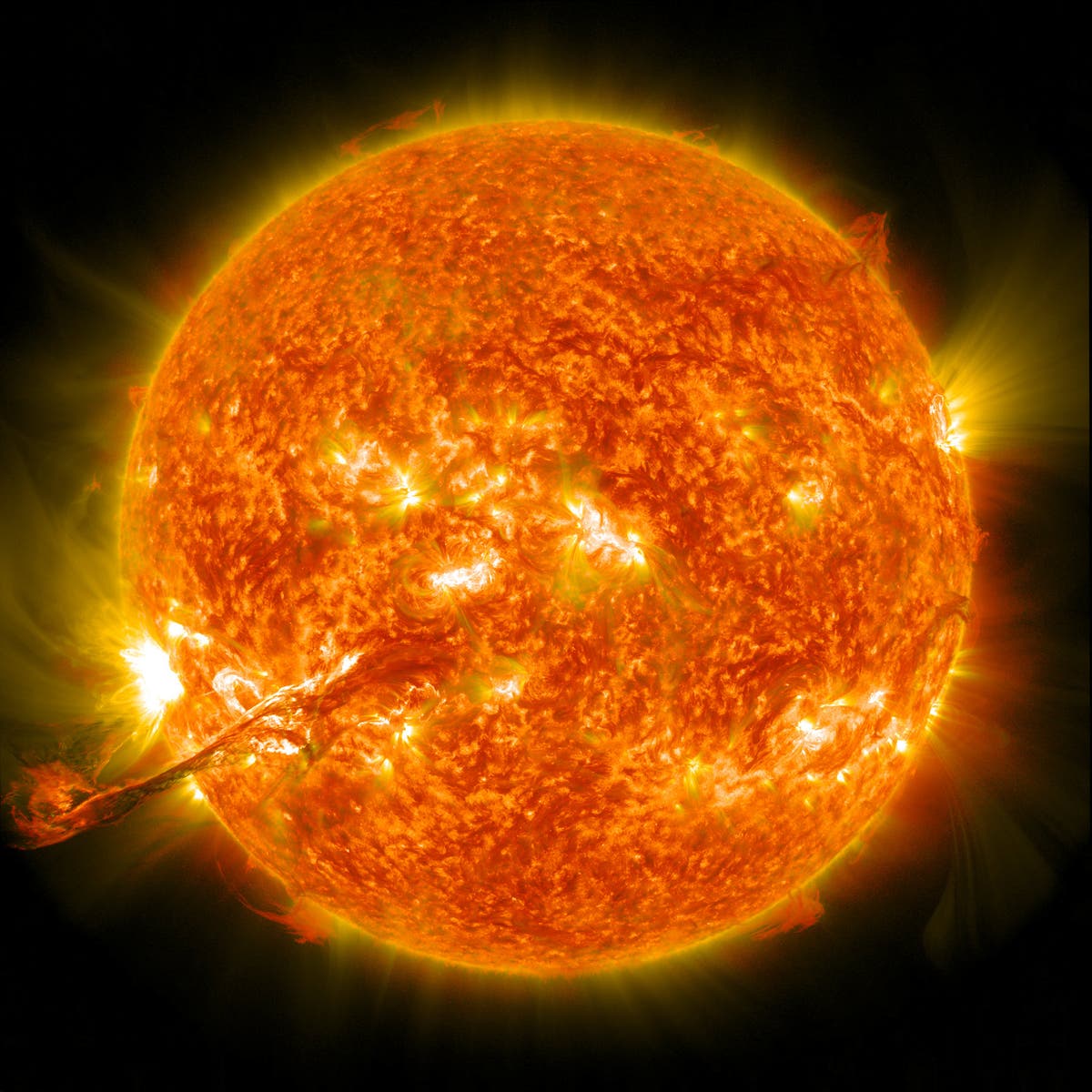
The Sun contains about 99.8 percent of all the mass in the solar system. Because it is so massive, its gravity dominates everything nearby.
The planets continuously fall toward the Sun, but they also move sideways at tremendous speeds. This balance between forward motion and gravitational attraction creates stable orbits.
Without the Sun’s gravity, Earth would travel in a straight line into deep space.
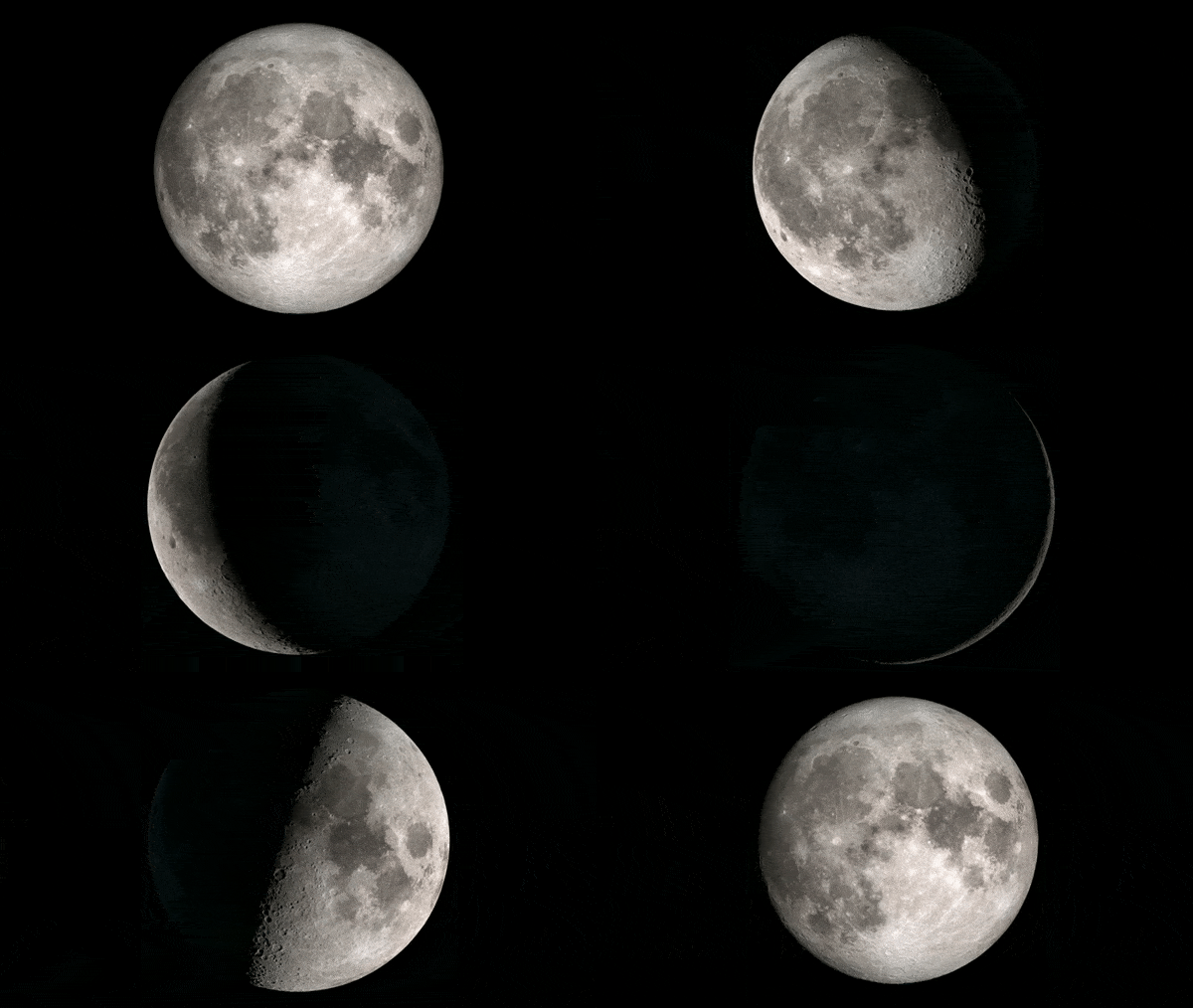
Similarly, Earth’s gravity keeps the Moon in orbit, while the Moon’s gravity influences Earth by creating ocean tides.
Gravity forms an interconnected system in which every object influences every other object.
Gravity Creates Stars and Galaxies
Gravity is responsible for building much of the universe.
Stars begin as enormous clouds of gas and dust floating through space. Over millions of years, gravity slowly pulls this material together.
As the cloud becomes denser, pressure and temperature increase until nuclear fusion begins at the center. A new star is born.
The Sun itself formed this way about 4.6 billion years ago.
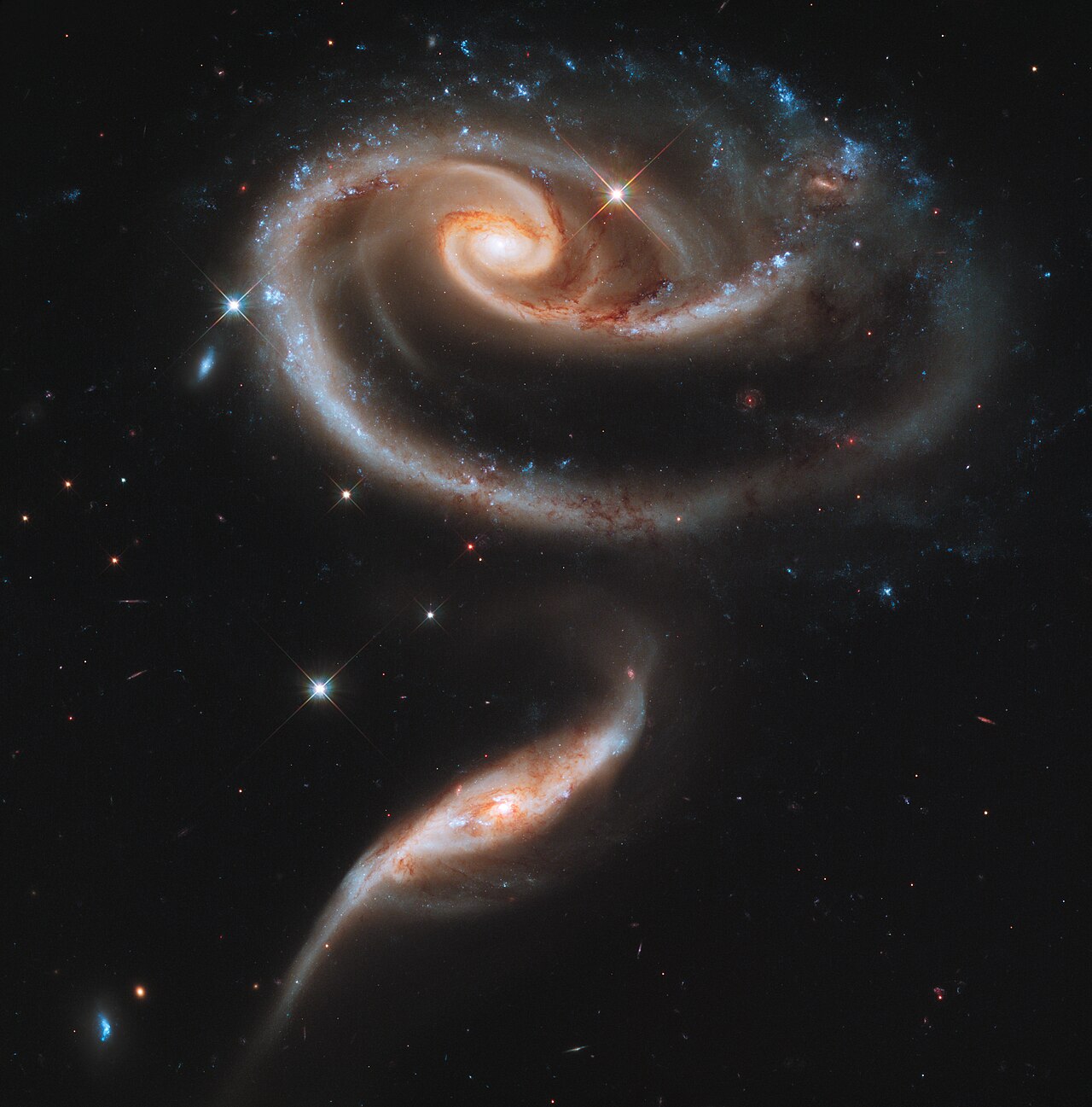
Gravity also gathers stars into galaxies and galaxies into even larger structures called galaxy clusters.
Without gravity, matter would never have come together to form the cosmic structures we observe today.
Isaac Newton’s Discovery
For thousands of years, people observed falling objects without fully understanding why they fell.
In the seventeenth century, English mathematician and physicist Sir Isaac Newton developed a revolutionary explanation.
According to a famous story, Newton became inspired after watching an apple fall from a tree. Whether the story is entirely true or not, it reflects an important insight.
Newton realized that the same force causing an apple to fall might also keep the Moon in orbit around Earth.
This led him to formulate the law of universal gravitation.
Newton proposed that every object in the universe attracts every other object through gravity.
His theory explained the motion of planets, moons, comets, and falling objects using one universal law.
For more than two centuries, Newton’s ideas accurately described countless observations and remain highly useful today.
Einstein Changed Our Understanding of Gravity
Although Newton’s theory worked remarkably well, scientists eventually discovered situations where it was not completely accurate.
In 1915, Albert Einstein introduced the theory of general relativity, fundamentally changing our understanding of gravity.
Einstein proposed that gravity is not simply a force pulling objects together.
Instead, massive objects bend the fabric of space and time, known together as spacetime.
Imagine placing a heavy bowling ball on a stretched rubber sheet. The ball creates a dip in the sheet. If you roll a marble nearby, it naturally follows the curved surface toward the bowling ball.
Although spacetime is not actually a rubber sheet, this analogy helps illustrate Einstein’s idea.
The Sun bends spacetime around itself.
Earth moves along the curved spacetime created by the Sun.
The Moon follows the curved spacetime around Earth.
According to general relativity, objects move along the natural paths created by curved spacetime.
This theory has passed every major experimental test for more than a century.
What Is Spacetime?
Before Einstein, scientists thought space and time were separate.
Einstein showed they are deeply connected.
Space and time form a single four-dimensional structure called spacetime.
Every object exists within spacetime.
Mass and energy change its shape.
That changing shape determines how objects move.
This concept explains not only planetary motion but also many surprising phenomena, including gravitational time dilation, where time passes at slightly different rates depending on gravity.
For example, clocks on satellites tick a little faster than clocks on Earth’s surface because gravity is weaker farther from Earth.
Scientists must account for this effect to keep satellite navigation systems accurate.
What Determines the Strength of Gravity?
Gravity depends mainly on two factors.
The first is mass.
Objects with greater mass produce stronger gravitational attraction.
The Sun has much stronger gravity than Earth because it contains far more mass.
Earth has stronger gravity than the Moon because it is much more massive.
The second factor is distance.
Gravity becomes weaker as objects move farther apart.
This is why astronauts aboard the International Space Station still experience about 90 percent of Earth’s gravity. They appear weightless not because gravity has disappeared but because they are continuously falling around Earth together with their spacecraft.
Gravity and Weight
People often confuse mass and weight, but they are different concepts.
Mass measures how much matter an object contains.
Weight measures the force of gravity acting on that mass.
Your mass remains essentially the same whether you are on Earth, the Moon, or Mars.
Your weight changes because each world has a different gravitational strength.
A person weighing 150 pounds on Earth would weigh only about 25 pounds on the Moon because the Moon’s gravity is much weaker.
This is why astronauts can jump much higher on the lunar surface.
Gravity Shapes the Oceans
Gravity is responsible for Earth’s tides.
Although Earth’s gravity keeps the oceans attached to the planet, the Moon’s gravity gently pulls on Earth’s oceans.
Because the Moon is closer to one side of Earth than the other, its gravitational pull is slightly stronger there.
This difference creates bulges in the oceans, producing high tides.
As Earth rotates, different coastlines move through these bulges, creating the familiar cycle of high and low tides.
The Sun also contributes to tides, although its effect is smaller than the Moon’s because it is much farther away.
Can Gravity Bend Light?
One of Einstein’s most astonishing predictions was that gravity can bend light.
Although light has no mass, it follows the curved paths created by warped spacetime.
Scientists confirmed this prediction during a solar eclipse in 1919.
Today, astronomers regularly observe this effect, known as gravitational lensing.
Massive galaxies can bend light from even more distant galaxies behind them.
This creates distorted images, rings, and multiple copies of the same object.
Gravitational lensing has become one of astronomy’s most valuable tools for studying distant galaxies and detecting invisible dark matter.
Black Holes and Extreme Gravity
Black holes represent gravity at its most powerful.
A black hole forms when an extremely massive star collapses under its own gravity.
The resulting object becomes so dense that gravity near it is extraordinarily strong.
At a certain boundary called the event horizon, the gravitational pull becomes so intense that nothing—not even light—can escape once it crosses that boundary.
Despite their name, black holes are not giant cosmic vacuum cleaners.
Objects must come very close before being captured by their immense gravity.
Scientists continue studying black holes to better understand gravity under the most extreme conditions in the universe.
Gravitational Waves
For many years, Einstein predicted that accelerating massive objects should create ripples in spacetime.
These ripples are called gravitational waves.
They spread across the universe at the speed of light.
In 2015, scientists directly detected gravitational waves for the first time using the Laser Interferometer Gravitational-Wave Observatory (LIGO).
The waves came from two merging black holes more than a billion light-years away.
This discovery opened an entirely new way of observing the universe.
Instead of studying only light, scientists can now detect vibrations in spacetime itself.
It represents one of the greatest scientific achievements of the twenty-first century.
Gravity and the Expansion of the Universe
Gravity influences the evolution of the entire universe.
After the Big Bang approximately 13.8 billion years ago, gravity gradually pulled matter together to form stars, galaxies, and galaxy clusters.
However, astronomers have discovered that the universe is expanding, and that this expansion is accelerating.
Scientists believe an unknown phenomenon called dark energy is responsible for this acceleration.
Gravity attempts to pull matter together, while dark energy appears to drive space apart.
Understanding how these two influences interact remains one of the greatest challenges in modern cosmology.
Can We Create Artificial Gravity?
Science fiction often shows spacecraft with artificial gravity similar to Earth’s.
In reality, creating true gravity remains beyond current technology.
However, scientists can simulate the feeling of gravity.
A rotating spacecraft could create an outward force that feels similar to gravity for people inside.
This idea has been explored for decades and may become important for future missions to Mars and beyond.
For now, astronauts aboard space stations experience prolonged weightlessness because they are continuously orbiting Earth.
Is Gravity the Weakest Fundamental Force?
Gravity is one of the four known fundamental forces of nature.
The others are electromagnetism, the strong nuclear force, and the weak nuclear force.
Among these, gravity is by far the weakest.
A small refrigerator magnet can easily lift a paper clip against the gravity of the entire Earth.
Yet gravity dominates the large-scale universe because it always attracts and acts across unlimited distances.
Unlike electric charges, which can cancel each other out, gravity only attracts.
As a result, its effects accumulate over enormous masses such as stars and galaxies.
The Mystery of Quantum Gravity
Although general relativity successfully explains gravity on large scales, scientists still struggle to explain gravity at the quantum level.
The other three fundamental forces are described by quantum physics.
Gravity has resisted complete integration into quantum theory.
Physicists are searching for a theory of quantum gravity that can unite Einstein’s description of spacetime with the principles of quantum mechanics.
Ideas such as string theory and loop quantum gravity are active areas of research, but no experimentally confirmed theory has yet emerged.
Solving this mystery could reveal a deeper understanding of the universe than ever before.
Gravity in Everyday Life
Gravity quietly influences almost everything we do.
It allows us to walk instead of floating away.
It keeps the atmosphere wrapped around Earth, providing the air we breathe.
It makes rivers flow, waterfalls plunge, and rain return to the ground.
It helps trees grow upward while their roots extend downward.
It enables sports, transportation, construction, and countless everyday activities.
Even sitting comfortably in a chair is possible because gravity gently holds us in place.
Most of the time, we barely notice gravity because it is always there, working silently in the background.
Why Gravity Matters
Gravity is much more than the reason objects fall. It is one of the fundamental forces that shapes the entire universe. It governs the motion of planets, the birth of stars, the structure of galaxies, the behavior of black holes, and the evolution of the cosmos itself.
At the same time, gravity is essential for life on Earth. It holds our planet together, keeps our oceans in place, stabilizes our atmosphere, and creates the conditions that allow living organisms to thrive.
Although scientists have learned an extraordinary amount about gravity, many of its deepest secrets remain unsolved. Each new discovery brings us closer to understanding not only gravity itself but also the remarkable universe it helps create.
Conclusion
Gravity is the invisible force that connects every object in the universe, from tiny grains of dust to immense galaxies. It keeps our feet on the ground, guides the motion of planets, shapes the lives of stars, and bends the very fabric of spacetime. Through the groundbreaking work of Isaac Newton and Albert Einstein, humanity has gained profound insights into this remarkable force, yet many questions remain unanswered.
As scientists continue exploring black holes, gravitational waves, dark matter, dark energy, and quantum gravity, our understanding of gravity continues to evolve. What began as a simple question about why objects fall has become one of the greatest scientific journeys ever undertaken—a journey that reveals not only how the universe works but also how deeply everything within it is connected.