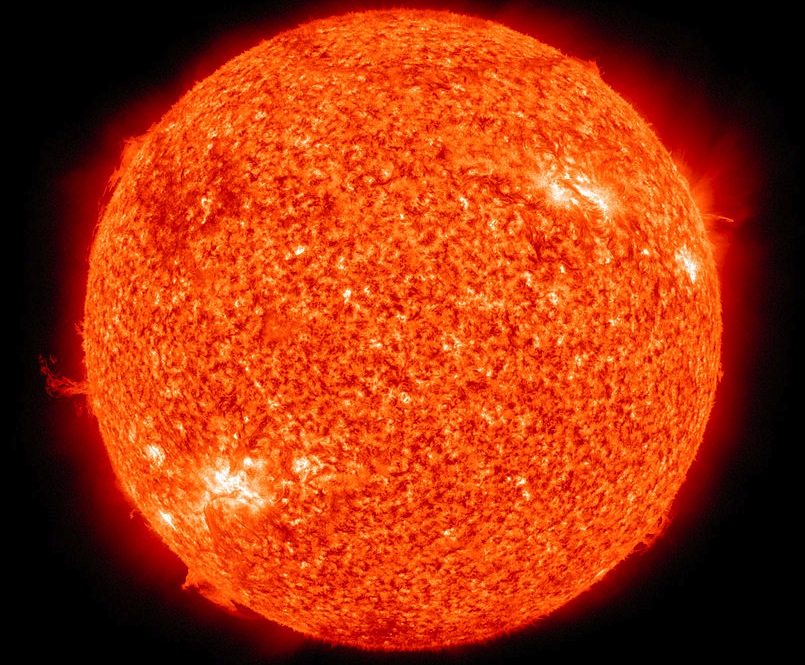
Deep inside the Sun, beyond the brilliant light we see from Earth, lies a vast and mysterious region where energy begins one of the longest journeys in the universe. This hidden layer is called the radiative zone, and although no spacecraft can ever visit it, it plays an essential role in keeping the Sun shining.
Every ray of sunlight that warms your face, powers plants, or lights up the daytime sky has passed through the radiative zone. Without it, the Sun could not transport the enormous energy created in its core to the outer layers where that energy finally escapes into space.
The radiative zone is one of the most fascinating parts of our star because it reveals that even light itself can become trapped for an astonishingly long time.
The Sun Is More Than a Ball of Fire
At first glance, the Sun may appear to be a giant sphere of burning gas. In reality, it is an enormous ball of extremely hot plasma—a state of matter in which atoms are stripped of many of their electrons. The Sun does not burn like wood or coal. Instead, it generates energy through nuclear fusion, a process that combines hydrogen nuclei into helium deep in its core.
The Sun is organized into several distinct layers, each with different temperatures, densities, and physical processes. At the center lies the core, where fusion occurs. Surrounding the core is the radiative zone, followed by the convective zone. Above these interior layers are the visible photosphere, the chromosphere, and the outer corona.
Among these layers, the radiative zone acts as a crucial bridge between the energy-producing core and the turbulent outer regions.
Where Is the Radiative Zone?
The radiative zone lies directly outside the Sun’s core. It extends from about 0.25 to 0.70 times the Sun’s radius, making it the largest layer inside the Sun by volume.
Although it occupies an enormous region, it remains completely hidden from direct observation because sunlight cannot escape from the Sun’s interior. Instead, scientists study it using advanced computer models and a technique called helioseismology, which analyzes vibrations traveling through the Sun much like seismologists study earthquakes to learn about Earth’s interior.
These observations have confirmed that the radiative zone behaves very differently from the layers above and below it.
Why Is It Called the Radiative Zone?
The name comes from the primary way energy moves through this region.
In the radiative zone, energy is transported mainly by radiation, not by the movement of hot material. Radiation is the transfer of energy through electromagnetic waves or particles of light called photons.
Every second, the Sun’s core produces an immense number of photons during nuclear fusion. These photons carry enormous amounts of energy. Their journey outward begins in the radiative zone.
However, they do not travel in straight lines.
Instead, they encounter an environment so incredibly dense that they are constantly absorbed and re-emitted by charged particles in the plasma.
A Journey That Takes Hundreds of Thousands of Years
One of the most surprising facts about the radiative zone is how slowly energy moves through it.
Although light travels through empty space at nearly 300,000 kilometers (186,000 miles) per second, the interior of the Sun is anything but empty.
The plasma inside the radiative zone is packed with ions and electrons. A photon may travel only a tiny fraction of a centimeter before colliding with another particle. After each collision, it is absorbed and then re-emitted in a different direction.
Imagine trying to cross a crowded stadium where every step causes someone to push you in a random new direction. You might eventually reach the exit, but only after countless detours.
This process is known as a random walk.
Because of these constant interactions, the energy created in the Sun’s core may take hundreds of thousands of years, and possibly up to about a million years depending on the model and assumptions, to pass through the radiative zone before reaching the outer layers.
This means the sunlight reaching Earth today was generated deep inside the Sun long before modern human civilization existed.
An Incredibly Hot Environment
The radiative zone is unimaginably hot.
Near its inner boundary, temperatures reach about 7 million kelvins, while near its outer edge they fall to roughly 2 million kelvins.
Although this is cooler than the core, it is still far hotter than almost anything found elsewhere in the universe.
At these temperatures, atoms cannot remain intact. Instead, matter exists as plasma composed of atomic nuclei and free electrons.
This electrically charged environment strongly influences how photons move, making their journey extraordinarily slow despite the immense speed of light itself.
Why Doesn’t the Material Mix Here?
Unlike the convective zone above it, the radiative zone is relatively stable.
The plasma in this layer does not circulate vigorously from one place to another. Instead, it remains arranged in layers according to temperature and density.
The reason lies in how energy is transported.
In the radiative zone, radiation carries energy efficiently enough that large-scale convection is unnecessary. Hot material does not need to rise rapidly because photons can gradually transfer energy outward through repeated absorption and emission.
Only when the plasma becomes less efficient at transporting energy by radiation does convection take over in the outer layers.
The Transition to the Convective Zone
Eventually, energy reaches the outer boundary of the radiative zone.
Here, the density and temperature decrease enough that radiation alone can no longer transport energy efficiently.
Instead, enormous currents of hot plasma begin rising toward the surface while cooler plasma sinks downward. This marks the beginning of the convective zone.
The change is similar to boiling water in a pot. As water near the bottom heats up, it rises while cooler water sinks.
Although the Sun is far more complex than boiling water, convection works on a similar principle.
The transition between these two regions is called the tachocline, a thin layer that scientists believe plays an important role in generating the Sun’s magnetic field.
The Radiative Zone Helps Control the Sun’s Stability
The Sun has remained remarkably stable for about 4.6 billion years.
One reason for this stability is the way energy moves through the radiative zone.
Because photons require such an extraordinarily long time to escape, sudden changes in the core do not immediately affect the Sun’s surface.
Instead, the radiative zone acts as a giant energy buffer, smoothing out fluctuations over immense timescales.
This slow transport helps maintain the steady flow of energy that makes the Sun a reliable source of light and heat for Earth.
What Is Plasma?
Understanding the radiative zone requires understanding plasma.
Plasma is often called the fourth state of matter, alongside solids, liquids, and gases.
When matter becomes extremely hot, electrons gain enough energy to separate from their atoms. The result is a mixture of positively charged ions and free electrons.
The Sun consists almost entirely of plasma.
Unlike ordinary gases, plasma responds strongly to electric and magnetic fields. These interactions influence everything from the Sun’s magnetic activity to the behavior of energy inside the radiative zone.
How Do Scientists Study the Radiative Zone?
No probe can survive the extreme temperatures and pressures inside the Sun.
Instead, scientists rely on indirect methods.
One of the most powerful is helioseismology.
The Sun constantly vibrates with waves generated by motions inside its interior. By observing tiny oscillations on the solar surface, researchers can determine how sound waves travel through different layers.
Because sound moves differently through materials with different temperatures and densities, these observations reveal valuable information about the Sun’s hidden interior.
Computer simulations based on the laws of physics also allow scientists to model conditions inside the radiative zone with remarkable accuracy.
Together, these techniques have provided a detailed picture of one of the least accessible regions in the Solar System.
The Radiative Zone and Neutrinos
Nuclear fusion in the Sun’s core produces not only photons but also tiny particles called neutrinos.
Unlike photons, neutrinos interact only very weakly with matter.
While photons spend hundreds of thousands of years slowly making their way through the radiative zone, neutrinos pass almost straight through the Sun.
Most solar neutrinos escape from the Sun in just a few seconds and continue racing through space at nearly the speed of light.
Every second, trillions of these particles pass harmlessly through your body without you noticing.
By detecting solar neutrinos on Earth, scientists gain direct information about the nuclear reactions occurring deep inside the Sun’s core.
Is the Radiative Zone Unique to the Sun?
The Sun is not the only star with a radiative zone.
Many stars possess interior regions where radiation transports energy.
However, the exact structure depends on a star’s mass.
In stars more massive than the Sun, the arrangement of radiative and convective zones may differ significantly. Some have convective cores surrounded by radiative envelopes, while others resemble the Sun more closely.
Studying these differences helps astronomers understand how stars form, evolve, and eventually die.
Why the Radiative Zone Matters
Although hidden from view, the radiative zone influences everything the Sun does.
It allows energy from nuclear fusion to move steadily outward.
It helps regulate the Sun’s long-term stability.
It connects the violent nuclear reactions of the core with the dynamic outer atmosphere visible through telescopes.
Without the radiative zone, the Sun would function in an entirely different way, and life on Earth might never have developed.
Every sunrise is possible because energy has successfully completed an extraordinary journey through this vast interior layer.
A Hidden Highway of Light
The radiative zone is one of the most remarkable places in the universe. It is a region where light, despite being the fastest thing known in nature, becomes trapped in an endless maze of collisions. Photons born in the blazing core spend hundreds of thousands of years wandering through this dense plasma before finally reaching the Sun’s outer layers and, eventually, streaming into space.
Although invisible to our eyes, the radiative zone quietly powers every beam of sunlight that reaches Earth. It reminds us that even the most familiar object in our sky holds astonishing secrets beneath its glowing surface. By studying this hidden layer, scientists continue to deepen our understanding of how stars work, how energy moves through the cosmos, and how our own Sun has remained a steady source of light and life for billions of years.