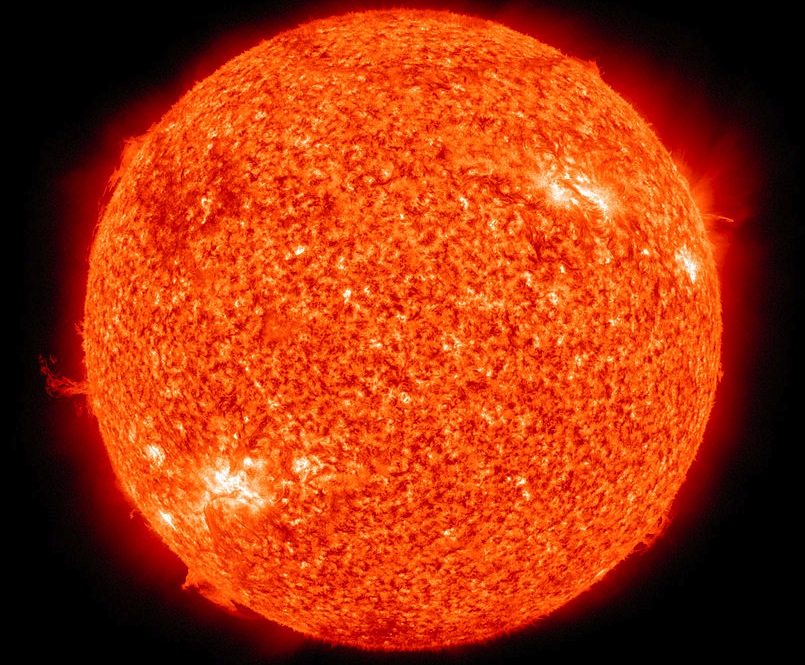
Every second, the Sun releases an unimaginable amount of energy, bathing Earth in light and warmth. That sunlight grows forests, powers weather, drives the water cycle, and makes life possible. Yet for thousands of years, people could only wonder where this incredible energy came from. Was the Sun simply burning like a giant fire? Would it eventually run out of fuel?
Modern physics has revealed a far more extraordinary answer. The Sun is not burning in the way wood or coal burns. Instead, deep within its core, tiny hydrogen atoms are continuously merging together to form helium. This process, known as nuclear fusion, is one of the most powerful energy-producing reactions in the universe.
Every ray of sunshine that reaches your face began as a nuclear reaction deep inside the Sun, where hydrogen was transformed into helium. Understanding how this happens takes us to the very heart of our nearest star.
The Sun Is a Giant Ball of Hot Plasma
Although the Sun may appear as a glowing yellow sphere in the sky, it is actually a massive ball of incredibly hot plasma. Plasma is often called the fourth state of matter. Unlike solids, liquids, or gases, plasma contains atoms that have been stripped of many of their electrons, leaving behind a mixture of positively charged ions and free electrons.
The Sun contains about 99.8% of all the mass in our Solar System. It has a diameter of nearly 1.39 million kilometers (864,000 miles) and a mass about 333,000 times greater than Earth’s.
Most importantly, the Sun is made primarily of hydrogen. About 73% of its current mass is hydrogen, while roughly 25% is helium, with the remaining small percentage consisting of heavier elements such as oxygen, carbon, neon, and iron.
This enormous supply of hydrogen serves as the fuel for nuclear fusion.
The Core Is Where Fusion Happens
Fusion does not occur throughout the entire Sun. It happens only in the core, the central region extending to about one-quarter of the Sun’s radius.
The conditions inside the core are unlike anything naturally found on Earth.
Temperatures reach approximately 15 million degrees Celsius (27 million degrees Fahrenheit).
The pressure is immense because the weight of the Sun’s outer layers presses down on the core from every direction.
The density is astonishingly high. A single cubic centimeter of material in the core contains many times more mass than the same volume of water.
These extreme conditions force hydrogen nuclei much closer together than would normally be possible.
Why Hydrogen Atoms Normally Repel Each Other
At first glance, nuclear fusion seems impossible.
Each hydrogen atom contains a positively charged nucleus. Positive charges naturally repel one another through the electromagnetic force.
Imagine trying to push together the identical poles of two magnets. They resist strongly.
Hydrogen nuclei behave similarly.
If the Sun were cooler or less dense, the hydrogen nuclei would simply bounce apart every time they approached each other.
So how do they ever come close enough to fuse?
The answer lies in the extraordinary temperatures and a remarkable effect of quantum physics.
Extreme Heat Gives Particles Incredible Speed
Temperature is a measure of how rapidly particles move.
Inside the Sun’s core, hydrogen nuclei travel at enormous speeds because of the extreme heat.
These high speeds allow many nuclei to collide with tremendous energy.
Most collisions still fail.
The nuclei approach one another, repel, and fly apart.
However, because there are an unimaginably large number of hydrogen nuclei colliding every second, even extremely rare successful collisions happen continuously.
Quantum Tunneling Makes Fusion Possible
Classical physics alone cannot fully explain fusion inside the Sun.
According to classical ideas, most hydrogen nuclei should never get close enough to fuse.
The missing piece comes from quantum mechanics.
Particles at the atomic scale do not always behave like tiny solid balls. They also possess wave-like properties.
Because of this, hydrogen nuclei sometimes pass through the energy barrier separating them instead of climbing over it. This phenomenon is called quantum tunneling.
Quantum tunneling allows a tiny fraction of collisions to bring hydrogen nuclei close enough for the strong nuclear force to take over.
Without quantum tunneling, the Sun would not shine as it does today.
The Strong Nuclear Force Takes Control
Once two hydrogen nuclei come extremely close together, something remarkable happens.
The strong nuclear force becomes stronger than the electrical repulsion between the positively charged nuclei.
Unlike electromagnetism, which pushes the nuclei apart, the strong nuclear force pulls them tightly together.
This force is one of the four fundamental forces of nature.
Although it acts only over extremely short distances, it is powerful enough to bind atomic nuclei together.
Once the nuclei are close enough, fusion becomes possible.
The Proton-Proton Chain Powers the Sun
The primary fusion process inside the Sun is called the proton-proton chain.
A proton is simply the nucleus of an ordinary hydrogen atom.
This chain of nuclear reactions gradually transforms hydrogen into helium while releasing enormous amounts of energy.
The process begins when two hydrogen nuclei collide.
One of the protons changes into a neutron through the weak nuclear force, creating a nucleus called deuterium, which is a heavier form of hydrogen.
During this reaction, a positron and an electron neutrino are also produced.
The deuterium nucleus then collides with another hydrogen nucleus.
They combine to form helium-3, releasing a high-energy gamma-ray photon.
Finally, two helium-3 nuclei collide.
They merge into one stable helium-4 nucleus while releasing two hydrogen nuclei back into the plasma.
Those released hydrogen nuclei can participate in future fusion reactions.
The cycle then begins again.
Four Hydrogen Nuclei Become One Helium Nucleus
Although the proton-proton chain involves several intermediate steps, its overall result is beautifully simple.
Four hydrogen nuclei are converted into one helium nucleus.
However, something important happens during this transformation.
The helium nucleus has slightly less mass than the combined mass of the four original hydrogen nuclei.
The missing mass has not disappeared.
It has been converted into energy according to Einstein’s famous equation:
E = mc²
Even though the amount of lost mass in each reaction is tiny, multiplying it by the enormous value of the speed of light squared produces an enormous amount of energy.
This is the fundamental reason the Sun shines.
The Sun Converts Millions of Tons of Matter into Energy Every Second
The numbers involved are almost impossible to imagine.
Every second, the Sun fuses approximately 600 million tons of hydrogen into helium.
Of that total, about 596 million tons become helium.
The remaining roughly 4 million tons of mass are converted directly into energy.
This energy is released as gamma rays, neutrinos, and the kinetic energy of newly formed particles.
Although 4 million tons sounds enormous, it represents only a tiny fraction of the Sun’s total mass.
At its current rate of fusion, the Sun has enough hydrogen fuel to continue shining for about 5 billion more years.
Why the Sun Does Not Explode
Considering the immense energy released by fusion, one might wonder why the Sun does not explode like a gigantic bomb.
The answer lies in a delicate balance.
Gravity constantly pulls the Sun inward.
Fusion generates heat and pressure that push outward.
These opposing effects maintain a stable equilibrium known as hydrostatic equilibrium.
If fusion slows slightly, gravity compresses the core.
Compression increases the temperature, causing fusion to speed up again.
If fusion becomes too intense, the increased pressure causes the core to expand slightly.
Expansion cools the core, slowing fusion.
This natural self-regulation has kept the Sun remarkably stable for billions of years.
The Energy Takes a Long Journey
It may seem surprising, but the sunlight reaching Earth today was not produced yesterday.
The energy begins as gamma rays inside the core.
These photons repeatedly collide with particles inside the Sun.
Each collision changes their direction and often lowers their energy.
Instead of traveling directly outward, photons undergo an incredibly slow random journey.
Scientists estimate that it may take tens of thousands to hundreds of thousands of years for energy produced in the core to finally reach the Sun’s visible surface, known as the photosphere.
Once the energy escapes into space as visible light, it travels at the speed of light.
It reaches Earth in only about 8 minutes and 20 seconds.
Neutrinos Escape Almost Instantly
Not all products of fusion remain trapped inside the Sun.
One remarkable exception is the neutrino.
Neutrinos interact extremely weakly with matter.
Most pass straight through the Sun without being absorbed.
After leaving the core, they reach Earth in about eight minutes, carrying direct information about ongoing fusion reactions.
Billions of solar neutrinos pass through your body every second without causing any noticeable effects.
Detecting these particles is extraordinarily difficult, but large underground detectors around the world have successfully measured them, providing direct evidence that nuclear fusion powers the Sun.
Every Beam of Sunlight Has an Incredible History
When sunlight reaches Earth, it has already undergone an extraordinary journey.
Its energy began with the fusion of hydrogen nuclei deep inside the Sun.
That energy slowly migrated through the dense solar interior over thousands to hundreds of thousands of years.
Eventually it escaped into space.
After traveling nearly 150 million kilometers (93 million miles) across the Solar System, it reached Earth in just over eight minutes.
Some of that energy warms your skin.
Some helps plants produce food through photosynthesis.
Some drives winds, ocean currents, and weather systems.
Some becomes electricity through solar panels.
Every ray of sunshine carries the story of hydrogen becoming helium.
Fusion Makes Life on Earth Possible
Without nuclear fusion inside the Sun, Earth would be a frozen, lifeless world.
The Sun provides nearly all the energy that powers Earth’s climate.
Plants use sunlight to produce sugars and oxygen through photosynthesis.
Animals, including humans, ultimately depend on this stored solar energy for survival.
Even fossil fuels contain ancient solar energy captured by plants millions of years ago.
The food we eat, the oxygen we breathe, and the warmth we experience all trace their origins back to fusion occurring deep inside the Sun.
Scientists Are Trying to Recreate Fusion on Earth
Because fusion releases enormous amounts of clean energy without producing carbon dioxide during the reaction itself, scientists have spent decades trying to reproduce it in laboratories.
This is an enormous challenge.
Creating temperatures hotter than the Sun’s core while safely containing the plasma requires advanced technologies such as tokamaks, stellarators, and powerful laser systems.
Unlike the Sun, which relies on its immense gravity to confine plasma, Earth-based fusion reactors must use powerful magnetic fields or intense laser compression.
Although practical commercial fusion power has not yet been achieved, researchers continue making significant progress.
If successful, fusion could become an important source of low-carbon electricity in the future.
The Sun Will Not Shine Forever
Although the Sun appears constant, it is slowly changing.
As hydrogen in the core is converted into helium, the amount of available hydrogen gradually decreases.
Over billions of years, the core will become richer in helium.
Eventually, about 5 billion years from now, the Sun will exhaust most of the hydrogen available for fusion in its core.
It will then begin a new stage of its evolution, expanding into a red giant before eventually shedding its outer layers and ending its life as a white dwarf.
For now, however, the Sun remains comfortably in the stable phase of its life known as the main sequence, steadily converting hydrogen into helium.
A Simple Reaction That Powers an Entire Solar System
The transformation of hydrogen into helium may sound like a tiny atomic event, but it is one of the most important processes in the universe. Every successful fusion reaction releases a small amount of energy, and together these countless reactions generate the immense power of the Sun.
That energy illuminates our world, sustains Earth’s climate, fuels the growth of forests, powers ecosystems, and makes life possible. It also reminds us that the universe often builds extraordinary things from remarkably simple beginnings.
Deep within the Sun, where temperatures reach millions of degrees and matter exists under crushing pressure, hydrogen nuclei quietly combine to form helium. This continuous process has kept our star shining for about 4.6 billion years and will continue to do so for billions more. Every sunrise is a reminder that, at the heart of the Sun, countless hydrogen atoms are becoming helium—one fusion reaction at a time.