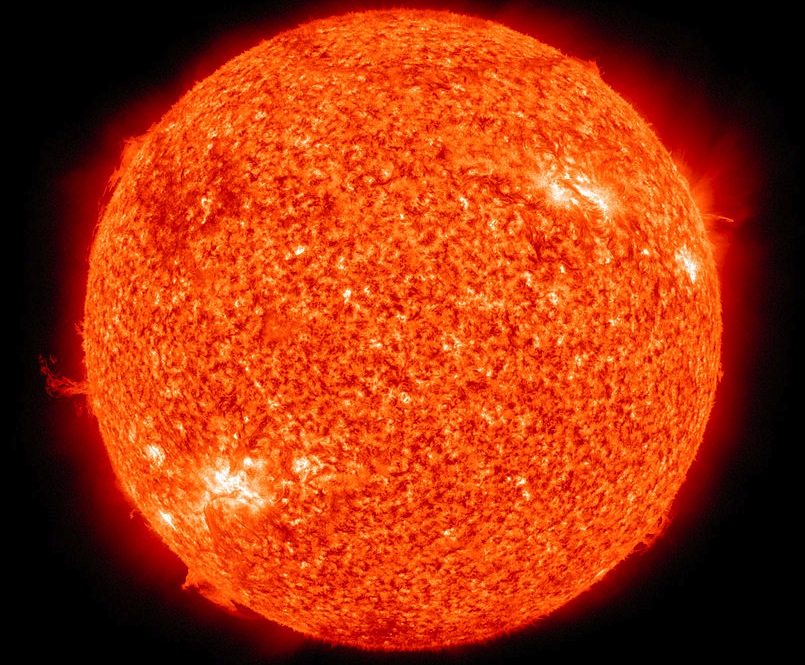
The Sun may appear calm from Earth, but beneath its glowing surface lies a world of constant motion. Deep inside our nearest star, unimaginably hot gases rise, cool, sink, and rise again in an endless cycle that has continued for billions of years. This giant churning layer is known as the convective zone, and it plays a vital role in how the Sun transports energy from its blazing interior to the surface.
Without the convective zone, the Sun would not shine the way it does. The sunlight that warms Earth, drives our climate, and makes life possible is connected to the remarkable processes taking place within this turbulent region. Although we cannot see the convective zone directly, scientists have learned a great deal about it through observations, physics, and sophisticated computer models.
Understanding the convective zone is like peering beneath the Sun’s bright face to discover the powerful engine that keeps it alive.
The Convective Zone Explained
The convective zone is one of the Sun’s main internal layers. It is the outermost part of the Sun’s interior, located just beneath the visible surface, known as the photosphere.
This region extends from about 70% of the Sun’s radius to the surface, making it roughly 200,000 kilometers (124,000 miles) thick. Although this sounds enormous, it occupies only the outer portion of the Sun. Below it lie the radiative zone and the core, where nuclear fusion produces the Sun’s energy.
Inside the convective zone, energy is transported mainly by the movement of hot plasma rather than by radiation alone. This process is called convection, which is where the layer gets its name.
Where the Convective Zone Is Located
To understand the convective zone, it helps to picture the Sun as a series of layers.
At the very center is the core, where temperatures reach around 15 million degrees Celsius (27 million degrees Fahrenheit). This is where hydrogen atoms fuse into helium, releasing enormous amounts of energy.
Surrounding the core is the radiative zone, where energy slowly moves outward as photons are repeatedly absorbed and re-emitted by particles. This journey is incredibly slow and may take hundreds of thousands of years.
Above the radiative zone lies the convective zone. Here, the conditions change dramatically. Instead of radiation carrying energy efficiently, the hot plasma itself begins to move, transporting energy through powerful currents.
Finally, above the convective zone are the Sun’s atmosphere, including the photosphere, chromosphere, and corona.
What Is Convection?
Convection is one of the three main ways heat can move from one place to another. The other two are conduction and radiation.
Convection occurs when heated fluids or gases become less dense and rise, while cooler, denser material sinks. This creates a continuous cycle called a convection current.
You can observe convection in everyday life.
When water boils in a pot, the water at the bottom heats first. As it becomes warmer, it rises toward the surface. Cooler water then sinks to replace it, where it is heated again. This constant circulation distributes heat throughout the pot.
The same basic principle operates inside the Sun—except instead of water, the moving material is extremely hot, electrically charged gas known as plasma.
Why Convection Happens in the Sun
Deep within the Sun, temperatures and pressures are so extreme that matter exists as plasma rather than as ordinary gas.
In the lower part of the convective zone, plasma absorbs energy from the hotter radiative zone beneath it. As the plasma heats up, it expands and becomes less dense than its surroundings.
Because it is lighter, the hot plasma rises toward the surface.
As it approaches the photosphere, it releases much of its heat into space in the form of visible light and other electromagnetic radiation.
Once it loses heat, the plasma becomes cooler and denser.
Gravity then pulls it downward, where it can be heated once more.
This endless circulation continues throughout the convective zone every second of every day.
Plasma: The Sun’s Special State of Matter
The material flowing through the convective zone is not solid, liquid, or ordinary gas.
Instead, it is plasma.
Plasma forms when temperatures become so high that electrons are stripped away from atoms, creating a mixture of positively charged ions and free electrons.
Because plasma carries electric charges, it interacts strongly with magnetic fields. This makes the behavior of the convective zone far more complicated than the movement of boiling water.
The Sun’s constantly shifting magnetic fields are closely tied to the turbulent motion of plasma inside this layer.
A Sea of Constant Motion
The convective zone is one of the most dynamic places in the Solar System.
Huge columns of hot plasma rise toward the surface while cooler plasma sinks below.
These convection currents range enormously in size.
Some cells are only about 1,000 kilometers (620 miles) across, while others stretch for tens of thousands of kilometers.
The entire region resembles an enormous ocean of boiling plasma, with countless rising and falling currents occurring simultaneously.
Although this movement appears chaotic, it follows the well-understood laws of fluid dynamics, thermodynamics, and magnetism.
The Surface Pattern Called Granulation
One of the most beautiful effects of convection can actually be seen on the Sun’s surface.
Powerful telescopes reveal that the photosphere is covered with countless bright, grain-like structures called granules.
Each granule marks the top of a convection cell.
Bright centers are areas where hot plasma has recently risen from below.
The darker edges are places where cooler plasma is sinking back into the Sun.
Each granule is roughly the size of a small country, often measuring around 1,000 kilometers across.
These features constantly change, with most surviving for only about 5 to 10 minutes before disappearing and being replaced by new ones.
The Sun’s surface is therefore never still.
Even Larger Convection Patterns
Granules are only the smallest visible convection cells.
Scientists have also identified much larger structures known as supergranules, which may span around 30,000 kilometers (19,000 miles).
These larger flows help organize the Sun’s magnetic field and influence how magnetic energy spreads across the solar surface.
Researchers continue studying even larger patterns, although many details remain active areas of solar physics research.
How the Convective Zone Transports Energy
Every second, the Sun produces an astonishing amount of energy through nuclear fusion.
That energy must somehow travel from the core to the surface before escaping into space as sunlight.
The convective zone performs the final stage of this journey.
Instead of photons slowly bouncing through matter, massive currents of plasma physically carry heat upward.
This method is much more efficient under the conditions found in the Sun’s outer interior.
When the rising plasma reaches the photosphere, much of its energy escapes into space.
About 8 minutes and 20 seconds later, some of that sunlight reaches Earth.
Why Radiation Stops Being Efficient
A natural question arises.
If radiation carries energy through the radiative zone, why doesn’t it continue doing so all the way to the surface?
The answer lies in changing conditions inside the Sun.
As energy moves outward, temperatures gradually decrease.
The cooler plasma in the Sun’s outer layers contains more partially ionized atoms, making it easier for photons to be absorbed.
Because photons cannot travel efficiently through this material, convection becomes the faster method for transporting energy.
Nature always favors the most effective way to move energy under the existing conditions.
The Convective Zone and the Sun’s Magnetic Field
The convective zone is also essential for generating the Sun’s powerful magnetic field.
The Sun does not rotate like a solid object.
Its equator rotates faster than its poles, a phenomenon called differential rotation.
Combined with the constant churning of electrically conducting plasma, this differential rotation powers the solar dynamo.
The solar dynamo continuously creates and reshapes magnetic fields throughout the Sun.
These magnetic fields influence nearly every aspect of solar activity.
The Birthplace of Sunspots
Many of the Sun’s most dramatic features are connected to the convective zone.
Sunspots are darker regions on the Sun’s surface where powerful magnetic fields suppress convection.
Because less hot plasma reaches these areas, they become cooler than their surroundings.
Although they appear dark by comparison, sunspots are still extremely hot, with temperatures of several thousand degrees Celsius.
Sunspots often occur in groups and can persist for days, weeks, or even months.
Their number rises and falls during the Sun’s approximately 11-year solar cycle.
Solar Flares and Space Weather
The motion inside the convective zone indirectly contributes to some of the most energetic events in the Solar System.
As plasma moves, it twists and stretches magnetic field lines.
Sometimes these magnetic fields suddenly reconnect, releasing enormous amounts of energy.
This process produces solar flares and can launch huge clouds of plasma known as coronal mass ejections.
These events create space weather, which can affect satellites, astronauts, radio communications, navigation systems, and electrical power grids on Earth.
Although the explosions occur higher in the Sun’s atmosphere, the magnetic energy involved is rooted in processes taking place within the convective zone.
Can Scientists See the Convective Zone?
The convective zone is hidden beneath the Sun’s bright surface, making direct observation impossible.
However, scientists have developed ingenious ways to study it.
One important technique is helioseismology, the study of sound waves traveling through the Sun.
Just as earthquakes reveal Earth’s interior, vibrations inside the Sun provide information about its hidden layers.
By measuring tiny oscillations on the solar surface, researchers can determine how plasma moves deep below.
Computer simulations also help scientists recreate the complex flows occurring within the convective zone.
Together, these methods have dramatically improved our understanding of the Sun’s interior.
Is the Convective Zone Unique to the Sun?
The Sun is not the only star with a convective zone.
Many stars contain one or more regions where convection transports energy.
The size and location of these regions depend mainly on a star’s mass, temperature, and stage of evolution.
Smaller stars, including many red dwarfs, may be almost entirely convective.
Very massive stars often have convective cores instead of large outer convective layers.
Studying these differences helps astronomers understand how stars evolve throughout their lifetimes.
Why the Convective Zone Matters
The convective zone is much more than a layer of moving plasma.
It is a crucial part of the Sun’s energy transport system.
It shapes the Sun’s magnetic field.
It creates the constantly changing patterns seen on the solar surface.
It influences the solar cycle.
It helps generate space weather that can affect modern technology on Earth.
Without this enormous churning region, the Sun would behave very differently, and life on our planet might never have developed in the way it did.
The Convective Zone Reminds Us That the Sun Is Alive With Motion
When we look at the Sun from Earth, it appears as a steady, glowing disk in the sky. Yet beneath that brilliant surface lies one of the most active environments in the Solar System. The convective zone is a vast, restless ocean of superheated plasma, where rising and sinking currents transport energy, shape magnetic fields, and drive the activity that makes our star so dynamic.
Every ray of sunlight that reaches Earth is connected to this remarkable layer. It is a reminder that the Sun is not a quiet ball of fire but a constantly evolving star, powered by the laws of physics and sustained by an intricate dance of heat, motion, and magnetism. As scientists continue exploring the Sun with advanced telescopes and spacecraft, the convective zone remains one of the most fascinating windows into the hidden workings of our life-giving star.