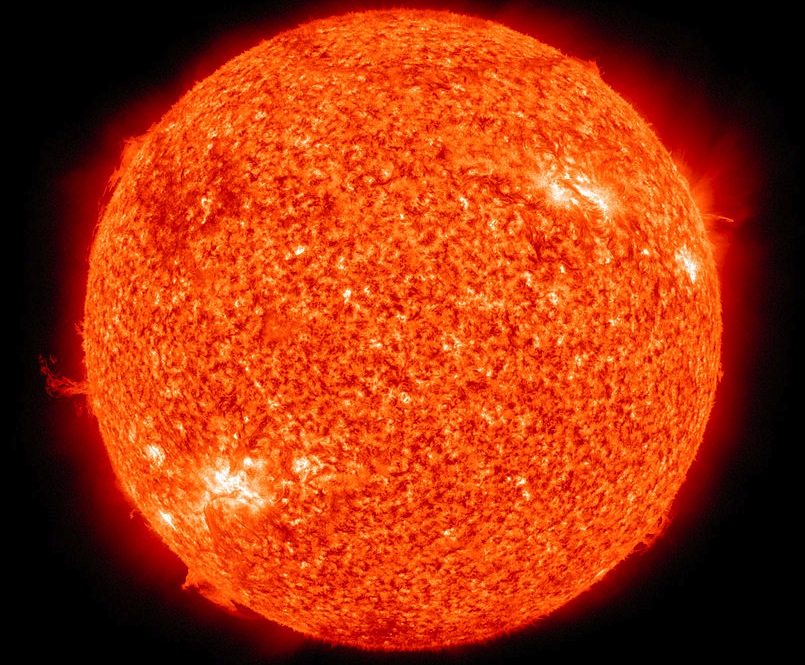
Every morning, the Sun rises without fail, bathing Earth in warmth and light. It powers the winds that move through forests, fuels the growth of plants, drives the water cycle, and makes life on our planet possible. We often think of the Sun as a giant ball of fire, but that picture is not quite right.
The Sun is not burning like wood in a campfire or gasoline in a car engine. Instead, deep within its heart, an extraordinary process is taking place—one so powerful that it has kept the Sun shining for about 4.6 billion years and will continue to do so for another 5 billion years.
At the center of the Sun, atoms are merging together in an incredible process called nuclear fusion. This is where almost all of the Sun’s energy is born. Understanding how this happens not only reveals the secret of our closest star but also explains why life exists on Earth.
The Sun Is a Giant Sphere of Hot Plasma
Before exploring the Sun’s core, it helps to understand what the Sun actually is.
The Sun is a star made mostly of hydrogen and helium. About 74 percent of its mass is hydrogen, while around 24 percent is helium. The remaining small fraction consists of heavier elements such as oxygen, carbon, neon, and iron.
Unlike Earth, the Sun has no solid surface. It is made of an extremely hot state of matter called plasma, in which electrons have been stripped away from atoms. This electrically charged gas behaves differently from ordinary gases and is influenced by powerful magnetic fields.
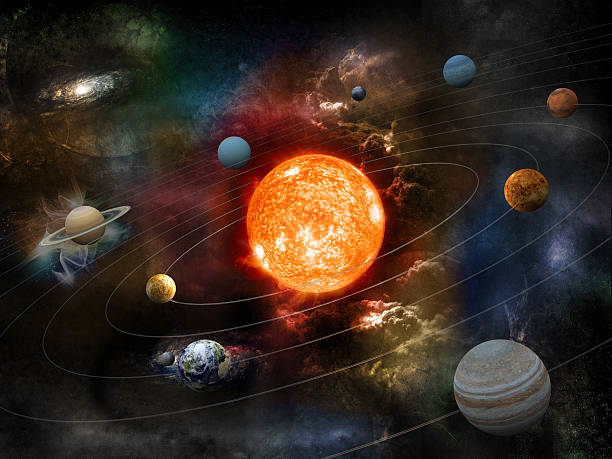
The Sun contains about 99.8 percent of all the mass in our solar system, making it the dominant object around which all the planets orbit.
Deep Inside the Sun Lies Its Core
The Sun is made of several layers, but the core is by far the most important when it comes to energy production.
The core extends from the Sun’s center to about one-quarter of its radius. Although this region occupies only a small part of the Sun’s volume, it contains an enormous amount of mass compressed by gravity.
Conditions inside the core are almost impossible to imagine.
The temperature reaches about 15 million degrees Celsius (around 27 million degrees Fahrenheit). The pressure is more than 200 billion times Earth’s atmospheric pressure at sea level. Matter is squeezed so tightly that particles are forced incredibly close together.
These extreme conditions create the perfect environment for nuclear fusion.
Gravity Is the Hidden Force Behind Everything
The energy produced in the Sun begins with gravity.
The Sun’s enormous mass creates a tremendous gravitational pull that constantly tries to crush the star inward. Every layer presses down on the layers below it, creating unimaginable pressure in the core.
If gravity were acting alone, the Sun would continue collapsing until it became much smaller.
But something pushes back.
That opposing force comes from the energy released by nuclear fusion. The outward pressure generated by the hot gases balances gravity’s inward pull, keeping the Sun stable. Astronomers call this delicate balance hydrostatic equilibrium.
Without gravity creating such intense pressure, nuclear fusion would never begin.
What Is Nuclear Fusion?
Fusion is the process of combining small atomic nuclei into larger ones.
Inside the Sun, the main fuel is hydrogen. A hydrogen atom usually consists of one proton surrounded by one electron. In the Sun’s core, however, temperatures are so high that electrons are stripped away, leaving only atomic nuclei.
Normally, positively charged protons strongly repel one another because like charges repel.
Under ordinary conditions on Earth, they rarely get close enough to stick together.
But inside the Sun’s core, temperatures and pressures are so extreme that protons move at tremendous speeds. Occasionally, they collide with enough energy to overcome their electrical repulsion.
When they come close enough, the strong nuclear force—the most powerful force over very short distances—takes over and binds them together.
This is the beginning of nuclear fusion.
The Proton–Proton Chain Powers the Sun
The primary fusion process inside the Sun is known as the proton–proton chain.
This sequence of nuclear reactions converts hydrogen into helium while releasing enormous amounts of energy.
The process begins when two protons collide. One of them changes into a neutron through the weak nuclear force, forming a nucleus called deuterium, a heavy form of hydrogen. This reaction also produces a positron and a tiny particle called a neutrino.
Next, the deuterium nucleus collides with another proton to form helium-3, releasing a high-energy gamma-ray photon.
Finally, two helium-3 nuclei collide and combine to create helium-4, while two protons are released back into the plasma to participate in future reactions.
Through this series of steps, four hydrogen nuclei ultimately become one helium nucleus.
This simple transformation is the engine that powers the Sun.
A Tiny Loss of Mass Creates Enormous Energy
One of the most remarkable aspects of nuclear fusion is that the helium nucleus weighs slightly less than the four hydrogen nuclei that created it.
The missing mass has not disappeared.
Instead, it has been converted into energy according to Albert Einstein’s famous equation:
E = mc²
In this equation, E represents energy, m represents mass, and c is the speed of light.
Because the speed of light is extraordinarily large, even an incredibly small amount of mass becomes a tremendous amount of energy.
Every second, the Sun converts about 600 million metric tons of hydrogen into helium. During this process, roughly 4 million metric tons of mass are transformed directly into energy.
Although 4 million metric tons sounds enormous, it represents only a tiny fraction of the Sun’s total mass. At its current rate, the Sun has enough hydrogen fuel to shine for billions more years.
Energy Begins as High-Energy Radiation
The energy released by fusion first appears mainly as gamma rays, the highest-energy form of electromagnetic radiation.
These gamma rays begin an incredibly long journey outward.
You might imagine that light produced in the Sun’s core travels straight into space.
In reality, it does not.
The Sun is so dense that photons repeatedly collide with electrons and atomic nuclei. Every collision changes a photon’s direction and often its energy.
Instead of moving in a straight line, photons follow a complicated random path.
Scientists estimate that it can take anywhere from tens of thousands to hundreds of thousands of years for energy produced in the core to reach the Sun’s visible surface.
Only after this long journey can sunlight finally escape into space.
The Radiative Zone Carries Energy Outward
Surrounding the core is the radiative zone.
Here, energy moves outward mainly through radiation.
Photons are continuously absorbed and re-emitted by particles in the dense plasma. Each tiny step carries energy only a short distance before another collision occurs.
Although every photon moves at the speed of light between collisions, the enormous number of interactions makes the overall journey extremely slow.
This region acts almost like a giant maze for light.
The Convection Zone Brings Heat to the Surface
Farther from the center, the Sun’s plasma becomes cooler and less dense.
In this outer region, called the convection zone, energy is transported differently.
Instead of radiation doing most of the work, hot plasma rises toward the surface while cooler plasma sinks back downward.
This circulating motion resembles boiling water in a pot.
These enormous convection currents carry heat to the Sun’s outer layers, eventually reaching the visible surface known as the photosphere.
Sunlight Finally Reaches Space
Once energy reaches the photosphere, photons are finally able to escape into space.
The sunlight that leaves the Sun travels through the vacuum of space at the speed of light.
It takes only about 8 minutes and 20 seconds for sunlight to travel the nearly 150 million kilometers (93 million miles) between the Sun and Earth.
Every ray of sunlight warming your face today began its journey as nuclear fusion deep inside the Sun, though the energy itself may have spent thousands to hundreds of thousands of years making its way from the core to the surface.
Tiny Particles Escape Almost Instantly
While photons take an incredibly long time to leave the Sun, another product of fusion behaves very differently.
Fusion reactions produce neutrinos, nearly massless particles that interact only very weakly with matter.
Because they rarely collide with anything, neutrinos pass almost effortlessly through the Sun.
Most escape from the core in just a few seconds and travel into space at nearly the speed of light.
Trillions of solar neutrinos pass through your body every second without causing harm, and you never notice them.
Studying these neutrinos allows scientists to observe fusion reactions occurring inside the Sun almost in real time.
The Sun Maintains a Delicate Balance
The Sun survives because two powerful forces constantly oppose one another.
Gravity tries to compress the star inward.
Fusion-generated pressure pushes outward.
As long as these forces remain balanced, the Sun stays stable.
If fusion slowed significantly, gravity would compress the core further, increasing temperature and pressure until fusion accelerated again.
If fusion became too intense, the Sun would expand slightly, lowering the core’s temperature and naturally reducing the fusion rate.
This remarkable self-regulating process has kept the Sun shining steadily for billions of years.
The Sun Does Not Burn Forever
Although the Sun contains an enormous amount of hydrogen, its fuel is not unlimited.
Over billions of years, hydrogen in the core is gradually converted into helium.
Eventually, the core will contain too little hydrogen to sustain its current fusion reactions.
When this happens, the Sun will begin a new stage of its life.
It will expand into a red giant, becoming much larger than it is today. Later, after shedding its outer layers, the remaining core will become a white dwarf, a dense stellar remnant that slowly cools over billions of years.
Fortunately, these dramatic changes are not expected for about 5 billion years, giving life on Earth plenty of time before the Sun enters its final chapters.
Scientists Can Study the Sun Without Visiting It
No spacecraft can reach the Sun’s core, yet scientists know a remarkable amount about what happens there.
They use powerful telescopes, satellites, computer simulations, laboratory experiments, and observations of neutrinos to understand the Sun’s interior.
One particularly valuable technique is helioseismology, which studies waves moving through the Sun. Much like earthquakes reveal Earth’s interior, these waves help scientists map conditions deep inside our star.
Modern solar physics combines observations with well-tested theories of nuclear physics, gravity, and plasma physics to build an increasingly detailed picture of the Sun’s hidden engine.
Why Fusion in the Sun Matters to Earth
The energy produced in the Sun’s core makes nearly every aspect of life on Earth possible.
Sunlight drives photosynthesis, allowing plants to convert light into chemical energy. This process supports nearly all ecosystems and provides the oxygen we breathe.
Solar energy powers weather patterns, ocean currents, and the water cycle. It influences Earth’s climate and creates the conditions necessary for life.
Even fossil fuels contain ancient solar energy stored by plants that lived millions of years ago.
Without the continuous fusion reactions in the Sun’s core, Earth would quickly become a frozen, lifeless world.
The Sun’s Heart Is One of Nature’s Greatest Power Plants
Deep beneath the Sun’s glowing surface, invisible to every telescope, an extraordinary engine has been running almost continuously for billions of years. In a region of crushing pressure and unimaginable heat, tiny hydrogen nuclei merge into helium, releasing the energy that lights our skies, warms our planet, and sustains life itself.
Every sunrise is a reminder of this remarkable process. The light that reaches Earth carries the story of countless fusion reactions that began deep inside the Sun’s core. From the growth of forests to the flight of birds, from the colors of a sunset to the electricity generated by solar panels, much of the world around us is connected to the energy born in the heart of our nearest star.
The Sun’s core is more than the center of a star—it is one of the universe’s greatest natural power plants, quietly transforming matter into energy and illuminating our corner of the cosmos day after day.