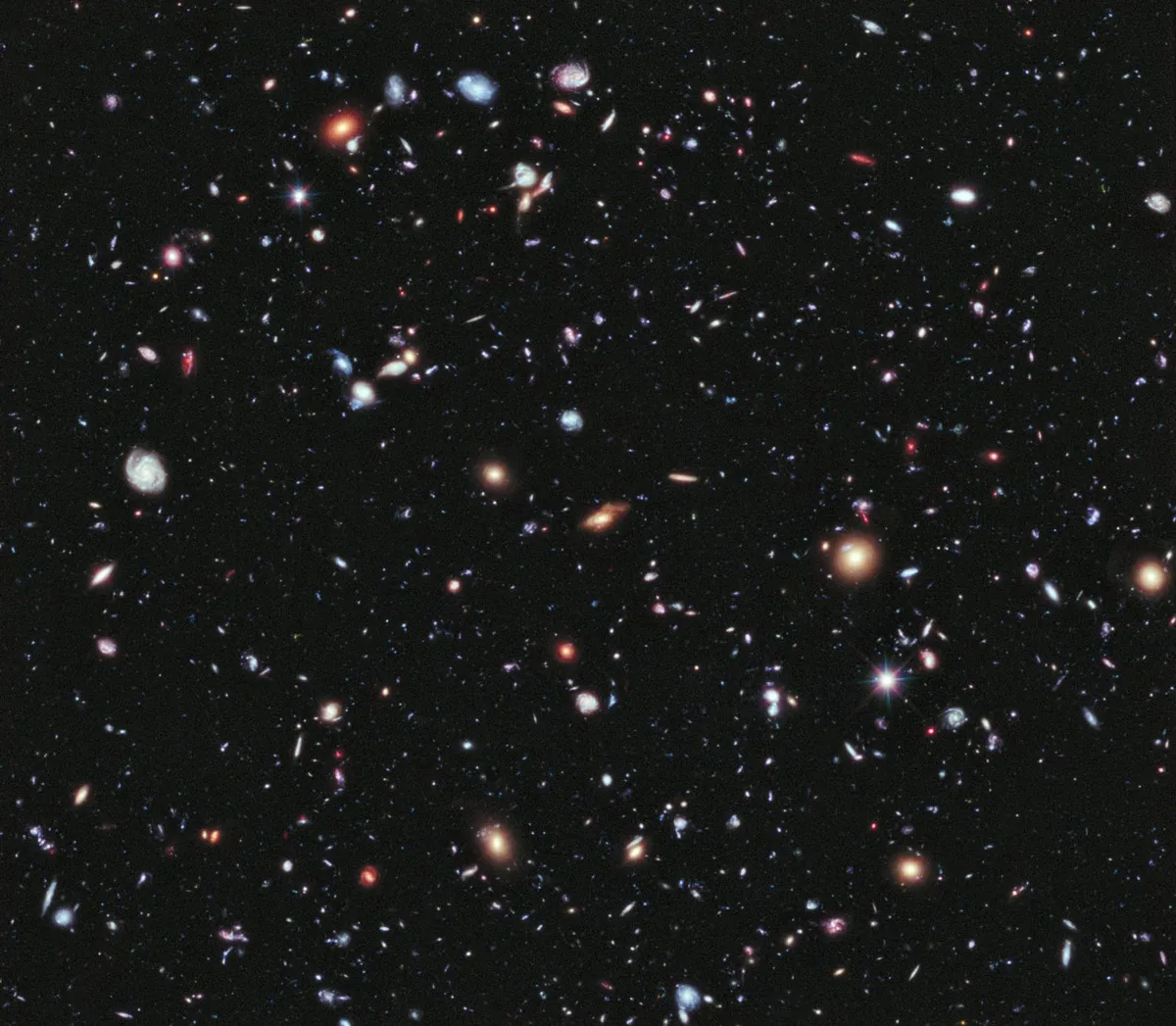
Look up at the night sky, and it may seem as though the universe is calm and unchanging. The stars appear fixed in place, the Moon follows its familiar path, and distant galaxies seem frozen in the darkness. For thousands of years, people believed the universe was static—a vast cosmic stage that had always existed in the same form.
Modern astronomy has revealed a far more astonishing reality.
The universe is not standing still. It is expanding. Every second, the immense fabric of space itself stretches, carrying galaxies farther apart. This expansion has been happening for about 13.8 billion years and continues today. It is one of the most important discoveries in the history of science, transforming our understanding of the cosmos, its origin, and its ultimate fate.
The expanding universe is not simply a fascinating idea. It is a scientifically supported fact backed by decades of observations from powerful telescopes, satellites, and detailed measurements of distant galaxies. Understanding this concept helps us answer some of humanity’s biggest questions: Where did the universe come from? How has it changed over time? And what will happen to it in the future?
What Does an Expanding Universe Mean?
An expanding universe means that the distance between galaxies is increasing over time because space itself is stretching.
This is a crucial idea. Galaxies are generally not flying through empty space away from one another like cars driving down a highway. Instead, the space between them is expanding, causing the galaxies to become more widely separated.
Imagine drawing several dots on the surface of a balloon. As you inflate the balloon, every dot moves farther away from every other dot. The dots themselves do not grow larger or move across the balloon’s surface. Instead, the surface stretches, increasing the distances between them.
The universe behaves in a similar way, although the analogy has limits because the universe expands in three dimensions, not just on a two-dimensional surface.
This expansion occurs everywhere throughout the cosmos. There is no special center from which everything is moving away. Every distant galaxy appears to recede from every other distant galaxy because the fabric of space is expanding uniformly on the largest scales.
The Universe Was Not Always This Large
If the universe is expanding today, an obvious question arises: what happens if we imagine time running backward?
The answer is remarkable.
As we trace cosmic history into the past, galaxies become progressively closer together. Eventually, we reach a time when the entire observable universe was compressed into an incredibly hot, dense state.
This idea forms the foundation of the Big Bang model.
Contrary to a common misconception, the Big Bang was not an explosion into empty space. Instead, it marked the beginning of the expansion of space itself. Both matter and space have been evolving together ever since.
About 13.8 billion years ago, the universe was unimaginably hot and dense. As it expanded, it cooled. Tiny particles combined to form atoms, gravity gathered matter into stars and galaxies, and over billions of years the universe developed into the rich cosmic landscape we observe today.
How Scientists Discovered the Universe Is Expanding
For much of history, astronomers assumed that the universe was static.
Even Albert Einstein initially believed this. When he developed his theory of general relativity in 1915, the equations suggested that the universe should either expand or contract. Since a static universe was the accepted view at the time, Einstein introduced an additional mathematical term, known as the cosmological constant, to keep the universe stable.
The picture changed dramatically during the 1920s.
Astronomers began measuring the light coming from distant galaxies. They discovered that nearly all galaxies appeared to be moving away from us.
The breakthrough came through the work of American astronomer Edwin Hubble. By studying distant galaxies, Hubble found a striking relationship: the farther away a galaxy is, the faster it appears to be receding.
Today this relationship is known as Hubble’s Law.
This discovery provided the first strong observational evidence that the universe is expanding.
Ironically, Einstein later referred to his decision to force a static universe as one of his greatest mistakes, although the cosmological constant has since regained importance in explaining dark energy.
Understanding Redshift
One of the strongest pieces of evidence for the expanding universe comes from a phenomenon called redshift.
Light travels as waves.
When an object moves away from an observer, its light waves become stretched, increasing their wavelength. This shifts the light toward the red end of the electromagnetic spectrum.
Astronomers examine the light emitted by distant galaxies using instruments called spectroscopes. These instruments reveal specific patterns produced by different chemical elements.
For distant galaxies, these patterns are shifted toward longer wavelengths. This redshift indicates that the galaxies are moving away.
The greater the redshift, the faster the galaxy is receding.
Because nearly every distant galaxy shows redshift, astronomers conclude that the universe as a whole is expanding.
Space Itself Is Expanding
One of the most challenging ideas in cosmology is that it is not simply galaxies moving through space.
Space itself expands.
This distinction is essential.
Imagine placing raisins inside a loaf of bread before baking it. As the dough rises, every raisin becomes farther from every other raisin because the dough expands. The raisins are not actively traveling through the dough. Instead, the dough itself stretches.
Galaxies behave in much the same way.
The expansion of space increases the distance between galaxies without requiring each galaxy to propel itself through the universe.
This concept is predicted by Einstein’s theory of general relativity, which describes gravity as the geometry of space and time.
Why Doesn’t Everything Expand?
If space is expanding everywhere, a natural question follows.
Why don’t Earth, the Solar System, or even our own galaxy expand?
The answer lies in gravity and other forces.
The expansion of the universe is significant only over enormous cosmic distances.
Within galaxies, gravity is strong enough to hold stars together.
Within solar systems, the Sun’s gravity dominates.
Within atoms, electromagnetic forces are vastly stronger than cosmic expansion.
As a result, planets, stars, galaxies, people, and everyday objects do not grow larger as the universe expands.
Expansion mainly affects the vast stretches of relatively empty space between clusters of galaxies.
The Cosmic Microwave Background
Another major piece of evidence for the expanding universe is the Cosmic Microwave Background, often abbreviated as the CMB.
This faint glow fills the entire sky.
It is the oldest light that astronomers can observe, originating about 380,000 years after the Big Bang, when the universe had cooled enough for light to travel freely.
As the universe expanded over billions of years, this ancient light stretched to much longer wavelengths, becoming microwave radiation.
The CMB provides an extraordinary snapshot of the young universe.
Measurements by satellites such as COBE, WMAP, and Planck have shown that its properties match the predictions of the expanding Big Bang model with remarkable precision.
Expansion Is Speeding Up
For many years, scientists expected gravity to gradually slow the expansion of the universe.
Instead, observations made during the late 1990s revealed something completely unexpected.
The expansion is accelerating.
Distant exploding stars known as Type Ia supernovae showed that galaxies are moving apart faster today than they were billions of years ago.
Something appears to be pushing space apart.
Scientists call this mysterious phenomenon dark energy.
Dark energy does not emit light, and its true nature remains unknown. Yet current observations suggest it makes up about 68 percent of the total energy content of the universe.
Although its origin remains one of modern physics’ greatest mysteries, dark energy is now considered the leading explanation for the accelerating expansion of the universe.
The Role of Gravity
Gravity has played a fascinating role throughout cosmic history.
Shortly after the Big Bang, tiny differences in the density of matter existed throughout the expanding universe.
Over billions of years, gravity amplified these small differences.
Dense regions attracted more matter, eventually forming stars, galaxies, and enormous galaxy clusters.
Without gravity, matter would never have gathered into the structures we observe today.
The universe therefore experiences two competing influences.
Gravity pulls matter together.
Cosmic expansion increases the distance between large-scale structures.
The balance between these processes has shaped the universe throughout its history.
Measuring the Expansion Rate
Astronomers describe the current rate of cosmic expansion using a value called the Hubble constant.
Determining its precise value is one of the biggest challenges in modern cosmology.
Different methods produce slightly different results.
Some measurements use nearby galaxies and exploding stars.
Others analyze the Cosmic Microwave Background from the early universe.
Interestingly, these approaches do not yet fully agree.
This discrepancy, known as the Hubble tension, may indicate subtle measurement uncertainties or perhaps even new physics beyond current theories.
Scientists around the world continue investigating this puzzle.
Does the Universe Have a Center?
One of the most common misconceptions is that the expanding universe must have a central point.
According to current cosmological models, it does not.
Every observer anywhere in the universe would see distant galaxies moving away in all directions.
This happens because expansion occurs throughout space rather than from a single location.
Returning to the balloon analogy, creatures living on the balloon’s surface would not find a center on the surface itself. Every point would appear similar.
Likewise, our universe has no known center within space.
Can Galaxies Move Faster Than Light?
This question often surprises people.
According to Einstein’s theory of special relativity, nothing can travel through space faster than the speed of light.
However, the expansion of the universe is different.
Because space itself expands, extremely distant galaxies can appear to recede from us faster than light without violating relativity.
This does not mean the galaxies are moving through space faster than light. Instead, the space between us and those galaxies is increasing rapidly enough that their separation grows faster than light can cross it.
This distinction is one of the most subtle and fascinating aspects of modern cosmology.
What Does the Future Hold?
The future of the universe depends largely on the behavior of dark energy.
If the current acceleration continues indefinitely, galaxies beyond our local group will gradually disappear from view as the expanding space carries them farther away.
Stars will eventually exhaust their nuclear fuel.
New star formation will slow dramatically.
Over unimaginable spans of time, the universe may become increasingly cold, dark, and dilute—a scenario often called the “heat death” of the universe.
However, scientists continue studying dark energy because its properties could alter these long-term predictions.
Why the Expanding Universe Matters
The discovery of the expanding universe fundamentally changed humanity’s place in the cosmos.
It showed that the universe has a history. It was different in the past and will continue changing in the future.
This realization transformed cosmology from philosophical speculation into a precise scientific discipline supported by observations and mathematical theory.
Studying cosmic expansion helps scientists estimate the age of the universe, understand galaxy formation, investigate dark matter and dark energy, and explore the earliest moments after the Big Bang.
Every new telescope, every improved observation, and every deeper measurement brings us closer to answering some of the most profound questions ever asked.
The Expanding Universe Continues to Surprise Us
Although scientists now understand many aspects of cosmic expansion, the universe still holds countless mysteries.
Dark energy remains unexplained.
The exact value of the Hubble constant is still debated.
Researchers continue searching for a deeper theory that unites gravity with quantum physics.
Future observatories on Earth and in space may reveal entirely new insights into how the universe began and how it will evolve over trillions of years.
The expanding universe reminds us that the cosmos is not a static backdrop but a dynamic, evolving system filled with wonder. Every galaxy drifting farther into the distance tells part of an ongoing story—a story that began billions of years ago and continues to unfold with every passing second.