On a clear night, when the sky is free from clouds and city lights, one object almost always captures our attention after the Sun has set—the Moon. It has inspired myths, poetry, calendars, navigation, scientific discoveries, and space exploration for thousands of years. It brightens the night, influences the ocean tides, and has become such a familiar part of our lives that it is easy to forget how extraordinary it really is.
But have you ever wondered why Earth has only one Moon?
Some planets have no moons at all, while others have dozens or even hundreds. Tiny Mars has two small moons. Giant Jupiter has nearly a hundred known moons, including several that are larger than Earth’s Moon. Saturn has even more. So why does Earth have just one natural satellite?
The answer lies in a dramatic event that happened more than 4.5 billion years ago, when the Solar System was still young and chaotic. Understanding why Earth has one Moon takes us back to the violent birth of our planet and reveals one of the most fascinating stories in planetary science.
What Is a Moon?
A moon, also called a natural satellite, is a natural object that orbits a planet or another larger body under the influence of gravity.
Moons come in many sizes and shapes. Some are tiny, irregular rocks only a few kilometers across, while others are enormous worlds with mountains, volcanoes, underground oceans, and even atmospheres.
Earth’s Moon is unusual because it is exceptionally large compared to its planet. Measuring about 3,474 kilometers (2,159 miles) across, it is more than one-quarter the diameter of Earth. No other rocky planet in the Solar System has such a large moon relative to its own size.
This unique relationship has played an important role in Earth’s history.
The Young Solar System Was a Violent Place
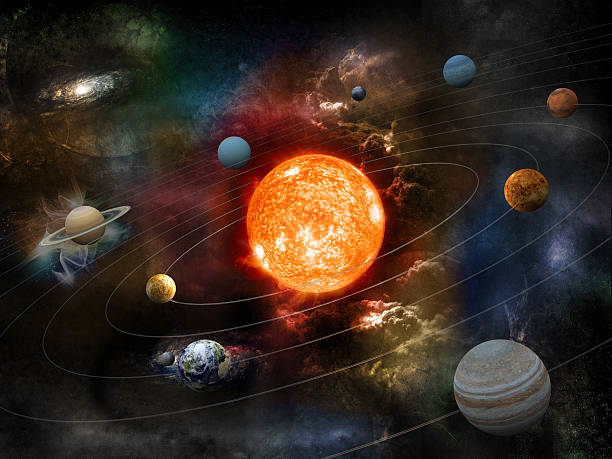
To understand the Moon’s origin, we first need to imagine the Solar System as it existed more than 4.5 billion years ago.
Today, the planets move in stable orbits around the Sun. But in its earliest days, the Solar System looked completely different.
A vast cloud of gas and dust surrounded the young Sun. Within this swirling disk, tiny particles collided and stuck together, gradually growing into larger rocks called planetesimals. Over millions of years, these objects merged into planetary embryos, which eventually became the planets.
Collisions were incredibly common.
Young planets frequently smashed into one another, sometimes merging, sometimes breaking apart, and sometimes completely changing their futures.
Earth itself was still growing during this chaotic period.
The Giant Impact Hypothesis
The leading scientific explanation for the Moon’s formation is called the Giant Impact Hypothesis.
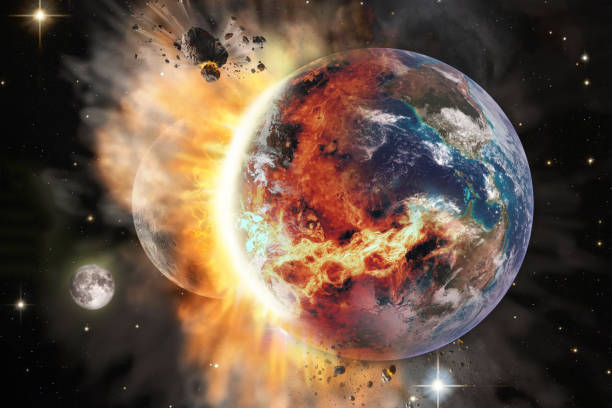
According to this theory, a Mars-sized protoplanet named Theia collided with the young Earth approximately 4.5 billion years ago.
This was not a gentle collision.
It was one of the most energetic events in Earth’s history.
The impact likely occurred at an angle rather than head-on. Instead of destroying Earth, the collision blasted enormous amounts of molten rock and vaporized material into space.
Much of this debris remained in orbit around Earth.
Over time, gravity pulled these fragments together.
Within a relatively short period—perhaps only a few thousand years to a few tens of thousands of years—the orbiting material combined to form a single large Moon.
Rather than producing many permanent moons, the debris largely merged into one dominant body because gravity favored the growth of the largest clump. Smaller fragments were gradually incorporated into the growing Moon, fell back to Earth, or were ejected from the Earth–Moon system.
Evidence Supporting the Giant Impact
Scientists do not simply accept this idea because it sounds convincing. The Giant Impact Hypothesis is supported by multiple lines of scientific evidence.
One of the strongest pieces of evidence comes from the rocks brought back during the Apollo missions.
Laboratory studies show that lunar rocks are remarkably similar to Earth’s outer layers in their chemical and isotopic composition.
This suggests that much of the Moon formed from material originating from Earth and the impactor, rather than being a captured asteroid from elsewhere in the Solar System.
The Moon also contains much less iron than Earth.
Earth has a massive iron core, while the Moon has a relatively small one.
This fits the giant impact model because most of Earth’s iron had already sunk into its core before the collision occurred. The material blasted into orbit mainly came from the outer rocky portions of Earth and Theia.
Computer simulations have also shown that giant impacts can naturally produce an Earth-Moon system with many of the characteristics we observe today.
Although scientists continue refining the details of exactly how the collision happened, the giant impact model remains the most widely accepted explanation.
Why Didn’t Earth Form Several Moons?
One of the most interesting questions is why the impact did not create multiple long-lasting moons.
The answer lies in gravity.
After the collision, countless pieces of rock orbited Earth.
As these fragments repeatedly collided, gravity caused the largest growing object to attract even more material.
This process is similar to how a snowball rolling downhill becomes larger as more snow sticks to it.
Eventually, one body became much larger than the others.
Its stronger gravitational pull allowed it to gather most of the remaining debris.
Any smaller moonlets that formed were likely absorbed into the growing Moon, collided with Earth, or became gravitationally unstable and were lost.
Instead of several permanent moons, the Earth-Moon system naturally evolved into one dominant satellite.
Could Earth Have Had More Than One Moon?
Some scientific models suggest that Earth may briefly have had additional small moonlets shortly after the giant impact.
These temporary companions may have orbited Earth for thousands or even millions of years before eventually colliding with the growing Moon or falling back onto Earth.
Some researchers have even proposed that differences between the Moon’s near side and far side might partly reflect an ancient collision with a smaller companion moon. This idea remains an area of scientific investigation and is not considered established fact.
Whether or not such moonlets existed, none survived to the present day.
Today, Earth has only one natural Moon.
Why Doesn’t Earth Capture Another Moon?
Space is full of asteroids and small objects, so why hasn’t Earth simply captured another moon?
Capturing a natural satellite is much more difficult than it may seem.
An object approaching Earth usually travels too fast.
Unless it loses enough energy through interactions such as atmospheric drag, collisions, or complex gravitational encounters, it simply flies past Earth instead of becoming trapped in orbit.
Earth’s atmosphere is far too thin and extends nowhere near far enough into space to slow incoming asteroids enough for permanent capture.
Temporary captures can happen.
Occasionally, a small asteroid may become briefly trapped by Earth’s gravity before escaping again after months or years.
These temporary “mini-moons” are rare and usually only a few meters across.
They are not stable, permanent moons like our familiar Moon.
Why Do Some Planets Have Many Moons?
The number of moons a planet has depends largely on its size, mass, formation history, and location in the Solar System.
The giant planets—Jupiter, Saturn, Uranus, and Neptune—have enormous gravitational fields.
Their strong gravity allows them to capture passing objects more easily than Earth can.
These planets also formed with large disks of gas and dust surrounding them, similar to miniature versions of the disk around the young Sun.
Within these disks, many moons formed naturally.
In addition, giant planets have captured numerous asteroids and icy bodies over billions of years.
Earth, by contrast, is much smaller and lacks the immense gravitational influence of the gas giants.
As a result, it formed only one major moon and has found it difficult to acquire additional permanent satellites.
Why Doesn’t Venus Have a Moon?
Venus is almost the same size as Earth, yet it has no moon.
Scientists are still investigating why.
One possibility is that Venus experienced giant impacts that either failed to produce a lasting moon or produced moons that eventually spiraled back into the planet.
Another possibility is that the Sun’s gravitational influence, combined with Venus’s slow and unusual rotation, made it difficult for a moon to remain in a stable orbit over billions of years.
Although the exact explanation remains uncertain, it shows that giant impacts do not always produce permanent moons.
Mars Has Two Moons
Mars has two tiny moons named Phobos and Deimos.
Unlike Earth’s Moon, these are small, irregularly shaped objects.
They are only a few tens of kilometers across and resemble asteroids.
Scientists continue studying whether they formed from debris around Mars after an impact or whether they are captured objects that later settled into their current orbits.
Either way, they are vastly different from Earth’s large, nearly spherical Moon.
Is Earth’s Moon Unusually Large?
Yes.
Earth’s Moon is exceptionally large compared with its parent planet.
Among the rocky planets of the Solar System, no other planet has such a large natural satellite relative to its own size.
This unusual ratio has important consequences.
The Moon’s gravity helps stabilize Earth’s axial tilt, preventing dramatic swings over long periods. This stability contributes to a relatively consistent pattern of seasons, although Earth’s climate is also influenced by many other factors.
The Moon also generates ocean tides by exerting gravitational forces on Earth’s oceans.
These tides affect coastal ecosystems, marine life, and the movement of water around the globe.
The Moon Is Slowly Moving Away
Although the Moon seems permanent, its orbit is slowly changing.
Powerful laser measurements have shown that the Moon is drifting away from Earth at an average rate of about 3.8 centimeters (1.5 inches) each year.
This happens because tidal interactions transfer a small amount of Earth’s rotational energy to the Moon’s orbit.
As a result, Earth’s rotation gradually slows, making days slightly longer over immense spans of time, while the Moon moves into a higher orbit.
The change is extremely slow and has no noticeable effect during a human lifetime.
How the Moon Changed Earth
Earth today would be a very different world without its Moon.
The Moon has influenced our planet since its formation.
Its gravity creates tides that shape coastlines and affect marine environments.
Its presence helps stabilize Earth’s rotation axis over long timescales.
The impact that formed the Moon may also have affected Earth’s early rotation and evolution, although many aspects of Earth’s habitability result from a combination of geological, atmospheric, and astronomical factors.
Without the Moon, Earth’s history would likely have unfolded in very different ways.
Could Earth Lose Its Moon?
The Moon is securely bound to Earth by gravity.
Although it is gradually moving farther away, it is not expected to escape Earth’s orbit during the Sun’s remaining lifetime.
Billions of years from now, the Sun will evolve into a red giant, dramatically altering the entire Solar System long before the Moon has any chance of drifting away completely.
For all practical purposes, the Moon will remain Earth’s faithful companion for billions of years to come.
Will Earth Ever Have Another Permanent Moon?
It is possible in principle, but extremely unlikely.
Capturing another large natural satellite would require a very specific sequence of events involving gravity, speed, and orbital dynamics.
Such conditions are extraordinarily rare.
Earth could temporarily acquire tiny “mini-moons” in the future, just as it occasionally has in the past, but these objects eventually escape.
A second large permanent moon is considered highly improbable under the Solar System’s current conditions.
The Moon Continues to Reveal New Mysteries
Even after decades of exploration, the Moon still surprises scientists.
Modern spacecraft continue mapping its surface in remarkable detail.
Researchers study ancient volcanic plains, permanently shadowed polar craters that contain water ice, and rocks that preserve a record of the early Solar System.
Future missions, including planned human exploration, aim to uncover even more about the Moon’s origin and its relationship with Earth.
Every new discovery helps scientists refine our understanding of the giant impact and the remarkable events that gave our planet its only natural satellite.
Conclusion
Earth has one Moon because of an extraordinary event that occurred during the birth of the Solar System. A colossal collision between the young Earth and a Mars-sized world likely produced a vast cloud of orbiting debris that gradually came together under the pull of gravity to form a single, large moon. Rather than remaining as many separate objects, most of the debris merged into one dominant body, creating the stable Earth-Moon system we see today.
That single Moon has done far more than brighten our nights. It has shaped Earth’s tides, helped stabilize our planet’s orientation in space, preserved clues about the earliest history of the Solar System, and inspired generations of explorers to look beyond our world. Every time we see the Moon rise above the horizon, we are looking at the enduring result of one of the most dramatic events in Earth’s history—a companion born from cosmic violence that has remained by our side for more than four and a half billion years.