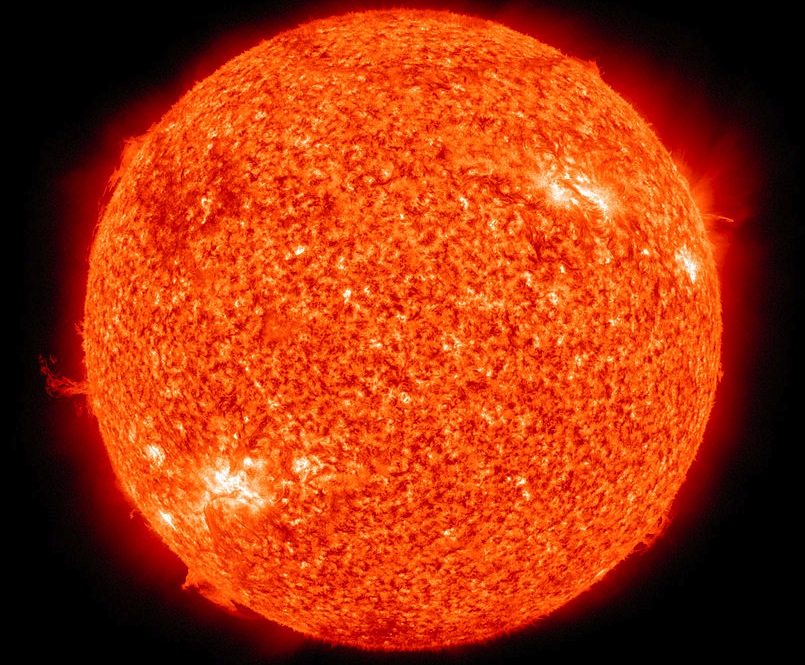
Every second, the Sun releases an astonishing amount of energy, enough to light and warm the entire Solar System. Without this steady flow of energy, Earth would be a frozen, lifeless world drifting through space. Plants could not grow, oceans would freeze, and life as we know it would never have existed.
But where does the Sun get all this energy?
For centuries, this question puzzled scientists. The Sun had been shining for billions of years, yet no known chemical reaction could keep it glowing for so long. Burning wood, coal, or oil could never produce enough energy to sustain a star. The answer turned out to be far more extraordinary than anyone imagined.
Deep inside the Sun’s core, tiny particles called protons collide under immense pressure and temperature. Through a series of nuclear reactions known as proton-proton fusion, these protons are transformed into helium, releasing enormous amounts of energy in the process. This energy eventually travels outward and reaches Earth as sunlight and heat.
Proton-proton fusion is the engine that powers the Sun and countless other stars throughout the universe. It is one of the most important processes in astrophysics because it explains how stars produce energy, how they evolve, and ultimately how the elements essential for life began to form.
Understanding Nuclear Fusion
To understand proton-proton fusion, it is first necessary to understand nuclear fusion itself.
Nuclear fusion is a process in which two or more light atomic nuclei combine to form a heavier nucleus. During this process, a small amount of mass is converted into energy according to Albert Einstein’s famous equation:
E = mc²
This equation shows that mass and energy are interchangeable. Even a tiny amount of lost mass can produce an enormous amount of energy because the speed of light squared is an incredibly large number.
Fusion is different from nuclear fission, which powers today’s nuclear power plants. Fission splits heavy atoms such as uranium into smaller atoms. Fusion does the opposite—it combines lighter atoms into heavier ones.
Fusion is the process that powers nearly every star in the universe.
What Is a Proton?
A proton is one of the fundamental particles that make up ordinary matter.
It is a positively charged particle found inside the nucleus of every atom. In fact, the simplest atom—hydrogen—consists of just one proton and one electron.
Hydrogen is by far the most abundant element in the universe. Most of the Sun is made of hydrogen, providing an enormous supply of protons available for fusion.
Because hydrogen nuclei are simply individual protons, the name “proton-proton fusion” literally means the fusion of hydrogen nuclei.
Where Does Proton-Proton Fusion Occur?
Proton-proton fusion occurs inside the cores of stars whose masses are similar to or smaller than the Sun.
The Sun’s core is an incredibly extreme environment.
Temperatures reach approximately 15 million degrees Celsius (about 27 million degrees Fahrenheit).
The pressure is hundreds of billions of times greater than Earth’s atmospheric pressure.
The density is so high that enormous numbers of protons are squeezed into a relatively small volume.
Under these extraordinary conditions, particles move at tremendous speeds, constantly colliding with one another.
Although most collisions accomplish nothing, an incredibly small fraction lead to nuclear fusion.
Why Protons Normally Repel Each Other
At first glance, proton-proton fusion seems impossible.
Every proton carries a positive electric charge.
According to electromagnetism, particles with the same charge repel one another.
This electrical repulsion is known as the Coulomb force, and it acts like an invisible barrier preventing protons from getting close enough to fuse.
If classical physics were the whole story, stars would never shine.
Fortunately, nature has another rule.
Quantum Tunneling Makes Fusion Possible
The secret behind proton-proton fusion lies in one of the strangest ideas in modern physics: quantum tunneling.
Quantum mechanics describes particles not simply as tiny solid balls but as objects with wave-like properties.
Because of these wave-like characteristics, there is a small probability that a proton can pass through the electrical barrier without having enough energy to climb over it.
This phenomenon is called quantum tunneling.
It does not happen often.
In fact, most proton collisions fail.
However, the Sun contains an unimaginably large number of protons. Even though the probability of fusion during any single collision is extremely low, countless successful fusion events occur every second.
Without quantum tunneling, the Sun would never have ignited.
The First Step of Proton-Proton Fusion
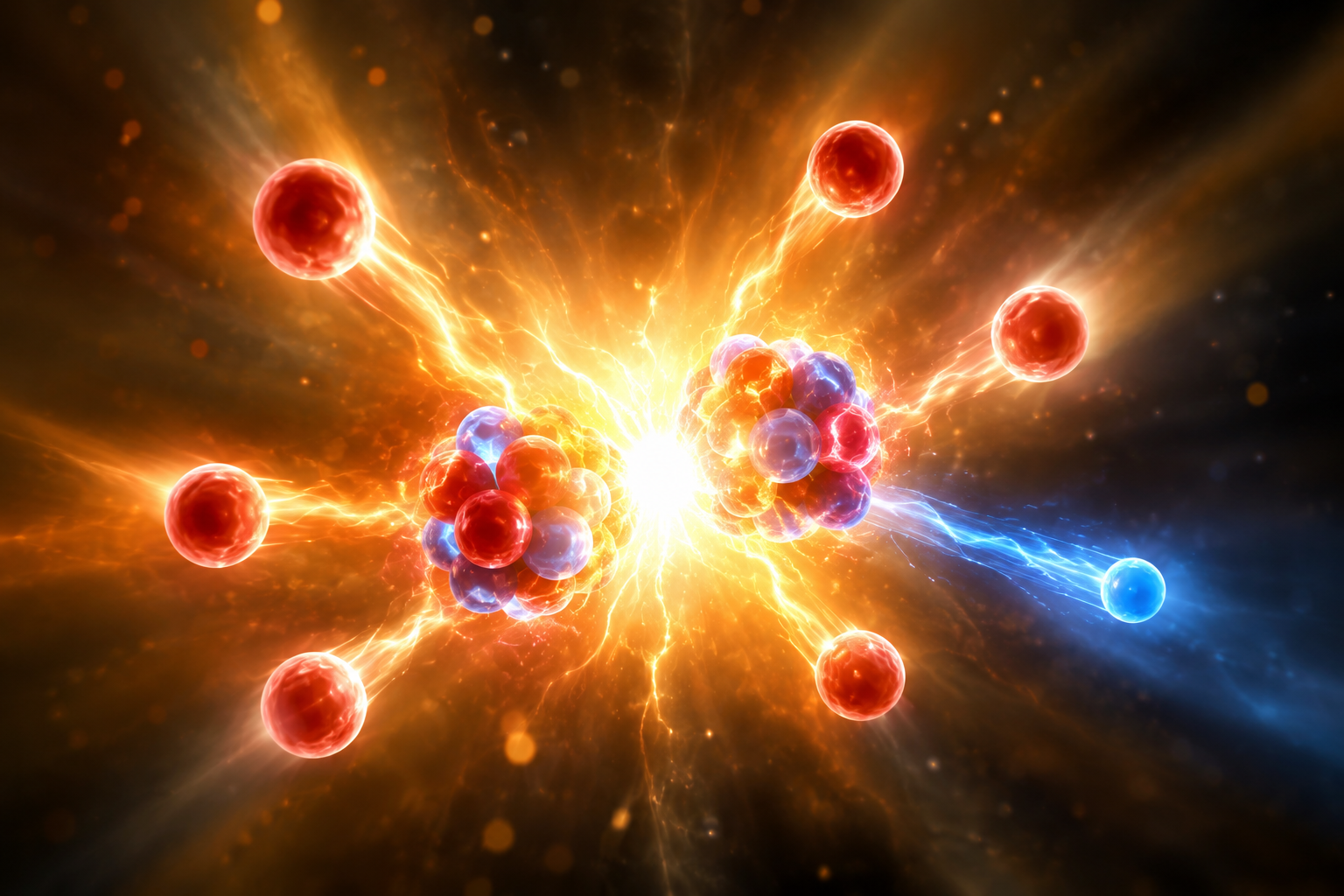
The proton-proton chain begins when two hydrogen nuclei collide closely enough for nuclear forces to take over.
One of the protons undergoes a transformation into a neutron through the weak nuclear interaction.
As a result, the two particles become bound together, forming a nucleus called deuterium, which is a heavier form of hydrogen containing one proton and one neutron.
During this reaction, two additional particles are produced.
One is a positron, the antimatter counterpart of the electron.
The other is an electron neutrino, an extremely light particle that rarely interacts with matter.
The reaction can be written as:
Proton + Proton → Deuterium + Positron + Electron Neutrino
This first step is extraordinarily slow.
Ironically, this slowness is one reason stars like the Sun can shine steadily for billions of years instead of burning through their fuel rapidly.
Building Helium
Once deuterium forms, the remaining reactions happen much more quickly.
A deuterium nucleus collides with another proton, producing helium-3, a rare isotope of helium.
Eventually, two helium-3 nuclei collide.
Together they produce one helium-4 nucleus while releasing two protons back into the surrounding plasma.
The overall result is that four original hydrogen nuclei are converted into one helium nucleus.
Some of the original mass disappears.
That missing mass becomes energy.
This energy is what powers the Sun.
How Much Energy Does Proton-Proton Fusion Produce?
Every individual fusion reaction releases only a tiny amount of energy.
On a human scale, it seems insignificant.
But the Sun performs these reactions on an unimaginable scale.
Every second, the Sun converts roughly 600 million metric tons of hydrogen into helium.
During this process, about 4 million metric tons of mass are converted directly into energy every second.
That energy radiates throughout space in every direction.
Only a tiny fraction reaches Earth, yet it is enough to sustain all life on our planet.
The Journey of Energy from the Sun’s Core
The energy produced by proton-proton fusion does not immediately escape the Sun.
Instead, it begins as high-energy gamma-ray photons.
These photons repeatedly collide with particles inside the dense solar interior.
Each collision changes their direction and energy.
As a result, the energy slowly works its way outward through the Sun.
This journey is astonishingly slow.
Scientists estimate that the energy generated in the Sun’s core may take tens of thousands to hundreds of thousands of years, depending on the path considered, before finally reaching the Sun’s visible surface.
Once the energy reaches the surface, it escapes into space as sunlight.
That sunlight then travels across approximately 150 million kilometers (93 million miles) to Earth in just over eight minutes.
The Neutrinos That Escape Immediately
Unlike photons, neutrinos interact only very weakly with matter.
As soon as they are produced in the Sun’s core, they pass almost straight through the surrounding solar material.
Most solar neutrinos leave the Sun within seconds.
They then race across space at speeds extremely close to the speed of light.
Every second, trillions of these neutrinos pass through your body.
Almost all continue their journey without interacting with a single atom.
Studying these neutrinos allows scientists to observe nuclear reactions happening directly inside the Sun.
Why Proton-Proton Fusion Is So Slow
It might seem surprising that stars produce so much energy while individual fusion reactions occur so rarely.
The explanation lies in the first step of the proton-proton chain.
Transforming one proton into a neutron requires the weak nuclear interaction, one of the least probable processes in particle physics.
Because this reaction is so unlikely, hydrogen fuel is consumed very slowly.
This slow pace allows stars like the Sun to remain stable for around 10 billion years.
If proton-proton fusion happened much faster, the Sun would have exhausted its fuel long before life appeared on Earth.
Stars That Use Different Fusion Processes
Not every star relies primarily on proton-proton fusion.
Very massive stars have much hotter cores than the Sun.
At these higher temperatures, another process called the carbon-nitrogen-oxygen (CNO) cycle becomes the dominant source of energy.
The CNO cycle also converts hydrogen into helium, but it uses carbon, nitrogen, and oxygen nuclei as catalysts.
Although the reactions differ, both processes achieve the same goal.
They transform hydrogen into helium while releasing enormous amounts of energy.
Why Fusion Cannot Happen Easily on Earth
Scientists have spent decades trying to recreate fusion on Earth.
The challenge is immense.
To overcome the electrical repulsion between atomic nuclei, fusion reactors must generate temperatures of more than 100 million degrees Celsius, even hotter than the Sun’s core.
Why is Earth required to reach even higher temperatures?
The answer lies in pressure.
The Sun’s enormous gravity squeezes its core to incredibly high densities.
On Earth, we cannot reproduce such immense pressures over large volumes, so higher temperatures are needed to increase the chances of fusion.
Researchers are developing experimental fusion reactors using magnetic confinement and inertial confinement techniques, hoping to produce a practical source of clean energy.
How Proton-Proton Fusion Shapes the Universe
Proton-proton fusion is much more than the power source of our Sun.
It is one of the processes that made the universe hospitable for life.
The energy produced by stars creates environments where planets can remain warm enough for liquid water.
Over billions of years, stars also forge heavier elements through later stages of nuclear fusion and stellar explosions.
The carbon in your cells, the oxygen you breathe, the calcium in your bones, and the iron in your blood all trace their origins to stars powered initially by hydrogen fusion.
Without proton-proton fusion, the universe would be a far darker and far simpler place.
Evidence That Proton-Proton Fusion Really Happens
Scientists have overwhelming evidence that proton-proton fusion powers the Sun.
The amount of energy emitted by the Sun matches predictions based on fusion.
Solar neutrinos have been directly detected by underground observatories around the world.
The measured abundance of helium in the Sun agrees with theoretical models.
Computer simulations based on proton-proton fusion accurately reproduce the observed properties of the Sun and many other stars.
Although no one can directly observe the Sun’s core, multiple independent lines of evidence point to the same conclusion.
Proton-Proton Fusion and the Life of the Sun
The Sun is currently about 4.6 billion years old.
It is roughly halfway through the phase of its life in which proton-proton fusion converts hydrogen into helium in the core.
Over time, helium gradually accumulates.
Eventually, the hydrogen in the core will become depleted.
At that point, the Sun will begin a new stage of evolution, expanding into a red giant.
Different fusion reactions will then occur under changing conditions.
For now, however, proton-proton fusion continues steadily, providing the stable energy that has supported life on Earth for billions of years.
Why Proton-Proton Fusion Matters
Proton-proton fusion is one of the most remarkable processes in nature. It transforms the simplest element in the universe—hydrogen—into helium while releasing the energy that powers stars. Every ray of sunshine, every warm summer day, every growing forest, and every living organism ultimately depends on this extraordinary sequence of nuclear reactions.
The process also demonstrates the remarkable unity of physics. Gravity compresses stellar cores, quantum mechanics allows particles to tunnel through otherwise impassable barriers, the weak nuclear interaction enables protons to transform into neutrons, and Einstein’s mass-energy equivalence explains why fusion releases such tremendous energy. Together, these principles create the steady brilliance of stars.
When we look at the Sun, we are witnessing proton-proton fusion in action. Deep within its hidden core, countless hydrogen nuclei are combining every second, producing the light and heat that have illuminated Earth for billions of years. Understanding this process not only reveals how our nearest star works but also helps explain the life cycles of stars across the universe and the cosmic origins of the energy and elements that make life itself possible.