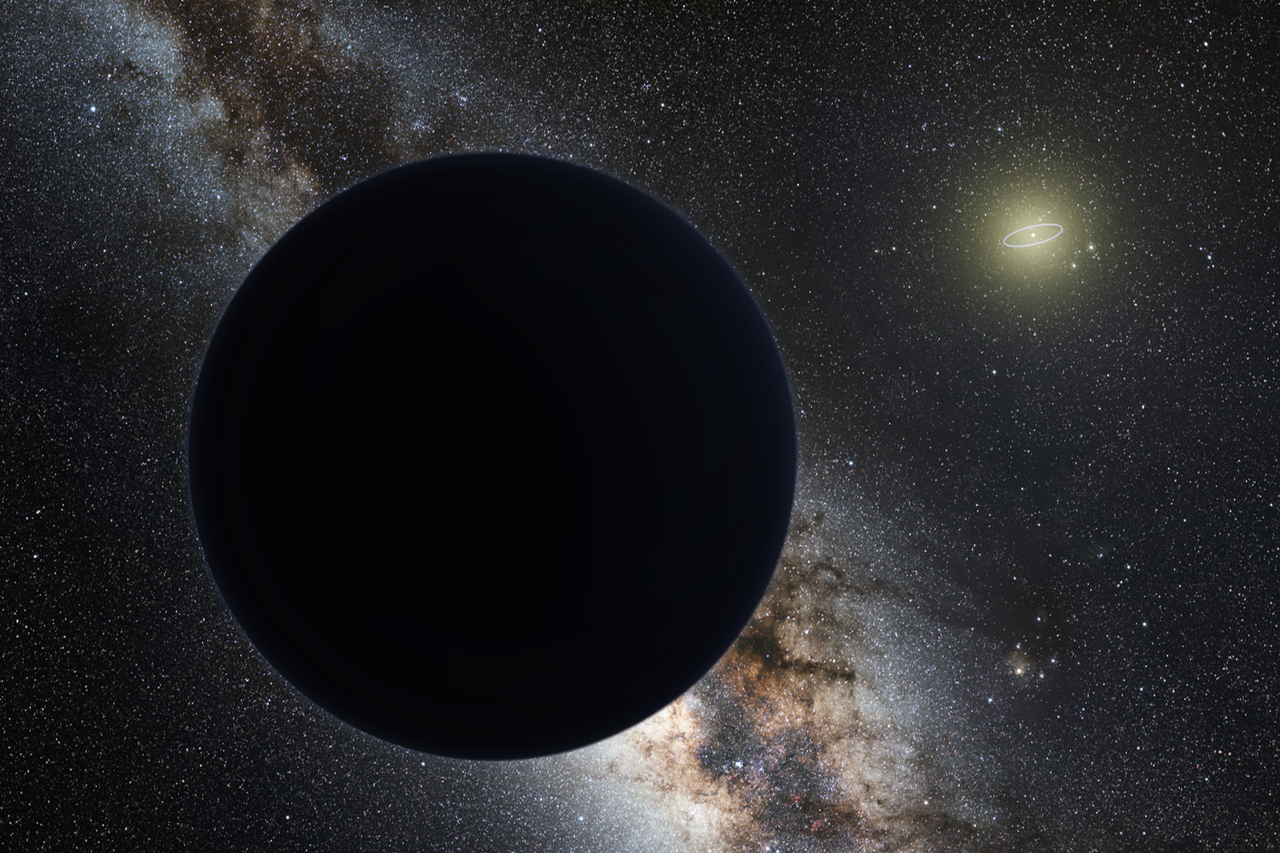
Imagine standing under a clear night sky, looking at the countless stars scattered across the darkness. We often think we know our own cosmic neighborhood well. After all, school textbooks teach us that the Solar System has eight planets orbiting the Sun. But what if something enormous is hiding far beyond Neptune, so distant and so faint that no telescope has clearly seen it yet?
It may sound like science fiction, but it is a genuine scientific question. For nearly a decade, astronomers have been investigating the possibility that an undiscovered giant world—known as Planet Nine—could exist in the outer reaches of our Solar System.
Unlike fictional hidden planets, Planet Nine is not an imaginary creation. It is a scientific hypothesis based on puzzling observations of distant icy objects beyond Neptune. Whether it truly exists remains one of the biggest mysteries in planetary science, and the search continues today.
The Solar System May Be Larger Than We Once Thought
The Solar System does not end with Neptune.
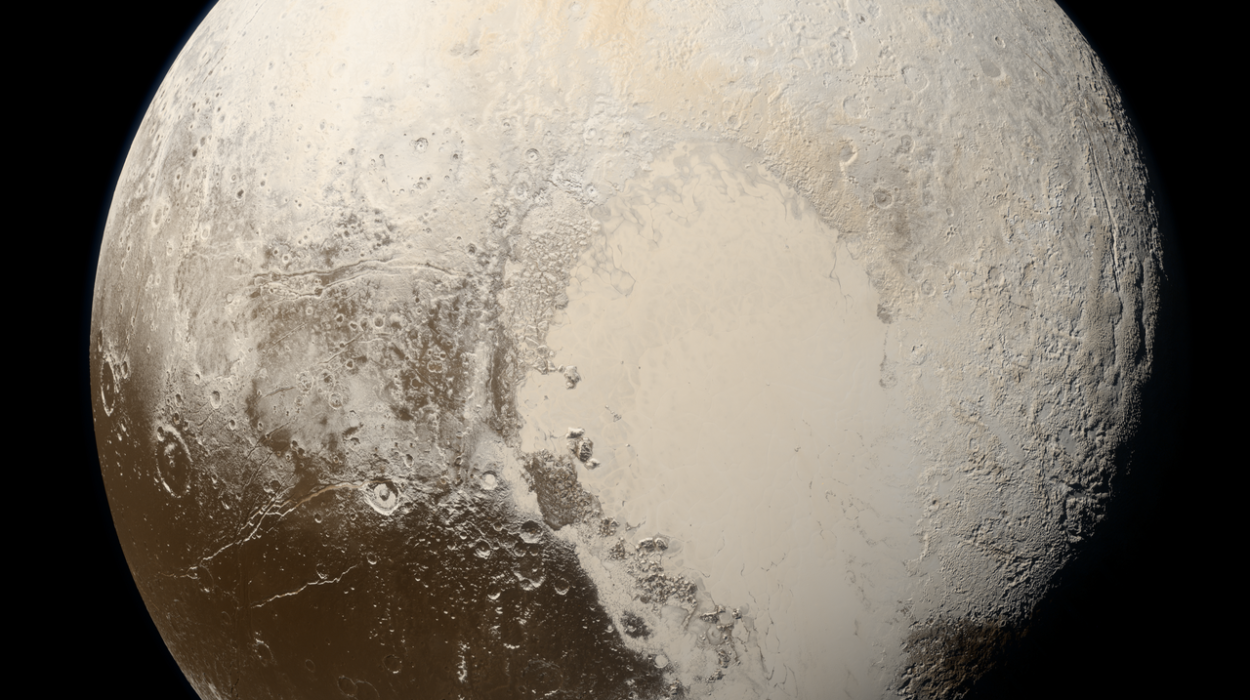
Beyond the eighth planet lies a vast region filled with countless icy bodies. This distant realm includes the Kuiper Belt, where dwarf planets such as Pluto reside, and an even more remote region where mysterious objects travel on enormous elongated orbits around the Sun.
These distant worlds are incredibly cold and receive only a tiny fraction of the sunlight that reaches Earth. Some take hundreds or even thousands of years to complete a single orbit around the Sun.
For many years, astronomers believed these objects moved according to the gravitational influence of the known planets. However, careful observations revealed something unexpected.
A Strange Pattern in the Outer Solar System
Scientists noticed that several extremely distant objects appeared to have oddly similar orbits.
Instead of pointing in random directions, their elongated paths seemed clustered in space. Statistically, this arrangement looked unusual and difficult to explain by chance alone.
This strange alignment caught the attention of astronomers.
If these icy worlds were truly behaving in a coordinated way, something massive might be influencing them from far beyond Neptune.
Gravity leaves clues even when the object creating it cannot be seen.
Just as invisible wind can bend trees, an unseen planet could slowly reshape the orbits of distant objects over millions or billions of years.
The Birth of the Planet Nine Hypothesis
In 2016, planetary scientists Konstantin Batygin and Michael E. Brown proposed a remarkable explanation.
Rather than suggesting a random coincidence, they argued that the unusual orbits could be produced by a large, undiscovered planet orbiting far from the Sun.
Their computer simulations showed that a giant planet with several times Earth’s mass could gradually organize the orbits of distant icy bodies through its gravitational influence.
This hypothetical world became known as Planet Nine.
Importantly, Batygin and Brown did not claim they had found the planet. Instead, they presented evidence suggesting that such a planet could explain the observed orbital patterns.
Their proposal immediately sparked worldwide interest.
How Big Might Planet Nine Be?
If Planet Nine exists, it is unlikely to resemble Earth.
Current models suggest it could have a mass between about five and ten times that of Earth.
That would make it much larger than our planet but considerably smaller than Uranus or Neptune.
Scientists think it might be an ice giant, similar in composition to Uranus and Neptune, with a rocky core surrounded by thick layers of ice, gas, and possibly hydrogen and helium.
Its diameter could be roughly two to four times Earth’s.
Although enormous, it would still be incredibly difficult to detect because of its tremendous distance from the Sun.
Just How Far Away Could It Be?
The distance proposed for Planet Nine is almost beyond imagination.
Earth orbits the Sun at an average distance of one astronomical unit, or 1 AU.
Neptune circles at about 30 AU.
Planet Nine, if it exists, could spend much of its orbit hundreds of astronomical units from the Sun, perhaps averaging around 400 to 800 AU, and possibly traveling even farther at certain points in its highly elongated orbit.
At such distances, sunlight becomes extremely weak.
The Sun would appear only as an exceptionally bright star in Planet Nine’s sky.
Because reflected sunlight decreases dramatically with distance, the planet would appear extraordinarily faint when viewed from Earth.
Why Hasn’t Anyone Seen It?
This is perhaps the biggest question.
How can a planet larger than Earth remain hidden?
The answer lies in distance.
Brightness decreases rapidly as an object moves farther away. A planet located hundreds of times farther from the Sun than Earth receives very little sunlight, and only a tiny fraction of that faint light reflects back toward us.
Even powerful telescopes struggle to detect such dim objects.
Another challenge is the vast area of sky.
Astronomers do not know exactly where Planet Nine would be.
Searching for one faint object across enormous portions of the sky is like trying to find a single grain of sand somewhere on an entire beach.
Following Gravity Instead of Light
Astronomers often discover unseen objects through their gravitational effects before directly observing them.
This approach has succeeded before.
The planet Neptune itself was discovered in the nineteenth century because astronomers noticed that Uranus was not moving exactly as predicted. Mathematical calculations suggested another unseen planet was pulling on Uranus.
When telescopes searched the predicted location, Neptune was found.
The Planet Nine hypothesis follows a similar logic.
Rather than seeing the planet itself, scientists are studying the motions of distant objects that might be responding to its gravity.
Could There Be Other Explanations?
Yes.
One of the strengths of science is that multiple explanations are carefully tested.
Some researchers argue that the unusual orbital patterns may result from observational bias.
Astronomers can observe only certain regions of the sky more easily than others. This uneven sampling might create the appearance of clustering even if no giant planet exists.
Other scientists have explored whether the combined gravity of many smaller distant objects could produce similar effects.
Some studies suggest that interactions among numerous icy bodies might explain at least part of the observed patterns.
Others propose that the evidence is not yet strong enough because only a limited number of extremely distant objects have been discovered.
These competing ideas are actively debated within the scientific community.
The Search Continues
Astronomers have not stopped looking.
Large telescopes around the world regularly survey the outer Solar System, searching for faint moving objects.
Each newly discovered distant body provides additional clues.
If more objects show the same unusual orbital alignment, the case for Planet Nine could become stronger.
If future discoveries reveal a more random distribution, the hypothesis may weaken.
Every new observation helps scientists refine their understanding.
The Vera C. Rubin Observatory Could Change Everything
One of the most exciting developments in the search is the Vera C. Rubin Observatory in Chile.
Equipped with one of the world’s most powerful digital cameras, the observatory is designed to repeatedly scan the night sky with exceptional sensitivity.
Its enormous survey of the sky will detect countless previously unknown asteroids, comets, and distant Solar System objects.
If Planet Nine exists and lies within the observable region, this observatory could dramatically improve the chances of finding it.
Even if it does not discover the planet directly, the new data may reveal many additional distant objects whose orbits could confirm or challenge the Planet Nine hypothesis.
Could Planet Nine Have Formed Near the Sun?
If Planet Nine exists, scientists also want to know where it came from.
One possibility is that it formed closer to the Sun during the early history of the Solar System.
Billions of years ago, the giant planets were still migrating through the young Solar System. Powerful gravitational interactions may have scattered Planet Nine outward into an extremely distant orbit rather than ejecting it completely into interstellar space.
Another idea suggests that the Sun may have captured the planet from another young star while both stars were part of the same stellar nursery billions of years ago.
Although possible in theory, this scenario is generally considered less likely.
Understanding Planet Nine’s origin would provide valuable insights into how planetary systems evolve.
What Would Planet Nine Be Like?
No one knows for certain.
Because it would receive almost no warmth from the distant Sun, its atmosphere would likely be extraordinarily cold.
Temperatures might fall below −200 degrees Celsius in many regions.
Its year could last ten thousand to twenty thousand Earth years, depending on its exact orbit.
If it possesses moons, they would experience one of the darkest and coldest environments in the Solar System.
Despite these harsh conditions, the planet itself could still retain internal heat left over from its formation, much like Uranus and Neptune.
Would Planet Nine Affect Earth?
Fortunately, no.
Even if Planet Nine exists, it would be far too distant to significantly influence Earth’s orbit or climate.
Its gravitational effects would mainly be noticeable on extremely distant objects in the outer Solar System.
Life on Earth would continue exactly as before.
The importance of Planet Nine lies not in any danger it poses but in what it could teach us about planetary formation and the architecture of our Solar System.
Why This Mystery Matters
Finding Planet Nine would be one of the most important astronomical discoveries of the twenty-first century.
It would reshape our understanding of the Solar System.
It would show that our planetary family is larger and more complex than previously believed.
It would also help explain the strange behavior of distant icy worlds that have puzzled astronomers for years.
Even if Planet Nine is ultimately shown not to exist, the search is still valuable.
Every survey uncovers new objects, improves telescope technology, and deepens our understanding of the distant Solar System.
Science advances not only through discoveries but also by testing bold ideas and following the evidence wherever it leads.
The Difference Between a Hypothesis and a Discovery
It is important to understand that Planet Nine has not been discovered.
Scientists have found intriguing evidence that suggests such a planet could exist, but no telescope has yet directly observed it.
Until direct observations are made—or convincing alternative explanations emerge—the Planet Nine hypothesis remains exactly that: a scientifically plausible hypothesis supported by some evidence but not yet confirmed.
This distinction is essential.
Science does not declare something true simply because it is exciting or widely discussed. It requires evidence that can withstand careful testing and independent verification.
A Hidden Giant Waiting to Be Found?
For centuries, humanity believed the Solar System ended with the planets visible to the naked eye. Then telescopes revealed Uranus, followed by Neptune, Pluto, thousands of dwarf planets, and countless icy worlds beyond.
History reminds us that the Solar System has repeatedly surprised us.
Whether Planet Nine eventually emerges from the darkness or turns out to be an illusion created by incomplete observations, the search itself represents the very best of science. Astronomers are using mathematics, powerful telescopes, computer simulations, and careful observations to solve one of the greatest mysteries in our cosmic neighborhood.
Somewhere beyond Neptune, hidden in the vast cold frontier of the Solar System, there may indeed be another giant world slowly orbiting the Sun over thousands of years. Or perhaps nature has an entirely different explanation waiting to be uncovered.
Until the evidence gives us a final answer, Planet Nine remains one of astronomy’s most fascinating unanswered questions—a reminder that even in our own Solar System, there are still mysteries waiting in the darkness.