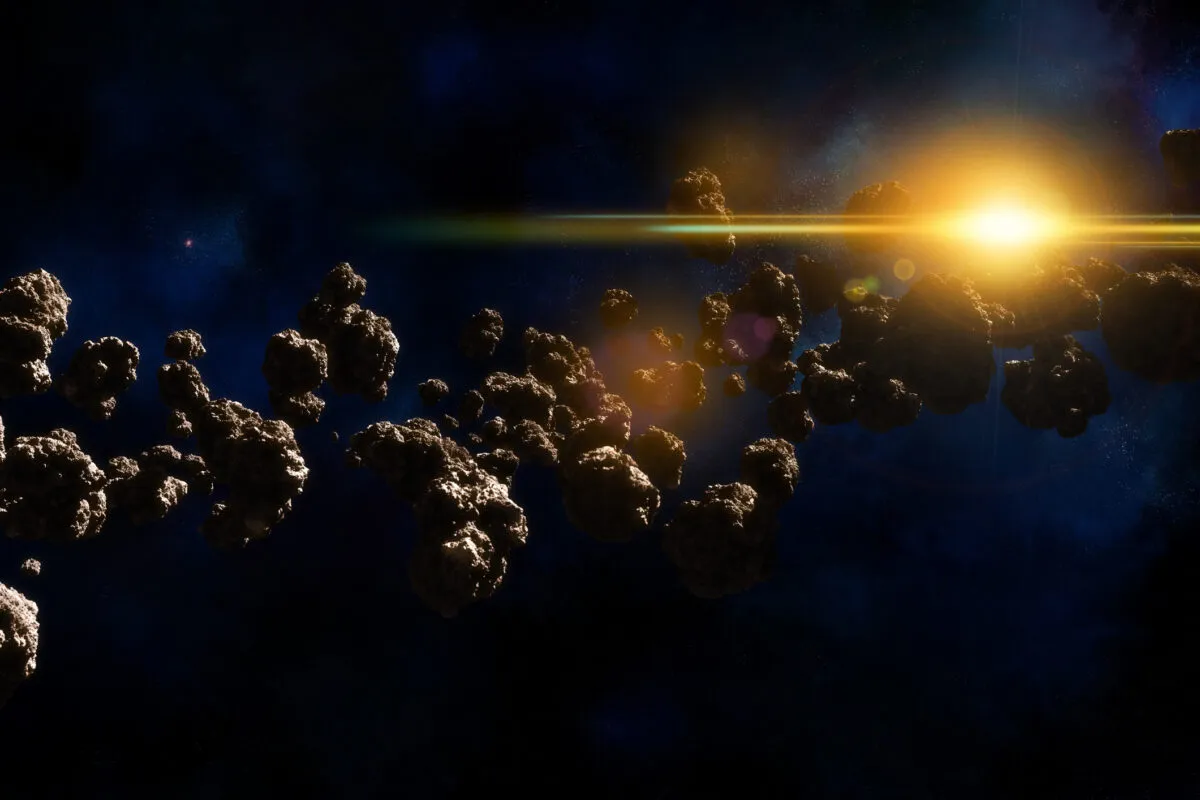
Imagine traveling through space between the planets Mars and Jupiter. Many people picture this region as a dangerous highway packed with enormous rocks constantly crashing into one another, much like the dramatic scenes shown in science fiction movies. In reality, the truth is both quieter and far more fascinating.
The asteroid belt is one of the most remarkable regions of our Solar System. It is home to millions of rocky objects that have remained largely unchanged since the Solar System formed about 4.6 billion years ago. These ancient bodies are often described as cosmic fossils because they preserve clues about the earliest days of planetary formation. By studying them, scientists can look back billions of years to understand how Earth, the other planets, and even the building blocks of life came into existence.
Although it may seem like just a collection of scattered rocks, the asteroid belt is actually a dynamic and scientifically important region that continues to reveal new secrets about our cosmic neighborhood.
Understanding the Asteroid Belt
An asteroid belt is a region of space where numerous asteroids orbit a star. In our Solar System, when people refer to “the asteroid belt,” they almost always mean the Main Asteroid Belt, located between the orbits of Mars and Jupiter.
This vast region stretches hundreds of millions of kilometers across space and contains countless rocky and metallic objects of many different sizes. Some asteroids are no larger than pebbles, while others are hundreds of kilometers wide.
Despite containing millions of objects, the asteroid belt is surprisingly empty. The average distance between sizable asteroids is so great that a spacecraft can pass through the belt without needing to dodge rocks. In fact, many spacecraft have traveled safely through this region during missions to the outer Solar System.
Where Is the Asteroid Belt Located?
The Main Asteroid Belt lies between Mars and Jupiter, roughly between 2.1 and 3.3 astronomical units (AU) from the Sun. One astronomical unit is the average distance between Earth and the Sun, approximately 150 million kilometers (93 million miles).
This means the asteroid belt begins well beyond Mars and extends toward Jupiter, occupying a broad region of the inner Solar System.
Every asteroid follows its own orbit around the Sun. Some complete an orbit in about three years, while others take six years or more, depending on their distance from the Sun.
How the Asteroid Belt Formed
To understand the asteroid belt, we must travel back to the birth of the Solar System.
About 4.6 billion years ago, a giant cloud of gas and dust called the solar nebula began collapsing under gravity. As the cloud shrank, it spun faster and flattened into a rotating disk. At the center, the Sun was born. Throughout the surrounding disk, tiny grains of dust collided and gradually stuck together.
Over millions of years, these particles formed larger and larger bodies called planetesimals. Many eventually grew into the planets we know today.
The region between Mars and Jupiter also contained enough material that it might have formed another planet. However, something prevented that from happening.
The answer lies with Jupiter.
Jupiter’s Powerful Influence
Jupiter is the largest planet in the Solar System, containing more than twice the mass of all the other planets combined.
Its immense gravity strongly affected the nearby region where the asteroid belt now exists.
As young planetesimals attempted to merge into a larger planet, Jupiter’s gravitational pull continually disturbed their orbits. Instead of allowing objects to collide gently and combine, Jupiter often caused high-speed collisions that shattered growing bodies into smaller pieces.
Over time, this process prevented the formation of a full-sized planet.
The result is the asteroid belt we see today—a region filled with leftover building materials from the early Solar System.
What Are Asteroids Made Of?
Asteroids are made from a variety of materials, reflecting the conditions under which they formed billions of years ago.
Many are composed mainly of rock, containing minerals rich in silicon and oxygen.
Others contain large amounts of metal, including iron and nickel.
Some are rich in carbon compounds and may also contain water-bearing minerals and complex organic molecules.
These differences allow scientists to classify asteroids into several major types based on their composition and how they reflect sunlight.
Because most asteroids have experienced relatively little geological change, they preserve ancient materials that date back to the earliest stages of Solar System history.
The Largest Objects in the Asteroid Belt
Although most asteroids are relatively small, a few are surprisingly large.
The biggest object in the asteroid belt is Ceres, which is about 940 kilometers (584 miles) in diameter. Ceres is so large and nearly spherical that it is officially classified as a dwarf planet rather than simply an asteroid.
Ceres contains a significant amount of water ice beneath its surface, and scientists have discovered evidence of salty deposits and ancient geological activity. Some researchers believe that liquid water may once have existed beneath its icy crust.
Other major members of the asteroid belt include Vesta, Pallas, and Hygiea.
Vesta is particularly interesting because it once experienced volcanic activity and developed a layered interior similar to that of terrestrial planets. Massive impacts have blasted pieces from Vesta’s surface, some of which eventually reached Earth as meteorites.
How Many Asteroids Are There?
The exact number of asteroids is impossible to determine because new ones are discovered regularly.
Astronomers have identified well over a million asteroids, and hundreds of thousands have accurately measured orbits. Scientists estimate that the Main Asteroid Belt contains millions more objects larger than one kilometer, along with countless smaller rocks, pebbles, and dust particles.
Despite these enormous numbers, the combined mass of everything in the asteroid belt is surprisingly small.
Altogether, the entire asteroid belt contains only about four percent of the Moon’s mass. Nearly half of this total mass belongs to just four objects: Ceres, Vesta, Pallas, and Hygiea.
Is the Asteroid Belt Dangerous?
Movies often show spacecraft weaving through dense fields of tumbling rocks.
Real space is very different.
The asteroid belt is so vast that most asteroids are separated by hundreds of thousands to millions of kilometers. The chance of a spacecraft accidentally striking a large asteroid while passing through the belt is extremely low.
NASA and other space agencies carefully calculate spacecraft trajectories, making asteroid impacts extraordinarily unlikely.
Many famous missions, including Pioneer 10, Pioneer 11, Voyager 1, Voyager 2, Galileo, Cassini, Dawn, New Horizons, and Lucy, have safely traveled through or visited this region.
Asteroids, Meteoroids, Meteors, and Meteorites
These terms are often confused, but they describe different stages of rocky objects in space.
An asteroid is a rocky or metallic object orbiting the Sun.
If a much smaller fragment breaks away from an asteroid, it is generally called a meteoroid.
When a meteoroid enters Earth’s atmosphere and produces a streak of light, it becomes a meteor.
If part of the object survives the journey through the atmosphere and lands on Earth’s surface, it is known as a meteorite.
Many meteorites found on Earth originated from collisions within the asteroid belt millions of years ago.
Why Scientists Study the Asteroid Belt
The asteroid belt acts as a natural museum of the early Solar System.
Unlike planets, which have undergone billions of years of geological activity, many asteroids have remained relatively unchanged.
Studying them helps scientists answer fundamental questions.
How did planets form?
How was water delivered to Earth?
What materials existed in the young Solar System?
How did organic compounds evolve before life appeared?
By analyzing asteroid samples, researchers can investigate conditions that existed long before Earth became habitable.
Space Missions to the Asteroid Belt
Space agencies have sent several missions to explore asteroids directly.
NASA’s Dawn mission became the first spacecraft to orbit two different worlds. It studied both Vesta and Ceres, revealing mountains, giant impact basins, mysterious bright salt deposits, and evidence of ancient geological processes.
NASA’s OSIRIS-REx mission visited the near-Earth asteroid Bennu and successfully returned samples to Earth. Although Bennu is not located in the Main Asteroid Belt today, scientists believe it originated there before migrating inward.
Japan’s Hayabusa and Hayabusa2 missions also collected asteroid samples, allowing scientists to examine pristine Solar System material in laboratories on Earth.
These missions provide information that cannot be obtained through telescopes alone.
Could Asteroids Have Brought Water to Earth?
One of the biggest mysteries in planetary science concerns the origin of Earth’s water.
The early Earth was extremely hot, making it difficult for liquid water to remain on the surface during its earliest stages.
Some scientists propose that water-rich asteroids collided with the young Earth, delivering large amounts of water and other volatile materials.
Carbon-rich asteroids also contain organic molecules, the chemical ingredients necessary for life.
Although this idea is still being investigated, asteroid studies continue to provide important clues about how Earth became a habitable planet.
Asteroids and Planetary Defense
While most asteroids remain safely within the Main Asteroid Belt, gravitational interactions can occasionally alter their paths.
Some asteroids eventually become near-Earth asteroids, whose orbits bring them close to our planet.
Large asteroid impacts have occurred throughout Earth’s history.
The impact that contributed to the extinction of the non-avian dinosaurs about 66 million years ago was caused by an object roughly 10 kilometers (6 miles) wide.
Today, astronomers around the world continuously monitor potentially hazardous asteroids.
Modern telescopes discover thousands of new near-Earth objects every year, allowing scientists to calculate their future orbits with increasing precision.
In 2022, NASA’s Double Asteroid Redirection Test (DART) mission successfully demonstrated that a spacecraft could deliberately alter the orbit of a small asteroid by colliding with it. This marked the first practical test of planetary defense technology.
Are Asteroid Belts Common in Other Solar Systems?
Astronomers believe that asteroid belts may exist around many other stars.
Although individual asteroids are far too small and distant to detect directly, telescopes can observe broad rings of dust produced by countless collisions among rocky bodies.
These dusty belts often resemble our own asteroid belt or the more distant Kuiper Belt.
Studying these structures helps scientists understand how planetary systems form and evolve throughout the galaxy.
The Difference Between the Asteroid Belt and the Kuiper Belt
The asteroid belt and the Kuiper Belt are often confused, but they are very different regions.
The Main Asteroid Belt lies between Mars and Jupiter and consists mostly of rocky objects.
The Kuiper Belt lies far beyond Neptune and contains vast numbers of icy bodies left over from the Solar System’s formation.
Many comets originate in the Kuiper Belt, whereas most asteroids are rocky rather than icy.
Both regions preserve ancient material, but they formed under different temperatures and conditions in the early Solar System.
What the Future Holds
The asteroid belt remains one of the most exciting frontiers of planetary science.
New telescopes continue discovering previously unknown asteroids every week. Improved computer simulations are revealing how the belt evolved over billions of years, while future spacecraft will explore additional asteroids in unprecedented detail.
Scientists are also investigating the possibility of mining certain asteroids for metals and water to support future space exploration. Although asteroid mining remains largely experimental, it illustrates the enormous scientific and economic interest these ancient objects inspire.
As technology advances, the asteroid belt will continue to offer valuable insights into the origins of planets, the history of our Solar System, and perhaps even the processes that made life on Earth possible.
Conclusion
The asteroid belt is far more than a collection of scattered rocks orbiting the Sun. It is a vast archive of cosmic history, preserving material that dates back to the birth of the Solar System itself. Every asteroid tells part of the story of how planets formed, how water and organic compounds may have reached Earth, and how the architecture of our planetary neighborhood came to be.
Far from being an empty curiosity in space, the asteroid belt is one of astronomy’s greatest natural laboratories. With every new mission, every newly discovered asteroid, and every returned sample, scientists uncover another piece of the story that began more than 4.6 billion years ago—a story that ultimately led to the formation of Earth and the emergence of life.