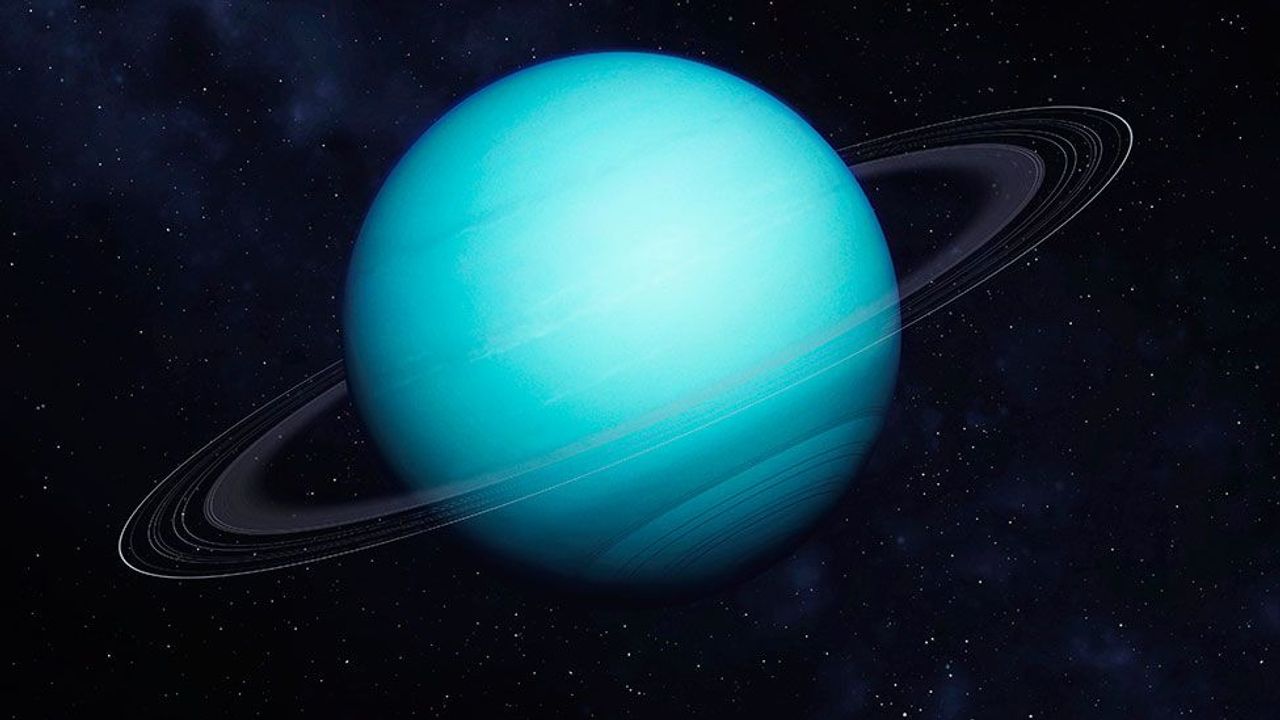
Among all the planets in our Solar System, Uranus immediately stands out because of its beautiful blue-green color. Floating billions of kilometers from the Sun, this icy giant appears calm, mysterious, and almost dreamlike. Unlike the reddish deserts of Mars or the colorful cloud bands of Jupiter, Uranus seems wrapped in a smooth blanket of pale blue.
But this stunning color is not just a coincidence or a trick of the eye. It is the result of fascinating physics, chemistry, and the way sunlight interacts with the planet’s atmosphere. Every shade we see tells a story about the gases surrounding Uranus, the sunlight traveling across the Solar System, and the invisible processes taking place high above the planet’s cloud tops.
Understanding why Uranus is blue takes us on a journey through planetary science and reveals how something as simple as color can teach us about an entire world.
A Planet Unlike Any Other
Uranus is the seventh planet from the Sun and the third-largest planet in our Solar System by diameter. It belongs to a category known as ice giants, along with its neighbor Neptune.
Although Uranus is often grouped with Jupiter and Saturn as a giant planet, it is very different inside. While Jupiter and Saturn are composed mostly of hydrogen and helium, Uranus contains much larger amounts of substances astronomers call “ices.” These include water, ammonia, and methane, although deep inside the planet these materials exist under enormous pressures rather than as ordinary ice.
Uranus is also famous for another remarkable feature—it rotates on its side. Instead of spinning upright like Earth, its axis is tilted by about 98 degrees. This unusual orientation creates some of the most extreme seasons in the Solar System, with each pole experiencing decades of continuous sunlight followed by decades of darkness.
Yet despite these extraordinary characteristics, the first thing most people notice is its peaceful blue appearance.
The Journey of Sunlight
To understand Uranus’ color, we first need to understand sunlight.
Although sunlight appears white, it actually contains all the colors of the visible spectrum. When white light passes through a prism, it separates into the familiar rainbow of red, orange, yellow, green, blue, indigo, and violet.
When sunlight reaches a planet, different materials in the atmosphere absorb some colors while reflecting or scattering others.
The colors that escape back into space are the ones our eyes—and telescopes—detect.
This simple process determines the appearance of every planet.
Mars looks red because iron-rich minerals reflect reddish light.
Earth appears blue from space largely because its oceans cover most of the surface, while its atmosphere also scatters blue wavelengths.
Venus looks pale yellow because of its thick cloud layers.
Uranus owes its color to an entirely different atmospheric ingredient.
Methane Is the Key
The main reason Uranus appears blue is methane gas.
Although methane makes up only a small percentage of Uranus’ atmosphere, it has a powerful effect on the planet’s appearance.
The atmosphere of Uranus is composed mostly of hydrogen and helium. Mixed within these gases is methane, which behaves in a unique way when sunlight passes through it.
Methane absorbs red wavelengths of visible light very effectively.
Blue and green wavelengths, however, are absorbed much less.
Because much of the red light disappears into the atmosphere while more blue and green light is reflected back into space, Uranus takes on its characteristic blue-green color.
In other words, Uranus is not producing blue light. Instead, methane removes much of the red light, leaving blue and green light to dominate what we see.
Why Doesn’t Uranus Look Deep Blue?
If methane reflects blue light, why isn’t Uranus a bright royal blue?
The answer lies in the complex interaction between methane, atmospheric particles, and clouds.
The atmosphere contains tiny particles known as aerosols and layers of clouds that scatter sunlight in many directions.
This scattering softens the colors reaching our eyes.
Instead of appearing intensely blue, Uranus looks pale blue-green.
The exact shade changes depending on the telescope, camera, observing conditions, and image processing techniques used by astronomers.
Some spacecraft images appear slightly greener, while others show a richer blue tone.
Both are scientifically accurate representations because the color depends on how the images are calibrated.
A Thick Atmosphere Hides the Planet
Unlike Earth, Uranus has no visible solid surface.
Everything we see is its atmosphere.
When astronomers observe Uranus, they are actually looking at the upper cloud layers high above the planet’s deeper interior.
These cloud layers contain hydrogen, helium, methane, and additional compounds that condense into clouds under the extremely cold temperatures found on Uranus.
Far below the visible atmosphere, pressure rises enormously, transforming the planet into a completely different environment.
Because the atmosphere is so deep, the beautiful blue color extends across the entire visible disk of the planet.
How Cold Is Uranus?
The atmosphere of Uranus is incredibly cold.
Cloud-top temperatures average around 49 kelvin, or approximately −224°C (−371°F), making Uranus the coldest planetary atmosphere in the Solar System despite Neptune being farther from the Sun.
Scientists are still investigating why Uranus emits much less internal heat than the other giant planets.
These freezing temperatures influence how gases behave in the atmosphere, allowing methane to exist in forms that help create the planet’s distinctive appearance.
Why Neptune Looks Darker
People often notice that Uranus and Neptune look very similar.
Both planets contain methane in their atmospheres, so both appear blue.
However, Neptune usually looks noticeably darker and richer in color.
For many years, scientists debated the reason.
Recent research indicates that Neptune contains a thinner haze layer than Uranus, allowing observers to see deeper into its methane-rich atmosphere. Because methane absorbs red light, viewing deeper layers enhances Neptune’s darker blue appearance.
Uranus, in contrast, has a thicker haze that reflects more sunlight before it reaches the methane-rich layers below.
This extra reflected light gives Uranus its softer, lighter blue-green color.
Although the two planets are often called twins, their atmospheres are more different than they first appear.
How Scientists Learned the Answer
Astronomers did not always know why Uranus was blue.
As telescopes improved during the twentieth century, scientists began analyzing the light reflected by planets using a technique called spectroscopy.
Every chemical substance absorbs and emits light at specific wavelengths, producing a unique spectral fingerprint.
When astronomers studied Uranus’ spectrum, they found strong absorption bands produced by methane.
These observations confirmed that methane was removing much of the red portion of sunlight.
Later observations by spacecraft and advanced Earth-based telescopes strengthened this understanding.
Today, scientists can model Uranus’ atmosphere with remarkable accuracy by combining observations with laboratory measurements of methane’s optical properties.
What Did Voyager 2 See?
In 1986, NASA’s Voyager 2 spacecraft became the only spacecraft ever to fly past Uranus.
Its cameras revealed a nearly featureless blue sphere.
Unlike Jupiter’s colorful storms or Saturn’s dramatic cloud bands, Uranus appeared surprisingly calm.
At first, scientists wondered whether the planet simply lacked weather.
Later observations with more powerful telescopes revealed that Uranus actually experiences storms, cloud systems, and powerful winds.
Many of these features were simply too subtle for Voyager 2’s cameras to detect during its brief flyby.
The spacecraft confirmed that the blue appearance extended across the planet and matched what methane absorption predicted.
Does Uranus Have Clouds?
Yes, Uranus has clouds.
In fact, it has several different cloud layers made from different materials.
The upper atmosphere contains methane clouds, while deeper layers may contain clouds made from hydrogen sulfide, ammonia, water, and other compounds under extreme pressures and temperatures.
Most of these clouds are hidden beneath thick atmospheric layers.
Occasionally, bright storms appear, temporarily interrupting the planet’s otherwise smooth appearance.
These storms provide valuable clues about atmospheric circulation deep inside Uranus.
Does Uranus Change Color?
Although Uranus always appears blue-green overall, its appearance is not completely constant.
The planet experiences seasons unlike those of any other world because of its extreme tilt.
Each season lasts about 21 Earth years.
As sunlight falls differently across the planet over decades, the brightness and distribution of clouds and atmospheric haze change.
These changes can subtly alter the planet’s color and brightness.
Astronomers have documented seasonal variations over many years using large observatories.
The differences are usually small, but they reveal that Uranus is a dynamic world rather than a motionless sphere.
Can You See the Blue Color From Earth?
Yes, but not with the naked eye.
Although Uranus can occasionally be seen without optical aid under exceptionally dark skies, it appears only as a tiny point of light.
Through a good telescope, however, observers can detect its delicate blue-green disk.
Larger telescopes reveal the color more clearly.
Professional observatories and space telescopes capture even finer details, showing subtle cloud structures and atmospheric features invisible to amateur instruments.
Could Humans Ever See Uranus Up Close?
If a future spacecraft entered orbit around Uranus, the view would likely be breathtaking.
Instead of looking down on oceans or continents, astronauts would see endless layers of pale blue clouds stretching across the horizon.
The sunlight would be much weaker than on Earth because Uranus is nearly 20 times farther from the Sun.
Even at midday, the Sun would appear as an exceptionally bright star rather than the large glowing disk we see from Earth.
Despite the dim sunlight, the atmosphere would still glow with its characteristic blue-green color as methane continued filtering the incoming light.
What Uranus Teaches Us About Other Worlds
Studying Uranus helps scientists understand much more than a single planet.
Many of the planets discovered around other stars are similar in size to Uranus and Neptune.
These distant worlds are often called sub-Neptunes or mini-Neptunes, and they appear to be among the most common types of planets in our galaxy.
By understanding how methane, clouds, haze, and atmospheric chemistry affect Uranus’ appearance, astronomers can better interpret observations of planets orbiting distant stars.
The lessons learned from Uranus are helping researchers explore thousands of newly discovered worlds across the Milky Way.
A Blue World Full of Mysteries
Although scientists understand why Uranus is blue, many questions remain unanswered.
Researchers are still investigating the planet’s unusual lack of internal heat, the detailed structure of its atmosphere, the composition of its deep interior, and the processes that drive its weather.
Future missions to Uranus could reveal entirely new discoveries about ice giant planets and the early history of our Solar System.
The planet’s gentle blue color is only the beginning of its story.
Conclusion
Uranus appears blue because of methane gas in its atmosphere. As sunlight reaches the planet, methane absorbs much of the red light while allowing more blue and green light to be scattered and reflected back into space. Thick layers of atmospheric haze soften this effect, giving Uranus its distinctive pale blue-green appearance.
What seems at first to be a simple color is actually the visible signature of complex atmospheric physics. Every photon of sunlight reflected from Uranus carries information about its gases, clouds, and weather, allowing scientists to study a world nearly three billion kilometers away.
The next time you see an image of Uranus, remember that its beautiful blue glow is not just one of the Solar System’s most striking sights—it is a window into the invisible chemistry and physics shaping one of the most mysterious planets ever discovered.