Imagine looking at the planets of our Solar System as spinning tops. Mercury spins almost upright. Earth tilts by about 23.5 degrees, giving us our familiar seasons. Mars has a similar tilt, while Jupiter and Saturn also rotate with relatively modest tilts. But then there is Uranus—a planet that seems to ignore the rules. Instead of spinning like a normal top, Uranus appears to be lying on its side, rolling around the Sun like a giant blue-green barrel.
This strange orientation has fascinated astronomers ever since the planet was discovered in 1781. Among all the major planets in the Solar System, Uranus is unique. Its unusual rotation affects everything from its seasons and weather to its magnetic field and even the behavior of its moons.
So why does Uranus rotate on its side? Did it form this way, or did something dramatic happen long ago? Scientists have spent decades investigating these questions, and while there is still some mystery, modern research has revealed several compelling clues.
Uranus Is Unlike Any Other Planet
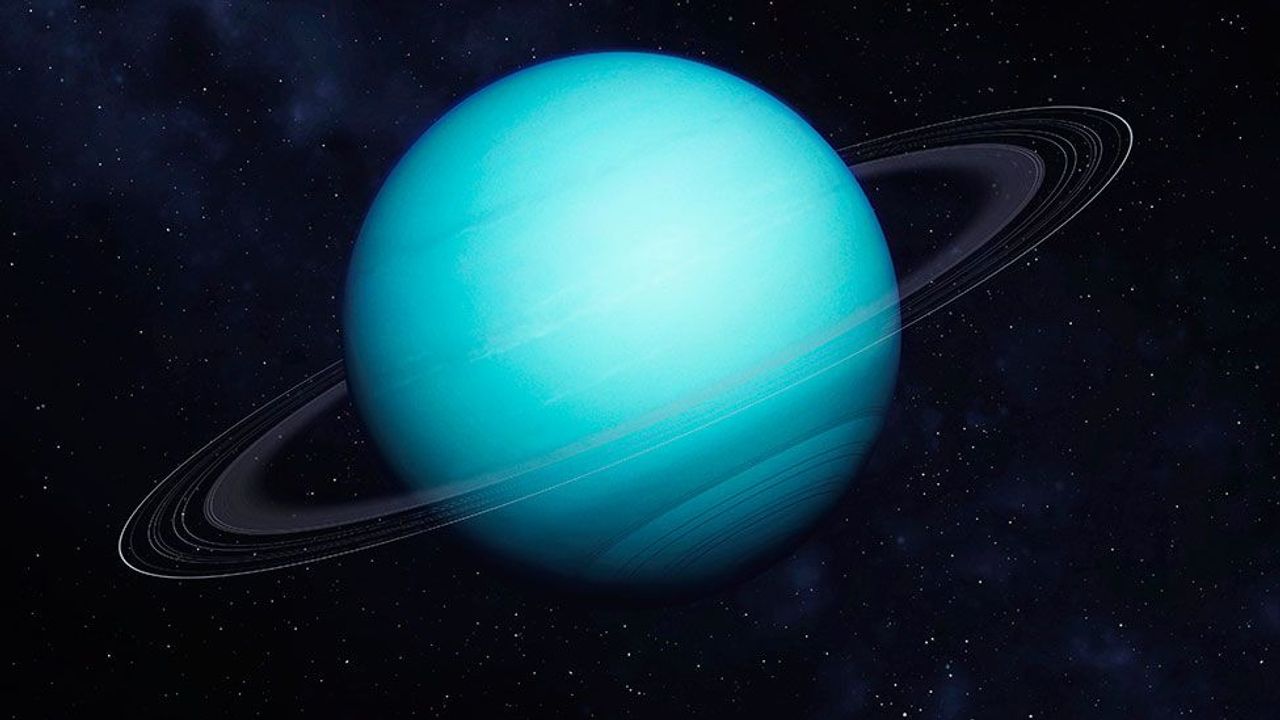
Uranus is the seventh planet from the Sun and the third-largest planet in the Solar System. It belongs to a category known as the ice giants, along with Neptune. Although both planets contain hydrogen and helium like Jupiter and Saturn, they also have much larger amounts of water, ammonia, and methane deep inside.
Methane gas in Uranus’s atmosphere absorbs red light and reflects blue and green wavelengths, giving the planet its beautiful pale cyan color.
But its appearance is only part of what makes Uranus extraordinary.
The planet’s rotation is unlike anything else among the major planets. Most planets rotate with their poles pointing roughly “up” and “down” relative to the plane of their orbits. Uranus, however, is tilted by about 98 degrees.
This means its axis of rotation is almost parallel to the plane in which it orbits the Sun.
In simple terms, Uranus is essentially spinning on its side.
What Does a 98-Degree Tilt Mean?
Earth’s axis is tilted by about 23.5 degrees. That small tilt creates the changing seasons we experience every year.
If Earth had no tilt, much of the planet would experience nearly the same amount of daylight throughout the year. Seasons would be far less dramatic.
Now imagine increasing Earth’s tilt to nearly 100 degrees.
That is essentially what happened to Uranus.
Instead of rotating upright, Uranus rotates almost horizontally. As it travels around the Sun, one pole points almost directly toward the Sun for years at a time, while the opposite pole remains in darkness.
The result is one of the strangest seasonal cycles in the Solar System.
Uranus Has Extremely Long Seasons
Because Uranus takes about 84 Earth years to complete one orbit around the Sun, each season lasts roughly 21 Earth years.
For decades, one pole experiences continuous sunlight while the opposite pole remains in nearly complete darkness.
Imagine living somewhere where the Sun never sets for more than twenty years.
Then imagine waiting another twenty years before seeing daylight again.
That is the reality on Uranus.
As the planet continues its orbit, the lighting gradually changes until both hemispheres receive sunlight more evenly around the equinoxes. Then the opposite pole enters decades of continuous daylight.
These extreme seasonal changes influence the planet’s atmosphere and weather in ways scientists are still trying to understand.
Did a Giant Collision Knock Uranus Over?
The most widely accepted explanation is both dramatic and violent.
Billions of years ago, during the chaotic early history of the Solar System, Uranus may have suffered a colossal collision with another massive object.
At that time, planets were still forming. Countless large bodies, called planetary embryos or protoplanets, orbited the young Sun. Collisions between these objects were common.
Scientists think one of these enormous worlds may have struck Uranus.
The impact would have been unimaginably powerful.
Instead of destroying the planet, the collision could have knocked Uranus over, permanently changing its orientation.
Computer simulations show that an impact involving an object roughly one to three times the mass of Earth could produce a tilt similar to what we observe today.
Such a collision might also explain several other unusual features of Uranus.
The Impact May Have Changed More Than Its Tilt
A giant collision would not simply alter the planet’s rotation.
It could also have affected its internal structure, atmosphere, and system of moons.
Some researchers believe the impact may have mixed the planet’s interior, changing how heat moves from the core toward the atmosphere.
Interestingly, Uranus emits very little internal heat compared with the other giant planets.
Jupiter, Saturn, and Neptune all release significantly more heat than they receive from the Sun.
Uranus, however, radiates only slightly more energy than it absorbs.
Some scientists suggest that a massive collision may have disrupted the movement of heat inside the planet, although this idea remains an active area of research.
Could Several Smaller Collisions Be Responsible?
Not all scientists agree that one enormous impact is the complete answer.
Another possibility is that Uranus experienced several smaller but significant collisions over millions of years.
Instead of one catastrophic event, repeated impacts could gradually have altered the planet’s orientation.
Computer models show that multiple impacts are capable of changing a planet’s spin direction while avoiding some problems associated with a single massive collision.
This scenario remains scientifically plausible, and researchers continue to compare it with observations.
Could Gravity Have Tilted Uranus?
There is another intriguing possibility.
Some scientists propose that Uranus may not have required a giant impact at all.
Instead, gravitational interactions with a massive object orbiting nearby during the early Solar System might slowly have tipped the planet over.
In this scenario, Uranus’s axis gradually changed orientation through complex gravitational effects rather than a sudden collision.
Although this idea is supported by some computer simulations, it requires very specific conditions and is generally considered less likely than the giant-impact hypothesis.
Even so, it demonstrates that planetary evolution can be more complicated than once believed.
How Does Uranus Spin Today?
Despite its unusual orientation, Uranus rotates surprisingly quickly.
A single day on Uranus lasts about 17 hours.
Like Venus, Uranus rotates in a retrograde direction. This means it spins opposite to the direction followed by most planets in the Solar System.
However, because Uranus is tilted beyond 90 degrees, describing its rotation becomes somewhat more complicated. The planet’s orientation makes its spin appear highly unusual compared with the other planets.
Its rapid rotation helps shape atmospheric circulation and influences its magnetic field.
A Strange Magnetic Field
Uranus is unusual in another remarkable way.
Most planets generate magnetic fields that are roughly aligned with their rotation axes.
Earth’s magnetic field is only tilted by about 11 degrees relative to its rotation axis.
Uranus is completely different.
Its magnetic field is tilted by nearly 59 degrees relative to its rotation axis and is also significantly offset from the planet’s center.
As Uranus rotates, this oddly shaped magnetic field twists through space in a highly complex pattern.
Scientists believe this unusual magnetic field is related to the structure and motion of electrically conducting fluids deep inside the planet.
Understanding exactly how it forms remains one of the biggest mysteries surrounding Uranus.
What Happens to the Atmosphere?
For many years, Uranus appeared to be a calm, nearly featureless world.
Images from NASA’s Voyager 2 spacecraft in 1986 showed a smooth blue planet with few visible clouds.
Later observations using powerful telescopes, including the Hubble Space Telescope and large ground-based observatories, revealed that Uranus is much more active than previously thought.
Storms occasionally erupt across its atmosphere.
Bright cloud systems appear and disappear.
Powerful winds race through the upper atmosphere at hundreds of kilometers per hour.
These atmospheric changes seem to become more active as sunlight reaches different regions during the planet’s long seasonal cycle.
Its unusual tilt plays an important role in driving these changes.
What About Uranus’s Rings?
Many people are surprised to learn that Uranus has rings.
Although they are much darker and fainter than Saturn’s spectacular ring system, Uranus possesses a collection of narrow rings composed mainly of dark material.
Because the planet rotates on its side, its rings also appear highly tilted relative to the rest of the Solar System.
As Uranus orbits the Sun, the rings present dramatically different views from Earth. Sometimes they appear nearly edge-on and become difficult to detect. At other times, they are more fully visible.
The Moons Follow the Tilt
Uranus has 28 known moons, many of which are named after characters from the works of William Shakespeare and Alexander Pope.
The major moons—including Titania, Oberon, Umbriel, Ariel, and Miranda—orbit around the planet’s tilted equator.
This means the entire Uranian system appears tipped over.
If the giant-impact hypothesis is correct, the collision likely influenced not only Uranus itself but also the formation or evolution of its moons.
Some scientists think the impact may even have produced a disk of debris that later helped shape the current satellite system.
Could Other Planets Be Like Uranus?
As astronomers discover thousands of planets around distant stars, they have found that planetary systems can be incredibly diverse.
Some exoplanets likely have extreme tilts similar to—or even greater than—that of Uranus.
Others may rotate upside down or experience dramatic seasonal changes unlike anything in our Solar System.
Studying Uranus gives scientists valuable insight into how these distant worlds might behave.
Understanding why Uranus rotates on its side helps astronomers better understand planetary formation throughout the galaxy.
What We Still Don’t Know
Despite decades of research, scientists have not solved every mystery surrounding Uranus.
The exact cause of its extreme tilt remains uncertain.
Researchers continue using advanced computer simulations to compare different formation scenarios.
Future spacecraft could provide the evidence needed to determine whether a giant collision, multiple impacts, gravitational interactions, or some combination of these processes shaped the planet.
Scientists also hope to better understand why Uranus emits so little internal heat, how its unusual magnetic field is generated, and how its atmosphere responds to its extraordinary seasons.
Future Missions Could Reveal the Answer
Remarkably, only one spacecraft has ever visited Uranus.
NASA’s Voyager 2 flew past the planet in January 1986, providing humanity’s first—and so far only—close-up look at this fascinating ice giant.
Since then, astronomers have relied on telescopes to study Uranus from millions or even billions of kilometers away.
Many planetary scientists consider a dedicated mission to Uranus one of the highest priorities for future Solar System exploration.
An orbiter equipped with modern instruments could study the atmosphere, magnetic field, rings, moons, and interior in unprecedented detail.
Such a mission could finally explain why Uranus became the Solar System’s sideways planet.
A Planet That Challenges Everything We Expect
Uranus reminds us that nature often refuses to follow our expectations. While the other major planets spin in relatively familiar ways, Uranus rolls through space with an almost impossible-looking tilt, experiencing seasons unlike anywhere else in the Solar System.
The leading explanation points to a colossal collision during the Solar System’s violent youth, though alternative ideas involving multiple impacts or long-term gravitational interactions remain under investigation. Whatever the true cause, the planet’s unusual orientation has shaped every aspect of its evolution—from its extraordinary seasons and tilted rings to its mysterious magnetic field and dynamic atmosphere.
Far from being an odd curiosity, Uranus is a window into the chaotic processes that built the planets billions of years ago. As future missions explore this distant ice giant, they may finally reveal how one of the Solar System’s most unusual worlds came to spin on its side—and, in doing so, deepen our understanding of how planets form and evolve throughout the universe.