For thousands of years, humans have looked up at the night sky with wonder. The stars, planets, and faint glowing clouds have inspired myths, guided travelers, and sparked countless questions about our place in the universe. But no matter how carefully we observed from Earth, our view of the cosmos was always limited by one unavoidable obstacle—the Earth’s atmosphere.
Today, thanks to space telescopes, we can see the universe with extraordinary clarity. These remarkable observatories orbit high above our planet, capturing breathtaking images of distant galaxies, exploding stars, mysterious black holes, and planets around other stars. They have transformed astronomy, revealing a universe far more dynamic, beautiful, and complex than anyone imagined.
A space telescope is much more than a camera in space. It is one of humanity’s most powerful scientific tools, allowing astronomers to look deeper into the universe, further back in time, and closer to the origins of everything we know.
What Is a Space Telescope?
A space telescope is a telescope that operates outside Earth’s atmosphere, either orbiting our planet or traveling through space. Unlike ground-based telescopes, which observe the sky from Earth’s surface, space telescopes avoid the atmospheric effects that blur, distort, or block incoming light.
Like all telescopes, a space telescope is designed to collect electromagnetic radiation from distant objects. This radiation includes visible light as well as invisible forms such as infrared light, ultraviolet light, X-rays, gamma rays, and sometimes even other wavelengths that cannot reach Earth’s surface.
By collecting and analyzing this radiation, space telescopes help scientists study stars, planets, galaxies, nebulae, black holes, comets, and many other cosmic objects.
Why Do We Need Space Telescopes?
The Earth’s atmosphere makes life possible, but it also creates challenges for astronomers.
As light from distant stars travels through the atmosphere, it passes through layers of air with constantly changing temperatures and densities. These changes bend the light slightly, making stars appear to twinkle. While this twinkling is beautiful to the naked eye, it blurs images captured by telescopes.
Even more importantly, the atmosphere blocks many types of electromagnetic radiation. Most ultraviolet light, X-rays, gamma rays, and much of the infrared spectrum never reach the ground because they are absorbed by atmospheric gases.
A telescope placed above the atmosphere avoids these problems. It can capture sharper images and observe wavelengths that are impossible to detect from Earth, giving astronomers a much more complete view of the universe.
How Does a Space Telescope Work?
Although space telescopes operate far above Earth, their basic purpose is similar to that of telescopes on the ground.
A space telescope gathers light or other forms of electromagnetic radiation from distant objects using mirrors or lenses. Most modern space telescopes use large mirrors because mirrors can collect more light and produce clearer images.
The collected light is directed toward highly sensitive scientific instruments. These instruments include cameras, spectrographs, detectors, and sensors designed to record different wavelengths.
The telescope converts incoming radiation into digital data, which is transmitted to Earth using radio signals. Scientists then process this data into images, measurements, and scientific observations.
Unlike ordinary cameras, many space telescopes do not simply take pictures. They measure brightness, temperature, chemical composition, movement, magnetic fields, and many other properties of celestial objects.
The Difference Between Space Telescopes and Ground-Based Telescopes
Ground-based telescopes have made many important discoveries and continue to play a vital role in astronomy. Modern observatories located on high mountains often use advanced technologies such as adaptive optics to reduce atmospheric distortion.
However, space telescopes offer several important advantages.
Because they operate above the atmosphere, they produce much sharper images. They can observe wavelengths blocked by Earth’s atmosphere and can often monitor celestial objects continuously without interference from weather, clouds, or daylight.
Ground telescopes are usually easier to repair and upgrade because they remain on Earth. Space telescopes, on the other hand, are much more expensive to launch and maintain. Once placed in space, repairs can be extremely difficult or even impossible, depending on their location.
For this reason, astronomers often use both kinds of telescopes together, combining their strengths to better understand the universe.
What Can Space Telescopes See?
Space telescopes observe an astonishing variety of objects across the universe.
They study nearby planets within our Solar System, revealing details of their atmospheres, weather systems, and surfaces. They observe distant stars at every stage of their lives, from their birth inside giant clouds of gas to their dramatic deaths as supernovae.
They capture images of colorful nebulae where new stars are forming. They investigate black holes, neutron stars, pulsars, and other extreme objects where the laws of physics are pushed to their limits.
Space telescopes also observe galaxies millions or even billions of light-years away. Because light takes time to travel through space, looking farther into the universe also means looking farther back in time. Some galaxies observed today appear as they existed only a few hundred million years after the Big Bang.
In recent years, space telescopes have also become powerful tools for studying exoplanets—planets that orbit stars beyond our Solar System. By analyzing tiny changes in starlight, astronomers can learn about these planets’ sizes, temperatures, and even the gases present in their atmospheres.
Observing More Than Visible Light
Human eyes can detect only a small portion of the electromagnetic spectrum, known as visible light.
The universe, however, shines across many different wavelengths.
Infrared telescopes observe cool objects such as dust clouds, newly forming stars, and distant galaxies hidden behind cosmic dust.
Ultraviolet telescopes study extremely hot stars, energetic gases, and the atmospheres of planets.
X-ray telescopes reveal violent regions where matter reaches millions of degrees, such as around black holes, neutron stars, and exploding stars.
Gamma-ray telescopes investigate the universe’s most energetic events, including gamma-ray bursts and active galaxies powered by supermassive black holes.
Each wavelength tells a different part of the universe’s story. By combining observations from multiple space telescopes, astronomers can build a far more complete picture of cosmic events.
The Hubble Space Telescope
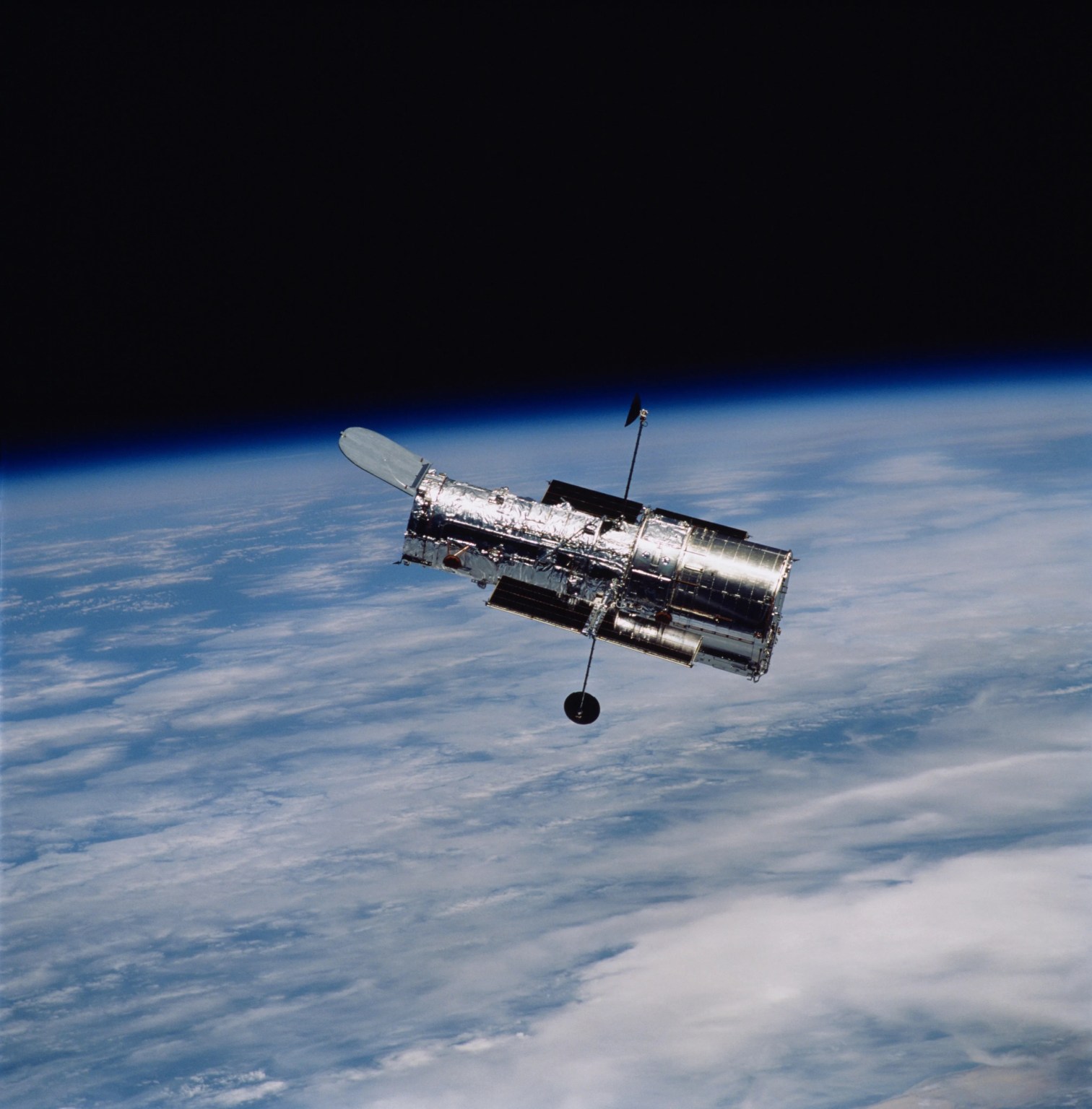
Among all space telescopes, none has had a greater impact on astronomy than the Hubble Space Telescope.
Launched in 1990, Hubble orbits Earth about 540 kilometers (335 miles) above the surface. During more than three decades of operation, it has transformed nearly every area of astronomy.
Hubble has captured some of the most famous images ever taken, including colorful nebulae, distant galaxies, and spectacular star clusters. Its observations have helped scientists determine the age of the universe more accurately, measure the rate at which the universe is expanding, study black holes, and observe planets both within and beyond our Solar System.
One of Hubble’s greatest achievements is the Hubble Deep Field and its later deep-field observations. By staring at a tiny, seemingly empty patch of sky for many days, Hubble revealed thousands of distant galaxies, demonstrating that the universe contains vastly more galaxies than previously imagined.
The James Webb Space Telescope
The James Webb Space Telescope represents one of the most advanced scientific instruments ever built.
Launched in 2021, Webb observes primarily in infrared light, allowing it to see through clouds of cosmic dust that block visible light. It operates around the Sun-Earth Lagrange Point 2, approximately 1.5 million kilometers (930,000 miles) from Earth.
Its enormous segmented mirror measures 6.5 meters (21.3 feet) across, making it much larger than Hubble’s primary mirror.
Webb was designed to study the earliest galaxies, investigate how stars and planets form, analyze the atmospheres of exoplanets, and explore many other questions about the universe.
Its first images revealed extraordinary detail and demonstrated its ability to observe some of the oldest known galaxies, providing new insights into the early universe.
Other Important Space Telescopes
Although Hubble and Webb are widely known, many other space telescopes have made remarkable contributions to science.
The Chandra X-ray Observatory studies powerful X-ray sources such as black holes, neutron stars, and galaxy clusters.
The Spitzer Space Telescope explored the infrared universe for more than sixteen years, helping scientists investigate exoplanets, brown dwarfs, and star-forming regions.
The Kepler Space Telescope revolutionized the search for exoplanets by discovering thousands of planets orbiting distant stars.
The Transiting Exoplanet Survey Satellite (TESS) continues this search by surveying nearly the entire sky for new planetary systems.
The Gaia spacecraft is creating the most detailed three-dimensional map of our Milky Way galaxy by measuring the positions and motions of billions of stars.
Each mission focuses on different scientific questions, expanding humanity’s understanding of the cosmos.
How Space Telescopes Discover Exoplanets
One of the most exciting achievements of modern astronomy is the discovery of thousands of planets beyond our Solar System.
Space telescopes play a central role in this search.
Many exoplanets are discovered using the transit method. When a planet passes in front of its parent star, it blocks a tiny fraction of the star’s light. Sensitive instruments measure these small changes in brightness.
Repeated observations allow scientists to determine the planet’s size, orbital period, and distance from its star.
Some advanced space telescopes can even analyze starlight passing through an exoplanet’s atmosphere during a transit. This technique reveals the presence of molecules such as water vapor, carbon dioxide, methane, and other gases.
Although detecting signs of life remains extremely challenging, these observations help scientists identify potentially habitable worlds.
Looking Back in Time
One of the most fascinating aspects of space telescopes is their ability to observe the past.
Light travels at a finite speed—about 299,792 kilometers (186,282 miles) per second.
This means light from the Moon takes about 1.3 seconds to reach Earth.
Light from the Sun takes about eight minutes.
Light from the nearest star beyond the Sun takes more than four years.
When astronomers observe a galaxy located billions of light-years away, they see that galaxy as it existed billions of years ago.
In this way, space telescopes act as time machines, allowing scientists to study the early history of the universe.
The Technology Behind Space Telescopes
Building a space telescope is one of the greatest engineering challenges ever undertaken.
The instruments must survive the intense vibrations of launch, extreme temperatures in space, cosmic radiation, and years of continuous operation without routine maintenance.
Many space telescopes use precision mirrors polished to extraordinary accuracy. Even tiny imperfections could reduce image quality.
They also carry highly sensitive detectors capable of recording incredibly faint signals from distant galaxies.
Some telescopes require sophisticated cooling systems because heat from the telescope itself could interfere with infrared observations.
Engineers also design complex communication systems that transmit enormous amounts of scientific data back to Earth, where teams of researchers analyze the information.
Challenges of Operating in Space
Although space offers clear views of the universe, it also presents significant challenges.
Space telescopes must operate in a harsh environment without air, weather, or easy access for repairs.
Micrometeoroids traveling at tremendous speeds can damage sensitive equipment.
Radiation from the Sun and deep space can affect electronic systems.
Power is usually generated by solar panels, meaning spacecraft must carefully manage their energy resources.
Communication delays increase as telescopes operate farther from Earth.
Because missions often cost billions of dollars and require decades of planning, reliability is essential. Every component must function precisely, often for many years beyond its original design life.
How Space Telescopes Have Changed Astronomy
Before the space age, many parts of the universe remained hidden.
Space telescopes have transformed our understanding of nearly every major field of astronomy.
They have shown that nearly every large galaxy contains a supermassive black hole at its center.
They have revealed that planets are common throughout the Milky Way.
They have helped refine measurements of the universe’s age and expansion.
They have captured evidence of galaxies forming shortly after the Big Bang.
They have observed stars being born inside dusty clouds and watched planets forming around young stars.
Each new observation has expanded humanity’s understanding of the cosmos.
The Future of Space Telescopes
Astronomy continues to advance rapidly, and future space telescopes promise even greater discoveries.
Scientists are designing new observatories capable of directly imaging Earth-like planets around nearby stars. Others will investigate dark matter, dark energy, gravitational waves, and the earliest moments of cosmic history.
Future missions may detect chemical signatures associated with potentially habitable worlds or uncover entirely new classes of astronomical objects.
As technology improves, space telescopes will become even more powerful, allowing humanity to explore regions of the universe that remain beyond our current reach.
Why Space Telescopes Matter
Space telescopes are far more than scientific instruments. They represent humanity’s desire to understand the universe and our place within it. Every image they capture and every measurement they make adds another piece to the grand puzzle of cosmic history.
Their discoveries influence not only astronomy but also physics, chemistry, planetary science, and our understanding of the origins of stars, planets, and life itself. They inspire new generations of scientists, engineers, and curious minds to ask bigger questions and seek deeper answers.
Conclusion
A space telescope is an observatory placed beyond Earth’s atmosphere to study the universe with exceptional clarity. By escaping the blurring effects of the atmosphere and observing wavelengths that cannot reach the ground, space telescopes provide an unparalleled view of the cosmos. They reveal distant galaxies, newborn stars, black holes, exoplanets, and some of the earliest structures formed after the Big Bang.
From the pioneering achievements of the Hubble Space Telescope to the groundbreaking discoveries of the James Webb Space Telescope, these extraordinary observatories have transformed modern astronomy. As future missions continue to push the boundaries of technology and exploration, space telescopes will remain among humanity’s most powerful tools for uncovering the mysteries of the universe, helping us better understand not only the cosmos above us but also our own place within its vast and ever-expanding story.