Every day, the Sun rises in the sky, bathing Earth in warmth and light. It appears calm, constant, and dependable. Yet beneath its brilliant surface lies one of the most violent and energetic environments in the Solar System. Giant rivers of superheated plasma twist and swirl under the Sun’s surface, while invisible magnetic fields become tangled like stretched rubber bands. Occasionally, those magnetic fields snap and reconnect in a sudden burst of energy so powerful that it briefly outshines millions of hydrogen bombs exploding at the same time.
This spectacular event is known as a solar flare.
Although solar flares occur nearly 150 million kilometers (93 million miles) away from Earth, their effects can travel across space and influence our planet. They can interfere with radio communications, disrupt satellite operations, affect astronauts in space, and even contribute to dazzling auroras near Earth’s poles.
Understanding solar flares helps scientists better predict space weather and protect the technology that modern society depends on every day.
Understanding a Solar Flare
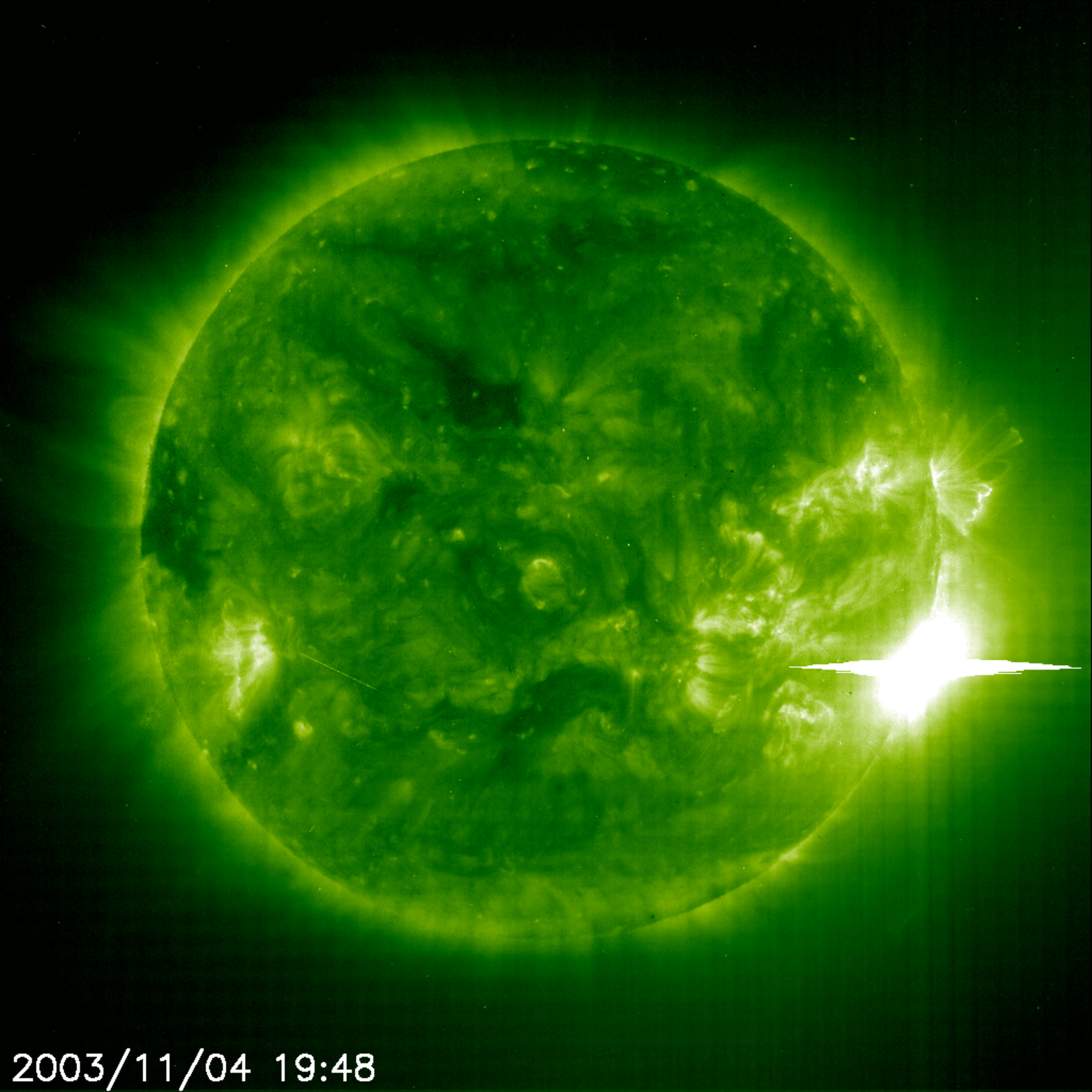
A solar flare is a sudden, intense release of energy from the Sun’s atmosphere. It occurs when magnetic energy that has built up in the Sun’s atmosphere is rapidly released through a process called magnetic reconnection.
During a flare, enormous amounts of energy are converted into light, heat, and high-speed particles. The event produces radiation across nearly the entire electromagnetic spectrum, including radio waves, visible light, ultraviolet radiation, X-rays, and gamma rays.
Unlike explosions on Earth, which require oxygen or chemical reactions, solar flares are powered by the Sun’s powerful magnetic fields interacting with its electrically charged plasma.
A typical solar flare lasts from a few minutes to several hours, depending on its size and complexity.
The Sun Is Not a Solid World
To understand solar flares, it is important to understand the Sun itself.
The Sun is not a solid object like Earth. Instead, it is an enormous sphere of extremely hot plasma—a state of matter in which electrons are separated from atomic nuclei.
Because the Sun is made of plasma, it conducts electricity very well. Moving plasma creates magnetic fields, and those magnetic fields constantly change as different parts of the Sun rotate at different speeds.
The Sun rotates faster near its equator than near its poles, a phenomenon known as differential rotation. This uneven rotation twists and stretches magnetic field lines over time.
Eventually, the magnetic fields become so stressed that they suddenly rearrange themselves.
When this happens, an enormous amount of stored magnetic energy is released almost instantly.
That release is a solar flare.
Where Solar Flares Occur
Solar flares usually originate in regions of intense magnetic activity called active regions.
These regions are often associated with sunspots, which are relatively cooler and darker areas visible on the Sun’s surface.
Sunspots are not actually dark. They simply appear darker because they are cooler than the surrounding surface. Even so, they remain extremely hot, with temperatures of around 3,500 to 4,500 degrees Celsius, compared with roughly 5,500 degrees Celsius for the surrounding photosphere.
The largest and most magnetically complex sunspot groups are the most likely places for powerful solar flares to occur.
Scientists carefully monitor these active regions because they can provide clues about future space weather.
What Causes a Solar Flare?
The driving force behind every solar flare is magnetism.
The Sun’s magnetic field is incredibly dynamic. As hot plasma moves beneath the surface, magnetic field lines become twisted, stretched, and tangled.
Imagine twisting several rubber bands together until they become tightly wound.
Eventually, the tension becomes so great that they suddenly snap into a new arrangement.
Something similar happens inside the Sun’s magnetic field.
During magnetic reconnection, magnetic field lines break and reconnect in a different configuration. This process releases enormous amounts of stored magnetic energy within minutes.
That energy rapidly heats surrounding plasma to tens of millions of degrees Celsius and accelerates charged particles to speeds approaching the speed of light.
The resulting burst of radiation is what we observe as a solar flare.
How Powerful Are Solar Flares?
Solar flares are among the most energetic events in the Solar System.
Even relatively small flares release tremendous amounts of energy.
Large flares can release energy equivalent to billions of megatons of TNT.
The plasma in the flare region may reach temperatures exceeding 10 million degrees Celsius and, in the largest events, can become even hotter.
Despite these extraordinary temperatures, Earth remains safe because of its great distance from the Sun.
The main concern is not the heat itself but the high-energy radiation and energetic particles that can affect Earth’s space environment.
The Different Types of Solar Flares
Scientists classify solar flares according to the peak intensity of their X-ray emission measured by satellites.
The classification system uses five primary categories: A, B, C, M, and X.
A-class flares are the weakest and generally have little effect on Earth.
B-class flares are also relatively small.
C-class flares are common and usually produce only minor impacts.
M-class flares are medium-strength events that can sometimes cause brief radio communication disruptions and stronger auroral displays.
X-class flares are the most powerful. Some X-class flares are capable of producing significant space weather effects that may disrupt satellites, radio communications, and navigation systems.
Within each category, a numerical scale provides additional detail. For example, an X2 flare is twice as intense in X-ray output as an X1 flare, while an X10 flare is ten times stronger than an X1 flare.
Solar Flares and Coronal Mass Ejections
Solar flares are often confused with coronal mass ejections, or CMEs.
Although they frequently occur together, they are different phenomena.
A solar flare is primarily a burst of electromagnetic radiation.
A coronal mass ejection is the eruption of billions of tons of solar plasma and magnetic fields into space.
A solar flare travels at the speed of light because it consists of electromagnetic radiation.
A coronal mass ejection travels much more slowly, typically taking one to several days to reach Earth if it is directed toward our planet.
Some large solar flares occur without major CMEs, while some CMEs occur with relatively modest flares.
However, the strongest space weather events often involve both.
How Long Does It Take Solar Flare Radiation to Reach Earth?
Because electromagnetic radiation travels at the speed of light, the radiation from a solar flare reaches Earth in about eight minutes.
This is the same amount of time sunlight normally takes to travel from the Sun to Earth.
As a result, scientists have very little warning once a flare occurs.
Energetic charged particles accelerated by the flare may arrive minutes to hours later, depending on their speed.
If a coronal mass ejection accompanies the flare, it generally arrives much later, usually within one to three days.
How Solar Flares Affect Earth
Earth is remarkably well protected by its atmosphere and magnetic field.
Our atmosphere absorbs much of the harmful ultraviolet, X-ray, and gamma-ray radiation produced by solar flares, preventing it from reaching the ground.
Meanwhile, Earth’s magnetic field deflects many charged particles that would otherwise strike the planet directly.
Even with these natural defenses, solar flares can still influence modern technology.
Strong flares can temporarily disrupt high-frequency radio communications by increasing ionization in Earth’s upper atmosphere.
Navigation systems may experience reduced accuracy during periods of intense solar activity.
Satellites can encounter increased radiation that affects sensitive electronics and communication systems.
Astronauts outside Earth’s protective atmosphere face greater radiation exposure during major solar events, making space weather forecasting especially important for human spaceflight.
Solar Flares and Auroras
One of the most beautiful consequences of solar activity is the appearance of auroras.
When energetic particles associated with solar activity interact with Earth’s magnetic field and atmosphere, they excite oxygen and nitrogen atoms high above the surface.
As these atoms return to lower energy states, they emit light.
The result is the breathtaking display known as the Aurora Borealis, or Northern Lights, in the Northern Hemisphere, and the Aurora Australis, or Southern Lights, in the Southern Hemisphere.
The most spectacular auroras usually occur when Earth is struck by a strong coronal mass ejection, although energetic particles associated with solar flares can also contribute to space weather conditions that enhance these displays.
The Solar Cycle
Solar flares do not occur at a constant rate.
Instead, their frequency changes over an approximately 11-year cycle known as the solar cycle.
During solar minimum, the Sun has relatively few sunspots and produces fewer solar flares.
During solar maximum, sunspots become much more numerous, and solar flares occur far more frequently.
This cycle is driven by changes in the Sun’s magnetic field.
Roughly every 11 years, solar activity rises from minimum to maximum and then declines again. The Sun’s overall magnetic polarity reverses approximately every solar cycle, so a complete magnetic cycle spans about 22 years.
Scientists closely monitor the solar cycle because it helps predict periods of increased space weather activity.
Can Solar Flares Harm People on Earth?
For people on Earth’s surface, solar flares pose very little direct danger.
Our atmosphere blocks the most harmful radiation before it reaches the ground.
You cannot feel a solar flare or become sunburned because of one.
However, astronauts aboard spacecraft or traveling beyond Earth’s magnetic field require additional protection.
Airline passengers and crews on high-latitude flights may experience small increases in radiation exposure during particularly intense solar events, though the doses are generally low and carefully monitored by aviation authorities.
The greatest risks from solar flares involve technological systems rather than direct effects on people on the ground.
How Scientists Observe Solar Flares
Modern solar observatories constantly watch the Sun.
Spacecraft positioned above Earth’s atmosphere provide continuous observations using instruments that detect visible light, ultraviolet radiation, X-rays, and other wavelengths.
These satellites monitor active regions, sunspots, magnetic fields, and changing conditions in the Sun’s atmosphere.
Ground-based observatories also contribute valuable information by studying different layers of the Sun.
Together, these observations help scientists understand how solar flares develop and improve forecasts of space weather.
Although predicting the exact timing of a solar flare remains challenging, scientists have become increasingly successful at identifying regions where flares are more likely to occur.
Historic Solar Flares
Throughout history, the Sun has occasionally produced exceptionally powerful solar storms.
One of the most famous occurred in 1859 and is known as the Carrington Event, named after British astronomer Richard Carrington, who observed an intense solar flare.
The associated geomagnetic storm caused telegraph systems around the world to malfunction, with some operators receiving electric shocks and telegraph equipment continuing to operate even after being disconnected from power sources.
Auroras became visible much farther from the poles than usual, appearing across regions where they are rarely seen.
If a similarly powerful event occurred today, it could have much greater consequences because modern civilization relies heavily on satellites, communication networks, navigation systems, and electrical infrastructure.
For this reason, understanding solar flares has become increasingly important.
Solar Flares Beyond Our Solar System
Our Sun is not unique in producing flares.
Many other stars experience stellar flares, and some are far more energetic than those produced by the Sun.
Young, rapidly rotating stars and certain types of red dwarf stars can generate enormous “superflares” that release vastly more energy than the strongest solar flares ever observed from our Sun.
Studying these stellar flares helps astronomers understand magnetic activity across the universe and evaluate whether planets orbiting active stars could remain suitable for life.
Why Solar Flares Matter
Solar flares are more than fascinating explosions on a distant star.
They reveal the extraordinary power of magnetic fields, help scientists understand how stars behave, and remind us that Earth exists within a dynamic space environment.
Modern society depends on satellites, global communications, navigation systems, weather forecasting, financial networks, and electrical infrastructure that can all be influenced by space weather.
As humanity expands its presence in space through missions to the Moon, Mars, and beyond, understanding solar flares becomes increasingly essential for protecting astronauts and spacecraft.
Every observation of the Sun brings scientists closer to improving forecasts and reducing the risks posed by these powerful events.
Conclusion
A solar flare is a sudden and powerful burst of energy released from the Sun when stressed magnetic fields rapidly reconnect. These events produce intense radiation across the electromagnetic spectrum and are among the most energetic phenomena in the Solar System.
Although they occur millions of kilometers away, solar flares remind us that our nearest star is far from quiet. They shape the space environment around Earth, influence modern technology, and offer scientists valuable insights into the behavior of stars throughout the universe.
The next time you look up at the bright, steady Sun, it is worth remembering that beneath its calm appearance lies a restless engine of magnetic energy—one capable of unleashing astonishing bursts of power that echo across the Solar System.