Far beyond the warmth of the Sun, where sunlight is so faint that daytime resembles a deep twilight, lies a world unlike any other in our Solar System. Neptune is a planet of violent winds, mysterious storms, invisible rings, and a beautiful deep-blue appearance that has fascinated astronomers since its discovery. Although it is the eighth and farthest recognized planet from the Sun, Neptune remains one of the least explored worlds because of its incredible distance from Earth.
This distant giant is a place where nature operates on a grand scale. Winds roar faster than the speed of sound, enormous storms drift across its atmosphere, and a tiny amount of sunlight struggles to warm a planet that is billions of kilometers away. Yet despite its remoteness, Neptune plays a crucial role in helping scientists understand how planets form, how giant worlds evolve, and what similar planets around other stars might be like.
Neptune at a Glance
Neptune is the eighth planet from the Sun and the fourth-largest planet by diameter. It is also the third most massive planet in the Solar System, surpassed only by Jupiter and Saturn.
Neptune belongs to a category of planets known as ice giants. Unlike Jupiter and Saturn, which are mainly composed of hydrogen and helium, Neptune contains much larger amounts of water, ammonia, and methane deep within its interior. These substances exist under enormous pressure and temperature, forming exotic layers that have no equivalent on Earth.
Because of its immense distance, sunlight takes about four hours to reach Neptune, compared to just over eight minutes for Earth.
How Neptune Was Discovered
Neptune has one of the most remarkable discovery stories in astronomy.
Unlike the other planets visible to the naked eye, Neptune cannot usually be seen without a telescope. Its discovery in 1846 was not the result of accidentally spotting it in the sky. Instead, it was discovered through mathematics.
Astronomers noticed that Uranus was not moving exactly as expected in its orbit. The small deviations suggested that another unseen planet was pulling on Uranus with its gravity.
Using Newton’s laws of motion and gravity, mathematicians independently calculated where this unknown planet should be located. When astronomers pointed a telescope toward the predicted position, they found Neptune almost exactly where the calculations had indicated.
It was one of the greatest triumphs in the history of science, demonstrating the extraordinary power of physics and mathematics.
Why Is Neptune Blue?
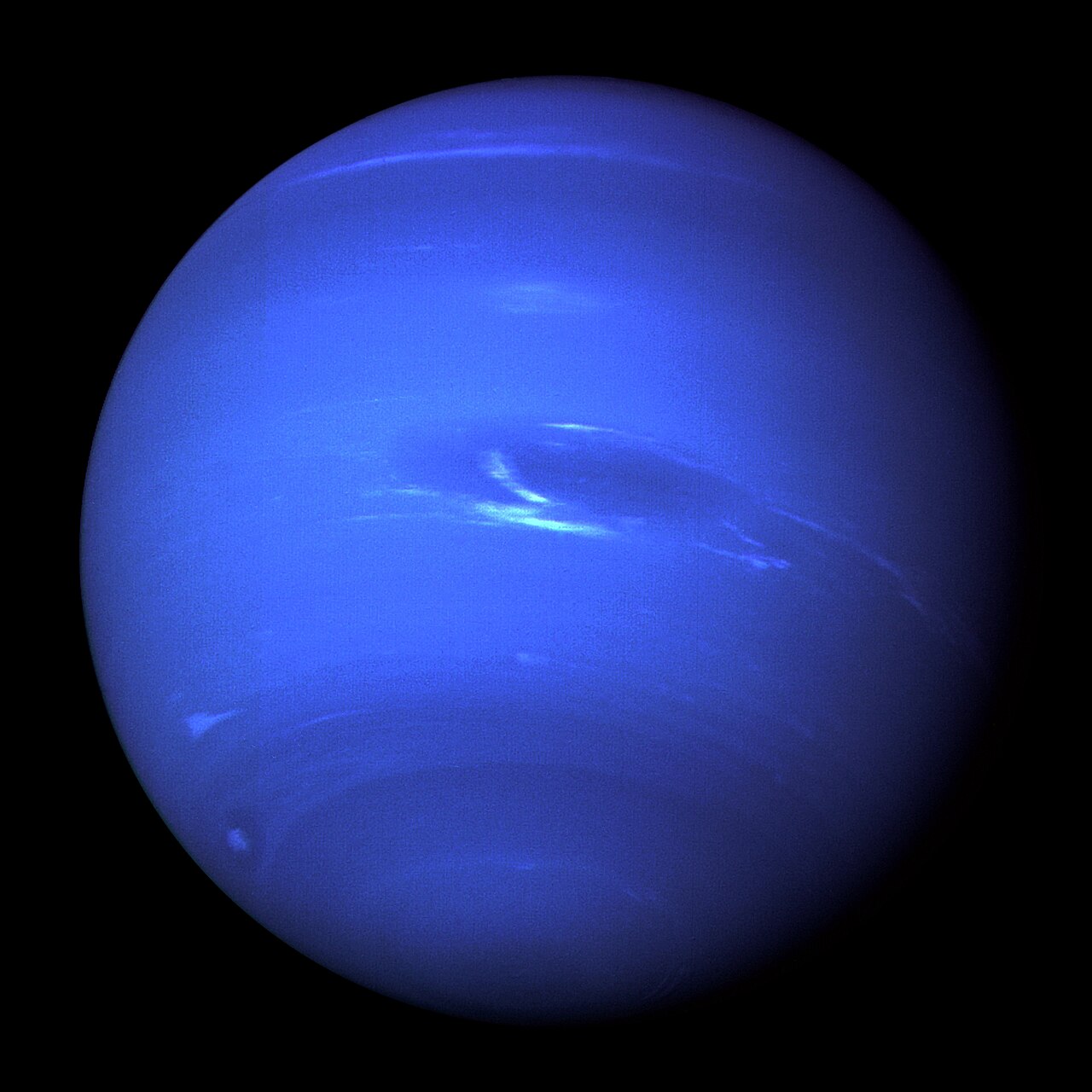
One of Neptune’s most striking features is its rich blue color.
The primary reason for this color is methane gas in the planet’s upper atmosphere. Methane absorbs red wavelengths of sunlight while allowing blue light to be scattered back into space, giving Neptune its beautiful appearance.
However, methane alone does not fully explain Neptune’s especially deep blue color. Scientists believe additional atmospheric particles and complex photochemical processes also contribute, although the exact details continue to be studied.
From space, Neptune appears as a glowing sapphire against the blackness of the cosmos.
How Big Is Neptune?
Neptune is enormous.
Its diameter is nearly four times that of Earth, measuring about 49,500 kilometers (30,800 miles).
More than 57 Earths could fit inside Neptune by volume.
Despite being much larger than Earth, Neptune is far smaller than Jupiter, the Solar System’s largest planet.
Neptune’s mass is about 17 times that of Earth, making it one of the giant planets that dominate the outer Solar System.
How Far Away Is Neptune?
Neptune orbits the Sun at an average distance of about 4.5 billion kilometers (2.8 billion miles).
Because light travels at a finite speed, sunlight needs roughly four hours to reach Neptune.
Radio signals sent from Earth also require about four hours to arrive there, depending on the planets’ positions in their orbits.
This vast distance makes Neptune one of the most difficult planets to study.
A Year on Neptune
Neptune moves slowly around the Sun because it is so far away.
One Neptunian year lasts approximately 165 Earth years.
This means that since Neptune was discovered in 1846, it has completed only one full orbit around the Sun. It finished its first complete orbit after discovery in 2011.
Its long year reflects the immense scale of the Solar System.
A Day on Neptune
Although Neptune takes an extremely long time to orbit the Sun, it spins rapidly.
One day on Neptune lasts about 16 hours.
This relatively fast rotation contributes to the planet’s complex weather patterns and powerful atmospheric circulation.
Neptune’s Atmosphere
Neptune’s atmosphere is mostly composed of hydrogen and helium, with a smaller amount of methane.
High in the atmosphere, methane gives the planet its blue appearance.
As scientists look deeper, pressure increases dramatically.
Clouds of methane ice drift through the upper atmosphere, while deeper layers may contain clouds made from other compounds under very different conditions.
The atmosphere is cold, dynamic, and constantly changing.
Bright white clouds often appear and disappear over relatively short periods, revealing an active weather system unlike the calm appearance sometimes seen in photographs.
The Fastest Winds in the Solar System
Neptune holds an extraordinary record.
It has the fastest planetary winds ever measured in the Solar System.
Some winds reach speeds of more than 2,000 kilometers per hour (about 1,200 miles per hour), faster than the speed of sound under Earth’s atmospheric conditions.
These extreme winds race around the planet despite Neptune receiving very little solar energy.
Scientists think much of the energy driving these winds comes from heat escaping from Neptune’s interior.
Exactly how these powerful winds form and persist remains an active area of research.
Giant Storms on Neptune
Neptune experiences enormous storms.
One of the most famous was the Great Dark Spot, discovered by NASA’s Voyager 2 spacecraft in 1989.
This storm resembled Jupiter’s Great Red Spot but behaved very differently.
When the Hubble Space Telescope later observed Neptune, the original Great Dark Spot had disappeared.
Since then, astronomers have discovered that Neptune’s dark storms can form, move, change shape, and disappear over relatively short timescales.
These storms are thought to be enormous atmospheric vortices surrounded by bright methane-ice clouds.
Neptune’s weather is among the most dynamic in the Solar System.
The Inside of Neptune
Neptune does not have a solid surface like Earth.
As you descend into the planet, the atmosphere gradually becomes denser until it transitions into hot, compressed fluids.
Scientists believe Neptune contains several distinct layers.
The outer atmosphere surrounds a thick mantle rich in water, ammonia, and methane under immense pressure.
Below this mantle lies a dense core composed mainly of rock and metal.
Temperatures inside Neptune become incredibly high, reaching several thousand degrees Celsius near the core.
The extreme pressure transforms ordinary materials into exotic states that cannot naturally exist on Earth.
Can You Stand on Neptune?
No.
Neptune has no solid surface where a person or spacecraft could stand.
As you descended, the atmosphere would become increasingly dense, pressure would rise to crushing levels, and temperatures would continue increasing.
Eventually, the environment would become completely inhospitable long before reaching the deep interior.
Neptune is not a place humans could ever visit in person using current technology.
Neptune’s Rings
Although Saturn is famous for its spectacular rings, Neptune also possesses a ring system.
Its rings are faint, dark, and composed mainly of dust particles mixed with larger rocky material.
One unusual feature is that some of Neptune’s rings contain bright clumps known as ring arcs.
These arcs remain grouped together rather than spreading evenly around the planet, a phenomenon that continues to interest scientists.
The gravitational influence of nearby moons likely helps maintain these unusual structures.
Neptune’s Moons
Neptune has many known moons, each with its own fascinating story.
The largest is Triton, one of the most unusual moons in the Solar System.
Triton orbits Neptune in the opposite direction from the planet’s rotation, known as a retrograde orbit.
This strongly suggests that Triton did not form around Neptune but was captured by its gravity long ago.
Triton has a thin atmosphere, icy plains, mountains, and active geysers that eject nitrogen gas and dust high above its frozen surface.
It remains one of the few worlds beyond Earth where active geological processes have been directly observed.
Scientists believe Triton may even contain a subsurface ocean beneath its icy crust.
Neptune Gives Off Its Own Heat
One of Neptune’s greatest mysteries is that it emits significantly more energy than it receives from the Sun.
The planet radiates internal heat into space.
This extra energy likely helps power Neptune’s strong winds and active weather.
Exactly why Neptune produces more internal heat than neighboring Uranus, which is similar in size and composition, remains an important scientific question.
Understanding this difference could reveal new insights into how giant planets evolve.
Magnetic Field
Neptune possesses a powerful magnetic field.
Unlike Earth’s magnetic field, Neptune’s is tilted significantly relative to its rotation axis and is offset from the planet’s center.
This unusual geometry creates a highly complex magnetic environment.
Scientists think the magnetic field is generated by electrically conducting fluids deep inside the planet rather than in a metallic core like Earth’s.
How Cold Is Neptune?
Neptune is one of the coldest places in the Solar System.
The average temperature near the cloud tops is around −214°C (−353°F).
Despite this extreme cold, temperatures increase dramatically deeper inside the planet due to enormous internal pressure and heat.
The contrast between the frigid atmosphere and the hot interior makes Neptune a fascinating object of study.
Visiting Neptune
Only one spacecraft has ever visited Neptune.
NASA’s Voyager 2 flew past the planet in August 1989.
During its historic encounter, Voyager 2 photographed Neptune’s atmosphere, rings, moons, magnetic field, and the famous Great Dark Spot.
The mission transformed our understanding of this distant world.
Since then, astronomers have continued studying Neptune using powerful telescopes on Earth and in space.
Scientists hope future missions will someday return to Neptune and explore Triton in much greater detail.
Neptune and Exoplanets
Neptune has become increasingly important in modern astronomy because planets similar in size are among the most commonly discovered around other stars.
Many exoplanets fall into the category of Neptune-sized or mini-Neptune worlds.
By studying Neptune up close, scientists gain valuable insights into the countless similar planets scattered throughout our galaxy.
These discoveries help place our own Solar System into a much broader cosmic context.
Could Neptune Support Life?
Life as we know it is highly unlikely to exist in Neptune’s atmosphere or deep interior.
The planet lacks a solid surface, experiences crushing pressures, and contains temperatures and conditions that are extremely hostile to known forms of life.
However, scientists are especially interested in Triton, whose suspected underground ocean could potentially offer environments more favorable for life, although no evidence currently exists.
The search for life beyond Earth continues to focus on many different worlds, including icy moons throughout the Solar System.
Neptune in the Night Sky
Neptune cannot usually be seen with the unaided eye because it is so distant and faint.
Even through many amateur telescopes, it appears only as a tiny bluish disk rather than a detailed planet.
Nevertheless, observing Neptune reminds us that our Solar System extends far beyond the planets easily visible from Earth.
Every glimpse of Neptune is a view into one of the most remote regions of our planetary neighborhood.
Why Neptune Matters
Neptune is far more than a distant blue dot at the edge of the Solar System. It is a dynamic world of fierce winds, enormous storms, mysterious rings, and remarkable moons. Its discovery showcased the predictive power of science, while its ongoing mysteries continue to challenge astronomers and planetary scientists.
Studying Neptune helps researchers understand not only our own Solar System but also the countless giant planets orbiting distant stars. Every new observation reveals another piece of a puzzle that stretches across billions of kilometers and billions of years.
Though only one spacecraft has ever visited this icy giant, Neptune remains one of the most captivating planets in the Solar System—a beautiful, powerful, and mysterious world that reminds us just how vast and extraordinary our cosmic neighborhood truly is.