Every year, people around the world notice the changing rhythm of the seasons. The days grow longer, then shorter. Summer slowly gives way to autumn, winter eventually turns into spring, and nature follows a familiar cycle that has repeated for millions of years. Trees bloom, flowers open, birds migrate, and temperatures rise and fall in harmony with Earth’s journey around the Sun.
At the heart of these seasonal changes are four remarkable astronomical events: two solstices and two equinoxes. These moments are more than just dates on a calendar. They mark important turning points in Earth’s annual orbit and have shaped human cultures, agriculture, calendars, and scientific understanding for thousands of years.
Although the words solstice and equinox may sound complicated, the ideas behind them are surprisingly simple. They are the natural result of Earth’s tilted axis and its year-long journey around the Sun. Understanding them helps us understand why seasons exist and why daylight changes throughout the year.
Why Earth Has Seasons
To understand solstices and equinoxes, we first need to understand why Earth experiences seasons.
Many people believe that the seasons happen because Earth is closer to the Sun during summer and farther away during winter. While this seems logical, it is actually incorrect.
Earth’s seasons are caused primarily by the tilt of its rotational axis, not by its distance from the Sun.
Earth spins on an imaginary line called its axis, which passes through the North Pole and the South Pole. Instead of standing perfectly upright, this axis is tilted by about 23.5 degrees relative to Earth’s orbit around the Sun.
This tilt means that as Earth travels around the Sun, different parts of the planet receive different amounts of sunlight at different times of the year.
When one hemisphere is tilted toward the Sun, it experiences longer days, more direct sunlight, and warmer temperatures. At the same time, the opposite hemisphere is tilted away from the Sun, receiving less direct sunlight and shorter days, resulting in cooler temperatures.
Six months later, the situation reverses.
Without Earth’s axial tilt, there would be no familiar seasons as we know them.
Earth’s Journey Around the Sun
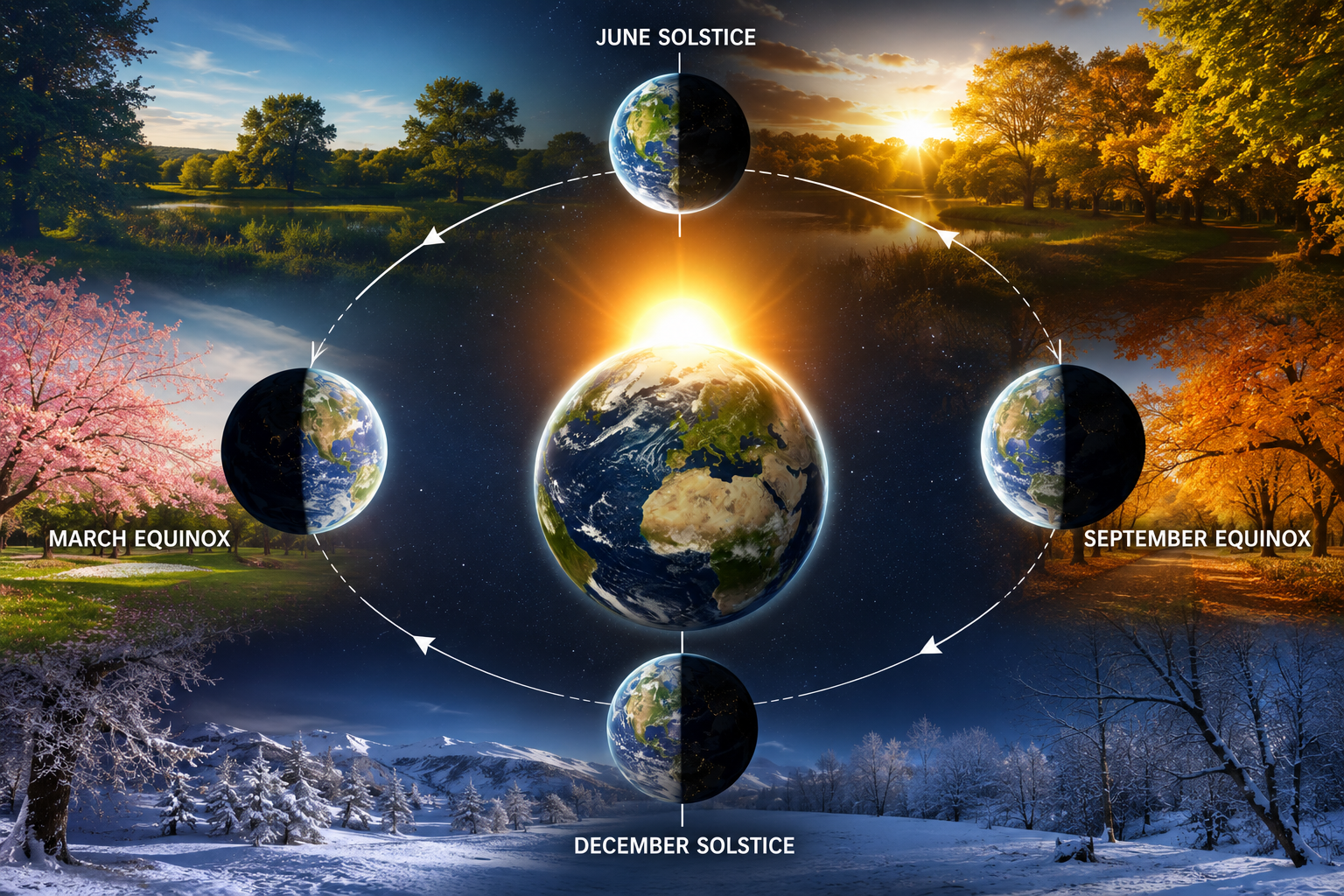
Earth completes one orbit around the Sun in approximately 365.25 days. During this journey, Earth’s axis continues pointing in nearly the same direction in space.
Because the axis remains tilted while Earth moves around the Sun, the angle at which sunlight strikes different parts of the planet changes throughout the year.
Sometimes the Northern Hemisphere leans toward the Sun.
Sometimes the Southern Hemisphere does.
And twice each year, neither hemisphere leans toward or away from the Sun.
These changing orientations create the solstices and equinoxes.
What Is a Solstice?
A solstice is the moment when one hemisphere of Earth is tilted as much as possible toward or away from the Sun.
There are two solstices every year.
One occurs around June 20 or 21, and the other around December 21 or 22.
During a solstice, the Sun reaches its highest or lowest position in the sky at noon, depending on your location and the season.
The word solstice comes from the Latin words sol (Sun) and sistere (to stand still). Ancient skywatchers noticed that around these dates, the Sun’s apparent movement northward or southward in the sky seemed to pause briefly before reversing direction.
Although the Sun never actually stops moving, its changing position becomes so gradual near the solstice that it appears almost stationary.
The Summer Solstice
The summer solstice marks the beginning of astronomical summer in one hemisphere.
In the Northern Hemisphere, it usually occurs around June 20 or 21.
On this day, the North Pole is tilted most directly toward the Sun.
As a result, the Northern Hemisphere receives its greatest amount of daylight during the entire year.
For many places north of the equator, this is the longest day and shortest night of the year.
The Sun also reaches its highest point in the sky at local noon.
Meanwhile, in the Southern Hemisphere, the same date marks the beginning of winter.
There, daylight is at its shortest, and nights are at their longest.
The seasons are always opposite between the two hemispheres.
The Winter Solstice
About six months later comes the winter solstice.
In the Northern Hemisphere, this usually occurs around December 21 or 22.
Now the North Pole is tilted farthest away from the Sun.
The Sun appears lower in the sky throughout the day.
Daylight lasts for fewer hours than on any other day of the year.
This is the shortest day and longest night in the Northern Hemisphere.
At the same time, people in the Southern Hemisphere experience their summer solstice, enjoying their longest day of the year.
After the winter solstice, daylight gradually begins increasing again in the hemisphere that has just experienced its shortest day.
What Is an Equinox?
An equinox is the moment when Earth’s axis is tilted neither toward nor away from the Sun.
Instead, both hemispheres receive sunlight almost equally.
There are two equinoxes each year.
One occurs around March 20 or 21, and the other around September 22 or 23.
The word equinox comes from the Latin words aequus (equal) and nox (night).
During an equinox, day and night are nearly equal in length across most parts of the world.
Although they are not exactly twelve hours each everywhere because of atmospheric refraction and the way sunrise and sunset are defined, they are very close.
The Spring Equinox
The March equinox marks the beginning of astronomical spring in the Northern Hemisphere.
Flowers begin blooming.
Trees grow new leaves.
Animals become more active.
Temperatures gradually rise.
At the same time, the Southern Hemisphere enters autumn.
Leaves begin changing color in many regions, and temperatures slowly become cooler.
The March equinox represents one of the two times each year when neither hemisphere receives more sunlight than the other.
The Autumn Equinox
The September equinox marks the beginning of astronomical autumn in the Northern Hemisphere.
Days continue becoming shorter.
Temperatures gradually decline.
Many plants prepare for winter.
In the Southern Hemisphere, however, the same event marks the arrival of spring.
Nature awakens once again after the colder months.
Like the March equinox, the September equinox occurs because neither hemisphere is tilted toward or away from the Sun.
Why Daylight Changes
One of the most noticeable effects of the solstices is the changing length of daylight.
Near the equator, daylight remains fairly consistent throughout the year, staying close to twelve hours every day.
Farther from the equator, the differences become much greater.
In places such as northern Canada, Alaska, Scandinavia, and parts of Russia, summer days can last nearly twenty-four hours, while winter days may have only a few hours of sunlight.
Inside the Arctic Circle, the Sun may remain above the horizon continuously for weeks or even months during summer. This phenomenon is called the Midnight Sun.
During winter, the opposite occurs. The Sun may not rise at all for extended periods, creating what is known as Polar Night.
These dramatic changes are direct consequences of Earth’s tilted axis.
The Tropics and the Solstices
The solstices are closely connected to two important imaginary lines on Earth.
The Tropic of Cancer, located at approximately 23.5° north latitude, receives the Sun directly overhead at noon during the June solstice.
The Tropic of Capricorn, located at approximately 23.5° south latitude, receives the Sun directly overhead during the December solstice.
These locations mark the farthest north and south that the Sun can ever appear directly overhead.
Between these two lines lies the tropical region, where the Sun can reach directly overhead at some point during the year.
Outside the tropics, the Sun is never directly overhead.
The Equator During an Equinox
During both equinoxes, the Sun shines directly above Earth’s equator at noon.
The line separating day from night, known as the terminator, passes almost exactly through both poles.
This unique alignment means nearly every location on Earth experiences roughly equal amounts of daylight and darkness.
It is one of the most balanced moments in Earth’s annual cycle.
Solstices and Equinoxes Across History
Long before modern astronomy, people carefully observed the Sun’s changing path across the sky.
Ancient civilizations recognized that solstices and equinoxes marked important seasonal transitions.
These events guided planting and harvesting, helped predict weather patterns, and influenced calendars.
Many ancient monuments were intentionally aligned with sunrise or sunset during solstices or equinoxes.
Some temples, stone circles, pyramids, and ceremonial sites demonstrate remarkable astronomical knowledge.
These alignments remind us that understanding the sky has always been essential to human survival and culture.
Solstices and Equinoxes in Modern Science
Today, astronomers calculate the exact timing of every solstice and equinox with extraordinary precision.
These events help define the astronomical seasons.
Meteorologists, however, often use a different system.
Meteorological seasons divide the year into three-month periods based on temperature patterns rather than astronomical events.
For example, meteorological summer in the Northern Hemisphere begins on June 1, while astronomical summer begins at the June solstice.
Both systems are useful but serve different purposes.
Common Misconceptions
One of the most common misunderstandings is that Earth is much closer to the Sun during summer.
In reality, Earth is actually closest to the Sun in early January, when it is winter in the Northern Hemisphere.
Likewise, Earth is farthest from the Sun in early July, during Northern Hemisphere summer.
The difference in distance is relatively small and has only a minor effect on Earth’s overall climate.
The tilt of Earth’s axis remains the overwhelming cause of the seasons.
Another misconception is that day and night are exactly twelve hours long everywhere during an equinox.
While they are nearly equal, small differences occur because Earth’s atmosphere bends sunlight slightly, allowing us to see the Sun before it has fully risen and after it has technically set.
Why Solstices and Equinoxes Matter
These astronomical events are more than scientific milestones.
They influence agriculture, ecosystems, wildlife behavior, climate patterns, tourism, cultural celebrations, and even human psychology.
Plants respond to changing daylight.
Many birds migrate according to seasonal changes.
Animals adjust breeding cycles based on day length.
Farmers use seasonal knowledge to plan crops.
Energy demand changes as daylight shifts.
Even our daily routines often change with the seasons.
Understanding solstices and equinoxes helps explain these natural rhythms.
The Beauty of Earth’s Seasonal Dance
Earth’s journey around the Sun is a graceful cosmic dance that has continued for more than four billion years. Every solstice and every equinox marks another step in this timeless cycle, reminding us that our planet is constantly moving through space while maintaining the delicate balance that makes life possible.
The longest day, the longest night, and the two nearly equal days of light and darkness are not random events. They are predictable consequences of Earth’s tilted axis and its yearly orbit around the Sun. Together, they create the changing seasons that shape landscapes, ecosystems, weather, and life across the globe.
Whether you watch the sunrise on the summer solstice, enjoy the colorful leaves of the autumn equinox, welcome the return of longer days after the winter solstice, or celebrate the fresh beginnings of the spring equinox, you are witnessing one of astronomy’s most beautiful and enduring rhythms—a reminder that our planet is part of a vast, orderly universe governed by the elegant laws of nature.