Few natural events inspire as much awe as an eclipse. Imagine standing beneath a bright daytime sky when, little by little, the Sun begins to disappear. Birds grow quiet, the air cools, and daylight briefly turns into an eerie twilight. Or picture looking up at a full Moon on a clear night as Earth’s shadow slowly creeps across its face, transforming it into a glowing copper-red orb. These extraordinary moments have fascinated people for thousands of years.
Long before science explained eclipses, many cultures believed they were signs from the heavens. Some imagined giant dragons swallowing the Sun, while others thought eclipses were warnings of great change. Today, thanks to astronomy and physics, we know that eclipses are not mysterious omens but predictable celestial events caused by the precise movements of the Earth, Moon, and Sun.
Although solar and lunar eclipses may seem magical, they are beautiful demonstrations of gravity, orbital motion, and the remarkable geometry of our Solar System.
Understanding the Dance of the Sun, Earth, and Moon
To understand eclipses, it helps to imagine the Solar System as a carefully choreographed dance.
The Earth travels around the Sun once every year. At the same time, the Moon orbits Earth about once every 27.3 days relative to the stars, or about every 29.5 days from one full moon to the next. These constant motions create an ever-changing arrangement of the three bodies.
Most of the time, the Sun, Earth, and Moon are not perfectly aligned. But every so often, they line up in almost a straight line. When this happens, one object casts a shadow on another, creating an eclipse.
Whether the eclipse is solar or lunar depends entirely on which object is in the middle.
What Is a Solar Eclipse?
A solar eclipse happens when the Moon moves directly between the Earth and the Sun. As the Moon passes in front of the Sun, it blocks some or all of the Sun’s light from reaching parts of Earth.
Even though the Sun is about 400 times larger than the Moon, it is also about 400 times farther away from Earth. This remarkable coincidence makes the Sun and Moon appear almost exactly the same size in our sky. Because of this, the Moon can sometimes cover the Sun almost perfectly.
When the alignment is just right, people standing in certain locations on Earth experience a solar eclipse.
How the Moon Creates a Shadow
Like any object illuminated by light, the Moon casts a shadow.
This shadow stretches into space and occasionally falls on Earth. However, the shadow is relatively small compared with Earth’s size, which is why only certain regions experience a total solar eclipse.
The Moon’s shadow has two main parts.
The darkest central region is called the umbra. People inside the umbra see the Sun completely covered by the Moon, resulting in a total solar eclipse.
Surrounding the umbra is the penumbra, where the Moon blocks only part of the Sun. Observers in this region see a partial solar eclipse.
Because the Moon continues moving in its orbit, its shadow races across Earth’s surface at speeds that can exceed several thousand kilometers per hour. As a result, totality at any one location usually lasts only a few minutes.
What Happens During a Total Solar Eclipse?
A total solar eclipse is one of nature’s most spectacular sights.
As the Moon gradually covers more of the Sun, daylight begins to fade. Shadows become unusually sharp, temperatures may drop several degrees, and animals sometimes behave as though evening has arrived.
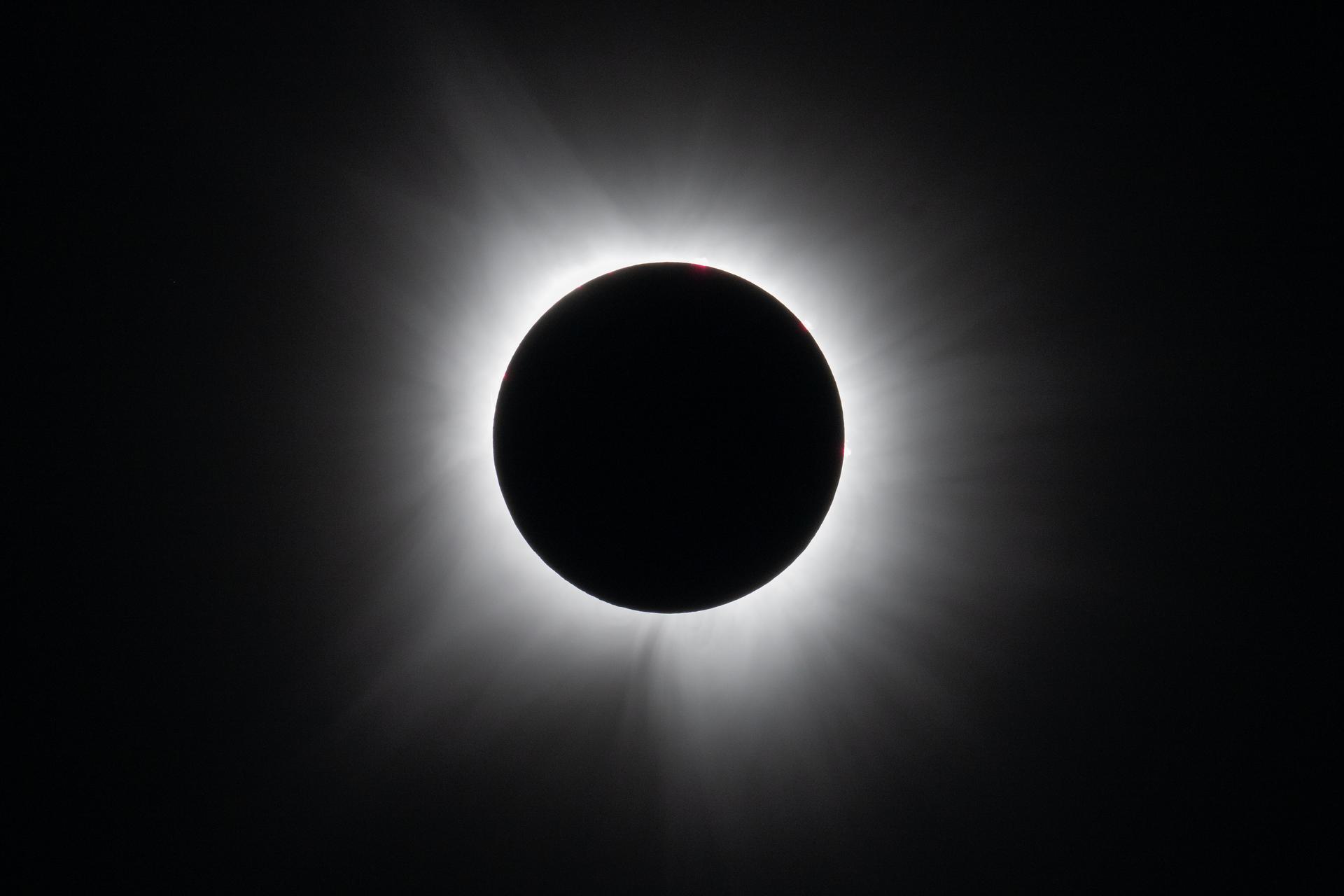
Just before totality, tiny points of sunlight shine through valleys along the Moon’s edge, creating the dazzling Baily’s Beads effect. Moments later, only one brilliant point of sunlight remains, producing the famous Diamond Ring appearance.
When the Sun is completely hidden, the sky becomes dark enough for bright stars and planets to appear.
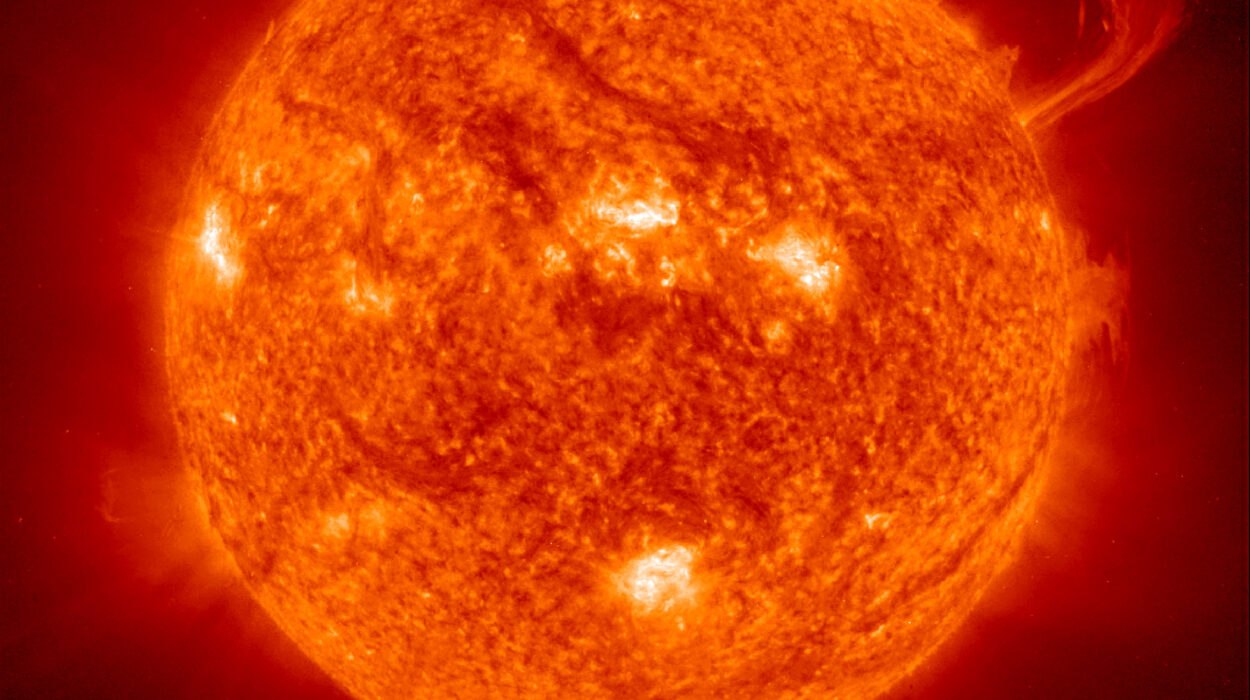
Perhaps the most breathtaking feature is the Sun’s corona, its outer atmosphere, which normally remains invisible because the Sun’s bright surface overwhelms it. During totality, the delicate white streams of the corona stretch millions of kilometers into space, creating one of astronomy’s most unforgettable views.
Different Types of Solar Eclipses
Not every solar eclipse looks the same because the distance between Earth and the Moon changes slightly throughout the Moon’s orbit.
A total solar eclipse occurs when the Moon completely covers the Sun.
A partial solar eclipse happens when only part of the Sun is hidden.
An annular solar eclipse occurs when the Moon is farther from Earth than usual. Because it appears slightly smaller in the sky, it cannot completely cover the Sun. Instead, a brilliant ring of sunlight remains visible around the Moon, creating the famous “ring of fire.”
A hybrid eclipse is much rarer. Depending on the observer’s location along the eclipse path, it may appear as either a total or an annular eclipse.
Why Solar Eclipses Do Not Happen Every Month
At first glance, eclipses might seem as though they should occur every month.
After all, the Moon passes between Earth and the Sun during every new moon.
The reason they do not is surprisingly simple.
The Moon’s orbit is tilted by about five degrees relative to Earth’s orbit around the Sun. Because of this slight tilt, the Moon usually passes slightly above or below the Sun from our point of view.
Only when the Moon crosses Earth’s orbital plane at exactly the right time during a new moon does a solar eclipse occur.
These crossing points are known as nodes, and eclipses happen only when the Sun is near one of them.
What Is a Lunar Eclipse?
A lunar eclipse occurs when the Earth moves directly between the Sun and the Moon.
Instead of the Moon casting its shadow on Earth, Earth casts its much larger shadow onto the Moon.
This can happen only during a full moon, when the Moon is on the opposite side of Earth from the Sun.
Unlike a solar eclipse, a lunar eclipse can be seen by everyone on the nighttime side of Earth because Earth’s shadow is much larger than the Moon.
How Earth’s Shadow Covers the Moon
Earth’s shadow also has two main regions.
The umbra is the darkest central part of the shadow.
The penumbra is the lighter outer portion.
As the Moon enters these regions, different types of lunar eclipses occur.
If the Moon passes only through the penumbra, the eclipse is subtle and sometimes difficult to notice.
If part of the Moon enters the umbra, a partial lunar eclipse occurs.
When the entire Moon moves into Earth’s umbra, observers witness a total lunar eclipse.
Why Does the Moon Turn Red?
One of the most fascinating features of a total lunar eclipse is the Moon’s reddish color.
Many people call it a “Blood Moon,” but despite the dramatic name, the explanation is entirely scientific.
When sunlight passes through Earth’s atmosphere, shorter blue wavelengths are scattered in all directions. This is the same process that makes our daytime sky appear blue.
Longer red and orange wavelengths pass through the atmosphere more easily.
During a total lunar eclipse, Earth’s atmosphere bends some of this reddish light into the shadow, allowing it to reach the Moon even though the direct sunlight is blocked.
The Moon reflects this red light back toward Earth, giving it its distinctive copper or deep orange appearance.
The exact shade depends on the condition of Earth’s atmosphere. Dust, volcanic ash, pollution, and clouds can make the Moon appear brighter or darker during an eclipse.
Why Lunar Eclipses Last Longer Than Solar Eclipses
Lunar eclipses usually last much longer than solar eclipses.
The reason is simple.
Earth’s shadow is much larger than the Moon’s shadow.
The Moon takes much longer to travel through Earth’s broad shadow than the Moon’s much smaller shadow takes to sweep across Earth’s surface.
A total lunar eclipse can last well over an hour, while totality during a solar eclipse typically lasts only a few minutes.
Why Everyone Cannot See Every Eclipse
Whether you can see an eclipse depends on where you are on Earth.
A solar eclipse is visible only along the narrow path traced by the Moon’s shadow. If you live outside that path, you may see only a partial eclipse—or none at all.
A lunar eclipse is much easier to observe because anyone on the nighttime side of Earth can usually see it, provided the sky is clear.
This difference makes lunar eclipses far more widely visible than total solar eclipses.
Are Eclipses Dangerous?
A lunar eclipse is completely safe to watch with the naked eye.
A solar eclipse is different.
Looking directly at the Sun without proper eye protection can permanently damage the retina because intense sunlight is focused inside the eye. Even when most of the Sun is covered, the remaining sunlight is still bright enough to cause serious injury.
The only time it is safe to view the Sun without certified eclipse protection is during the brief period of totality in a total solar eclipse, when the Sun’s bright surface is completely hidden. Before and after totality, proper solar viewing glasses or specially designed solar filters are essential.
Ordinary sunglasses, smoked glass, camera film, or homemade filters do not provide adequate protection.
How Scientists Predict Eclipses
Modern astronomers can predict eclipses years, decades, and even centuries into the future with extraordinary precision.
These predictions are possible because the motions of Earth and the Moon are understood in great detail.
Powerful computer models calculate their positions and account for factors such as gravity, orbital changes, and Earth’s rotation.
Long before computers existed, ancient astronomers discovered repeating eclipse cycles. One of the best known is the Saros cycle, which lasts about 18 years, 11 days, and 8 hours. After one Saros cycle, the Earth, Moon, and Sun return to nearly the same relative positions, allowing a very similar eclipse to occur.
Although each eclipse is unique, these repeating patterns have helped astronomers understand eclipse timing for centuries.
How Eclipses Have Advanced Science
Eclipses are not only beautiful—they have also played an important role in scientific discovery.
During total solar eclipses, astronomers can study the Sun’s corona in detail because the Moon blocks the Sun’s bright surface.
Observations of the corona have improved our understanding of solar activity, magnetic fields, and the solar wind that flows throughout the Solar System.
One of the most famous scientific moments occurred during the total solar eclipse of 1919. Astronomers measured how the Sun’s gravity bent the light from distant stars, providing the first major confirmation of Albert Einstein’s theory of general relativity. This historic observation transformed our understanding of gravity and space-time.
Lunar eclipses have also helped scientists study Earth’s atmosphere by analyzing the sunlight that passes through it before reaching the Moon.
Eclipses on Other Worlds
Earth is not the only place where eclipses occur.
Many planets and moons throughout the Solar System experience eclipses.
On Jupiter, its large moons regularly cast shadows across the giant planet’s cloud tops.
Saturn’s moons create similar events.
Mars experiences eclipses caused by its small moons, Phobos and Deimos. Because these moons are much smaller than Earth’s Moon, they usually produce partial or annular-like eclipses rather than total ones.
These events help scientists learn more about planetary systems beyond our own.
Why Total Solar Eclipses Are So Special
Earth is unique in one remarkable way.
The apparent sizes of the Sun and Moon in our sky are almost perfectly matched. This allows the Moon to completely hide the Sun while leaving the spectacular corona visible.
This coincidence is temporary on geological timescales. The Moon is slowly moving away from Earth at an average rate of about 3.8 centimeters per year due to tidal interactions.
Millions of years from now, the Moon will appear too small in our sky to completely cover the Sun. Future generations on Earth will no longer experience total solar eclipses as we know them today.
This makes every total solar eclipse a rare opportunity to witness a phenomenon that is unique to our era in Earth’s history.
The Beauty Behind the Shadows
Solar and lunar eclipses remind us that the universe operates according to elegant physical laws. They are not accidents or supernatural events but predictable results of gravity and orbital motion.
Every eclipse is a celestial alignment that reveals the remarkable precision of our Solar System. The Moon’s shadow briefly sweeping across Earth or Earth’s shadow slowly embracing the Moon tells a story of cosmic motion that has continued for billions of years.
Whether you witness the breathtaking darkness of a total solar eclipse or the gentle glow of a crimson lunar eclipse, you are watching the same timeless dance that has fascinated humanity since the dawn of civilization. These rare events connect us to the rhythms of the cosmos, reminding us that even the grandest spectacles in the sky arise from the simple, beautiful laws of physics that govern our universe.