Two children buried more than 10,000 years ago in what is now the coastal village of Camarones provide the earliest known human burials in Patagonia and some of the oldest evidence of people living along South America’s Atlantic coast.
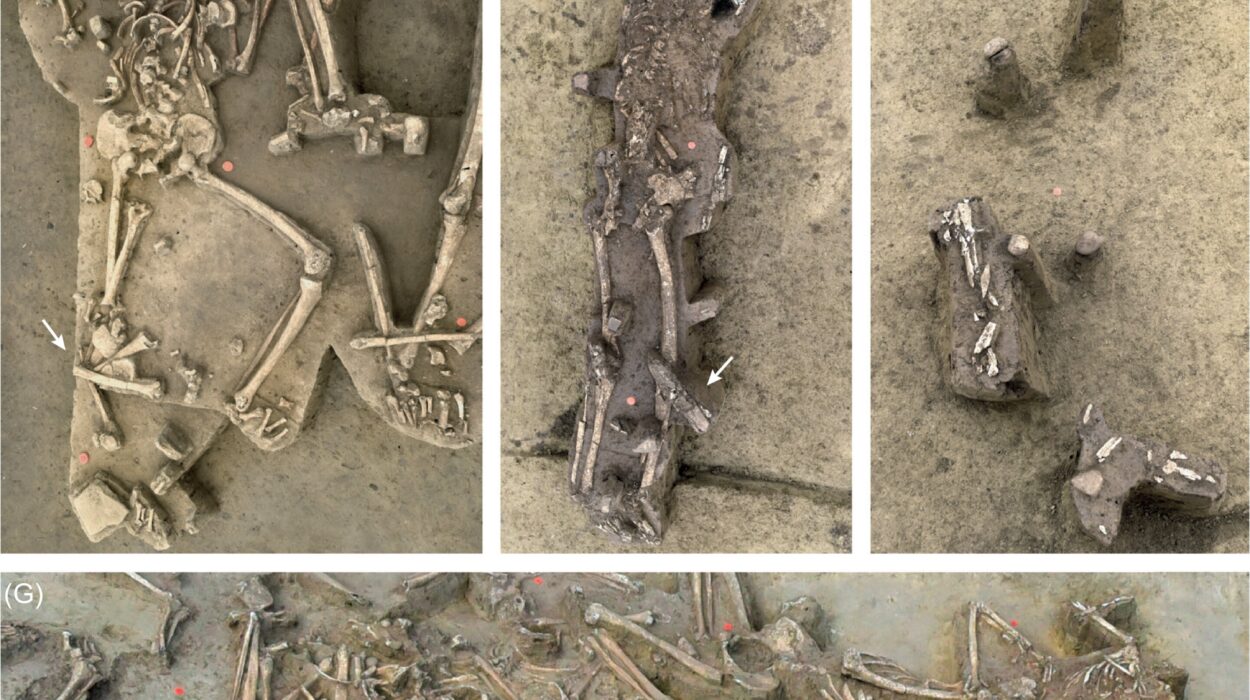
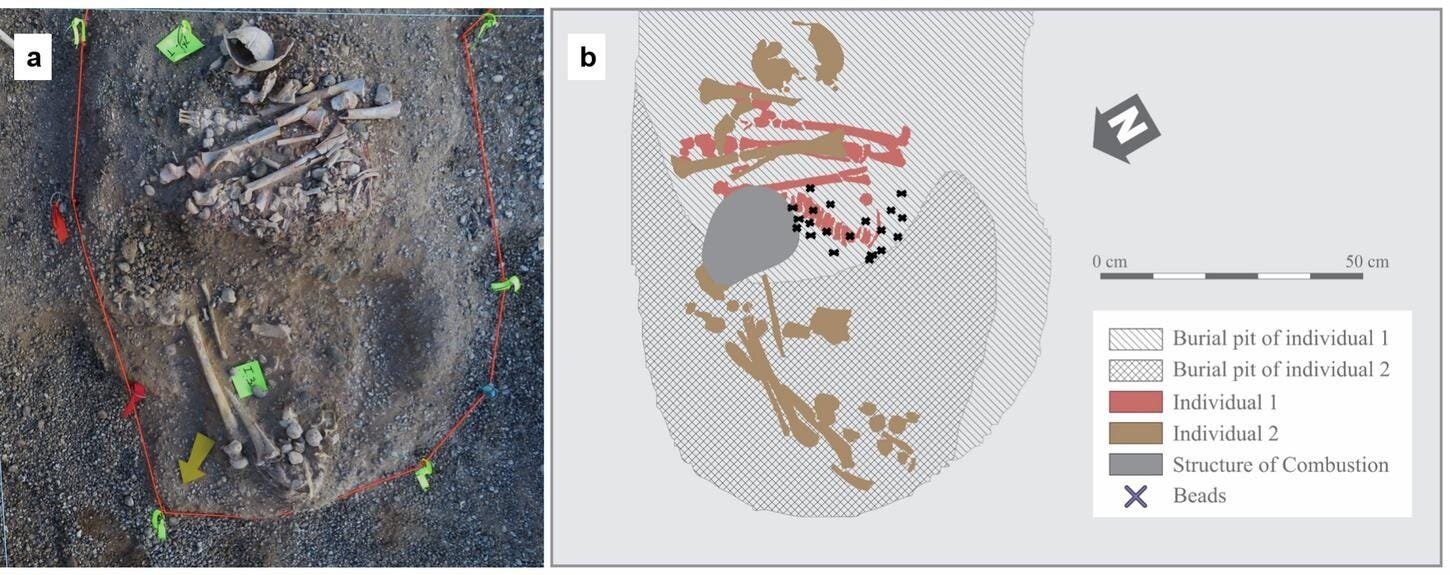
The burials came to light unexpectedly in October 2020, when construction of a house in Camarones exposed human bones. A police investigation brought archaeologists to the site, where excavation uncovered the remains of three individuals. Further analysis showed that two of them belonged to the same skeleton.
One individual was about 8 or 9 years old when they died. The other was around 14. Radiocarbon dating placed their lives at roughly 10,210–9,878 calibrated years before the present for the younger individual and 10,798–10,302 calibrated years before the present for the older one.
Those dates substantially extend the known history of human occupation at Camarones. Before these burials were studied, the oldest evidence from the area indicated occupation between about 6,000 and 600 years before the present.
The findings also make the Camarones remains the oldest known human burials in Patagonia.
Evidence points to life along the Atlantic coast
The timing is important because archaeologists have debated how early hunter-gatherers spread through South America. Proposed routes include an interior corridor and coastal routes along both the Pacific and Atlantic.
Early evidence from the Pacific coast includes occupations dating to the Late Pleistocene and Early Holocene. Evidence from the Atlantic coast has generally been younger. In Patagonia, the earliest previously known sites were dated to roughly 7,000–8,000 years before the present, while the oldest previously known burial, at La Arcillosa 2, dated to around 5,205 uncalibrated years before the present.
The researchers also note that rising sea levels during the transition from the Pleistocene to the Holocene, about 11,700 years ago, likely submerged some earlier coastal sites. That loss of archaeological evidence may help explain why the Atlantic record has been comparatively sparse.
The Camarones burials provide evidence from much earlier in that period.
The children had different levels of seafood consumption
Stable carbon and nitrogen isotope analyses were used to investigate what the two individuals ate. Both regularly consumed seafood, but the younger individual had a substantially more marine-based diet than the older one.
The researchers interpret this as direct evidence that the people represented by the burials were using the nearby coastal environment for food rather than merely moving through the area.
The findings also indicate that early Atlantic-coast hunter-gatherers were not limited to a terrestrial diet. Earlier burials in Patagonia have generally been associated with terrestrial or mixed diets, while early hunter-gatherers on the Pacific coast predominantly relied on marine foods.
The burial practices suggest repeated use of the area
The younger individual was buried with red ocher and 50 beads made from bird bones. The beads were likely once part of a necklace about 1.5 meters long.
The same burial location was reused within roughly 400 years. Along with the use of nearby red ocher and the bird-bone beads, this pattern was interpreted as evidence that people knew the local landscape and its sources of raw materials and returned to the location repeatedly.
The researchers argue that this pattern is inconsistent with groups simply passing through an unfamiliar area. Instead, the evidence points to populations maintaining knowledge of the territory and returning to the same place.
One unusual feature of the younger individual’s remains was a set of triangular lower incisors. The researchers identified this as a rare dental feature known as a talon cusp and noted that no cases had previously been reported from such early periods in the Americas.
The cause of death for either individual could not be determined. The researchers found no dental or skeletal evidence of disease or trauma. They noted that an acute infection could have caused the deaths without leaving visible traces in the remains, but this remains a possibility rather than an identified cause.
More remains could be found at the site
Because the burial site lies within the urban area of Camarones, continued residential construction could expose additional human remains. The archaeological team is involved in recovering and analyzing any remains that are uncovered.
Further work on the two individuals is also underway, including genetic analyses, experimental research on the beads, and more detailed dental and bioanthropological studies.
The study was published in the Journal of Archaeological Science: Reports.