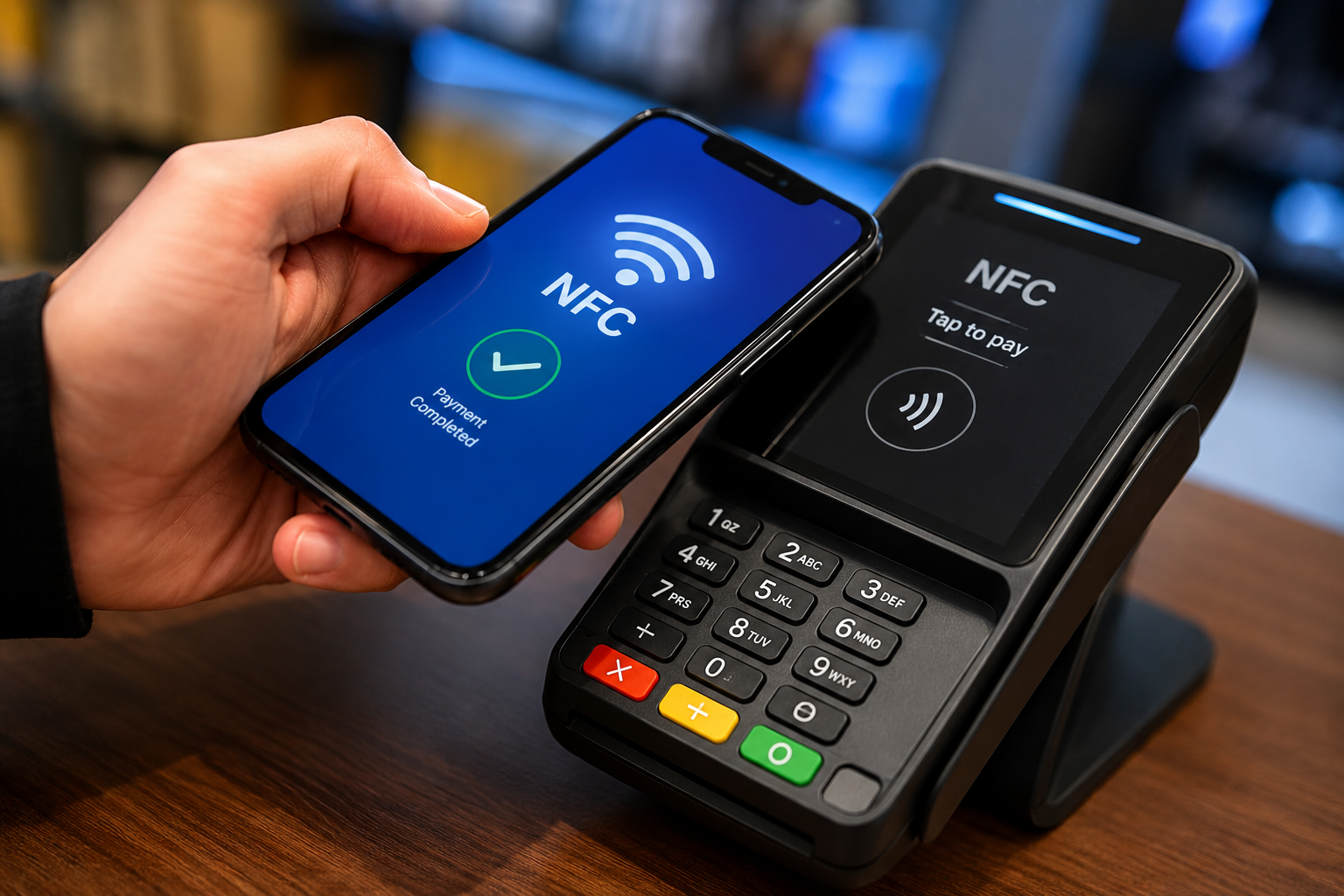
Imagine buying a cup of coffee with a single tap of your phone, unlocking your hotel room without a key, or instantly sharing a photo with a friend just by bringing two devices close together. These everyday conveniences are made possible by a technology called Near Field Communication, better known as NFC.
Although NFC works almost invisibly, it represents an impressive achievement in wireless communication. Every time you tap your smartphone against a payment terminal or use a contactless transit card, an incredibly fast exchange of information takes place in just a fraction of a second. There are no visible wires, no lengthy setup process, and often no need to press a button.
Understanding how NFC works reveals that this seemingly magical technology is actually based on well-established principles of physics and radio communication. Despite its simplicity, NFC has become an essential part of modern life, making digital interactions faster, safer, and more convenient.
What Is NFC?
Near Field Communication (NFC) is a short-range wireless communication technology that allows two compatible devices to exchange data when they are brought very close together, usually within about 4 centimeters (1.6 inches).
NFC is a specialized form of radio communication. Instead of using cables, devices communicate by generating and receiving electromagnetic fields. Because the communication range is extremely short, NFC is both convenient and naturally resistant to many types of unwanted interference.
Today, NFC is built into billions of smartphones, smartwatches, payment cards, transportation passes, access badges, and other electronic devices.
The Science Behind NFC
At its core, NFC works because of electromagnetic induction, a principle discovered in the nineteenth century by physicist Michael Faraday.
When electric current flows through a coil of wire, it creates a magnetic field around the coil. If another coil is brought close to this magnetic field, the changing field can induce an electric current in the second coil.
NFC uses this same scientific principle.
Inside every NFC device is a tiny antenna made of several loops of wire. When activated, this antenna creates a rapidly changing magnetic field operating at a frequency of 13.56 megahertz (MHz). If another NFC device enters this magnetic field, the two antennas become magnetically coupled, allowing information to be exchanged wirelessly.
Unlike Wi-Fi or cellular networks, NFC does not rely on long-distance radio signals. Instead, it depends on close-range magnetic field interactions.
Why NFC Only Works at Very Short Distances
One of NFC’s defining features is its extremely short operating range.
The magnetic field generated by an NFC antenna becomes much weaker as distance increases. Beyond approximately 4 centimeters, the signal becomes too weak for reliable communication.
This short range is not a limitation—it is actually one of NFC’s greatest strengths.
Because devices must be intentionally brought close together, accidental connections are much less likely. It also reduces the chance that someone farther away could intercept the communication.
This close proximity helps make NFC suitable for applications involving payments, identification, and secure access.
The Role of NFC Antennas
Every NFC-enabled device contains a specially designed antenna.
In smartphones, the antenna is often a thin spiral of conductive material positioned near the back of the device.
Payment cards contain an even thinner antenna hidden inside layers of plastic.
Although these antennas are small, they play a crucial role. They create magnetic fields, receive incoming signals, and help convert radio waves into digital information that electronic circuits can process.
Without these antennas, NFC communication would not be possible.
How Two NFC Devices Communicate
When two NFC devices come close together, communication begins almost instantly.
One device usually acts as the initiator, generating the magnetic field needed for communication. The second device detects this field and responds.
Information is transferred by making tiny changes to the magnetic field. These variations represent digital data, similar to how computers communicate using sequences of zeros and ones.
The receiving device detects these changes, interprets them as digital information, and processes the transmitted message.
This entire exchange usually takes only a few hundred milliseconds, making NFC interactions feel nearly instantaneous.
Active and Passive NFC Devices
Not every NFC device works in exactly the same way.
Some devices actively generate their own magnetic field.
Others do not produce any power at all and instead rely entirely on energy supplied by another NFC device.
An NFC-enabled smartphone typically functions as an active device because it has its own battery and electronics.
An NFC payment card, however, is generally passive. It contains a tiny chip and antenna but no battery.
When the card is placed near a payment terminal, the terminal’s magnetic field provides enough energy to briefly power the chip inside the card. During those few moments, the card can transmit its stored information before becoming inactive again.
This clever design allows contactless payment cards to function for years without ever needing to be charged.
How NFC Powers Battery-Free Devices
One of the most fascinating aspects of NFC is its ability to transfer small amounts of energy.
When an active NFC device creates a magnetic field, nearby passive devices can capture a tiny portion of that energy.
This harvested energy powers the integrated circuit inside the passive device long enough to complete the communication.
The amount of energy transferred is very small—far too little to charge a smartphone—but it is sufficient to operate tiny electronic chips found in payment cards, identification badges, and NFC tags.
What Happens During a Contactless Payment
A contactless payment appears almost effortless, but several sophisticated processes occur in a very short time.
As the smartphone or payment card approaches the payment terminal, the terminal generates a magnetic field.
The NFC chip detects this field and establishes communication.
Instead of transmitting sensitive financial information directly, modern payment systems typically use secure cryptographic methods and tokenization. A temporary digital token or encrypted credential is sent to the payment terminal rather than exposing the actual card number.
The payment terminal forwards the encrypted information through the payment network for authorization.
Within seconds, the bank verifies the transaction and sends approval.
The result is the familiar confirmation sound or message indicating that payment has been completed successfully.
How NFC Tags Work
An NFC tag is a tiny electronic chip combined with a small antenna.
Unlike smartphones, NFC tags usually contain no battery.
Each tag stores a small amount of digital information.
When an NFC-enabled phone comes close, it powers the tag through electromagnetic induction and reads the stored data.
Depending on what has been programmed into the tag, the phone might automatically open a website, connect to a Wi-Fi network, display contact information, launch an application, or perform another predefined action.
Because NFC tags are inexpensive and require no battery, they are widely used in advertising, museums, smart homes, product authentication, and inventory management.
Different Communication Modes
NFC supports several methods of communication depending on the devices involved.
Sometimes one device simply reads information stored in another device, such as reading data from an NFC tag.
In other situations, two active devices exchange information directly. This allows smartphones to share small amounts of data or establish connections for other wireless technologies.
NFC can also allow smartphones to behave like contactless smart cards, enabling digital payments, transit passes, hotel room keys, and secure identification.
These different operating modes make NFC remarkably versatile.
How NFC Differs from Bluetooth
Although NFC and Bluetooth are both wireless technologies, they serve different purposes.
Bluetooth is designed for communication over longer distances, often extending several meters. It is well suited for headphones, speakers, keyboards, and file transfers.
NFC works only at extremely close range and transfers data much more slowly.
However, NFC has one major advantage.
Communication begins almost immediately without requiring users to search for devices or complete lengthy pairing procedures.
In fact, many Bluetooth devices use NFC to simplify the pairing process. A simple tap allows the devices to exchange connection information before Bluetooth takes over for larger data transfers.
How NFC Differs from RFID
NFC evolved from Radio Frequency Identification (RFID) technology.
Traditional RFID systems often involve one-way communication between a reader and a tag. Many RFID systems can operate over considerably longer distances depending on their design.
NFC builds upon this technology by allowing secure two-way communication between compatible devices while maintaining an intentionally short communication range.
Because of this enhancement, NFC supports far more interactive applications than conventional RFID systems.
Security Features of NFC
People often wonder whether NFC is secure enough for financial transactions.
Several features help improve security.
The short communication distance means devices must be extremely close before any data exchange occurs.
Modern payment systems also use encryption to protect transmitted information.
Many smartphones require fingerprint recognition, facial recognition, or a passcode before allowing NFC payments.
Tokenization adds another layer of protection by replacing actual payment credentials with temporary digital identifiers that are useless if intercepted.
While no technology is completely immune to security risks, properly implemented NFC systems are considered highly secure for everyday use.
Common Uses of NFC
NFC has become deeply integrated into modern digital life.
Millions of people use it daily for contactless payments in stores, restaurants, and public transportation.
Many offices rely on NFC access cards for secure building entry.
Hotels increasingly offer digital room keys stored on smartphones.
Some cars can be unlocked or started using NFC-enabled devices.
Smart posters and advertisements use NFC tags to provide instant access to websites, videos, or promotional offers.
Healthcare systems use NFC to identify patients and manage medical equipment.
Manufacturers use NFC to verify product authenticity and reduce counterfeiting.
The technology continues to find new applications across numerous industries.
Why NFC Uses 13.56 MHz
NFC operates globally at a radio frequency of 13.56 MHz, which belongs to the high-frequency (HF) portion of the radio spectrum.
This frequency has several practical advantages.
It supports reliable short-range communication, allows efficient magnetic coupling between antennas, and is internationally standardized for NFC and many smart card technologies.
Using a globally recognized frequency also helps ensure that NFC devices from different manufacturers can communicate with one another.
Advantages of NFC
NFC has gained widespread adoption because it offers several important benefits.
Communication is extremely fast and usually begins with a simple tap.
Its short operating range reduces accidental connections.
Many passive devices require no batteries, making them inexpensive and long-lasting.
The technology consumes very little power.
It is easy to use, requiring almost no technical knowledge from users.
These qualities have made NFC one of the most user-friendly wireless technologies available.
Limitations of NFC
Despite its many strengths, NFC also has limitations.
Its communication range is intentionally very short, making it unsuitable for long-distance wireless communication.
Data transfer speeds are relatively low compared with Wi-Fi or Bluetooth, so NFC is not designed for transferring large files such as videos.
The technology also requires compatible hardware, meaning both devices must support NFC for communication to occur.
These limitations are generally acceptable because NFC is designed for quick, close-range interactions rather than continuous data transmission.
The Future of NFC
NFC continues to evolve as digital technology advances.
Smartphones are increasingly replacing physical wallets, transportation cards, hotel keys, and identification badges.
The Internet of Things (IoT) is creating new opportunities for NFC-enabled smart devices that can be configured with a simple tap.
Digital identity systems, electronic passports, secure authentication methods, and connected home technologies are also expanding the role of NFC.
Researchers continue improving security, efficiency, and integration with emerging technologies, ensuring that NFC will remain an important part of everyday digital life.
Understanding the Invisible Tap
The next time you tap your phone to pay for groceries, unlock a door with a smart card, or scan an NFC tag on a product, you are witnessing a remarkable combination of physics, electronics, and computer science working together in perfect harmony.
In less than a second, invisible magnetic fields, tiny antennas, encrypted digital messages, and carefully engineered electronic circuits cooperate to complete a secure exchange of information. What feels like a simple tap is actually the result of decades of scientific research and technological innovation.
NFC demonstrates that some of the most powerful technologies are also the simplest to use. By harnessing the principles of electromagnetic induction and combining them with modern digital security, NFC has transformed countless everyday interactions into experiences that are fast, reliable, and effortless. As our world becomes increasingly connected, this small but powerful technology will continue to make digital communication more seamless, bringing convenience and security together with every tap.