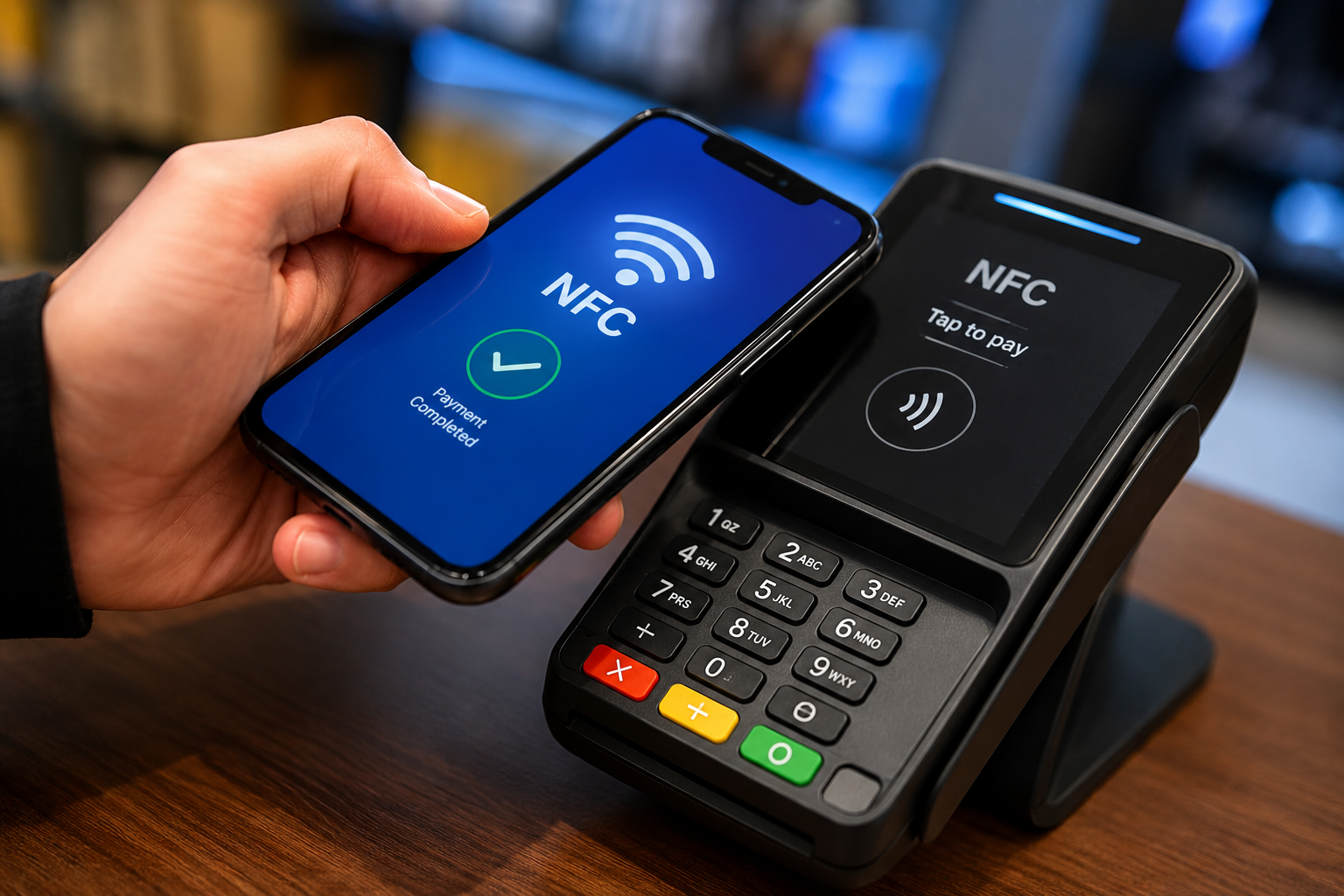
Imagine paying for your morning coffee by simply tapping your phone against a payment terminal. Or sharing photos with a friend by bringing two smartphones close together. Perhaps you’ve unlocked your office door with a card or paired your wireless headphones in seconds. These seemingly magical moments are powered by a remarkable technology called Near Field Communication, better known as NFC.
Although millions of people use NFC every day, many have little idea how it works. Hidden inside smartphones, smartwatches, credit cards, passports, and countless other devices, NFC quietly makes everyday tasks faster, safer, and more convenient.
Far from being science fiction, NFC is a practical application of physics and wireless communication that has become an essential part of modern digital life. As contactless payments, smart homes, and connected devices continue to grow, understanding NFC helps us appreciate one of the smallest yet most powerful technologies around us.
What Is NFC?
NFC, or Near Field Communication, is a short-range wireless communication technology that allows two compatible devices to exchange information when they are brought very close together—typically within about 4 centimeters (1.6 inches).
Unlike Wi-Fi or Bluetooth, which can work over much longer distances, NFC is intentionally designed to operate only at extremely close range. This short operating distance makes it both convenient and secure for applications such as contactless payments, digital tickets, access cards, and identity verification.
NFC enables devices to communicate almost instantly with a simple tap or by holding them close together. No cables, complicated setup, or lengthy pairing process is required for many NFC interactions.
What Does NFC Stand For?
The name Near Field Communication describes exactly how the technology works.
“Near” refers to the very short distance between devices.
“Field” refers to the electromagnetic field used for communication.
“Communication” means that information can be exchanged between compatible devices.
Together, the name reflects a technology that allows nearby devices to communicate through an electromagnetic field created over a very short distance.
How Does NFC Work?
At its core, NFC uses electromagnetic induction, a principle first discovered in the nineteenth century by physicist Michael Faraday.
When an NFC-enabled device is activated, it generates a small alternating magnetic field using a tiny antenna built inside the device. If another compatible NFC device enters this magnetic field, the two devices can exchange digital information using radio waves operating at 13.56 megahertz (MHz).
Because the communication range is so short, users usually need to intentionally place one device near another. This close proximity greatly reduces accidental connections and makes unauthorized interception much more difficult than with longer-range wireless technologies.
The data transfer happens incredibly quickly, often taking only a fraction of a second.
The Science Behind NFC
Although NFC feels almost magical, it is based on well-understood principles of physics.
Every NFC device contains a small antenna shaped like a coil of wire. When electric current flows through this coil, it creates a changing magnetic field.
A nearby NFC device contains another coil. As the changing magnetic field passes through this second coil, it induces a tiny electrical current. This process allows the two devices to exchange digital information without direct electrical contact.
The same physical principle is used in wireless charging systems, although NFC transfers information rather than significant amounts of electrical power.
Because magnetic fields weaken rapidly with distance, NFC naturally operates only across a few centimeters. This limitation is actually one of its greatest advantages, improving both accuracy and security.
The Different Ways NFC Devices Communicate
NFC technology supports several methods of communication, allowing it to perform a wide variety of tasks.
Sometimes two active devices, such as two smartphones, exchange information directly with one another.
In other situations, an active device communicates with a passive NFC tag. These tiny tags contain no battery and draw the small amount of power they need from the magnetic field generated by the active device.
A third mode allows NFC devices to emulate contactless smart cards. This is how smartphones can function as digital wallets or electronic access cards.
These different communication modes make NFC extremely flexible for both consumers and businesses.
Why NFC Works Only at Short Distances
One of the first questions people ask is why NFC works only when devices are almost touching.
The answer lies in both physics and security.
Unlike Wi-Fi, which is designed for long-distance communication, NFC relies primarily on magnetic field coupling between two nearby antennas.
Magnetic fields become dramatically weaker as distance increases. Beyond just a few centimeters, the signal quickly becomes too weak for reliable communication.
This built-in limitation helps ensure that users intentionally initiate transactions by bringing devices close together.
For activities such as payments or secure access, this physical requirement provides an additional layer of protection.
NFC vs Bluetooth
Although NFC and Bluetooth are both wireless technologies, they are designed for different purposes.
Bluetooth can connect devices across distances of several meters and is ideal for streaming music, transferring larger files, connecting keyboards, speakers, and headphones.
NFC works over only a few centimeters and is optimized for extremely fast, simple interactions involving relatively small amounts of data.
Interestingly, many Bluetooth devices actually use NFC to simplify pairing. Instead of manually searching through device menus, users simply tap the devices together. NFC exchanges the necessary connection information, after which Bluetooth takes over for ongoing communication.
NFC vs Wi-Fi
Wi-Fi provides high-speed wireless networking over relatively large areas.
It can transfer huge files, stream high-definition video, and connect many devices simultaneously.
NFC, by contrast, transfers only small amounts of information but does so almost instantly with minimal power consumption.
Rather than replacing Wi-Fi, NFC complements it by providing a quick way to initiate secure interactions.
NFC vs RFID
NFC evolved from a broader family of technologies known as Radio Frequency Identification, or RFID.
RFID is widely used in inventory management, supply chains, warehouse logistics, livestock tracking, and retail security systems.
NFC builds upon high-frequency RFID technology while adding the ability for two compatible devices to communicate in both directions.
In simple terms, every NFC system is based on RFID principles, but not every RFID system supports NFC.
Everyday Uses of NFC
Many people use NFC several times a day without realizing it.
Contactless payment systems allow customers to purchase goods by tapping their smartphone, smartwatch, or payment card.
Public transportation systems increasingly use NFC-enabled tickets and travel cards.
Hotels can issue digital room keys directly to smartphones.
Office buildings use NFC access cards for secure entry.
Some healthcare systems use NFC-enabled patient identification.
Smart posters and product labels can contain NFC tags that instantly open websites, videos, or product information with a simple tap.
Many cameras, speakers, headphones, and printers also use NFC to simplify wireless connections.
Contactless Payments
Perhaps the most familiar use of NFC is contactless payment.
When you tap your phone or payment card against a payment terminal, NFC securely exchanges encrypted payment information in less than a second.
Modern mobile payment systems typically use tokenization, meaning your actual card number is not transmitted during the transaction. Instead, a temporary digital token represents your payment information, reducing the risk of exposing sensitive financial details.
Many smartphones also require fingerprint recognition, facial recognition, or a passcode before authorizing payment, providing additional protection.
NFC in Smartphones
Nearly all modern smartphones include an NFC chip.
This tiny component enables digital wallets, transit cards, electronic identity systems, quick pairing with accessories, and reading NFC tags.
Some smartphones can also write information onto programmable NFC tags, allowing users to automate everyday tasks.
For example, an NFC tag near your front door might automatically silence your phone when you arrive home or connect it to your home Wi-Fi network.
NFC Tags
An NFC tag is a tiny electronic chip connected to a small antenna.
Unlike smartphones, these tags usually contain no battery.
Instead, they remain inactive until an NFC-enabled device comes close enough to provide power through its magnetic field.
Once activated, the tag can send stored information such as a web address, contact details, Wi-Fi login information, or custom commands.
Because they are inexpensive, NFC tags are increasingly used in homes, businesses, museums, retail stores, and educational environments.
Is NFC Safe?
NFC is generally considered a secure communication technology, particularly when used correctly.
Its very short operating distance makes unauthorized interception significantly more difficult than longer-range wireless technologies.
Most payment systems use strong encryption and authentication protocols.
Mobile wallets often require biometric verification before completing transactions.
However, like any technology, NFC is not completely immune to security risks.
If a malicious NFC tag is programmed to direct users to fraudulent websites or install unwanted software, it could potentially create security problems. For this reason, users should avoid interacting with unknown or suspicious NFC tags.
Keeping device software updated and using trusted payment applications further enhances security.
Can Someone Steal Your Data Through NFC?
Many people worry that thieves could secretly steal information using NFC.
In practice, this is quite difficult.
Because NFC operates at such a short distance, an attacker would generally need to be extremely close to the target device. Even then, modern payment systems use encryption, secure elements, tokenization, and multiple authentication steps that make useful data difficult to obtain.
Most smartphones also allow users to disable NFC when it is not needed.
Does NFC Use the Internet?
NFC itself does not require an internet connection.
It simply transfers small amounts of information between nearby devices.
However, some applications initiated by NFC may later use the internet.
For example, tapping a payment terminal may trigger communication with banking servers to verify a transaction, while tapping an NFC tag might open a website using your internet connection.
Does NFC Use Battery Power?
NFC is one of the most energy-efficient wireless communication technologies.
Its short operating range and brief communication time mean it consumes very little battery power.
Passive NFC tags require no battery at all because they receive the tiny amount of energy they need directly from the active NFC device’s magnetic field.
Advantages of NFC
One of NFC’s greatest strengths is its simplicity. Users do not need to search through menus, enter pairing codes, or configure complicated settings. A quick tap is often all that is required.
The technology is fast, energy efficient, and widely supported across modern smartphones, payment systems, and wearable devices. Its short communication range reduces accidental connections and provides an additional level of security for sensitive activities such as payments and access control.
NFC also enables seamless interactions between the physical and digital worlds. A small tag placed on an object can instantly connect users to online information, automation systems, or digital services.
Limitations of NFC
Despite its many advantages, NFC is not suitable for every task.
Its communication range is intentionally very limited, making it unsuitable for long-distance communication.
Data transfer speeds are much slower than those offered by Wi-Fi or Bluetooth, so NFC is not designed for transferring large files such as videos or extensive photo collections.
Successful communication also requires compatible hardware in both devices, and not every electronic device supports NFC.
The Future of NFC
NFC technology continues to evolve alongside the growing digital economy.
As smartphones replace physical wallets, NFC is becoming central to digital identity systems, transportation, healthcare, smart cities, and connected homes.
Future applications may include more advanced digital driver’s licenses, secure electronic passports, hotel check-in systems, medical records, and Internet of Things devices that can be configured with a simple tap.
As wearable technology expands, NFC is also expected to become increasingly important in smart rings, fitness trackers, augmented reality devices, and future generations of connected electronics.
Why NFC Matters More Than Ever
In a world where convenience, speed, and security are increasingly important, NFC has quietly become one of the most valuable technologies in everyday life. It allows complex digital interactions to happen almost instantly while remaining simple enough for anyone to use.
Behind every effortless tap is a carefully engineered combination of physics, radio communication, cryptography, and modern computing. What feels like a small convenience is actually the result of decades of scientific research and technological innovation.
Whether you’re buying groceries, unlocking a hotel room, boarding a train, sharing information, or connecting smart devices, NFC is helping create a future where technology fades into the background, making everyday life smoother, faster, and more connected than ever before.