Imagine buying a new phone, traveling to another country, or switching to a different mobile carrier without searching for a tiny SIM card, opening a SIM tray, or worrying about losing a piece of plastic smaller than your fingernail. That future is already here, thanks to a technology called eSIM.
Although many people still use traditional SIM cards, eSIM technology is rapidly becoming the new standard in smartphones, smartwatches, tablets, laptops, connected cars, and even Internet of Things (IoT) devices. It makes connecting to a mobile network faster, more flexible, and more convenient than ever before.
But what exactly is an eSIM? How does it work? Is it better than a physical SIM card? And should you switch to one?
Understanding eSIM helps explain how mobile technology is evolving toward a world where connecting to a cellular network becomes almost effortless.
What Is eSIM?
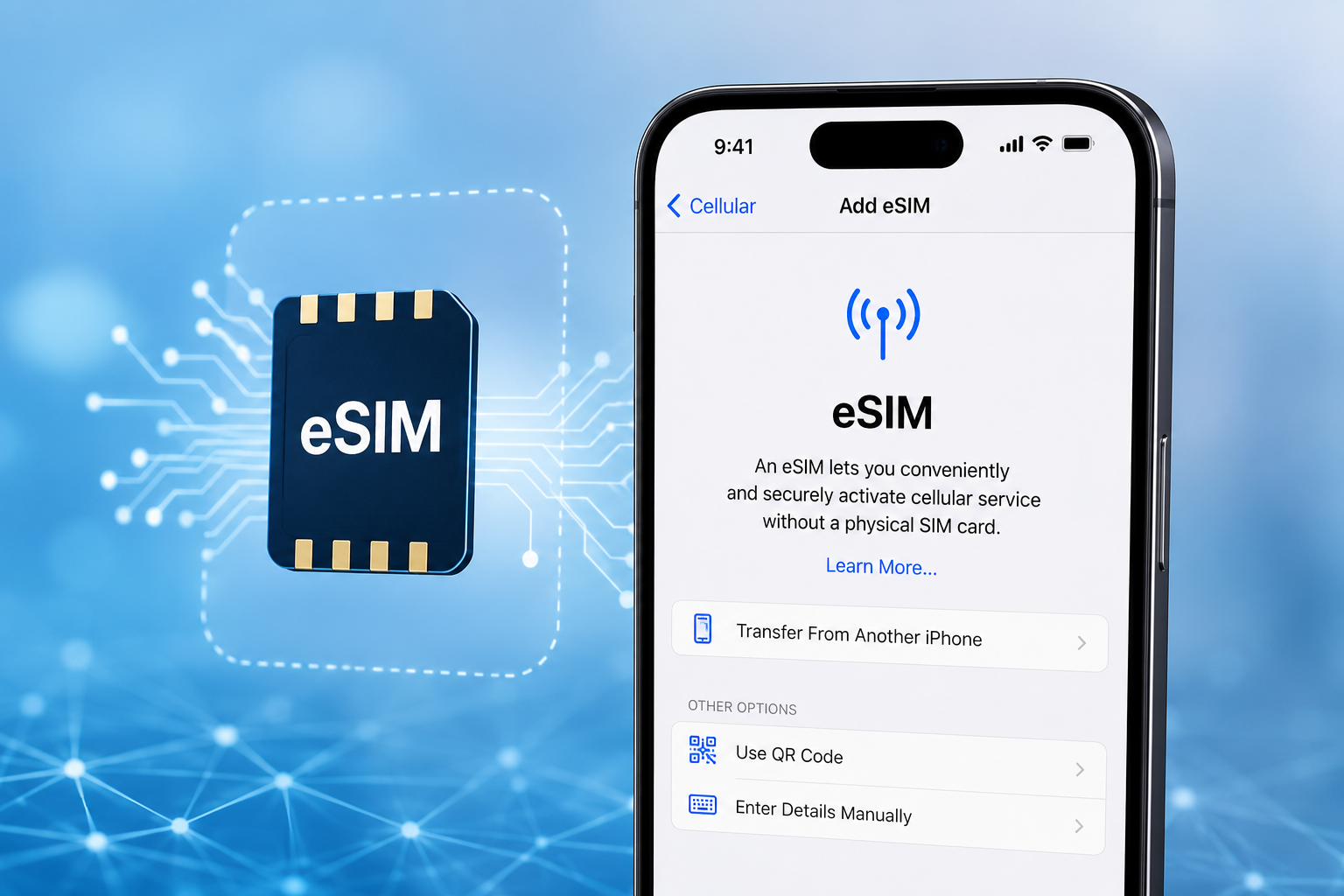
An eSIM, short for embedded Subscriber Identity Module, is a digital version of the traditional SIM card found in mobile phones. Unlike a physical SIM card that you insert into your device, an eSIM is a tiny chip permanently built into the device during manufacturing.
Although it is physically embedded inside the phone or other device, it performs the same essential job as a regular SIM card. It securely stores information that identifies your mobile subscription and allows your device to connect to your carrier’s cellular network.
Instead of inserting a plastic card, users simply download their carrier’s profile onto the embedded chip. This digital activation eliminates the need for swapping physical SIM cards whenever changing carriers or mobile plans.
What Does a SIM Card Actually Do?
To understand eSIM, it helps to first understand what a SIM card does.
A SIM card acts as your identity on a cellular network. It securely stores information that tells the mobile carrier who you are and what services you are allowed to use.
When your phone connects to a network, the SIM authenticates your subscription. This process allows you to make phone calls, send text messages, and use mobile data while protecting your account from unauthorized access.
Without a valid SIM or eSIM profile, a phone cannot normally connect to a carrier’s cellular network for standard mobile service.
Why Was eSIM Created?
Traditional SIM cards served mobile phones well for decades, but they have limitations.
They require physical handling whenever switching carriers. Tiny SIM cards are easy to lose or damage. Manufacturers also need to reserve space inside devices for SIM trays, connectors, and waterproof seals.
As electronic devices became thinner, smaller, and more compact, engineers looked for a better solution.
The result was eSIM technology.
By embedding the SIM directly into the device, manufacturers save valuable internal space while making activation much simpler for users. The technology also supports remote provisioning, allowing mobile subscriptions to be installed digitally over the internet or a cellular connection.
How Does eSIM Work?
Although eSIM eliminates the plastic card, the underlying purpose remains the same.
Every eSIM contains secure hardware capable of storing one or more mobile carrier profiles. When you activate a mobile plan, your carrier sends a digital profile to the device.
This profile contains the information needed for authentication on the carrier’s network.
Many carriers activate eSIM by providing a QR code. After scanning it, the phone downloads the carrier profile securely. Some carriers activate eSIM directly through their mobile apps, while others allow automatic activation during device setup.
Once the profile is installed, the phone behaves just like a device using a physical SIM card.
From the user’s perspective, making calls, sending texts, and accessing mobile data all work in essentially the same way.
The Difference Between eSIM and a Physical SIM
The biggest difference is simple.
A physical SIM is a removable plastic card containing an electronic chip.
An eSIM is a permanently installed chip inside the device that stores digital carrier profiles instead of requiring removable hardware.
While a physical SIM must be physically replaced when changing carriers, an eSIM usually allows users to download a new carrier profile within minutes.
This digital approach makes switching mobile providers significantly more convenient.
Why More Smartphones Are Using eSIM
Modern smartphones increasingly support eSIM because it offers practical advantages for both manufacturers and users.
Removing the SIM tray frees up internal space that can be used for larger batteries, improved cameras, or other components. It can also simplify device design and reduce openings that need protection from water and dust.
For consumers, activation becomes much faster. Many users can purchase a mobile plan online and activate service immediately without visiting a retail store.
As more carriers expand eSIM support, its convenience continues to grow.
Traveling Becomes Much Easier
International travel is one of the biggest reasons many people appreciate eSIM.
In the past, travelers often searched for local SIM cards after arriving in another country. This meant finding a store, purchasing a SIM card, replacing the existing one, and carefully storing the original SIM to avoid losing it.
With eSIM, travelers can often purchase a local or international data plan online before leaving home or immediately after arriving.
Within minutes, they can activate a local carrier without touching the SIM tray.
This not only saves time but also reduces roaming costs in many situations.
Switching Mobile Carriers
Changing mobile providers has traditionally involved receiving a new SIM card.
With eSIM, many carriers allow users to transfer service digitally.
The activation process often takes only a few minutes.
This flexibility encourages competition among mobile providers because customers can switch more easily without waiting for physical hardware.
Using Multiple Phone Numbers
Many modern smartphones allow users to store multiple eSIM profiles simultaneously.
Depending on the device, users can keep personal and business phone numbers on the same phone.
Some devices also support both a physical SIM and one or more active eSIMs at the same time, making dual-SIM functionality easier for people who need multiple numbers.
The exact number of stored or active eSIM profiles varies by device model and manufacturer.
eSIM in Smartwatches
Smartwatches are among the devices that benefit most from eSIM technology.
Because smartwatches are extremely compact, eliminating the need for a removable SIM card helps manufacturers save valuable internal space.
An eSIM allows many smartwatches to connect directly to cellular networks.
This means users can often make phone calls, send messages, stream music, or receive notifications even when their smartphone is not nearby.
eSIM Beyond Smartphones
Although smartphones receive most of the attention, eSIM technology is becoming common in many other products.
Tablets use eSIM for mobile internet access.
Some laptops include built-in cellular connectivity for working away from Wi-Fi.
Connected cars use eSIM technology for navigation, emergency communication, software updates, and internet services.
Smart home devices and industrial sensors increasingly rely on eSIM because remote activation simplifies deployment and management.
As the Internet of Things continues expanding, millions of connected devices are expected to use eSIM technology.
Is eSIM More Secure?
In many situations, eSIM offers security advantages over traditional SIM cards.
Because the chip is permanently embedded inside the device, it cannot simply be removed if a phone is lost or stolen.
Digital activation also reduces the risk of losing or damaging a physical SIM card.
However, no technology is completely immune to threats. Criminals may still attempt fraud by convincing a carrier to transfer a phone number to another device, a scam often called SIM swapping. This risk exists for both physical SIMs and eSIMs because the attack targets the carrier’s account management rather than the SIM hardware itself.
Strong account passwords, multi-factor authentication, and carrier security features remain important regardless of which type of SIM is used.
Can eSIM Work Without the Internet?
Initial activation often requires an internet connection, such as Wi-Fi or an existing cellular connection, so the device can download the carrier profile.
After activation is complete, the eSIM functions normally through the cellular network.
Phone calls, text messages, and mobile data then work just like they do with a traditional SIM card.
Does eSIM Affect Network Speed?
No.
An eSIM does not make your mobile internet faster or slower.
Network speed depends on factors such as your carrier, network coverage, available spectrum, congestion, and whether you’re connected to technologies like 4G LTE or 5G.
Since both physical SIMs and eSIMs authenticate your device in similar ways, they generally provide the same network performance under equivalent conditions.
Does Every Phone Support eSIM?
No.
While many flagship smartphones, premium tablets, smartwatches, and newer laptops support eSIM, not every device includes this feature.
Some budget phones continue using only physical SIM cards.
Even when a phone supports eSIM, availability may depend on the manufacturer, regional model, or mobile carrier.
Checking both your device specifications and your carrier’s support is the best way to confirm compatibility.
Can You Use Both eSIM and a Physical SIM?
Many modern smartphones support both technologies simultaneously.
This allows users to keep one phone number on a physical SIM and another on an eSIM.
For example, someone might use one number for work and another for personal calls.
International travelers may keep their home number active while using a local eSIM for affordable mobile data.
The exact capabilities depend on the phone’s hardware and software.
Are There Any Disadvantages?
Although eSIM offers many benefits, it is not perfect.
Some mobile carriers still do not support eSIM, particularly in certain countries or regions.
Moving your mobile service to a new phone may sometimes involve contacting your carrier or following additional activation steps, depending on the carrier’s policies.
Users who frequently swap SIM cards between multiple devices may also find traditional physical SIMs more convenient in some situations.
As global support continues to improve, however, many of these limitations are gradually becoming less significant.
The Future of eSIM
The mobile industry is steadily moving toward digital connectivity.
Many manufacturers now release devices where eSIM plays an increasingly important role, and some smartphone models in certain markets have eliminated the physical SIM tray entirely.
Future generations of connected devices are expected to rely even more heavily on embedded connectivity.
As 5G networks expand and billions of Internet of Things devices come online, eSIM technology provides a scalable way to activate, manage, and update mobile connections remotely.
Industry organizations continue developing standards that make switching carriers and managing digital profiles even easier.
Why eSIM Matters
The introduction of eSIM represents more than the removal of a tiny plastic card. It reflects a broader shift toward simpler, more flexible, and more connected technology.
By replacing manual hardware with secure digital activation, eSIM reduces friction in everyday tasks such as changing carriers, setting up new devices, or staying connected while traveling. It also supports the growing ecosystem of smart devices that increasingly depend on reliable cellular connectivity.
As mobile technology continues to evolve, eSIM is likely to become the default way many devices connect to cellular networks. For users, this means fewer physical components to manage and a smoother experience when staying connected, whether at home or across the world.
Conclusion
eSIM is a modern evolution of the traditional SIM card, replacing removable plastic with an embedded chip that can be programmed digitally. While its purpose remains the same—securely connecting your device to a mobile carrier—it offers greater convenience, flexibility, and efficiency.
Whether you’re activating a new smartphone, switching carriers, traveling internationally, or using a connected smartwatch, eSIM makes the process faster and simpler without changing the way your phone communicates with the network.
As more devices and carriers embrace this technology, eSIM is becoming an important part of the future of mobile communication. Though physical SIM cards are still widely used today, the growing adoption of eSIM suggests that digital connectivity is steadily becoming the new standard.