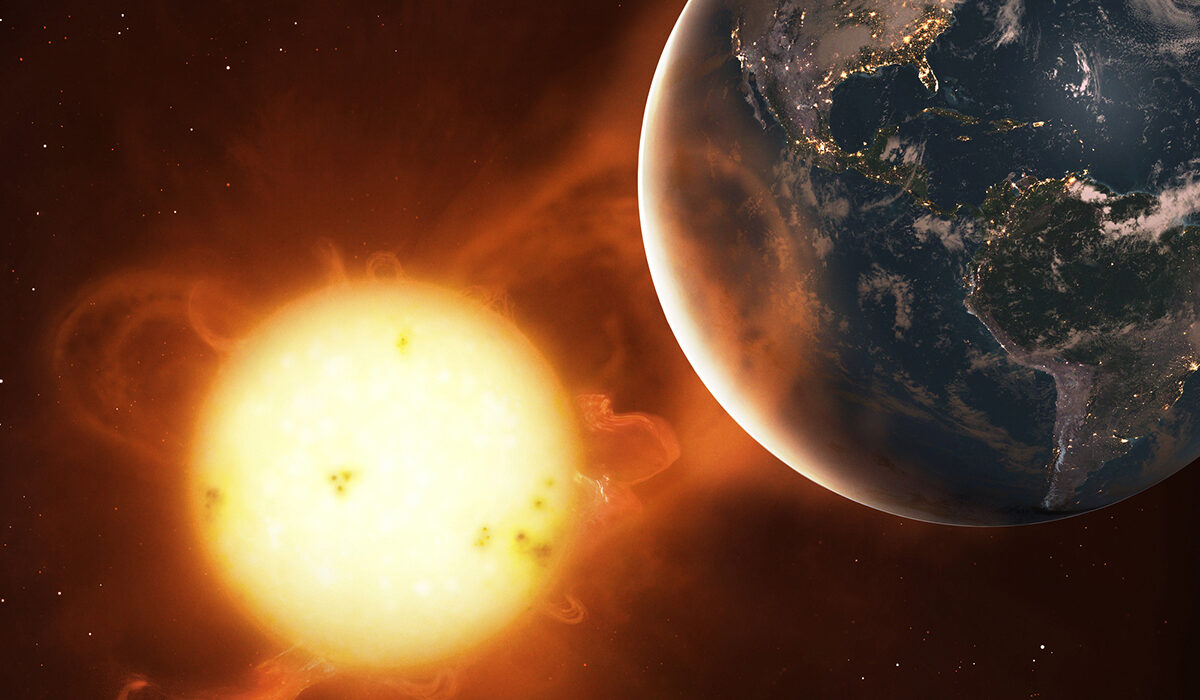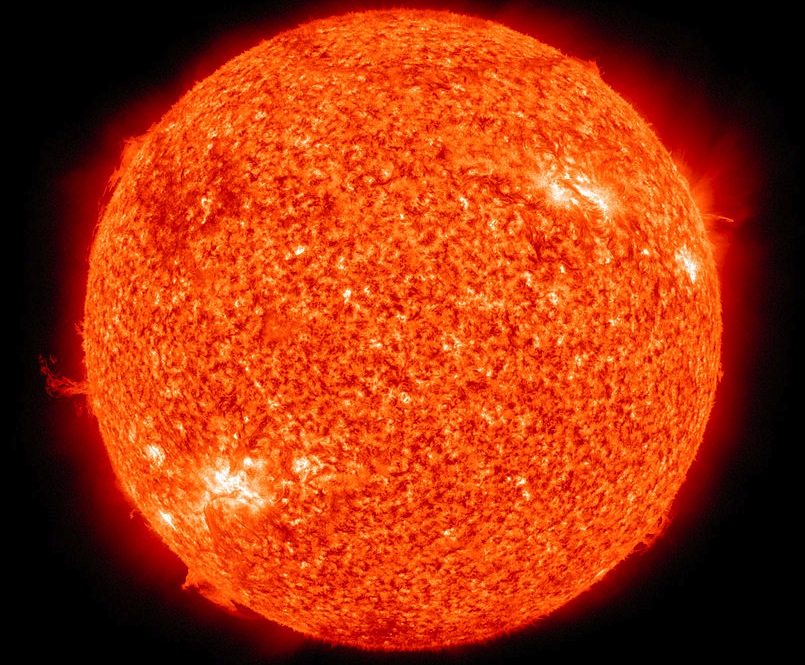
Every morning, the Sun rises almost effortlessly, flooding Earth with warmth and light. It looks peaceful, familiar, and unchanging. Yet behind that calm golden glow lies an object of unimaginable size and mass—so enormous that it dominates the entire Solar System.
The Sun is not just another star in the sky. It is the heart of our cosmic neighborhood, holding planets, moons, asteroids, comets, and countless smaller objects together through its immense gravity. Everything from Earth’s yearly journey around the Sun to the distant orbit of Neptune depends on one extraordinary fact: the Sun is incredibly massive.
But just how massive is it?
The answer is almost beyond human imagination. To truly understand the Sun’s mass, we must leave everyday experiences behind and begin thinking on a cosmic scale.
The Sun’s Incredible Mass
The Sun has a mass of approximately 1.989 × 10³⁰ kilograms.
Written out in full, that number looks like this:
1,989,000,000,000,000,000,000,000,000,000 kilograms
This is nearly 2 nonillion kilograms in the short scale used in the United States.
Numbers this large are difficult to picture. Even if every person on Earth spent their entire lives counting one kilogram every second, humanity would never come close to counting the Sun’s total mass.
Its sheer weight is unlike anything we encounter in daily life.
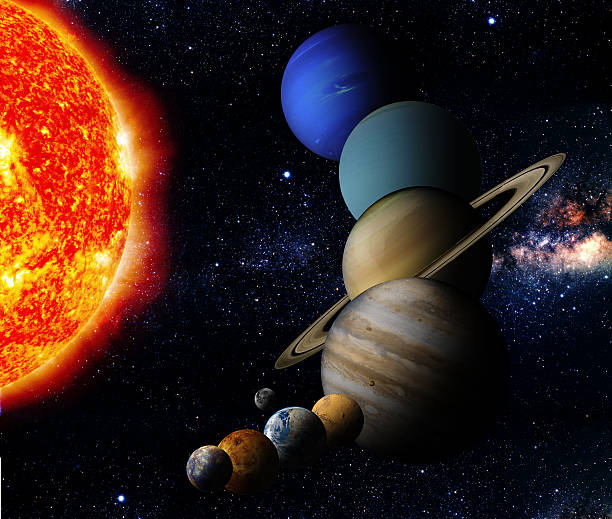
The Sun Contains Almost All the Mass in the Solar System
One of the most astonishing facts about the Solar System is that the Sun contains about 99.86% of its total mass.
Everything else—the planets, moons, dwarf planets, asteroids, comets, dust, and gas—shares the remaining 0.14%.
This means the eight planets combined are almost insignificant compared to the Sun.
Although Jupiter is enormous by planetary standards, it still contains only about one-thousandth of the Sun’s mass.
If you could gather every planet into one giant object, the Sun would still outweigh it hundreds of times over.
The Solar System is, in many ways, the Sun with a few tiny companions orbiting around it.
How Many Earths Would Equal the Sun’s Mass?
Earth feels unimaginably large to us.
It contains oceans, continents, mountains, and every living thing we know.
Yet compared with the Sun, Earth is astonishingly small.
It would take about 333,000 Earths to equal the Sun’s mass.
Imagine stacking entire planets together until there were more than three hundred thousand Earths. Only then would you have something as massive as the Sun.
This comparison reveals just how dominant our star truly is.
The Sun Is More Massive Than Jupiter
Jupiter is the largest planet in the Solar System.
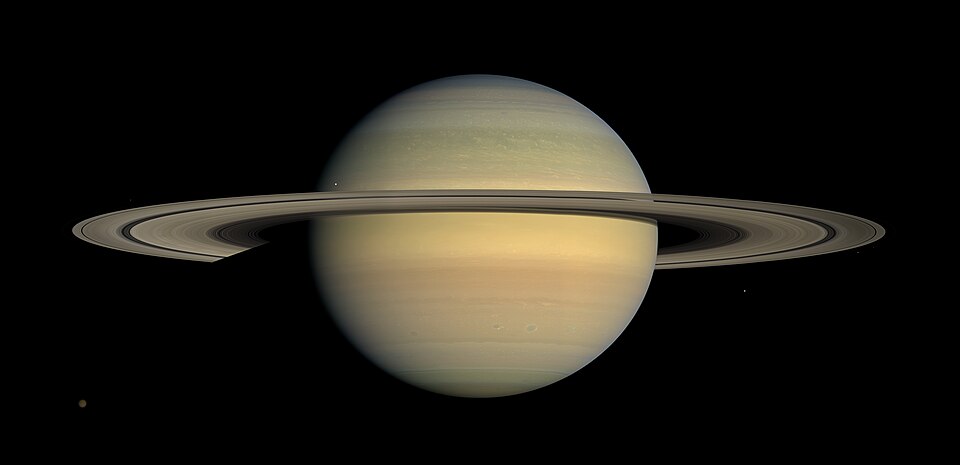
Its swirling clouds stretch across a world so enormous that more than 1,300 Earths could fit inside it by volume.
Yet even Jupiter is tiny compared with the Sun.
The Sun is approximately 1,048 times more massive than Jupiter.
If Jupiter were much larger, it still would not become a star. Scientists estimate it would need roughly 80 times its current mass before its core could become hot and dense enough to sustain hydrogen fusion like the Sun.
This shows just how extraordinary the Sun really is.
Why Is the Sun So Massive?
The Sun formed about 4.6 billion years ago from a giant cloud of gas and dust called a molecular cloud.
Gravity slowly pulled this cloud together.
As more material gathered in one place, the growing object became increasingly massive.
Its own gravity compressed the center more and more.
Eventually, the pressure and temperature became so extreme that hydrogen atoms began fusing into helium.
At that moment, a star was born.
Most of the original material from the collapsing cloud ended up inside the Sun. The small amount left over formed the planets, moons, asteroids, and other bodies that orbit it today.
That is why the Sun possesses nearly all the Solar System’s mass.
Gravity Comes From Mass
The Sun’s enormous mass gives it incredibly powerful gravity.
Gravity is the force that attracts objects toward one another, and the more massive an object is, the stronger its gravitational pull.
The Sun’s gravity keeps every planet moving in stable orbits.
Without it, Earth would drift away into interstellar space.
Mercury, Venus, Mars, Jupiter, Saturn, Uranus, Neptune, countless asteroids, and distant comets all remain part of the Solar System because the Sun’s gravity binds them together.
Even objects billions of kilometers away still feel its influence.
The Sun Doesn’t Pull Planets Straight In
If the Sun’s gravity is so powerful, why doesn’t Earth simply fall into it?
The answer lies in motion.
Earth is constantly moving sideways at about 29.8 kilometers (18.5 miles) per second as it travels around the Sun.
Gravity continuously pulls Earth inward, while Earth’s forward motion keeps carrying it ahead.
The result is an orbit.
A helpful comparison is swinging a ball attached to a string. The string constantly pulls the ball inward while the ball keeps moving around in a circle.
In a similar way, gravity acts as the invisible “string” that keeps planets orbiting the Sun.
The Sun Is Constantly Losing Mass
Although the Sun is incredibly massive, it slowly becomes lighter over time.
Deep inside its core, nuclear fusion converts hydrogen into helium.
During this process, a tiny fraction of matter changes directly into energy according to Einstein’s famous equation:
E = mc²
Every second, the Sun converts about 600 million metric tons of hydrogen into helium.
Around 596 million metric tons become helium, while roughly 4 million metric tons of mass are transformed into energy.
That energy leaves the Sun as sunlight, heat, and other forms of electromagnetic radiation.
This means the Sun loses about 4 million metric tons of mass every second.
Although this sounds enormous, it is insignificant compared to the Sun’s total mass.
At its current rate, the Sun has enough hydrogen fuel to continue shining for about another 5 billion years.
What Is the Sun Made Of?
The Sun’s great mass comes almost entirely from two simple elements.
About 74% of its mass is hydrogen.
Around 24% is helium.
The remaining 2% consists of heavier elements such as oxygen, carbon, neon, nitrogen, magnesium, silicon, sulfur, and iron.
Although these heavier elements make up only a small fraction of the Sun’s mass, they play an important role in understanding how stars evolve and how planetary systems form.
How Scientists Measure the Sun’s Mass
No giant scale exists for weighing stars.
Instead, astronomers determine the Sun’s mass using gravity.
The motion of Earth and the other planets provides the answer.
By carefully measuring planetary orbits and applying Newton’s law of gravitation, scientists can calculate the Sun’s mass with remarkable accuracy.
Modern spacecraft, radar observations, and highly precise measurements have refined this value over many decades.
Today, the Sun’s mass is one of the best-known quantities in astronomy.
The Sun Is Massive, But Not the Biggest Star
The Sun feels unimaginably enormous compared with Earth.
However, in the universe, it is considered a fairly ordinary star.
Many stars are far more massive.
Blue giant stars can contain tens of times the Sun’s mass.
The most massive known stars may exceed 100 times the Sun’s mass, although such giants live only a few million years before ending their lives in spectacular explosions.
On the other hand, many stars are much smaller.
The most common stars in the Milky Way are red dwarfs, which often have less than half the Sun’s mass.
Our Sun sits comfortably in the middle—a medium-sized star that provides a stable environment for billions of years.
Why the Sun’s Mass Matters
The Sun’s mass determines almost everything about it.
It controls how bright the Sun shines.
It determines how hot its core becomes.
It influences how long the Sun will live.
It governs the strength of its gravity.
It shapes the orbits of planets.
It even affects the future evolution of the Solar System.
If the Sun had been significantly less massive, nuclear fusion might never have started, and Earth would never have received enough heat and light to support life.
If it had been much more massive, it would burn through its fuel far more quickly, leaving much less time for life to develop.
In many ways, the Sun’s mass is one of the reasons Earth exists as a habitable world today.
The Sun’s Mass Shapes the Entire Solar System
The Solar System is more than a collection of planets wandering through space. It is a family held together by one overwhelmingly dominant member.
The Sun’s immense mass creates the gravity that keeps planets in their paths, drives the cycles of day and year, and powers the light and warmth that make life on Earth possible.
Without its extraordinary mass, there would be no stable planetary orbits, no seasons, no climate, and likely no life as we know it.
A Star of Extraordinary Weight
The Sun may appear as a bright disk in the daytime sky, but its true nature is almost impossible to grasp. With a mass of nearly 2 nonillion kilograms, containing 99.86% of the Solar System’s total mass, it is the giant anchor of our cosmic neighborhood.
Its gravity shapes the paths of worlds, its immense weight fuels the nuclear reactions in its core, and its steady energy has illuminated Earth for billions of years.
Every sunrise is more than the beginning of a new day. It is a reminder that an unimaginably massive star, born billions of years ago from a collapsing cloud of gas, continues to hold our entire Solar System together—quietly, powerfully, and with remarkable stability.