Every website faces risks the moment it goes online. Whether it is a personal blog, an online store, a news website, or a large business platform, every site is a potential target for cyberattacks. Hackers constantly search for vulnerabilities that allow them to steal data, disrupt services, or take websites offline. As websites become more important in our daily lives, protecting them has become just as essential as building them.
Many people think a Content Delivery Network (CDN) exists only to make websites load faster. While improving speed is one of its most well-known benefits, a modern CDN also plays a major role in website security. In fact, many of the world’s largest websites rely on CDNs not only to deliver content quickly but also to defend against millions of malicious requests every day.
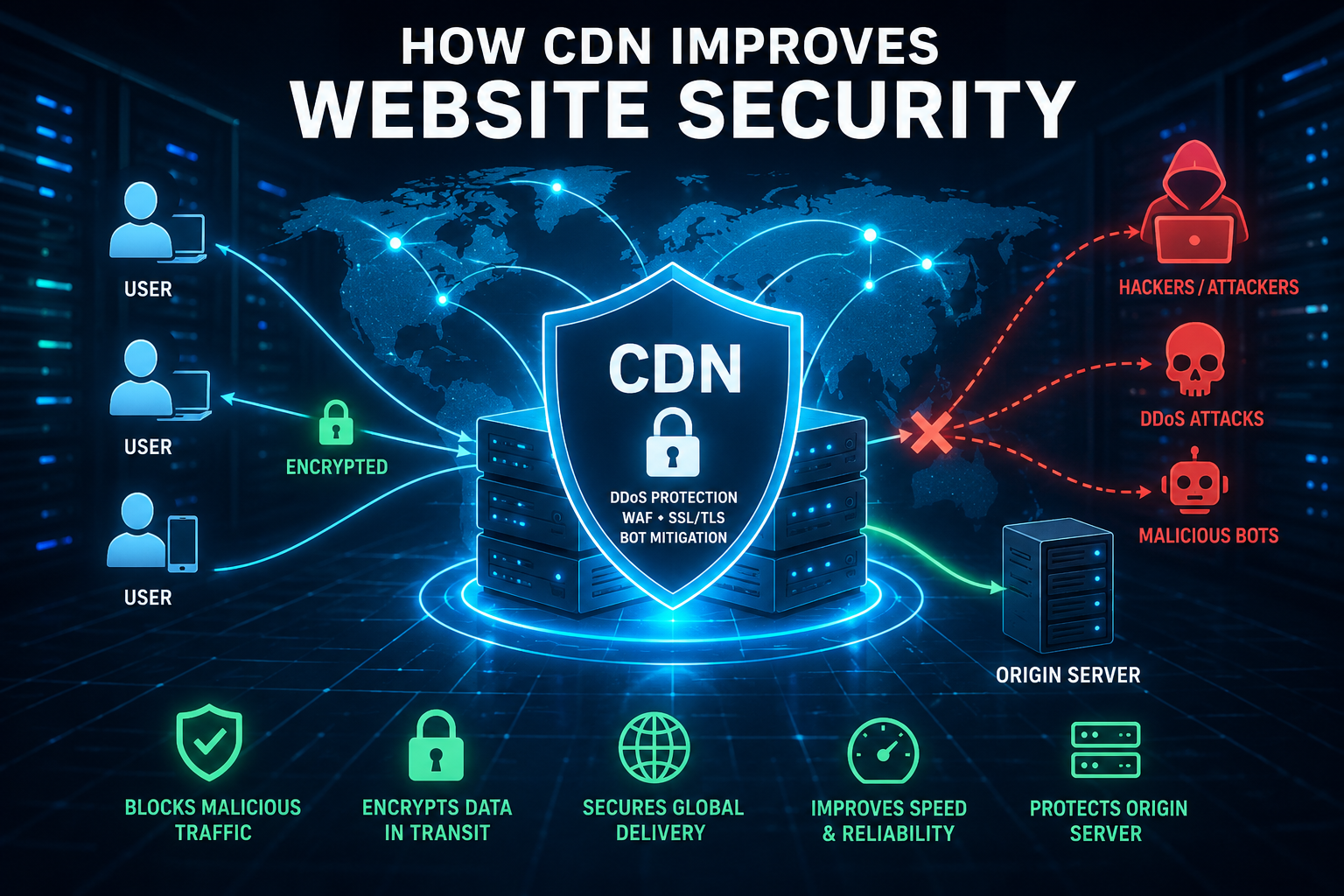
A CDN acts as a protective layer between visitors and the origin server. It filters harmful traffic, absorbs large-scale attacks, hides sensitive infrastructure, and helps ensure that legitimate users can continue accessing a website even when attackers are trying to bring it down.
Understanding how a CDN improves website security helps explain why it has become one of the most important technologies in modern web infrastructure.
What Is a CDN?
A Content Delivery Network, commonly called a CDN, is a network of servers distributed across many cities and countries around the world. Instead of every visitor connecting directly to a website’s origin server, visitors often connect to the nearest CDN server, also known as an edge server.
These edge servers store cached copies of website content such as images, videos, stylesheets, JavaScript files, and other static resources. Because these files are served from locations closer to users, websites load more quickly and place less demand on the original server.
However, the CDN does much more than deliver cached content. Since nearly every request passes through the CDN before reaching the website, the CDN can inspect, analyze, and filter traffic. This ability allows it to detect suspicious behavior and block many cyber threats before they ever reach the origin server.
Why Website Security Matters
Cyberattacks have become increasingly sophisticated over the past two decades. Criminal organizations, automated bots, and malicious individuals target websites for many different reasons.
Some attackers want to steal customer information. Others attempt to disrupt businesses by taking websites offline. Some try to overload servers with fake traffic, while others search for software vulnerabilities that allow unauthorized access.
Even small websites can become targets because automated attack tools continuously scan the internet for weaknesses.
A successful cyberattack can lead to stolen customer data, financial losses, damaged reputation, lost search engine rankings, interrupted business operations, and reduced customer trust.
Website security is therefore not simply an optional feature. It is a fundamental requirement for any website connected to the internet.
How a CDN Protects the Origin Server
One of the biggest security advantages of a CDN is that it sits between users and the website’s origin server.
Instead of exposing the origin server directly to the internet, visitors interact primarily with CDN edge servers.
This arrangement creates an additional security layer.
If attackers send malicious requests, those requests first encounter the CDN. The CDN evaluates whether the traffic appears legitimate or suspicious before deciding whether it should be forwarded to the origin server.
As a result, many attacks never reach the server that hosts the website.
This reduces both security risks and server workload.
Hiding the Website’s Real IP Address
Every server connected to the internet has an Internet Protocol (IP) address.
Attackers often try to discover this address because it allows them to target the server directly.
Many CDNs help conceal the origin server’s actual IP address by exposing only the CDN’s network to public users.
Instead of seeing the website’s real server location, visitors and attackers see the CDN’s infrastructure.
This makes direct attacks against the origin server significantly more difficult.
Even if attackers know the website’s domain name, they often cannot easily determine where the actual server is located.
This additional layer of anonymity strengthens overall website security.
Protecting Against DDoS Attacks
Distributed Denial-of-Service (DDoS) attacks are among the most common threats facing websites today.
In a DDoS attack, thousands or even millions of compromised computers, known as a botnet, simultaneously send enormous numbers of requests to a website.
The goal is not to steal information but to overwhelm the server until legitimate visitors can no longer access it.
Without protection, even powerful servers can become overloaded.
A CDN helps defend against these attacks because its network consists of hundreds or even thousands of edge servers spread around the world.
Instead of one server receiving all incoming requests, the traffic is distributed across a massive global network.
Modern CDNs continuously monitor traffic patterns. When unusually large amounts of traffic appear, sophisticated systems analyze whether the requests come from real users or automated attack sources.
Malicious traffic can often be blocked, filtered, or rate-limited before it reaches the origin server.
Because CDN providers operate extremely large networks with enormous bandwidth capacity, they can absorb attacks that would easily overwhelm individual hosting servers.
Intelligent Traffic Filtering
Not every visitor behaves like a human.
Many automated programs, called bots, constantly browse the internet.
Some bots are beneficial.
Search engine crawlers help websites appear in search results.
Website monitoring tools check whether websites remain online.
Performance testing services measure loading speed.
However, many bots are malicious.
They attempt password guessing, content scraping, spam posting, vulnerability scanning, or other harmful activities.
Modern CDNs analyze incoming requests using multiple indicators.
They examine request frequency, browser characteristics, IP reputation, geographic patterns, behavioral signals, and known attack signatures.
Suspicious requests can be challenged, slowed down, or blocked automatically while genuine visitors continue accessing the website normally.
This intelligent filtering significantly reduces malicious activity.
Web Application Firewall Protection
Many CDN providers include a Web Application Firewall, commonly called a WAF.
A WAF examines HTTP and HTTPS requests before they reach the website.
Instead of only looking at network traffic, it analyzes the contents of requests.
If someone attempts to exploit known vulnerabilities, the WAF can detect suspicious patterns and prevent the request from reaching the application.
For example, attackers sometimes attempt SQL injection attacks, in which malicious database commands are inserted into website forms.
Others may attempt Cross-Site Scripting (XSS), where harmful scripts are injected into webpages viewed by other users.
A properly configured WAF can recognize these attack techniques and block them automatically.
Because attack methods constantly evolve, many CDN providers continuously update firewall rules based on newly discovered threats.
This ongoing protection helps websites defend against emerging vulnerabilities.
Blocking Malicious IP Addresses
Cybersecurity companies continuously collect information about malicious IP addresses associated with hacking activities, botnets, malware, and spam campaigns.
Many CDN providers maintain large threat intelligence databases built from worldwide observations across millions of protected websites.
When a request arrives from an IP address known for malicious behavior, the CDN can immediately block or challenge the request.
Because CDN networks protect enormous numbers of websites, they often detect new attack sources much faster than individual website owners could on their own.
This shared intelligence strengthens protection across the entire network.
Rate Limiting Prevents Abuse
Some attacks do not rely on massive traffic volumes.
Instead, attackers repeatedly send requests to login pages, search forms, or application programming interfaces in hopes of discovering passwords or overwhelming specific website functions.
Rate limiting helps prevent this abuse.
A CDN can restrict how many requests a user or IP address may send within a certain period.
Legitimate users rarely submit hundreds of login attempts every minute.
Attack tools often do.
By limiting excessive requests, the CDN helps stop brute-force password attacks and reduces server strain.
Rate limiting also protects APIs from automated abuse while allowing normal users to continue using the website.
Secure HTTPS Connections
Modern websites increasingly use HTTPS instead of the older HTTP protocol.
HTTPS encrypts information exchanged between users and websites.
Encryption prevents attackers from reading sensitive information such as passwords, payment details, or personal messages while data travels across the internet.
Many CDN providers automatically manage Secure Sockets Layer (SSL) and Transport Layer Security (TLS) certificates.
These certificates authenticate the website and enable encrypted communication.
The CDN often performs encryption at the network edge, reducing the computational burden on the origin server while ensuring secure communication with visitors.
Strong encryption improves both privacy and security.
Protection Against Traffic Spikes
Not every traffic surge is an attack.
Sometimes a website suddenly becomes popular after appearing on social media, news websites, or television.
Millions of legitimate visitors may arrive within a short period.
Without proper infrastructure, the server may become overloaded even though the traffic is genuine.
A CDN distributes visitors across numerous edge servers, allowing the website to handle large numbers of simultaneous users more efficiently.
Although this is primarily a performance benefit, it also improves availability during unexpected traffic surges.
Keeping websites online during periods of heavy demand is an important aspect of overall security.
Bot Management
Modern malicious bots have become increasingly sophisticated.
Some imitate human browsing behavior by moving between pages, delaying requests, or rotating IP addresses.
Advanced CDN services use machine learning and behavioral analysis to distinguish humans from automated programs.
Rather than relying solely on simple rules, these systems evaluate numerous characteristics simultaneously.
Suspicious bots may be blocked entirely.
Others may be presented with CAPTCHA challenges requiring proof that a real human is interacting with the website.
Legitimate search engine bots are generally allowed while malicious automation is restricted.
Geographic Access Controls
Some websites only serve users from specific countries or regions.
Others may observe repeated attacks originating from certain geographic areas.
Many CDNs allow administrators to apply geographic access controls.
Requests from selected countries can be blocked, restricted, or challenged depending on the website’s needs.
Although geographic filtering cannot stop every attack, it provides another useful layer of defense in situations where regional access restrictions are appropriate.
Preventing Credential Stuffing Attacks
Credential stuffing has become increasingly common.
In these attacks, criminals use usernames and passwords stolen from unrelated data breaches.
Because many people reuse passwords across multiple websites, attackers automatically test millions of stolen credentials against login pages.
A CDN helps reduce these attacks through rate limiting, bot detection, behavioral analysis, and suspicious login monitoring.
Although users should always choose unique passwords, CDN protection reduces opportunities for automated credential testing.
Continuous Monitoring and Threat Detection
Modern CDN providers monitor network traffic twenty-four hours a day.
Their systems analyze billions of requests daily.
Artificial intelligence, machine learning, statistical analysis, and security researchers work together to identify emerging attack patterns.
When new attack techniques appear anywhere on the network, protective rules can often be updated rapidly across all protected websites.
This continuous monitoring enables faster responses than most individual organizations could achieve independently.
Faster Security Updates
Cybersecurity changes constantly.
New software vulnerabilities are discovered every year.
Attackers continually develop new methods.
CDN providers maintain dedicated security teams responsible for updating defenses as threats evolve.
Instead of each website owner individually responding to every new attack technique, many security improvements are automatically deployed throughout the CDN infrastructure.
This shared security model provides valuable protection even for smaller websites with limited technical resources.
Reducing Server Exposure
The fewer requests that reach the origin server, the smaller its attack surface becomes.
Cached content served directly from CDN edge servers never reaches the origin server at all.
Images, stylesheets, JavaScript files, videos, and many other static resources can often be delivered entirely by the CDN.
This reduces opportunities for attackers to interact directly with the hosting server while also lowering CPU usage, memory consumption, and bandwidth requirements.
A less exposed server generally represents a more secure server.
Improving Website Availability
Security is not only about preventing unauthorized access.
It is also about ensuring legitimate users can access the website whenever they need it.
Cybersecurity professionals describe this principle as availability.
CDNs improve availability by distributing traffic, filtering attacks, balancing loads, and serving cached content from multiple locations.
Even if one data center experiences technical problems, traffic can often be redirected to another nearby location.
This redundancy helps websites remain accessible despite hardware failures, network outages, or localized disruptions.
The Limits of CDN Security
Although CDNs significantly strengthen website security, they are not complete security solutions on their own.
A CDN cannot fix vulnerable website software.
It cannot eliminate weak passwords chosen by users.
It cannot replace secure coding practices or proper server configuration.
Website owners must still regularly update content management systems, plugins, operating systems, and server software.
Strong authentication, secure backups, malware scanning, database security, and careful access control remain essential components of comprehensive cybersecurity.
The most effective protection comes from combining a CDN with multiple complementary security measures.
Choosing a Secure CDN
Not all CDN providers offer identical security capabilities.
Some focus primarily on performance, while others include advanced cybersecurity features designed for businesses and enterprise applications.
Important security capabilities often include DDoS mitigation, Web Application Firewalls, automated SSL certificate management, bot protection, rate limiting, threat intelligence, real-time monitoring, access controls, and detailed security analytics.
Organizations should evaluate CDN services based on both performance and security requirements rather than speed alone.
The Future of CDN Security
Cyber threats continue evolving as attackers develop increasingly sophisticated techniques.
In response, CDN technology is also advancing.
Artificial intelligence now plays a growing role in detecting unusual traffic patterns that traditional rule-based systems might miss.
Machine learning models continually improve by analyzing global traffic across millions of websites.
Future CDNs are expected to provide even more intelligent threat detection, faster automated responses, stronger encryption methods, and deeper integration with cloud security platforms.
As the internet continues to expand, CDNs will likely become even more important in protecting websites against both existing and emerging threats.
Conclusion
A Content Delivery Network is far more than a tool for making websites load faster. It has become one of the internet’s most effective security technologies, protecting websites by filtering malicious traffic, hiding origin servers, mitigating DDoS attacks, blocking harmful bots, managing encrypted connections, and preventing many common forms of cyberattack before they reach the website itself.
By acting as a protective shield between users and the origin server, a CDN strengthens website resilience while helping legitimate visitors enjoy a safer and more reliable browsing experience. Although it should be combined with secure software, regular updates, strong authentication, and responsible security practices, a modern CDN forms a critical layer in any comprehensive website security strategy. As cyber threats continue to grow in scale and complexity, the role of CDNs in defending the web will only become more essential.