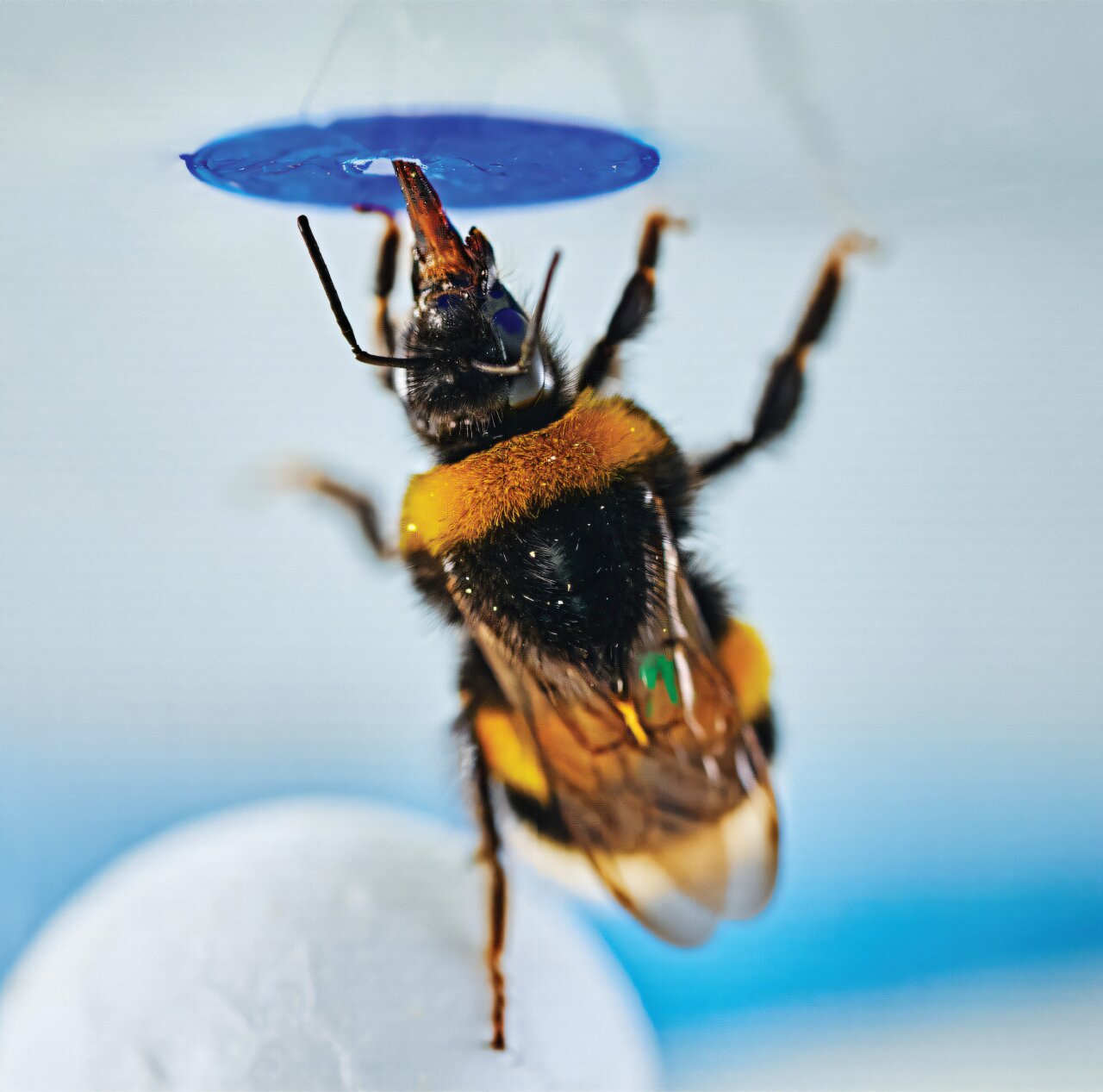
A bumble bee walks into a small container where its wings are of little use. Above it hangs an artificial flower filled with nectar, just out of reach. Rather than attempting to fly toward the reward, the bee moves a small ball across the floor, positions it beneath the flower and climbs onto it. The reward becomes accessible. In another experiment, bumble bees learned complicated sequences of movements by watching other bees. Some even appeared to catch an optimistic outlook simply by observing a nestmate. These behaviors are challenging traditional ideas about how much brainpower intelligence requires.
Bumble bees have fewer than a million neurons, yet research discussed by neuroscientists Lars Chittka of Queen Mary University of London and Stanley Heinze of Lund University suggests that their brains support several abilities associated with complex cognition. These include flexible problem-solving, learning from others, forming memories that can be applied in different situations and transmitting emotion-like states between individuals.
The findings raise questions about how relatively small nervous systems can support sophisticated behavior. They also suggest that intelligence may depend less on having an enormous brain than on how effectively neural circuits organize, store and use information.
In their commentary, published in Science, Chittka and Heinze bring together several lines of research on bumble bee behavior and brain organization. Rather than reporting a new experiment, they examine existing behavioral findings alongside emerging knowledge of insect neural circuits to explore the possible mechanisms behind these abilities.
Moving objects to reach an otherwise inaccessible reward
One of the most striking examples involves a problem-solving task that resembles an experiment conducted with chimpanzees nearly a century ago.
In the chimpanzee experiments, a banana was suspended from the ceiling, beyond the animals’ reach. The chimpanzees could obtain it by moving boxes beneath the fruit and climbing on them.
A more recent experiment presented bumble bees with a related challenge, but with an important difference. The insects entered a container with a ceiling too low for controlled flight, restricting their movement to walking.
Artificial flowers containing nectar were positioned on the underside of the container’s roof. The bees could not reach the flowers directly. Instead, they had to move a ball across the floor and position it beneath a flower before climbing onto it to obtain the nectar.
The bees managed to complete the task. More remarkably, they could direct the ball toward a target location even after that location was no longer visible.
That detail is important because it suggests that the insects were not simply responding to an immediately visible reward. Their behavior was consistent with maintaining information about a goal and organizing their movements to reach it.
The authors interpret these results as evidence of goal-directed problem-solving. The bees appeared able to combine previously learned information in a way that allowed them to tackle a situation they had not encountered before.
The distinction is between following a fixed behavioral response and flexibly organizing actions to achieve an objective. An animal that simply repeats a learned movement may succeed in familiar circumstances but struggle when the arrangement changes. A flexible problem-solver can use information about the goal to adjust what it does.
The experiments do not establish every cognitive process involved in the bees’ behavior, but they demonstrate that a very small brain can support surprisingly adaptable solutions to physical problems.
Complex skills can spread through a group
Individual problem-solving is only part of the picture. Bumble bees can also acquire behaviors by watching other members of their colony.
In another experiment, bees faced puzzle boxes that could be opened only by moving specific latches in the correct sequence to gain access to nectar.
The task required more than a single movement. Bees had to learn a multistep procedure in which the order of actions mattered.
Some bees initially had no training in how to solve the puzzle. However, after watching three skilled demonstrators complete it, some of these observers eventually managed to perform the task themselves.
An especially important detail was that no individual bee could solve the puzzle without the opportunity to learn socially.
This suggests that the behavior was too complex to emerge through individual learning alone under the experimental conditions. Watching experienced bees provided information that the observers could use to acquire the necessary sequence of actions.
The distinction matters because social learning does not always involve copying a simple movement. In this case, the observers acquired a coordinated series of actions needed to complete a challenging task.
Chittka and Heinze note that the social acquisition of behaviors too complex to emerge through individual learning has also been reported in humans and chimpanzees.
The finding adds another dimension to the question of insect intelligence. Bumble bees are not merely capable of solving problems independently. Under the conditions studied, they can also acquire complex behavioral strategies from other individuals.
An optimistic bee can influence another bee’s judgment
Perhaps even more unexpected is evidence that bumble bees can transmit emotion-like states through visual observation.
Researchers have investigated these states using experiments that resemble tests of optimism and pessimism in mammals.
The basic idea involves an ambiguous stimulus. If an animal interprets an uncertain signal as more likely to predict a reward, it can be described as displaying an optimism-like judgment bias. If it interprets the same signal less favorably, the bias is more pessimistic.
In one experiment, an unexpected reward induced an optimism-like state in bumble bees. The insects subsequently judged an ambiguous stimulus as more likely to be rewarding.
The researchers then examined whether this altered outlook could spread to other bees.
They placed an optimistic bee where another bee could observe it through a transparent partition. The observing bee subsequently developed a similar judgment bias.
Crucially, the insects did not need to exchange food or come into physical contact. The transmission occurred through visual information alone, without requiring chemical cues.
This suggests that observing another bee can influence how an individual evaluates an uncertain situation.
The authors describe this phenomenon as affective contagion, a basic component of empathy in which an individual’s emotional or internal state influences another individual’s state.
That distinction is important. The experiments do not establish that bumble bees experience emotions in exactly the same way humans do, nor do they demonstrate the full range of abilities associated with empathy. They provide evidence that emotion-like states can spread between insects through observation.
Alternative explanations for these behavioral effects remain debated. Nevertheless, the authors point to converging evidence from different experimental approaches as support for the idea that bumble bees do not simply react to external stimuli through rigid behavioral programs.
Instead, their decisions appear to be influenced by internal states that can themselves be affected by other individuals.
Two brain regions may help explain their abilities
The behavioral findings raise a fundamental question: What features of the bumble bee brain make such flexible behavior possible?
Chittka and Heinze identify two major brain regions as particularly important: the mushroom bodies and the central complex.
The mushroom bodies are involved in forming memories and associating sensory information with positive or negative outcomes. The central complex contributes to selecting actions according to context, particularly during spatial behavior.
Together, these regions provide a possible neural framework for understanding how bees remember experiences, interpret new information and choose appropriate movements.
The mushroom bodies are especially important for learning. Within these structures, neurons called Kenyon cells encode sensory information.
Their organization is relatively sparse. Although the mushroom bodies contain a large population of these cells, only a small proportion respond to a particular sensory input. Different sights, smells and other signals can therefore produce distinct patterns of neural activity.
The brain can associate these patterns with positive or negative outcomes depending on the reinforcement received during learning. Once an association has formed, encountering the sensory signal again can trigger an appetitive or aversive response.
For example, a bee that associates a particular smell with a food reward can subsequently respond to that smell based on the memory it formed.
This system also provides a way to distinguish between different experiences and combine information from multiple senses.
Bumble bees have a much larger memory system than fruit flies
One striking difference between bumble bees and fruit flies is the size of their mushroom bodies.
Although the basic architecture of these structures is broadly conserved across insects, bumble bees possess approximately 50 times more Kenyon cells than fruit flies.
That difference could provide considerably greater memory capacity.
A larger population of Kenyon cells allows more distinct associative memories to coexist without interfering with one another. In other words, the brain may be able to retain a wider variety of learned associations rather than repeatedly overwriting or confusing existing ones.
Bumble bee mushroom bodies also receive more developed inputs from different sensory systems, including vision, smell and taste.
This multimodal organization may help the insects apply what they have learned through one type of sensory experience to situations involving another.
Such flexibility is important for forming abstract representations. Instead of remembering only the exact sensory details of a particular experience, an animal can potentially extract information that remains useful when the surrounding circumstances change.
The authors also draw attention to similarities between the sparse organization of insect mushroom bodies and the mammalian hippocampus, a brain region involved in memory formation and recall.
In fruit flies, sparse coding helps distinguish between similar sensory inputs, a process known as pattern separation.
Chittka and Heinze suggest that the greater complexity of bumble bee mushroom bodies might support additional memory operations, including pattern completion. This process involves reconstructing a complete memory from partial or noisy information.
Such an ability could contribute to more advanced forms of memory and abstraction, although the proposed hippocampus-like computations in bees remain a possibility for future investigation rather than an established explanation of their behavior.
The central complex helps bees keep track of goals and direction
The second major brain region, the central complex, plays a different but complementary role.
It helps insects select actions according to their current circumstances. During spatial tasks, it compares the animal’s heading with the direction of its goal, allowing the animal to adjust its course when the two do not align.
A bee navigating toward a destination, for example, must continuously relate its current direction of movement to where it needs to go.
Researchers understand aspects of how this process works in fruit flies, and similar mechanisms appear to operate in bumble bees.
One particularly interesting discovery in fruit flies concerns neurons that encode the animal’s intended walking direction.
The internal signal can persist even when external sensory information is temporarily disrupted. This makes it a form of working memory, the temporary retention of information that an animal can use while carrying out a task.
The fruit fly brain also contains numerous cell types anatomically similar to these so-called goal neurons.
Their existence suggests that working memory may be capable of maintaining several goals simultaneously, rather than representing only one intended action at a time.
That would be useful when an animal must choose between alternative actions.
The authors note that the bumble bee central complex contains circuits that differ from those found in fruit flies. These additional circuits contribute to a neural network involved in computing navigational vectors, which represent directions and distances.
The bee-specific circuitry could potentially allow several navigational vectors to be stored in parallel.
One example is traplining, a behavior in which bumble bees find an efficient route connecting multiple food sources.
To navigate such a route, a bee must make decisions at successive feeding locations. The authors suggest that it may compare possible flight directions and distances in working memory before selecting its next destination.
This is an intriguing connection because the same general computational ability could potentially be used beyond navigation.
If a brain can represent different possible destinations as internal goals and compare them, similar operations might help it evaluate alternative actions in more abstract problem-solving situations.
The authors propose that representations of behavioral goals could be compared, combined and linked together using computational operations similar to those involved in spatial navigation.
They point to mammalian hippocampal-entorhinal circuits as a comparison. These networks support spatial, temporal and semantic frames of reference used in episodic memory.
Whether comparable computational principles operate in bumble bee cognition remains an important question.
Internal states change how the brain processes information
Memory and navigation alone may not explain the full range of behaviors discussed by Chittka and Heinze.
An animal’s internal condition can also influence how it interprets sensory information and chooses what to do.
For example, sleep drive can change over time, while attractive odors can influence an insect’s behavioral priorities. These internal and contextual signals can alter which actions become more likely.
The central complex is involved in integrating such information into action selection.
An important part of this process involves neuromodulators, chemical messengers that adjust the activity of neural circuits over longer timescales.
Rather than simply carrying a specific sensory message, neuromodulators can change how strongly different neural pathways influence behavior.
The combined activity of these systems creates what the authors describe as a neurochemical context. Depending on that context, some actions become more likely than others.
Chittka and Heinze suggest that bumble bees possess a more elaborate system of neuromodulatory networks than fruit flies, particularly when it comes to neuropeptides.
This difference could give bees a larger repertoire of internal states and allow them to make finer distinctions between situations that might otherwise produce the same behavioral response.
The proposed connection to emotional contagion is particularly interesting.
If internal states are represented through activity in these neural systems, observing another bee might activate pathways that alter the observer’s own internal state.
The authors suggest that studying the modulatory circuits and the pathways carrying information from one bee to another could help identify how observing another individual triggers a particular internal state.
However, the precise neural mechanisms responsible for this transmission have not yet been established.
A small brain may be using familiar neural computations in more elaborate ways
The central argument developed by Chittka and Heinze is that sophisticated cognition may not require entirely new types of neural algorithms.
Instead, evolution may have expanded the capacity of existing insect brain circuits, allowing familiar computational processes to operate across a much richer range of information.
The larger mushroom bodies of bumble bees, their extensive sensory inputs, the additional circuits in their central complex and their more elaborate neuromodulatory systems are possible examples of this expansion.
This interpretation offers an alternative to the traditional assumption that complex intelligence necessarily requires a large brain.
The bumble bee brain is substantially larger than that of a fruit fly, which has approximately 140,000 neurons. But even the bee’s relatively small nervous system contains fewer than a million neurons.
The important question, therefore, is not simply how many neurons an animal possesses, but how those neurons are organized and what kinds of computations their connections support.
The authors point out that some of the relevant neural features are already present in simpler forms in fruit flies. This raises the possibility that differences in cognitive abilities could emerge through changes in the capacity and organization of existing circuits.
However, the proposed explanation remains a framework for understanding the behavioral evidence, not a complete demonstration of how each ability is generated by particular neural connections.
Mapping the bee brain could test these explanations
A major obstacle to understanding insect intelligence is that researchers still lack a complete wiring diagram of the bumble bee brain.
Such a diagram, known as a connectome, maps the connections between neurons at synaptic resolution.
A complete connectome of the fruit fly brain is already available, while efforts to map parts of the brains of three bee species are underway.
So far, only a limited number of bumble bee brain regions have been mapped at this level of detail.
The authors suggest that technological advances could make a complete bee-brain connectome achievable within approximately a decade.
This would allow researchers to compare the neural architecture of different insects and investigate whether specific differences in their connections correspond to particular cognitive abilities.
For example, researchers could examine whether a greater number of memory-related neurons corresponds to increased capacity for storing distinct associations. They could also investigate whether additional central-complex circuits support the ability to maintain and compare multiple navigational goals.
The most informative comparisons, the authors argue, would connect identifiable differences in neural circuitry with specific predictions about how the brain processes information.
Simply comparing brain structures would not be enough. Researchers would need to establish how those structural differences relate to measurable cognitive abilities.
Intelligence may be difficult to compare across species
There are also important limitations to interpreting differences in animal cognition.
A species that performs poorly on a particular task does not necessarily lack the mental capacity required to solve it.
Ecological differences may make certain tasks more relevant to some animals than others. As a result, one species might excel at a particular challenge because its natural behavior and sensory abilities are better suited to the task, rather than because it possesses greater general intelligence.
The authors use complex task planning in fruit flies as an example. Determining whether such a cognitive ability is genuinely absent can be difficult because the experimental task may not match the species’ ecological circumstances.
It is also possible that bumble bees have larger brains partly because they need to support greater sensory acuity and motor dexterity, without necessarily having greater cognitive capacity in every domain.
This distinction makes comparisons between species particularly challenging.
The authors therefore call for systematic investigations of cognitive abilities across a broader range of animals, including close relatives of bumble bees that do not share the same behavioral capacities.
Comparing their brains could help identify which neural features are associated with particular abilities and which differences may have other explanations.
Different insect species might also have evolved different neural solutions to produce similar cognitive behaviors, just as different groups of vertebrates can possess distinct neural arrangements supporting comparable abilities.
Understanding both shared and distinct neural solutions will be important for determining how intelligence evolves.
The research discussed by Chittka and Heinze does not establish that all animals with small brains possess the same cognitive abilities, or that brain size is irrelevant to intelligence. Nor does it resolve exactly how bumble bees generate abstract memories, maintain multiple goals or transmit emotion-like states.
Instead, the behavioral findings and emerging knowledge of insect brain organization provide a basis for investigating how relatively compact neural systems can support flexible learning, problem-solving and social behavior.
The study was published in Science.