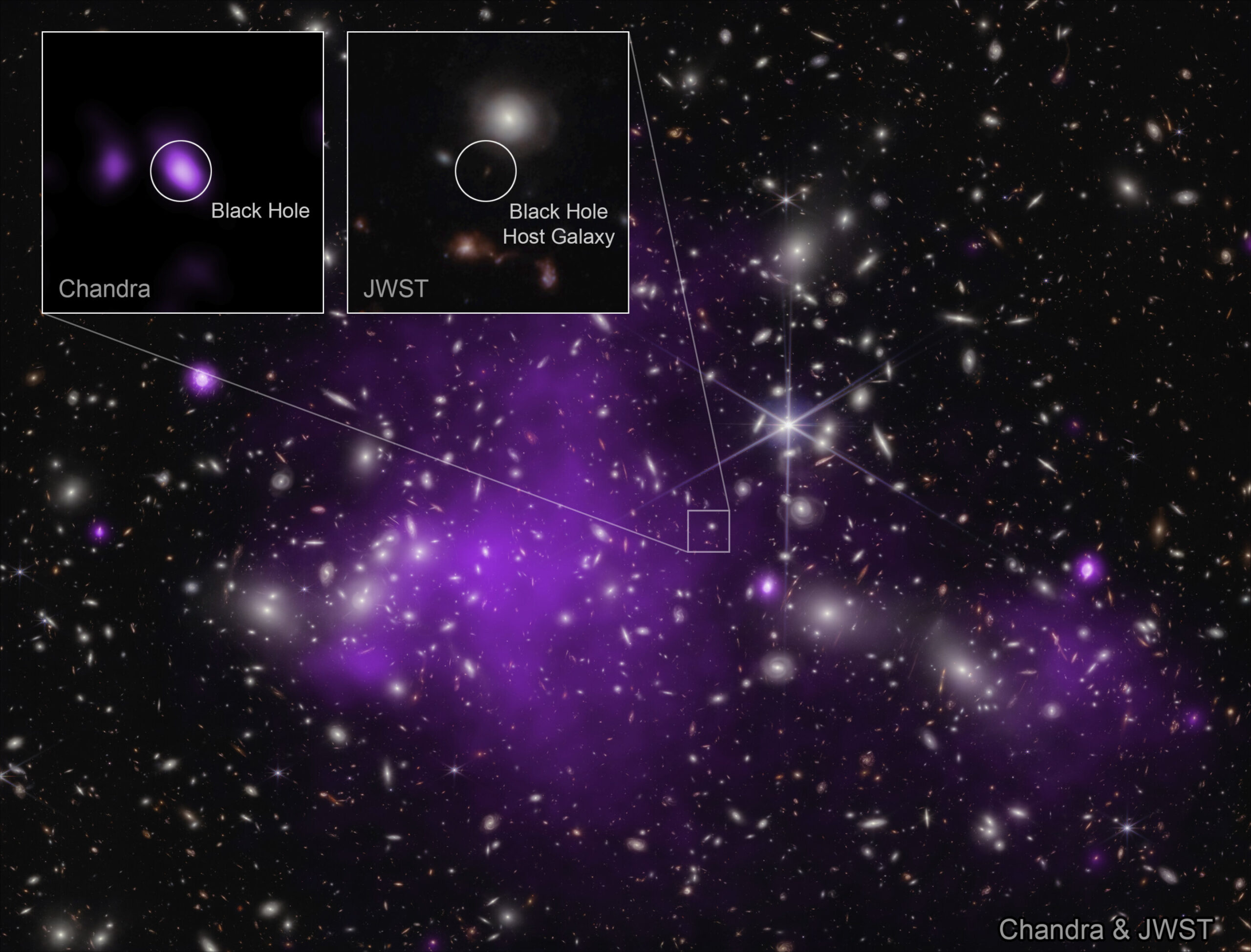
Just 450 million years after the Big Bang, a young galaxy called UHZ1 was already raising the possibility of something extraordinary: a black hole growing so rapidly that it could rival the mass of all the stars in its host galaxy. The possibility attracted attention because such an object could offer clues to how supermassive black holes became so large so early in cosmic history. But a closer examination of the galaxy’s X-ray emissions, along with new observations from the James Webb Space Telescope, has cast serious doubt on that interpretation. Instead, the evidence points to a relatively low-mass, metal-poor galaxy actively forming stars, with no compelling evidence for the powerful hidden black hole once proposed.
The question surrounding UHZ1 reaches back to one of the biggest challenges in astronomy: explaining how supermassive black holes became so enormous so early in the universe’s history.
Astronomers have identified hundreds of quasars powered by black holes containing more than a billion times the mass of the Sun at distances corresponding to less than a billion years after the Big Bang. Explaining how these objects grew so quickly remains difficult. If they began as ordinary stellar remnants, weighing only tens to hundreds of solar masses, they would have needed to grow through prolonged periods of extremely rapid feeding.
One possible solution involves a very different beginning. Rather than forming from the remnants of dying stars, some black holes may have emerged directly from enormous clouds of gas in the early universe.
This proposed process, known as direct collapse, could produce black hole seeds weighing roughly 10,000 to 1 million solar masses. Starting with such a massive seed would make it easier to explain how billion-solar-mass black holes appeared so early.
A key prediction is that a young black hole formed this way could temporarily become unusually massive compared with the galaxy surrounding it. During this stage, the black hole might contain as much mass as the galaxy’s stars, or even more.
Astronomers call such systems outsize black hole galaxies. Because the rapidly feeding black hole would dominate the galaxy’s energy output, the system should produce unusually strong X-ray emission relative to its visible and infrared light.
That combination made UHZ1 particularly interesting. Its apparent X-ray brightness, compared with its relatively modest stellar mass, suggested that astronomers might be looking at a black hole that had started with an exceptionally large seed.
But that interpretation depended heavily on a faint X-ray signal and a series of assumptions about how much radiation the proposed black hole was producing and how much of it was being absorbed.
Why UHZ1 became a black hole candidate
UHZ1, also identified as UNCOVER-26185, lies at a spectroscopically confirmed redshift of 10.054. In practical terms, astronomers observe it as it existed when the universe was only about 450 million years old.
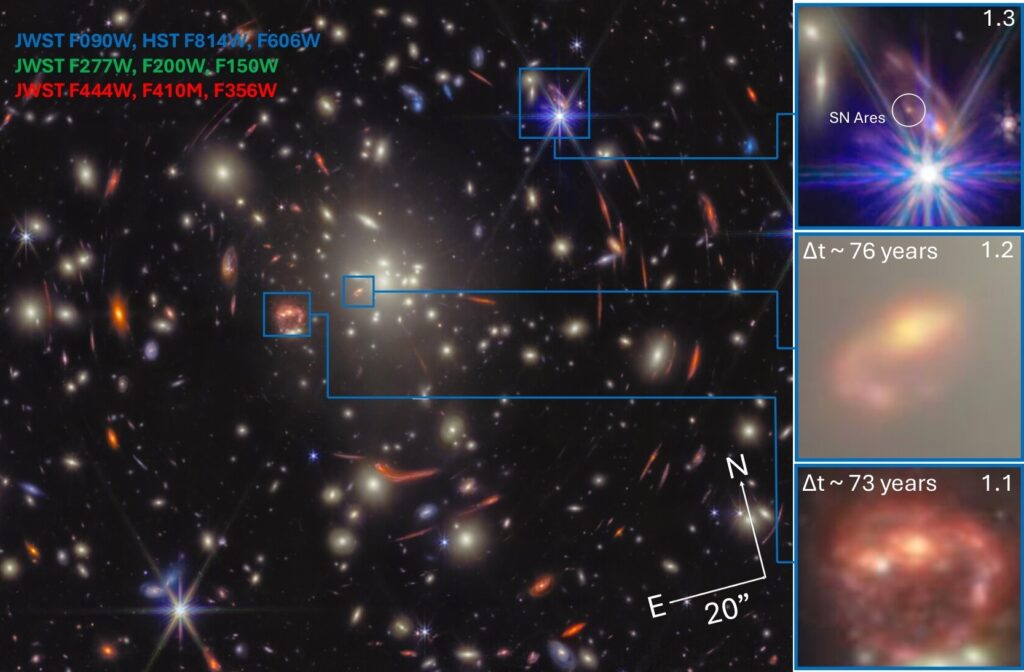
The galaxy was identified in observations of the galaxy cluster Abell 2744, also known as Pandora’s Cluster. The cluster’s gravity bends and magnifies light from more distant objects behind it, making otherwise difficult-to-observe galaxies easier to study.
For UHZ1, this gravitational magnification is estimated at approximately 3.71 times.
Earlier observations with the James Webb Space Telescope established that the galaxy contains a relatively modest stellar population. Its estimated stellar mass is about 170 million solar masses, and its metallicity is approximately 4 percent of the Sun’s. Metallicity describes the abundance of elements heavier than helium in a star or galaxy.
These measurements painted a picture of a young, relatively metal-poor galaxy.
The controversy began with observations from NASA’s Chandra X-ray Observatory.
Using 1.25 million seconds of Chandra exposure, an earlier research team reported an excess of hard X-ray photons at UHZ1’s position. The signal appeared in the 2–7 kiloelectronvolt energy range, corresponding to much higher energies when viewed in the galaxy’s own reference frame.
The researchers detected approximately 21 net counts above an estimated background of 21.4 counts. Although the number of photons was small, their analysis assigned the signal a statistical significance of 4.2–4.4 sigma.
A possible explanation was that a powerful active galactic nucleus was producing X-rays inside UHZ1. An active galactic nucleus, or AGN, is a galaxy’s central region where gas falling toward a supermassive black hole releases enormous amounts of energy.
The proposed black hole was thought to be surrounded by an exceptionally dense layer of gas. Such an arrangement is called Compton-thick obscuration because the gas is dense enough to strongly scatter and absorb X-rays.
Under this interpretation, the absence of detectable soft X-rays alongside the hard X-ray excess was consistent with a heavily obscured source.
Modeling the X-ray signal suggested a hydrogen column density of approximately 8 × 10²⁴ particles per square centimeter. The estimated intrinsic X-ray luminosity was around 10⁴⁶ erg per second, although the original analysis acknowledged substantial uncertainty because of the limited number of detected photons.
Assuming the black hole radiated at its Eddington limit, the earlier team inferred a black hole mass of approximately 10 million to 100 million solar masses, comparable to the stellar mass of the entire galaxy.
That apparent relationship between black hole mass and host galaxy mass made UHZ1 a particularly interesting direct-collapse candidate.
However, the interpretation had two important weaknesses. The X-ray detection was below the 5-sigma threshold the new study considers appropriate for an extraordinary claim, and the inferred black hole mass depended on several model-dependent steps.
The new investigation by Fan Zou and colleagues at the University of Michigan and collaborating institutions set out to examine whether the X-ray signal could withstand a more extensive analysis and whether independent infrared observations supported the presence of a powerful hidden black hole.
A much larger X-ray dataset changes the picture
The researchers reanalyzed the original Chandra observations and added another 950,000 seconds of observations obtained between May 2023 and May 2024.
This expanded the total exposure from 1.25 million to approximately 2.2 million seconds, or about 25.5 days of accumulated observing time.
The additional observations provided an important opportunity to test the original interpretation. If UHZ1 contained a relatively steady, continuously emitting X-ray source, the number of detected source photons should generally increase as more observing time is accumulated.
The team also examined a technical issue that can become especially important when astronomers are trying to identify a faint source against a complicated background: the precise alignment of observations.
Chandra images taken at different times must be registered to a common reference position before they can be combined. Small differences in the estimated positions of sources can affect how many photons fall inside the aperture used to measure a faint object.
This problem is particularly relevant for UHZ1 because it appears close to the center of Abell 2744, where the surrounding intracluster medium produces substantial X-ray emission.
The intracluster medium is extremely hot gas filling the space between galaxies in a cluster. In Abell 2744, its temperature is approximately 11 kiloelectronvolts, making it a strong source of X-ray background.
Unlike a relatively empty region of space, this environment contains extended, structured emission that can vary across very small distances.
The researchers therefore compared three ways of aligning the Chandra observations.
The first involved making no additional astrometric corrections. The second followed the earlier study’s approach, aligning observations with reference X-ray sources. The third used optical positions from the Legacy Survey as reference points.
For each alignment method, the researchers measured photons inside a circular aperture with a radius of one arcsecond around UHZ1. They estimated the local background using a surrounding annulus extending from three to six arcseconds.
They also independently modeled the surrounding X-ray background using a fourth-order polynomial. The predicted background inside the source aperture agreed with the annular estimate to within approximately 0.1 count.
This agreement suggested that the average local background estimate was not strongly dependent on the method used. However, the researchers cautioned that variations on scales smaller than one arcsecond could not be completely excluded.
To assess whether the detected photons represented a genuine excess, they used a statistical method called the binomial no-source probability. This approach is particularly useful when the number of detected photons is small and a conventional signal-to-noise calculation may be less appropriate.
The results were substantially weaker than those originally reported.
Across the different data reductions and alignment choices, the hard X-ray signal reached only 2.0–2.9 sigma.
In the original 1.25-million-second dataset, the new analysis obtained significances ranging from 2.6 to 2.9 sigma. When all 2.2 million seconds were included, the significance ranged from 2.0 to 2.9 sigma.
The full-energy-band signal was weaker still, reaching only 0.6–2.3 sigma. No significant excess appeared in the soft X-ray band.
The researchers also checked whether their results depended on the initial data-cleaning procedures. They repeated the photon-counting analysis using archived Chandra event files at different processing stages. These checks produced hard-band significances of approximately 2.6–2.8 sigma, consistent with their main analysis.
Three authors with expertise in X-ray astronomy independently analyzed the Chandra data and obtained similarly low significances. The article also notes an independent report of a nondetection by another research team.
Together, these checks suggested that the discrepancy was not simply the result of one particular data-processing choice.
Tiny alignment changes can produce a much stronger apparent signal
To investigate the discrepancy with the original detection more directly, the researchers performed a large set of simulations.
They randomly shifted the astrometric positions of individual Chandra observations, using offsets consistent with the expected absolute positional accuracy of the telescope.
They repeated this procedure 100,000 times for both the original dataset and the expanded dataset, measuring the resulting X-ray significance each time.
The results revealed just how sensitive the apparent excess was to the assumed alignment.
Across the simulations, small positional changes could produce or suppress apparent X-ray excesses of approximately 3–4 sigma at UHZ1’s position.
The originally reported significance, after correcting a difference in the statistical conversion used by the two studies, was approximately 4.0–4.3 sigma.
Yet such a strong signal appeared in only 0.03 percent of the simulations involving the original dataset and 0.1 percent of those involving the full dataset.
In other words, the earlier result occupied an extreme part of the distribution of possible outcomes generated by reasonable positional shifts.
This does not establish exactly why the original analysis produced a stronger signal. However, it demonstrates that the reported significance is highly sensitive to the particular astrometric alignment adopted.
The distinction matters because the signal itself is marginal. When only a small number of photons distinguish a possible source from its background, even a small change in which photons are assigned to the source aperture can influence the result.
The authors also point out that the original search considered 11 galaxy candidates at redshifts above 9. Applying a conservative Bonferroni correction to account for this multiple-candidate search would further weaken the statistical case.
The original detection therefore does not emerge as a robust result across the range of reasonable analyses.
The additional observations do not strengthen the signal
The expanded Chandra dataset provided another independent way to examine the proposed source.
A genuine, steady X-ray emitter should generally contribute more photons as observing time increases. If the source maintains a constant average brightness, a longer exposure should accumulate additional counts in proportion to the added observing time.
But that is not what happened at UHZ1.
The researchers compared the original 1.25-million-second dataset with the expanded 2.2-million-second dataset. Despite the additional 950,000 seconds of exposure, the inferred hard X-ray source counts did not increase proportionally.
The researchers then examined the observations individually, constructing a light curve showing the estimated hard X-ray count rate over time.
The earlier observations showed a positive net count rate. In contrast, the more recent observations were consistent with zero net source emission.
Considering the additional 950,000 seconds alone, the researchers calculated a 90 percent upper limit of 8.3 net counts per million seconds for the hard-band count rate.
If the source had maintained a constant rate at that upper limit, the original 1.25-million-second observations would have been expected to contain fewer than 10 net counts. The measured value was approximately 14.
However, the authors were careful not to interpret this difference as proof that the source varies.
The statistical uncertainty in estimating the net counts from the original observations was approximately six counts. Combined with the already marginal detection, that uncertainty was too large to establish variability confidently.
The important point is therefore more limited: the signal does not accumulate as expected for a steady point source, further weakening the case that the original excess represents a persistent X-ray source.
The researchers could not determine from these data alone whether the apparent excess was caused by a statistical fluctuation, background structure, or some other source of uncertainty.
James Webb searches for the heat of a hidden black hole
Even if the X-ray interpretation remained uncertain, another telescope offered an independent way to test whether a powerful black hole was hidden inside UHZ1.
The researchers turned to the Mid-Infrared Instrument, or MIRI, aboard the James Webb Space Telescope.
The reason this matters is that a heavily obscured black hole should not necessarily disappear at every wavelength.
A dense layer of gas can absorb or scatter X-rays, but dust surrounding an active black hole can absorb its radiation and reradiate much of that energy as infrared light.
In this way, infrared observations can reveal energy from a hidden source even when its direct radiation is difficult to detect.
At UHZ1’s redshift, JWST’s mid-infrared observations probe the galaxy’s rest-frame optical and near-infrared wavelengths. These include the wavelength range where hot dust surrounding an AGN can produce substantial emission.
If the proposed black hole were releasing enormous amounts of energy, its surrounding dust would be expected to absorb some of that energy and produce infrared emission.
This makes mid-infrared measurements an important independent test of the obscured-AGN interpretation.
The researchers analyzed observations from all nine MIRI broadband filters, covering observed wavelengths from 5.64 to 25.36 micrometers.
The observations were obtained through JWST observing program 6123, led by Elena Gallo and Guido Roberts-Borsani.
After subtracting the background and masking other detected sources, the team examined UHZ1’s position in each image.
They found no source above the local noise level in any of the nine filters.
To quantify the result, the researchers measured the flux inside small circular apertures designed to capture half of the instrument’s point-spread-function energy. They estimated the local noise by measuring equivalent apertures in nearby regions without detected sources.
The resulting signal-to-noise ratios were consistent with zero across all nine bands.
Combining the images into a variance-weighted stack did not reveal a source either.
The researchers therefore established 3-sigma upper limits on the galaxy’s infrared brightness.
The limits varied across the filters. At 5.64 micrometers, the maximum allowed flux density was 0.13 microjanskys. At 15.06 micrometers, it was 1.14 microjanskys, while the limit at 25.36 micrometers was 26.23 microjanskys.
These measurements provided a way to estimate how powerful a hidden AGN could be without producing infrared emission brighter than JWST observed.
Infrared limits put a ceiling on the hidden AGN
To translate the MIRI nondetections into limits on black hole activity, the researchers compared the observations with two models of heavily obscured active galaxies.
The first was a conventional obscured-quasar model known as the Torus template. It represents radiation from an AGN surrounded by hot, dusty material.
The second was a much redder model based on hot dust-obscured galaxies, commonly called Hot DOGs. These systems represent an especially infrared-luminous class of heavily buried AGNs.
The Hot DOG template was particularly useful because it provided a conservative comparison for an extremely red, dust-obscured source.
The researchers fitted both models to UHZ1’s observed spectral energy distribution, which describes how much radiation the galaxy emits at different wavelengths.
They restricted the fits to rest-frame wavelengths longer than one micrometer. Shorter wavelengths are more vulnerable to host-galaxy contamination and uncertainties in how much optical radiation escapes from an obscured nucleus.
Each model was increased in brightness until it reached the tightest relevant MIRI upper limit.
For the conventional Torus model, the most restrictive measurement came from the F1500W filter. For the Hot DOG model, it came from F1800W.
After correcting for gravitational magnification, the conventional Torus model constrained the bolometric luminosity of any buried AGN to less than 1.3 × 10⁴⁵ erg per second.
Bolometric luminosity represents the total energy emitted across all wavelengths, rather than the energy measured in just one part of the spectrum.
The researchers also used the relationship between bolometric and X-ray luminosity adopted in the earlier UHZ1 analysis. This produced an upper limit on the intrinsic 2–10 kiloelectronvolt X-ray luminosity of approximately 1.8–6.2 × 10⁴³ erg per second.
They performed a separate calculation using the AGN’s rest-frame 6-micrometer luminosity, which is closely related to X-ray luminosity and is relatively less affected by emission from the host galaxy.
This approach produced intrinsic X-ray luminosity limits of approximately 9.6 × 10⁴³ erg per second for the Torus model and 4.2 × 10⁴⁴ erg per second for the Hot DOG model.
Combining the bolometric and 6-micrometer constraints, the authors place the intrinsic X-ray luminosity of any buried AGN below approximately 1.8 × 10⁴³ to 4.2 × 10⁴⁴ erg per second.
That is roughly one to three orders of magnitude below the 9 × 10⁴⁵ erg per second inferred in the earlier study under its Compton-thick AGN model.
The difference is substantial. The infrared observations do not merely fail to reveal the proposed black hole. Under the adopted obscured-AGN models, they place an upper limit on its possible power that is far below the earlier estimate.
The authors also considered an alternative approach using the galaxy’s rest-frame K-band emission, around 2.1 micrometers. This produced considerably looser X-ray luminosity limits, between approximately 2 × 10⁴⁵ and 8 × 10⁴⁶ erg per second, depending on which local Seyfert-galaxy relationship was adopted.
Because these estimates rely on extrapolating relationships beyond their calibrated luminosity range, the researchers do not use them as their primary constraints. They instead rely on the more restrictive spectral-energy-distribution fits.
Could the black hole be hidden without producing infrared light?
The absence of infrared emission raises an important complication.
The infrared limits rely on models in which dust absorbs energy from the central black hole and reradiates it at longer wavelengths. But the authors recognize that this emission could be suppressed under certain physical conditions.
One possibility is that the obscuring gas contains little or no dust. This could prevent the expected infrared emission even if the black hole were heavily obscured by gas.
Another possibility is that the obscuring material lies far from the central black hole. Dust at greater distances would be cooler and could release much of its energy at far-infrared wavelengths beyond the range where the MIRI observations provide their strongest constraints.
These possibilities mean that infrared nondetections alone cannot rule out every conceivable configuration of an obscured black hole.
However, the researchers argue that other observations of UHZ1 make these explanations difficult to reconcile with the full set of evidence.
If the obscuring gas were dust-free, radiation from the central AGN in the ultraviolet and optical ranges should remain visible. Yet the existing JWST observations do not reveal the expected signatures.
If the obscuring material were sufficiently distant and cool to shift its emission predominantly into the far-infrared, the galaxy would still need an adequate dust reservoir. Independent observations do not provide evidence for one.
The authors therefore regard the infrared limits based on hot-dust emission as conservative constraints rather than assuming that every possible obscuration geometry has been excluded.
Webb’s spectra also lack the expected signs of an active nucleus
The new X-ray and MIRI analyses are not the only evidence against a powerful hidden black hole.
The researchers also examined independent JWST spectroscopic observations of UHZ1, which provide information about the physical processes energizing the galaxy’s gas.
Earlier observations with JWST’s Near-Infrared Spectrograph, or NIRSpec, did not reveal prominent high-ionization ultraviolet emission lines commonly associated with powerful accreting sources.
These include features associated with highly ionized carbon, nitrogen and helium.
The absence of such features was initially attributed to the possibility that an exceptionally thick layer of obscuring material was hiding the central AGN.
However, subsequent observations provided additional information at longer wavelengths.
A 13.9-hour JWST/MIRI Low Resolution Spectroscopy observation detected two important groups of emission lines: Hβ together with the doubly ionized oxygen lines, and Hα.
The Hβ+[O III] emission was detected at approximately 10-sigma significance, while Hα was detected at approximately 8-sigma significance.
These lines provide information about the conditions in the gas surrounding young stars and possible active galactic nuclei.
The observed emission-line ratios placed UHZ1 in the region associated with low-metallicity star-forming galaxies rather than AGN-powered systems.
The inferred ionization parameter was also consistent with low-metallicity stellar photoionization models, rather than the models used to describe active galactic nuclei.
In simpler terms, the detected emission lines can be explained by radiation from young stars ionizing the surrounding gas. The spectra do not require an additional powerful radiation source from a central black hole.
The study also points to the galaxy’s low dust attenuation. Its spectral-energy-distribution analysis gives a best-fit visual extinction of approximately 0.2 magnitudes.
Independent measurements of the Balmer decrement, which compares the strengths of hydrogen emission lines, are consistent with relatively little obscuration, corresponding to a visual extinction of no more than approximately 0.4 magnitudes.
These measurements provide little support for the large amount of dust that would be expected if the galaxy’s entire host environment were responsible for hiding a powerful nucleus.
Another independent constraint comes from observations with the Atacama Large Millimeter/submillimeter Array. The reported nondetections of far-infrared dust emission constrain the galaxy’s cold dust mass to approximately 550,000 solar masses or less.
That is a limited dust reservoir for a galaxy supposedly hiding a highly luminous central source behind enormous quantities of obscuring material.
The researchers therefore conclude that the host galaxy itself cannot provide the Compton-thick obscuration required by the original X-ray interpretation. Any such material would have to be located very close to the black hole.
There is also a separate discrepancy involving the galaxy’s Hα emission.
The observed Hα luminosity can be used to estimate the X-ray luminosity expected from an AGN through established relationships. Applying these relationships to UHZ1 gives an expected intrinsic X-ray luminosity of a few times 10⁴³ erg per second.
That estimate is at least an order of magnitude below the luminosity inferred in the earlier Compton-thick model.
The lack of high-excitation narrow emission lines further weakens the proposed interpretation of UHZ1 as a powerful obscured AGN.
Taken together, these spectroscopic and dust measurements provide independent evidence that the galaxy is dominated by star formation rather than an exceptionally luminous active nucleus.
What remains uncertain about UHZ1
The new analysis does not establish that UHZ1 contains no black hole.
The researchers’ conclusion is specifically that there is no compelling evidence for a luminous, heavily obscured AGN of the kind proposed in the earlier study.
A less luminous accreting black hole is not excluded by the observations. Nor do the results determine whether a black hole formed through direct collapse or through another formation process.
The distinction is important because the original direct-collapse interpretation depended on identifying an unusually powerful black hole and estimating its mass from the X-ray signal.
If that signal is not statistically robust, the subsequent mass estimate becomes unreliable. The uncertainty is compounded by the degeneracy between the assumed gas column density and the intrinsic X-ray luminosity in the original spectral model.
The infrared observations introduce their own model dependence because the conversion from measured flux limits to black hole luminosity relies on assumptions about the shape of the AGN spectral energy distribution.
The authors address some of these uncertainties by considering both conventional obscured-quasar and extremely red Hot DOG templates, as well as alternative infrared luminosity relationships. Nevertheless, the limits remain conditional on the adopted models.
The temporal analysis also has an important qualification. Although the additional observations contribute little apparent signal, the available photon statistics are insufficient to establish that the source is genuinely variable.
The researchers’ strongest conclusion comes from the agreement among several independent lines of evidence: the marginal X-ray detection, its sensitivity to astrometric alignment, the failure of the signal to grow with additional exposure, the absence of infrared emission, and the lack of AGN-like spectral signatures.
The earlier black hole mass estimate of approximately 10⁷–10⁸ solar masses was derived through a long chain of assumptions starting with a small number of X-ray photons. The new analysis demonstrates how systematic uncertainties at the beginning of that chain can affect the final astrophysical interpretation.
Instead, the available observations are consistent with UHZ1 being a low-mass, metal-poor, star-forming galaxy with a stellar mass of approximately 100 million solar masses and a star formation rate of about one solar mass per year.
The evidence does not establish how any black hole in the galaxy originally formed. It does, however, leave the proposed exceptionally luminous, obscured black hole without the multiwavelength support that would be needed to identify UHZ1 as a convincing direct-collapse candidate.
The study was published in The Astrophysical Journal.