Black holes weighing about 10 times as much as the Sun appear far more frequently in gravitational-wave observations than those weighing around 15 solar masses. The merger rate drops by roughly two orders of magnitude across this relatively narrow mass range, before rising again among heavier black holes. This unusual pattern may reflect a particular way massive stars die, in which a failed supernova allows the star to collapse directly into a black hole within a limited range of stellar masses. New analysis of gravitational-wave observations suggests that the 10-solar-mass black holes may belong to a distinct astrophysical population, potentially separated from heavier black holes by a region where mergers are exceptionally rare.
When two black holes orbit one another and eventually merge, they release energy in gravitational waves, tiny distortions in spacetime that can be detected by observatories on Earth. By studying these signals, astronomers can estimate the masses and spins of the black holes involved.
As the number of detected mergers has grown, a striking pattern has emerged in the distribution of black hole masses. The merger rate reaches a prominent maximum around 10 solar masses, then declines sharply at higher masses.
The decline is particularly noticeable between approximately 10 and 15 solar masses. Instead of gradually decreasing as the black holes become heavier, the rate falls by roughly 100 times across just a few solar masses.
The distribution becomes more complicated beyond this region. The merger rate rises again above approximately 16 solar masses before gradually declining at still higher masses.
This pattern raises an important question about how black holes form. If the black holes around 10 solar masses and those at higher masses come from the same underlying population of dying stars, their mass distribution might be expected to change more gradually. A sharp concentration followed by a deep decline could instead indicate that different stellar processes produce different groups of black holes.
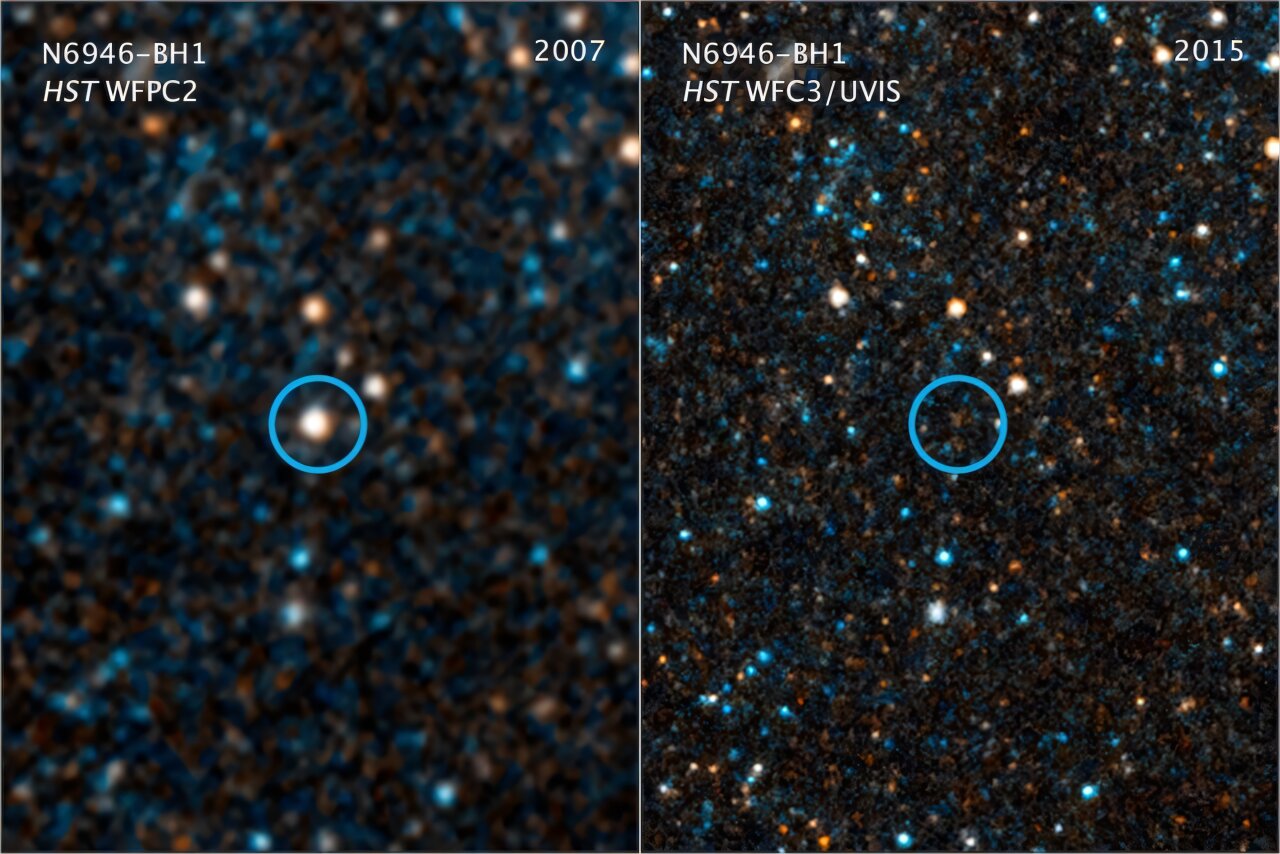
One possible explanation involves failed supernovae, stellar explosions that never successfully develop and instead leave the collapsing star to form a black hole directly.
Isaac Legred, Jacob Golomb and Katerina Chatziioannou investigated this possibility by developing a population model that treats black holes around 10 solar masses as a potentially distinct group rather than simply another feature of the broader black hole mass distribution.
Their analysis also examines whether the low-mass group is separated from heavier black holes by a genuine gap in the merger rate.
Why some massive stars may collapse without exploding
The proposed explanation begins with the final stages of a massive star’s life.
When a massive star reaches the end of its evolution, its core can collapse. Depending on the physical conditions inside the star, this collapse may produce a successful supernova explosion, leaving behind a neutron star or a black hole, or the explosion may fail, allowing the material to collapse directly into a black hole.
The likelihood of a successful explosion depends partly on the structure of the collapsing stellar core.
One property that has received particular attention is core compactness, which describes how concentrated the star’s mass is within its central region. A highly compact core can be more difficult to explode successfully.
Earlier theoretical work connected an unusual concentration of black holes around 9–10 solar masses to stars with particularly compact carbon-oxygen cores. These cores can make direct collapse more likely under certain conditions.
However, this explanation alone does not appear sufficient to account for the observed abundance of black holes around 10 solar masses.
Population-synthesis estimates based on this mechanism suggest an enhancement in black hole formation of roughly three times around 9–10 solar masses. The observed merger-rate difference, however, is considerably larger.
The researchers therefore consider another possibility: the ability of a massive star to produce a successful supernova may depend on more than core compactness.
The internal composition and entropy structure of the star can also influence whether an explosion succeeds. This means stars with relatively similar initial masses may not necessarily have the same outcome when their cores collapse.
Three-dimensional simulations of dying massive stars provide an important motivation for this idea.
Among the solar-metallicity progenitors examined in one set of simulations, stars with initial masses of approximately 11–14 solar masses formed black holes through failed supernovae. Other stars with slightly lower or higher initial masses successfully exploded, leaving neutron stars or much lower-mass black holes.
Other simulations have similarly identified stars near 12 solar masses as particularly prone to failed explosions, although the outcome depends on metallicity and other stellar properties.
These results suggest that a relatively narrow range of stellar progenitors may be especially vulnerable to direct collapse.
If such stars frequently produce black holes that later become members of merging binary systems, they could create an unusually concentrated population around 10 solar masses.
The researchers propose that this process may contribute to the observed peak. It remains a possible astrophysical explanation, however, rather than a mechanism directly demonstrated by the gravitational-wave observations.
Looking for two distinct populations in gravitational-wave data
To investigate whether the mass distribution contains separate populations, the researchers analyzed 153 binary black hole observations from the GWTC-4.0 gravitational-wave catalog.
They selected events with a false alarm rate below one per year that were included in the catalog’s binary black hole population analysis.
Rather than assuming that every merging black hole belongs to one continuous mass distribution, they constructed a model containing two components.
The first component represents the proposed failed-supernova population. Its primary black hole masses follow a Gaussian distribution, meaning that most objects cluster around a preferred mass, with fewer objects appearing farther from the center. The distribution is also restricted to specified minimum and maximum masses.
The second component represents the remaining black holes. The researchers did not assign these objects a specific stellar origin. Instead, they tested two possible mathematical descriptions of their mass distribution.
One model combines a power law with an additional Gaussian peak. The other uses a broken power law, in which the distribution follows different slopes below and above a particular mass.
An important feature of the analysis is that the researchers allowed the higher-mass population to begin at a different mass from the upper boundary of the low-mass population.
This distinction matters because a conventional model that forces the higher-mass population to extend continuously into the 10-solar-mass region cannot adequately test whether a gap exists between the two groups.
The researchers also allowed the populations to have different mass-ratio and spin distributions.
The mass ratio describes how the smaller black hole’s mass compares with that of its larger companion. The effective aligned spin, usually written as χ_eff, describes the combined contribution of the two black holes’ spins along the direction of their orbital angular momentum.
These properties provide additional ways to investigate whether black holes in different mass ranges share the same characteristics.
The analysis used a hierarchical Bayesian statistical framework. In practical terms, the researchers combined the individual gravitational-wave measurements with a model of the underlying population to estimate how frequently black holes of different masses merge.
They also accounted for observational selection effects. Gravitational-wave detectors do not detect every merger equally well, so the analysis incorporated simulated sources to estimate the detectors’ sensitivity across different black hole masses.
This correction is important because an apparent shortage of certain black holes could otherwise reflect observational limitations rather than a genuine feature of the underlying population.
The merger rate drops sharply after the 10-solar-mass peak
Both population models recovered almost identical results around the low-mass peak.
The estimated center of the failed-supernova component was 9.95 solar masses, with a 90% credible interval extending from 8.70 to 10.48 solar masses.
Its estimated standard deviation was approximately 0.71 solar masses, although the uncertainty was substantial.
The differential merger rate reached its maximum around 10 solar masses, at an estimated 7.36 black hole mergers per cubic gigaparsec per year per solar-mass interval. The 90% credible interval ranged from 4.25 to 13.71 in the same units.
The rate then declined dramatically.
Between approximately 10 and 14 solar masses, the researchers found a reduction of roughly two orders of magnitude. In the 13–15 solar-mass interval, the highest estimated differential rate was only 0.24 mergers per cubic gigaparsec per year per solar-mass interval.
The results from the broken-power-law model were similar, with a peak rate of approximately 8.41 around 10 solar masses and a maximum rate of approximately 0.19 in the 13–15 solar-mass range.
The agreement between the two models is important because it indicates that the prominent low-mass peak and subsequent rate decline do not depend strongly on which of the two descriptions is used for the higher-mass population.
The researchers also estimated how much of the overall merging black hole population belongs to the proposed failed-supernova component.
Their preferred model placed approximately 76% of the sources in this group, with a 90% credible interval of approximately 59–83%.
The broken-power-law model produced a very similar estimate of approximately 75%.
This means that, under the models tested, the majority of observed binary black hole mergers are consistent with belonging to the population concentrated around 10 solar masses.
The higher-mass component accounts for the remaining sources.
A possible gap between 12 and 16 solar masses
The sharp rate decline raises the possibility that the two populations are separated by a genuine gap in primary black hole masses.
The researchers examined this possibility using two complementary approaches.
First, they investigated the inferred merger rate at individual masses. They then compared the upper extent of the low-mass population with the mass at which the higher-mass population begins to contribute substantially.
There is an important distinction between a region containing no black holes and one in which the merger rate is simply too low for current detectors to identify a meaningful number of events.
The researchers therefore did not require the inferred merger rate to be mathematically equal to zero.
Instead, they defined an operational threshold for an effectively zero merger rate: less than 0.001 mergers per cubic gigaparsec per year per solar-mass interval.
This threshold was chosen using an estimate of the observing volume and duration covered by the LIGO, Virgo and KAGRA observations through O4a.
For black hole binaries with component masses around 15 solar masses, the researchers estimated a sensitive volume-time of approximately 20 cubic gigaparsecs multiplied by years.
At the adopted rate threshold, they would expect only about 0.1 detections across a mass interval of approximately five solar masses.
Consequently, observing no events in such a region would be entirely consistent with that low rate.
Using this definition, the power-law-plus-peak model found that the merger rate was consistent with being effectively zero at 90% credibility for primary masses between 12.0 and 16.1 solar masses.
The broken-power-law model identified a narrower interval, between 12.3 and 14.1 solar masses.
These results indicate that a substantial suppression of mergers in this region is supported by the observations. However, the exact boundaries depend on the population model.
Importantly, an effectively zero rate does not establish that no black holes exist at these masses. It means that the inferred merger rate is sufficiently small that the current observing sensitivity would be unlikely to produce detectable events from this interval.
The authors also tested whether their conclusions depended heavily on the chosen threshold. Changing the threshold by an order of magnitude in either direction did not substantially alter the overall picture.
They emphasize that the posterior probability distribution still has a tail extending toward higher merger rates. The available observations therefore do not require an absolutely empty region.
The two populations may have different mass boundaries
The researchers also investigated the separation between the populations by comparing two characteristic masses.
One is the effective upper mass of the failed-supernova population. They defined it as the smaller of the distribution’s maximum allowed mass and three standard deviations above its mean.
The other is the turnover mass of the higher-mass population, which marks the point where that component begins contributing substantially to the merger rate after accounting for a smooth transition.
If the turnover mass is higher than the effective upper mass of the low-mass population, the two groups can be separated by a region of strongly suppressed merger activity.
In the power-law-plus-peak model, the estimated turnover mass was 16.21 solar masses, with a 90% credible interval of approximately 9.30–20.02 solar masses.
The effective upper mass of the failed-supernova population was estimated at 12.06 solar masses, with a 90% credible interval of approximately 11.13–13.43 solar masses.
The probability that the turnover mass exceeds the effective upper mass of the low-mass population was 88%.
The broken-power-law model also favored a separation, although less strongly. Its probability of the turnover mass exceeding the effective upper mass was 61%.
The researchers additionally found approximately 88% support for a local minimum in the primary mass distribution between 10 and 20 solar masses under the power-law-plus-peak model. The corresponding probability was 54% under the broken-power-law model.
Together, these results favor a separation between the two populations, but the statistical evidence is not strong enough to establish that a gap must exist.
Why a handful of gravitational-wave events complicate the picture
The gap inference is influenced partly by how individual gravitational-wave events are interpreted within the population model.
To investigate this, the researchers examined the estimated masses of the 153 binary black hole systems under two different population assumptions.
One assumption allowed the two populations to overlap, producing no gap. The other placed the beginning of the higher-mass population above 15 solar masses, producing a separated distribution.
Under the model without a gap, no individual binary had a primary mass posterior entirely contained within the proposed 12–16 solar-mass interval at more than 90% credibility.
However, approximately two events had median primary masses near the upper boundary of that interval. Another four or five had about half of their posterior probability extending into the region.
Around 10 additional events had smaller amounts of probability within the interval.
When the population model included a gap, these events were assigned lower probabilities of having primary masses inside the suppressed region.
This comparison helps explain why the population analysis favors a gap. No individual event provides especially strong evidence for a primary black hole lying securely inside the proposed interval, but uncertainties in several events leave room for some mergers there.
Two other events present a different complication.
GW190924 021846 and GW230627 015337 have unusually low inferred binary masses compared with the main group around 10 solar masses.
Their detector-frame chirp masses were estimated at approximately 5.8 and 6.02 solar masses, respectively.
The chirp mass is a combination of the two component masses that strongly influences the gravitational-wave signal and is often better constrained than either individual mass.
Both events have effective aligned spins consistent with zero. Their mass ratios are also consistent with approximately equal-mass binaries, although the uncertainties permit more unequal systems.
Their secondary components are almost certainly black holes, with masses above approximately 3.1 solar masses.
The researchers considered whether these two events might belong to a separate population of low-mass binaries rather than the main failed-supernova component.
To test their influence, they repeated the analysis after excluding events below a source-frame chirp mass of 6.35 solar masses, effectively removing these two systems.
The failed-supernova peak became narrower, with its standard deviation decreasing from approximately 0.71 to 0.56 solar masses.
The preference for a gap also increased. Approximately 93% of the posterior supported a separation between the populations.
However, the authors caution that the changes in the inferred rate above the peak partly result from the mathematical structure of the population model. The overall rate estimates remained consistent within their uncertainties.
The main conclusion about the possible gap therefore does not depend on including these two unusual events.
The black holes have different spin distributions
Mass is not the only property that distinguishes the proposed populations.
The researchers also found a difference in the effective aligned spins of the black holes.
The failed-supernova population had a relatively narrow spin distribution centered around 0.05, with an estimated standard deviation of 0.07.
The higher-mass population had a similar central value, approximately 0.04, but a considerably wider distribution, with a standard deviation of 0.13.
In other words, the two groups have similar average effective aligned spins, but the higher-mass population displays greater variation.
This distinction is consistent with the possibility that the black holes have different formation histories.
The mass-ratio distributions, however, were much more similar.
The researchers found that the failed-supernova population tended to contain more unequal-mass binaries, but the statistical evidence for this difference was modest. The probability that the higher-mass population has a steeper mass-ratio distribution was approximately 73%.
Both populations also had similar minimum mass-ratio estimates, around 0.28.
The authors caution that these mass-ratio results are affected by the exclusion of binaries whose secondary objects cannot be clearly distinguished from neutron stars.
An additional test replaced the failed-supernova population’s power-law mass-ratio distribution with a Gaussian distribution.
The alternative model favored a peak around a mass ratio of 0.6, but the two descriptions remained statistically consistent. Their Bayes factor was approximately one, indicating no meaningful preference for either model.
When the two unusually low-mass events were excluded, the inferred mass-ratio distribution became more concentrated around 0.6–0.7. However, the original and revised distributions remained consistent within their 90% uncertainties.
The spin results also survived an alternative analysis in which both populations were allowed to have two-component Gaussian spin distributions instead of a single Gaussian.
The difference between the populations became smaller under this more flexible model, but their spin distributions remained distinct. In particular, the higher-mass population shifted toward lower effective aligned spins and had essentially no support at high positive spin.
These tests suggest that the spin distinction is not simply an artifact of assuming a single Gaussian distribution.
Why the way black holes are paired matters
One of the most important methodological questions concerns how the two black holes in a binary are assigned to the underlying populations.
The researchers’ main model describes the primary mass distribution separately from the mass-ratio distribution. This allows the primary and secondary components to have different mass distributions.
That flexibility is particularly relevant if binary black holes form through isolated stellar evolution, where the two stars may have different evolutionary histories.
However, an alternative approach is to assume that both black holes are independently drawn from the same underlying mass distribution and then paired according to a mass-ratio function.
This type of model can be appropriate for certain formation scenarios, including dynamical assembly.
The researchers tested such an alternative to determine whether the proposed gap survives when the component masses are required to share the same underlying distribution.
They divided the black holes into two groups: the failed-supernova population and the higher-mass population.
Each binary could then contain two black holes from the failed-supernova group, two from the higher-mass group, or one from each.
The resulting model allowed four possible combinations, each with its own mass-ratio and spin distributions.
But this approach imposes an important mathematical restriction: if the primary mass distribution has zero support at a particular mass, the secondary mass distribution must also have zero support there.
Under the researchers’ main model, the primary mass distribution can have a gap even when the secondary mass distribution does not.
The alternative pairing model therefore cannot reproduce the same type of separation.
Indeed, when the researchers applied it, the sharp minimum in the primary mass distribution just above 12 solar masses disappeared.
Instead, both component distributions developed a broader local minimum around 18–20 solar masses. Neither showed the proposed gap.
The researchers also compared the highest-likelihood population models under the two approaches. The maximum likelihood was approximately 8.9 times higher for their main failed-supernova-plus-power-law-plus-peak model.
The pairing model nevertheless provided an additional observation. It suggested that binaries containing two black holes from the same population may be more common than mixed combinations.
The two dominant combinations accounted for approximately 40% and 30% of the total population on average, respectively. The mixed combinations were consistent with zero, although their upper limits remained relatively large.
The researchers also noted that several binaries may contain secondaries around 10 solar masses even when their primaries are substantially heavier.
Such systems could indicate a concentration in the secondary mass distribution that is not necessarily present in the primary mass distribution.
The alternative model therefore highlights an important unresolved issue: a gap in primary black hole masses does not automatically imply a corresponding gap in secondary masses.
The existence and interpretation of the proposed gap depend partly on how the binary components are modeled.
The result depends on allowing a genuinely separate low-mass population
The researchers also compared their model with a more conventional population model used in the GWTC-4.0 analysis.
That model includes two power laws and two Gaussian peaks, but it does not allow the same independent separation between the 10-solar-mass peak and the higher-mass population.
As a result, it cannot reproduce a sharp gap in the primary mass distribution.
The comparison produced an interesting statistical result.
The maximum likelihood, which measures how well a model can fit the observations at its best-fitting parameters, was approximately 547 times higher for the failed-supernova-plus-power-law-plus-peak model.
However, the Bayes factor favored the conventional model by a factor of approximately five.
These measures answer different questions. Maximum likelihood focuses on the best-fitting parameter values, while the Bayes factor also accounts for the range of parameter values allowed by the model and their prior probabilities.
The authors explain that the more flexible model introduces additional parameters that are not tightly constrained. This can reduce its overall Bayesian evidence even when its best-fitting configurations describe the observations considerably better.
To determine whether the improvement was specifically associated with allowing a gap, they repeated the analysis with restrictions that forced the higher-mass population to begin below the 10-solar-mass peak.
Under this restriction, the maximum-likelihood advantage fell from approximately 547 to 3.6.
This indicates that the improved fit depends substantially on allowing the primary mass distribution to contain a suppressed region between the two populations.
It also illustrates why population-model assumptions are particularly important when investigating features as sharp as the one reported here.
The pattern persists in the larger GWTC-5.0 catalog
The researchers also repeated their main analysis using the newer GWTC-5.0 gravitational-wave catalog, which became available while the study was under review.
This expanded analysis included 257 binary black hole observations that passed the same false-alarm-rate threshold, excluding two earlier events first identified in the newer catalog.
The resulting component-mass distribution remained consistent with the GWTC-4.0 findings.
The uncertainties became smaller overall, while the prominence of another peak around 35 solar masses decreased.
The researchers also recovered the distinction between the spin distributions of the two populations.
Most importantly, the evidence for a suppressed region between the low- and higher-mass populations persisted.
The probability that the higher-mass population’s turnover mass exceeds the effective upper mass of the failed-supernova component was approximately 85%, compared with 88% in the earlier catalog.
Approximately 90% of the posterior supported a local minimum in the primary mass distribution.
The merger rate was consistent with being effectively zero between 12.3 and 15.7 solar masses.
The researchers also tested a less restrictive requirement for the convergence of their statistical calculations. The estimated mass interval with an effectively zero rate remained unchanged, while support for a local minimum decreased slightly, from 90% to 88%.
This consistency suggests that the central mass-distribution pattern is not dependent on the smaller GWTC-4.0 sample alone.
However, the larger catalog does not eliminate the uncertainty about whether the suppressed region represents a genuine gap with no mergers or an extremely low merger rate.
The stellar origin remains an open question
The proposed failed-supernova explanation provides a possible connection between the gravitational-wave mass distribution and the final stages of massive stellar evolution.
If a narrow range of stellar progenitors is particularly prone to failed explosions, those stars could produce a concentrated group of black holes through direct collapse.
A different group of progenitors could then account for the higher-mass population, with relatively few merging systems appearing between the two.
The researchers suggest that the background power-law population may begin contributing substantially only near 16 solar masses, potentially reflecting progenitors with different initial masses and metallicities.
But several aspects remain unresolved.
First, the gravitational-wave observations do not directly identify how an individual black hole formed. The proposed connection to failed supernovae is an interpretation of the population’s mass and spin characteristics, supported by comparisons with stellar-collapse simulations.
Second, the inferred gap remains sensitive to how the primary and secondary masses are modeled. A model that requires both components to share the same underlying mass distribution cannot produce the same primary-mass gap.
Third, the study does not include every possible black hole formation pathway.
Some stellar-collapse simulations indicate that successful supernova explosions can also leave behind black holes. These processes may produce black holes with masses around three solar masses, but distinguishing such objects from neutron stars is difficult. The researchers therefore do not model this possible population.
The relationship between the initial mass of a star, its mass immediately before collapse and the mass of its final compact remnant may consequently be more complicated than the two-population model captures.
The authors also note that if failed supernovae are responsible for the observed feature, fully general relativistic simulations of black hole formation may be needed to establish the finer details of the proposed mechanism.
For now, the gravitational-wave observations establish a prominent concentration of merging black holes around 10 solar masses, followed by a steep decline in the merger rate and a recovery at higher masses. The possibility that these features mark two astrophysically distinct populations remains supported by the data, but not conclusively established.
The study was posted on arXiv on November 9, 2026.