A giant planet orbiting the star 51 Eridani has appeared in a new image from the James Webb Space Telescope, even though earlier observations failed to detect it at the same wavelength. The difference came not from a change in the telescope or the planet, but from a new way of separating the planet’s faint light from the overwhelming brightness of its host star. By reconstructing the telescope’s optical behavior mathematically, researchers recovered a planetary signal that conventional image-processing techniques had missed.
The planet, 51 Eridani b, was detected at a wavelength of 4.3 micrometers, where light from the planet’s atmosphere includes an absorption band associated with carbon dioxide. The detection has a signal-to-noise ratio of 6.3, and the researchers report that their method improved sensitivity at the planet’s location by about a factor of four compared with the standard technique used in the earlier analysis.
The result is part of a broader demonstration that astronomers may be able to photograph planets closer to their stars, and much fainter than previously accessible, without depending as heavily on the extraordinary stability of a space telescope.
The researchers developed a computational method called Physics-based Learning for Imaging Planets, or FLIP. Tested on observations from Webb’s Near-Infrared Camera, it improved planet-detection sensitivity by factors of roughly two to 15 compared with a widely used alternative.
The work addresses one of the central difficulties in directly photographing planets beyond our solar system: even a powerful space telescope can struggle to distinguish a faint planet from the much brighter star beside it.
The star is the biggest obstacle to seeing its planets
Direct imaging offers astronomers an opportunity to study exoplanets using light captured from the planets themselves. Unlike methods that detect planets indirectly through their effects on host stars, direct imaging can provide access to the light needed to investigate planetary properties and atmospheres.
But the brightness difference between a star and its planets makes this extraordinarily difficult.
Even the brightest young giant planets are about 100,000 times fainter than their host stars in near-infrared observations, according to the researchers. When a telescope observes a star, its light spreads across the image rather than remaining confined to a single point. This distribution of light is called the point spread function, or PSF.
A coronagraph helps address the problem by blocking much of the direct starlight. However, it cannot eliminate the entire stellar signal. Residual light remains in the image, potentially overwhelming the much weaker signal from a nearby planet.
Astronomers therefore need to estimate the shape and brightness of the remaining stellar light and subtract it from the image.
The difficulty is that the stellar pattern is not perfectly constant.
Small changes in telescope pointing, optical alignment and temperature can alter the way starlight appears in an image. Even when two observations use the same instrument, the resulting stellar patterns may differ slightly.
Those differences matter because the planet’s light is so faint. A small mismatch between the estimated stellar pattern and the actual pattern can leave behind residual light that obscures a planet or creates features that complicate its identification.
Traditional methods address this problem by observing reference stars or collecting multiple observations of the same target. These images provide information about the shape of the unwanted stellar signal.
One widely used approach is Karhunen–Loève image processing, known as KLIP. It builds a mathematical representation of the stellar light using a collection of reference images and subtracts that representation from the science observation.
The method can be highly effective, but its accuracy depends partly on how closely the reference observations resemble the actual observation of the target.
If the telescope changes between observations, the reference images may no longer provide an accurate representation of the stellar light that needs to be removed.
This creates a fundamental limitation. Astronomers can collect more reference images, but those images cannot necessarily account for every small change in the telescope’s optical behavior.
Reconstructing the light instead of borrowing a reference image
FLIP takes a different approach.
Rather than relying primarily on a collection of observed stellar images to estimate the unwanted light, it attempts to reproduce the light mathematically using a physical model of the telescope and its instrument.
The starting point is an existing optical model of Webb’s NIRCam instrument, based on the nominal models available through the Space Telescope Science Institute’s STPSF software.
These models describe how light travels through the telescope’s optical system and forms an image. They incorporate information about the instrument, observing wavelength, telescope optics and known optical aberrations.
However, the researchers recognized that the available models do not perfectly reproduce the actual behavior of Webb’s coronagraphic observations.
Instead of treating the model as an exact description of the instrument, they made it flexible enough to adjust its parameters until the simulated stellar image closely matched the real observation.
The model includes four main groups of adjustable parameters.
The first describes the star’s brightness and its precise position behind the coronagraph’s mask. The second and third describe optical path differences, or OPDs, before and after the coronagraph’s focal-plane mask. These differences represent departures from the ideal optical wavefront as light travels through the system. The fourth describes the detector’s response at the individual-pixel level.
Together, these parameters allow FLIP to account for changes in telescope pointing, optical aberrations and detector behavior that affect the final image.
The distinction between the two optical path differences is important. FLIP models the optical behavior on both sides of the coronagraph mask rather than attempting to reproduce the entire image using a single adjustable optical surface.
The researchers found that this additional flexibility was important for producing accurate stellar models.
They also found that detector-response adjustments were needed to account for pixel-level effects that could not be adequately reproduced by changing the optical parameters alone.
Although the model is based on physical descriptions of the instrument, the researchers caution that its optimized parameters do not necessarily represent the telescope’s actual physical state. Other unmodelled effects, including optical manufacturing imperfections and more complicated detector behavior, may be absorbed into the adjustable parameters.
The goal is to produce an accurate representation of the observed stellar light, not necessarily to recover every underlying physical imperfection in the instrument.
Teaching the model what the telescope actually looks like
A major challenge was making the physical model accurate enough to work with real observations.
Previous attempts at model-based stellar-light subtraction had encountered difficulties because real optical systems are more complicated than their theoretical descriptions. A model that works well with simulated data may not reproduce the imperfections present in observations from an actual telescope.
FLIP addresses this through a two-stage optimization process.
First, the researchers calibrate the model using a reference-star observation. Because the reference star is selected to be similar to the target and is expected to be free of contaminating sources such as planets or binary companions, it provides a relatively clean image for adjusting the instrument model.
During this stage, the model is given considerable flexibility. Its parameters are optimized to reproduce the observed stellar pattern, helping compensate for inaccuracies in the original optical description.
Once the calibration is complete, the researchers apply the model to the actual science observation.
The second stage adjusts a smaller subset of parameters to account for differences between the reference-star and science observations. These adjustments allow the model to accommodate changes in pointing and optical aberrations without having to reconstruct the entire instrument model from scratch.
The researchers divide the optimization into additional steps to reduce interactions between parameters that could otherwise make the process unstable.
The computational engine behind this procedure is automatic differentiation, or autodiff.
In conventional optimization, calculating how changes in a large number of parameters affect an image can be computationally expensive. Autodiff provides an efficient way to calculate the derivatives needed to determine how the model should change to reduce the difference between its simulated image and the real observation.
The team implemented the optical model using PyTorch and used a gradient-based optimization algorithm called Adam.
This allowed FLIP to adjust approximately one million free parameters during the optimization process.
On a single NVIDIA A30 graphics processing unit, the complete procedure took about 35 minutes. The reference-star calibration generally required 10–15 minutes, while optimization on the science observation took another 10–30 minutes.
But fitting a stellar model to an image creates another potential problem: the algorithm might mistake a planet for part of the unwanted stellar light and subtract it.
The researchers therefore introduced an additional safeguard.
Before processing the science image, they inject simulated planets at known positions and brightness levels. They then monitor how well those artificial planets survive as the optimization progresses.
Initially, their signals become clearer as the stellar model improves. Eventually, however, continued optimization begins to remove some of the injected planetary light.
The researchers use the signal-to-noise ratio of these artificial planets to determine when to stop. They generally halt the optimization when the recovered signals reach a peak or plateau, before further adjustments cause substantial over-subtraction.
This approach also provides a way to measure how much planetary light the algorithm removes and to correct the final detection-sensitivity estimates.
Four observations put FLIP to the test
The researchers evaluated the method using four JWST NIRCam datasets covering three stellar systems.
Two systems contained previously known planets: HIP 65426, which hosts HIP 65426 b, and 51 Eridani, which hosts 51 Eridani b.
The fourth dataset came from observations of TYC 5899, a star included in a planet-search survey but without a known planetary companion in the observations analyzed.
The datasets covered three filters: F444W, F410M and F430M. They also included two different NIRCam coronagraph designs, allowing the researchers to test FLIP under different observing conditions.
The target stars represented different spectral types: HIP 65426 is an A2V star, 51 Eridani is an F0IV star, and TYC 5899 is an M3 star.
The observations also differed in how reference images were obtained.
HIP 65426 and 51 Eridani had dedicated reference stars observed close in time to their science observations. TYC 5899, by contrast, came from a self-referenced survey in which observations of other science targets were assembled into a reference library.
The TYC 5899 science observation was taken four months after its reference-star observations. That made it particularly useful for examining whether FLIP could compensate for changes in the telescope over longer periods.
For comparison, the researchers processed the observations using KLIP, following the optimization settings used in the original publications. They then compared the resulting images with those produced by FLIP.
An important methodological difference is that KLIP used observations from both telescope roll angles, while FLIP was applied to only one roll angle in each dataset for simplicity. The researchers identified combining multiple FLIP observations as an area for future investigation.
Despite using only one roll, FLIP produced stronger planetary signals in all four comparisons.
A previously missed signal at 4.3 micrometers
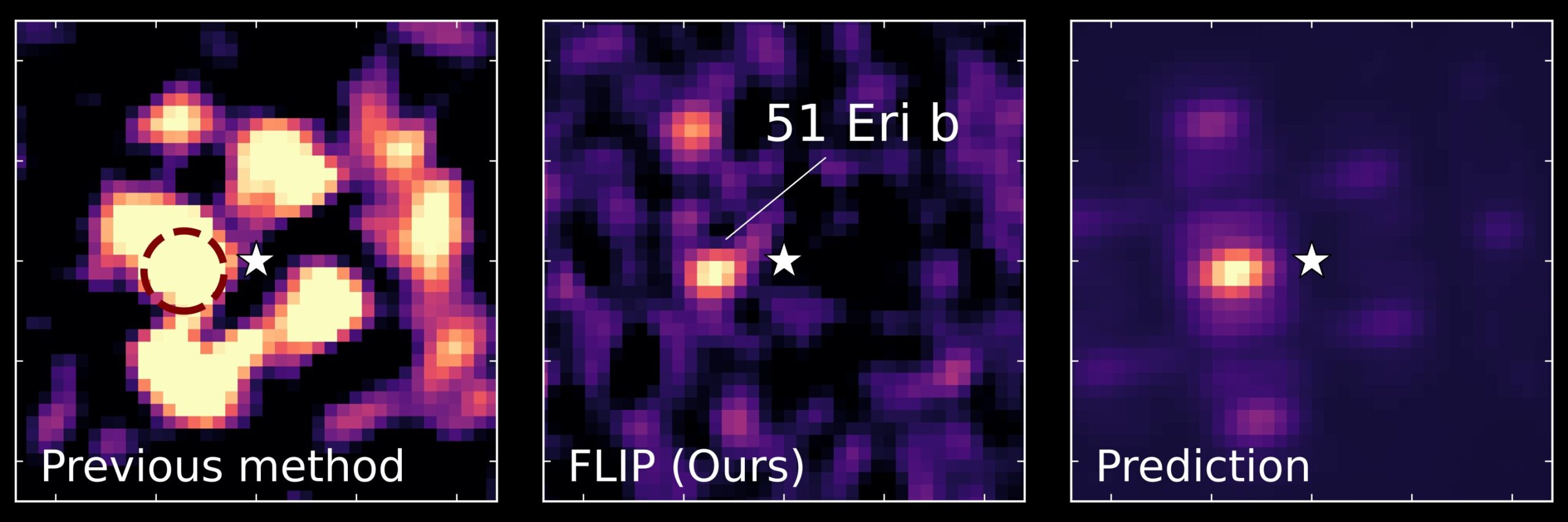
The clearest new astronomical result came from 51 Eridani b.
This young giant planet had previously been detected at 4.1 micrometers using Webb’s NIRCam. At 4.3 micrometers, however, the earlier analysis produced no detection.
After applying FLIP to the same observations, the researchers recovered a planetary signal at that wavelength with a signal-to-noise ratio of 6.3.
The improvement was particularly notable because the wavelength lies within the spectral region containing a carbon dioxide absorption band.
Carbon dioxide is relevant to atmospheric characterization because it can help astronomers investigate a planet’s atmospheric metallicity, a measure related to the abundance of elements heavier than helium.
The researchers describe the result as the first image of 51 Eridani b at 4.3 micrometers.
The difference between the two processing methods is apparent in the detection statistics.
At 4.1 micrometers, the planet’s signal-to-noise ratio increased from 6.7 with KLIP to 14.2 with FLIP, an improvement of about 2.1 times.
At 4.3 micrometers, KLIP produced a non-detection, whereas FLIP recovered the planet with a signal-to-noise ratio of 6.3.
After accounting for small-sample statistical effects, the corresponding detection confidence was approximately 5.3σ.
The researchers also compared the recovered signal with a simulated planetary point spread function. This helped establish that the feature had the expected appearance of a point source rather than being an artifact produced by the telescope’s residual stellar pattern.
The 4.3-micrometer result is particularly useful because the wavelength is difficult to access from ground-based observations owing to absorption by Earth’s atmosphere.
The researchers say future work will use the new detection to measure the planet’s photometry at this wavelength and carry out additional atmospheric characterization.
That could help assess earlier evidence suggesting that 51 Eridani b has an atmospheric metallicity approximately five times the value measured for its host star.
However, the new image itself does not establish that atmospheric composition. It provides a detection at a wavelength that can support further investigation.
Stronger detections across the other observations
The improvement was not limited to 51 Eridani.
HIP 65426 b, a previously known giant planet, was detected with a signal-to-noise ratio of 82.5 using KLIP. FLIP increased that value to 130.1, approximately a 1.6-fold improvement.
The results for 51 Eridani b at 4.1 micrometers were similarly encouraging, with its signal-to-noise ratio increasing from 6.7 to 14.2.
The TYC 5899 observation provided a different kind of test because the researchers did not have a known planet to recover.
Instead, they inserted artificial planets into the original science image before processing it. This allowed them to compare the two algorithms under controlled conditions using signals of known brightness and position.
One of these artificial planets was recovered with a signal-to-noise ratio of 8.8 using FLIP. The same injected planet was not detected using KLIP.
The image also contained a bright star away from the central target. Although FLIP reduced the surrounding stellar contamination, the nearby star remained visible in a distorted form after subtraction.
Together, the observations demonstrate that the method can improve the recovery of both known planetary companions and simulated signals in a dataset without a known companion.
The biggest gains appear close to the star
The researchers also examined how much fainter a planet could be before becoming undetectable.
To do this, they calculated detection-sensitivity curves for both methods at different angular separations from each host star.
These curves are based on contrast, which describes the brightness of a potential planet relative to its host star. Better sensitivity means astronomers can detect planets with lower brightness contrasts.
The team calibrated the curves using artificial-planet injection and recovery tests. They also accounted for the loss of planetary light caused by the processing algorithms and the coronagraph itself.
The strongest improvements appeared at relatively small angular separations, where the residual glare of the star creates the greatest challenge.
For TYC 5899, FLIP achieved approximately 15 times better sensitivity than KLIP at a separation of 0.5 arcseconds. At 1 arcsecond, the improvement was about fivefold.
For 51 Eridani’s F430M observation, the sensitivity improvement was approximately fivefold at 0.5 arcseconds and 2.5-fold at 1 arcsecond.
Across the observations, the researchers report improvements of roughly two to 15 times compared with standard processing techniques.
These differences are important because detecting a faint planet near its star is particularly difficult when small changes in telescope alignment and optical behavior leave behind residual starlight.
To investigate that problem, the team also estimated a stability-limited sensitivity for KLIP.
They generated simulated observations with realistic variations in the alignment between the star and the coronagraph, as well as changes in the telescope’s optical path differences.
They performed 50 random realizations of each observation sequence, varying these instrumental effects while leaving out other sources of noise, such as photon noise and detector noise.
This allowed them to isolate how telescope instabilities alone could limit the performance of conventional reference-image subtraction.
The KLIP sensitivity measured in the real observations was consistent with the simulated stability-limited performance to within a factor of two.
In most cases, FLIP achieved sensitivity substantially better than this estimated stability limit.
The comparison supports the researchers’ central finding: a sufficiently flexible physical model can compensate for instrumental changes that would otherwise limit the ability to remove starlight using reference observations.
Better than the stability limit, but not yet the noise limit
The improvements do not mean that FLIP has eliminated every obstacle to direct exoplanet imaging.
The researchers compared their results with a fundamental noise limit calculated from the JWST data products. This limit accounts for the combined uncertainty from photon noise, read noise and flat-field noise.
It represents an optimistic estimate of the sensitivity that could be achieved if the unwanted stellar signal were removed perfectly, without introducing additional noise or losing planetary light.
FLIP moved the detection limits substantially closer to this benchmark than KLIP did.
However, the method did not reach the fundamental noise limit in any of the observations.
That distinction matters because overcoming telescope-instability limitations is not the same as eliminating all sources of uncertainty in an astronomical image.
At larger angular separations, for example, the researchers found that FLIP sometimes produced greater planetary signal loss than KLIP in the TYC 5899 dataset.
This explains why the KLIP sensitivity curve was deeper than the FLIP curve in some of those regions.
The authors note that observations at larger separations are often limited by background noise rather than by residual starlight. In such circumstances, improving the stellar subtraction may provide less benefit.
The method’s strongest advantage therefore lies in the closer regions where imperfect stellar-light removal and telescope instability are major limitations.
There are also practical differences in how the algorithms handle planetary signals.
Near the locations of the measured companions, the estimated signal loss from algorithm overfitting varied across the datasets. For HIP 65426 b, it was about 5–10% with KLIP and 5–20% with FLIP. For 51 Eridani b in F410M, the corresponding losses were about 20–70% and 20–40%. In F430M, they were about 50–80% and 30–50%. For the TYC 5899 comparison, they were about 10–40% and 40–60%, respectively.
These results show that FLIP does not automatically preserve more planetary light in every observation. Its performance depends on the observing conditions and the behavior of the optimization.
The researchers also identify detector modelling as an area requiring further development. Their current model can account for pixel-level response variations, but more sophisticated descriptions of detector behavior could improve its accuracy.
Another unresolved issue is the interpretation of the optimized parameters themselves. Although FLIP can compensate for phase variations and pointing changes, the team has not yet systematically calibrated the inferred instrumental changes or established their uncertainties.
The current method is therefore designed primarily to reproduce the observed stellar image accurately rather than to provide a definitive measurement of every physical change occurring inside the telescope.
What remains uncertain in the recovered images
The extended analysis also identifies features that require caution.
In the F410M image of 51 Eridani, the researchers observed an artifact near the right edge of the field of view.
The F430M image contains another faint signal to the left of 51 Eridani b. The authors describe its nature as inconclusive, so it cannot be confidently identified as another astronomical companion.
These details illustrate why improved image processing does not remove the need to examine residual features carefully. A stronger signal is not automatically evidence that every remaining point-like feature represents a planet.
The researchers also acknowledge that FLIP’s sensitivity measurements around HIP 65426 b have a specific limitation. A bright lobe of the planet’s own point spread function prevented them from measuring FLIP’s contrast performance within 0.6 arcseconds of the star. KLIP’s corresponding measurements could account for the planet using an additional modelling procedure.
The comparison is therefore incomplete in that innermost region.
The study also remains a demonstration on a relatively small collection of observations. It covers three stellar systems, two coronagraph designs and three filters, but it does not establish that the same improvements will occur under every possible JWST observing condition.
The authors identify several technical challenges that will need attention before the method can be used more broadly. These include improving detector models, understanding degeneracies between adjustable parameters, investigating optimization settings in greater detail and reducing computational costs.
Applying FLIP to larger datasets, particularly ground-based observations, will also require ways to handle substantially greater data volumes.
For now, the results establish that model-based subtraction can outperform conventional reference-image techniques on real coronagraphic observations, rather than only on simplified computer simulations.
The study was published in Nature.