A supermassive black hole 55 million light-years away has passed another important test of its most recognizable feature. Using an independent imaging technique that avoids some of the calibration problems affecting conventional radio observations, astronomers have reconstructed the dark central shadow of M87 and recovered the same ring-shaped structure seen in earlier Event Horizon Telescope images. The ring measures approximately 42.2 microarcseconds across, and its size points to a black hole with a mass of about 6.5 billion Suns. The result comes from a new analysis of observations collected across three years, providing an independent check on one of the most famous images in modern astronomy.*
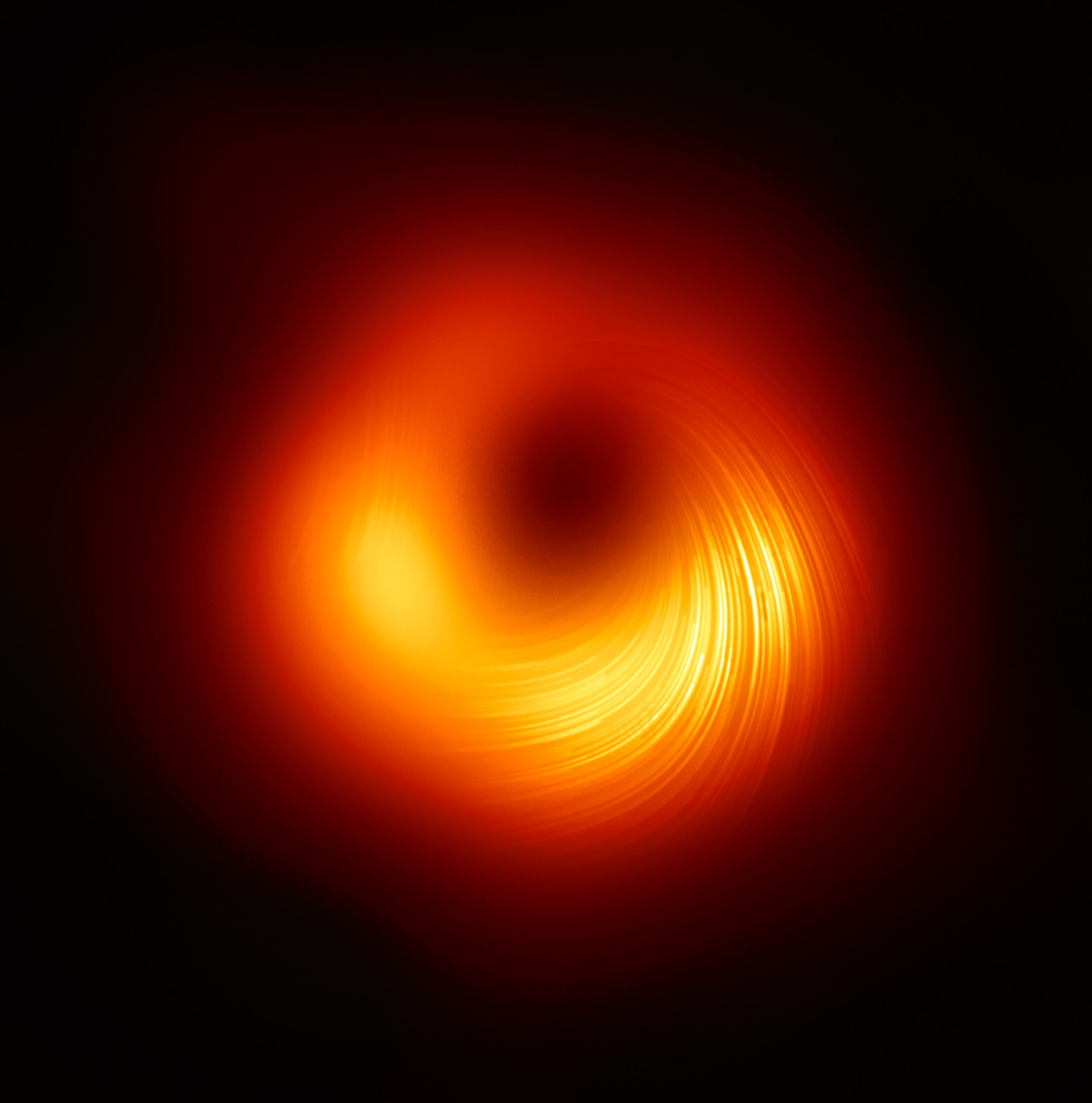
When the Event Horizon Telescope (EHT) Collaboration released its first image of the supermassive black hole at the center of the galaxy Messier 87 in 2019, the image revealed a bright, uneven ring surrounding a dark central region. The object, known as M87*, had become the first black hole to be directly imaged at the scale of its event horizon.
The ring-like appearance is expected from the way gravity affects light near a black hole. Radiation emitted by hot material surrounding the black hole is bent by its intense gravitational field, producing a bright structure around a central shadow. The shadow is not a photograph of the event horizon itself. Instead, it reflects how the black hole’s gravity influences the paths of light reaching distant observers.
Although the overall ring shape became a defining feature of the M87* image, reconstructing its finer details has proved challenging.
The EHT does not operate like an ordinary telescope with a single large mirror. It combines radio signals from observatories distributed across Earth, using a technique called very long baseline interferometry, or VLBI. By coordinating these facilities, astronomers effectively create a virtual telescope with a diameter comparable to that of the planet.
The technique provides extraordinary angular resolution, but it comes with a significant limitation. The network does not collect information from every possible direction and spatial frequency needed to construct a complete image.
As Earth rotates, the changing positions of the observatories provide additional measurements, gradually filling parts of the information space needed to reconstruct the source. However, the resulting coverage remains incomplete and uneven.
Astronomers must therefore use mathematical algorithms to reconstruct an image from relatively sparse measurements. Different algorithms, calibration choices and assumptions about the expected appearance of the source can produce different results.
This sensitivity has been particularly important for M87*. Independent analyses have sometimes produced noticeably different representations of its fine-scale structure. Some have even challenged whether the available observations necessarily require a ring-shaped image.
One earlier analysis, for example, reported that extending the assumed image field of view beyond 120 microarcseconds could favor a single elongated bright region rather than a ring.
The problem is not simply that different algorithms produce slightly different pictures. When the available measurements are incomplete, the assumptions used to fill in missing information can influence the reconstructed morphology.
The new research addresses this problem by using a different kind of interferometric measurement that is less sensitive to instrumental calibration errors.
Reconstructing the image without relying on conventional calibration
The researchers developed their analysis around quantities called closure invariants. These measurements contain information about the source’s structure while remaining insensitive to certain errors introduced by the instruments and the atmosphere.
In conventional radio interferometry, signals received at different observatories are affected by station-specific changes in phase and amplitude. These changes can distort the measurements and make it difficult to recover the original source accurately.
Closure invariants are constructed by combining measurements from multiple pairs of observatories in a way that cancels the effects of these station-based errors.
They also do not depend on the absolute position or total brightness of the source. Those properties are not necessary for determining its basic morphology.
Traditional approaches often use closure phases and closure amplitudes as separate measurements, treating them with different statistical procedures. The researchers instead used a unified mathematical framework that combines equivalent morphological information into a common set of calibration-independent quantities.
They then fed these measurements into an imaging algorithm called Generative Deep learning Image Reconstruction with Closure Terms, or GenDIReCT.
The algorithm uses a machine-learning architecture based on a conditional latent diffusion model. Rather than beginning with a manually selected image and repeatedly adjusting it, GenDIReCT generates possible image reconstructions conditioned on the measured closure invariants.
A separate neural network then combines information from these generated images to produce a representative reconstruction that remains consistent with the observations.
This approach differs from conventional imaging methods that can depend heavily on an initial image model, manually selected regularization settings or adjustments to instrumental calibration.
It is not completely free of assumptions. GenDIReCT learns general image characteristics from a training library, which provides an implicit statistical prior. However, the researchers designed the method to avoid prescribing a particular astronomical shape for the object being reconstructed.
Most of its training images came from augmented, non-astronomical photographs in the CIFAR-10 dataset. The researchers also included simple geometric shapes, including disks, rings, ellipses and other structures, in their main training configuration.
Importantly, they tested whether those geometric shapes were responsible for producing the ring in M87*. When they trained the architecture without the geometric shapes, the resulting reconstructions showed no notable difference.
Before applying the algorithm to the actual observations, the researchers also tested its performance using synthetic datasets, different source morphologies and varying levels of data corruption. They withheld the real M87* data from the final analysis until the models had passed their internal validation tests, reducing the risk of adjusting the method to favor an expected result.
Eight observing sessions across three years
The analysis used publicly available EHT observations of M87* collected during three observing campaigns in 2017, 2018 and 2021.
The researchers examined eight individual observing epochs:
- Four sessions on April 5, 6, 10 and 11, 2017.
- Two sessions on April 21 and 25, 2018.
- Two sessions on April 13 and 18, 2021.
The observations were made at approximately 1.3-millimeter wavelengths, using two frequency bands centered at 227.1 and 229.1 gigahertz.
The EHT network also changed between observing campaigns. Seven facilities participated in 2017. The Greenland Telescope joined in 2018, improving the coverage of measurements in the north-south direction. In 2021, the 12-meter Kitt Peak telescope and the upgraded Northern Extended Millimeter Array joined the observations.
These differences provided an opportunity to test whether the reconstructed appearance of M87* remained consistent despite changes in the observing network and its coverage.
For each dataset, the researchers reconstructed images using three different fields of view: 128 × 128, 225 × 225 and 450 × 450 square microarcseconds.
The different fields of view were important because they changed the range of source sizes that the reconstruction could accommodate. If the ring appeared only when the researchers imposed a narrow field of view, that would raise concerns about whether the result was being driven by the chosen image boundaries.
For every combination of observing dataset and field of view, the researchers generated hundreds of individual reconstructions. They then aligned the images and calculated their pixel-by-pixel median to produce a representative image.
The median approach helped reduce the influence of unusual reconstructions and alignment problems, allowing the researchers to identify the structures appearing consistently across the image population.
The three highest-quality datasets, April 11, 2017, April 21, 2018, and April 18, 2021, were selected as the main reference observations. The remaining datasets provided additional opportunities to test the consistency of the results.
A ring appears in every observing year
Across the independent observing epochs, GenDIReCT consistently reconstructed a compact, ring-like structure measuring approximately 40 microarcseconds across.
The result was particularly clear in the three highest-quality datasets. Their median reconstructions produced compact, approximately circular rings with consistent diameters and orientations.
The rings also showed a brighter region toward the south or southwest.
The researchers measured the ring diameter from their reconstructed images using an image-analysis procedure similar to the one employed in the original EHT analysis.
Across all eight observing epochs, the measurements produced a mean diameter of 42.2 ± 1.5 microarcseconds.
The individual measurements were:
| Observation | Ring diameter |
|---|---|
| April 5, 2017 | 42.0 ± 3.6 μas |
| April 6, 2017 | 43.1 ± 2.3 μas |
| April 10, 2017 | 43.3 ± 0.4 μas |
| April 11, 2017 | 43.3 ± 1.0 μas |
| April 21, 2018 | 42.7 ± 0.5 μas |
| April 25, 2018 | 43.3 ± 4.6 μas |
| April 13, 2021 | 40.4 ± 1.7 μas |
| April 18, 2021 | 39.9 ± 1.8 μas |
The consistency is important because the measurements come from different observing dates, with different levels of data coverage and instrumental sensitivity.
The researchers also compared their results with reconstructions produced using established EHT imaging methods, including THEMIS, DIFMAP, eht-imaging, SMILI and Comrade.
The measured ring diameters and orientations were generally consistent across the independent approaches.
Most importantly, changing the reconstruction field of view did not eliminate the ring in the higher-quality datasets. This directly addresses the earlier concern that a ring might be an artifact of a particular choice of image boundaries.
The researchers also examined the different solution clusters generated by GenDIReCT. These clusters represent groups of visually similar reconstructions.
For the highest-quality observations, differences between the clusters mainly involved the brightness distribution and the amount of diffuse emission surrounding the ring, rather than fundamental changes to its structure.
In addition, no non-ring solution was favored over the ring-like morphology in either the population of reconstructions or the data-fidelity scores across the tested fields of view.
The April 25, 2018, observations were the most ambiguous. That dataset lacked measurements from the Large Millimeter Telescope, leaving a substantial gap in the available spatial-frequency coverage near 1 gigalambda. The resulting reconstructions had lower image fidelity than those from April 21, 2018.
Even with this weaker dataset, however, the analysis did not establish a competing non-ring morphology as the preferred solution.
The ring’s brightness and orientation are less stable
Although the overall diameter and ring-like structure remained consistent, not every measured property was equally reliable.
The researchers examined several additional characteristics, including ring width, orientation, azimuthal asymmetry and central brightness fraction.
Ring width describes how thick the bright structure appears. Azimuthal asymmetry measures how unevenly its brightness is distributed around the ring. Central brightness fraction compares the emission inside the ring with the brightness along the ring itself.
These properties varied more substantially between observing dates and imaging methods than the diameter did.
For example, the measured ring widths ranged from approximately 11 to 36 microarcseconds. The April 25, 2018, reconstruction produced the largest value, but it also came from one of the less reliable datasets.
The researchers found that differences in image processing, particularly the use of different image-convolution procedures, could substantially influence the apparent ring width.
The central brightness fraction also varied considerably. Some reconstructions contained a very dark central region, while others showed more emission inside the ring.
Azimuthal asymmetry was similarly sensitive to the observing date and the available measurements.
Consequently, the researchers cautioned that ring width and central brightness fraction probably do not provide reliable measurements of intrinsic source properties in their current form.
The orientation measurements showed a different pattern. The ring’s position angle changed between observing dates, with the measurements from 2018 and 2021 more closely aligned with the large-scale forward jet of M87 than those from 2017.
The authors noted that the apparent changes in orientation during 2017 might partly reflect uncertainty in the ring’s brightness distribution caused by sparse observational coverage on April 5 and 6.
They also considered the evolution between 2017 and 2018 noteworthy, suggesting that it could be associated with the turbulent nature of material accreting around the black hole.
However, the observations do not establish the physical cause of the changes.
A second analysis independently measures the ring
To check whether the reconstructed diameter depended on the new imaging algorithm, the researchers performed a separate analysis using Bayesian geometric modeling.
This method approaches the observations differently. Instead of generating an image from a learned statistical representation, it describes the source using a collection of mathematical shapes whose predicted radio signals can be calculated directly.
The central component was an xsringauss model, designed to represent the crescent-like appearance expected from emission surrounding a black hole.
The model consists of an outer disk and an offset inner disk, producing a bright crescent with a central depression. Several additional components account for other emission that the basic ring model cannot describe.
These include an elliptical Gaussian representing localized emission near the crescent, a circular Gaussian representing residual emission inside it, a larger background Gaussian accounting for extended flux, and two additional elliptical Gaussians to accommodate diffuse emission and other measurement-related effects.
The researchers fitted this combined model directly to the observed closure invariants.
They used a Bayesian sampling procedure called DYNESTY to explore the possible parameter values and estimate their uncertainties. The model included 28 parameters describing the ring and its additional emission components.
The geometric analysis independently recovered a mean ring diameter of 42.3 ± 1.1 microarcseconds across the observing epochs.
That measurement is almost identical to the 42.2 ± 1.5 microarcseconds obtained from the non-parametric GenDIReCT images.
The agreement is particularly useful because the two approaches do not reconstruct the source in the same way. One generates images using a learned diffusion model, while the other fits a prescribed geometric representation directly to the measurements.
Both nevertheless recover essentially the same characteristic diameter.
The geometric model also provided estimates of the ring’s inner and outer radii, eccentricity and brightness fading across the crescent.
These measurements helped characterize the shape of the emission, but they do not remove the broader uncertainty associated with how the observed radiation relates to the underlying black hole and its surrounding material.
The measured ring points to a black hole weighing 6.5 billion Suns
The diameter of the bright ring can also be used to estimate the mass of M87*.
A black hole’s gravitational influence determines the characteristic scale of the shadow. However, the observed ring diameter is not simply equal to the black hole’s gravitational radius multiplied by a universal constant.
The relationship must be calibrated using simulated observations of black hole accretion systems. These simulations account for how the emission surrounding the black hole is gravitationally lensed and how the resulting image depends on the physical properties of the system.
A key parameter in this calibration is represented by α, which relates the measured ring diameter to the gravitational radius.
The EHT Collaboration previously established calibration values using large collections of simulated black hole images. For image-domain feature-extraction methods, the calibration factor ranged from 10.67 to 11.01. For geometric modeling methods, it ranged from 11.01 to 12.06.
The researchers adopted a median calibration factor of approximately 11.0, with a theoretical uncertainty of 0.4.
They also used an estimated distance to M87 of 16.8 megaparsecs, with an uncertainty of +0.8 and −0.7 megaparsecs.
Using these parameters and their independently measured ring diameter, they estimated the black hole’s mass at:
6.5 ± 0.5 billion solar masses.
The estimate is consistent with previous measurements based on the motions of stars around the center of M87.
In particular, stellar dynamical measurements had previously placed the black hole’s mass at approximately 6.6 billion solar masses, with an uncertainty of 0.4 billion.
The result also differs from the smaller mass estimated using gas dynamics, which produced a value of approximately 3.5 billion solar masses, with an uncertainty of +0.9 and −0.7 billion.
The researchers noted that the smaller mass estimate would imply a substantially smaller ring diameter, making it difficult to reconcile with the observed ring given the approximate 20-microarcsecond resolution of the EHT observations.
They also calculated how the mass estimate changes across the full range of calibration factors. Depending on the adopted calibration, the inferred mass falls between approximately 6.0 billion and 6.7 billion solar masses.
The authors therefore report 6.5 ± 0.5 billion solar masses as their conservative estimate.
The observations favor a tilted view of the black hole
The researchers also investigated how the appearance of M87* depends on the black hole’s spin and the angle from which it is observed.
The inclination angle describes the orientation of the black hole system relative to the observer. In this case, it is measured in relation to the approaching jet.
A black hole’s spin and the orientation of its accretion flow can influence the brightness distribution and shape of the surrounding emission. Comparing observed images with simulated black hole images can therefore help constrain these properties.
For this analysis, the researchers used synthetic 230-gigahertz images produced with the IPOLE radiative-transfer algorithm.
The images were based on general relativistic magnetohydrodynamic simulations, which model the behavior of magnetized material in the strong gravitational environment around a black hole.
They examined five spin prescriptions, ranging from −0.94 to +0.94, and inclination angles from 5° to 90°, in one-degree increments.
The researchers focused on magnetically arrested disk simulations, which they considered the more likely evolutionary scenario for M87* based on constraints from its jet power.
They then compared the simulated images with the reconstructed M87* images using a normalized cross-correlation measure. This allowed them to identify which combinations of spin and inclination produced the closest image-domain matches.
The comparison favored an inclination angle of approximately 20°.
This is consistent with the independently inferred viewing angle of 17.2° ± 3.3° obtained from 43-gigahertz observations of the M87 jet.
The analysis also favored a nonzero black hole spin. However, it did not constrain the magnitude of that spin.
In other words, the researchers found that models with some rotation produced better image matches than the non-rotating case, but the observations were not sufficient to determine how rapidly M87* spins.
The inclination estimate also depends on the assumptions used to construct the simulated images. When the researchers repeated the analysis with a different electron-temperature parameter, the preferred inclination shifted downward by approximately 2°.
The viewing angle is therefore a more constrained result than the spin magnitude, which remains unresolved.
The researchers noted that future horizon-scale observations using space-based VLBI could potentially resolve the photon ring and provide a more direct and precise determination of the black hole’s spin.
The study was published in Nature.