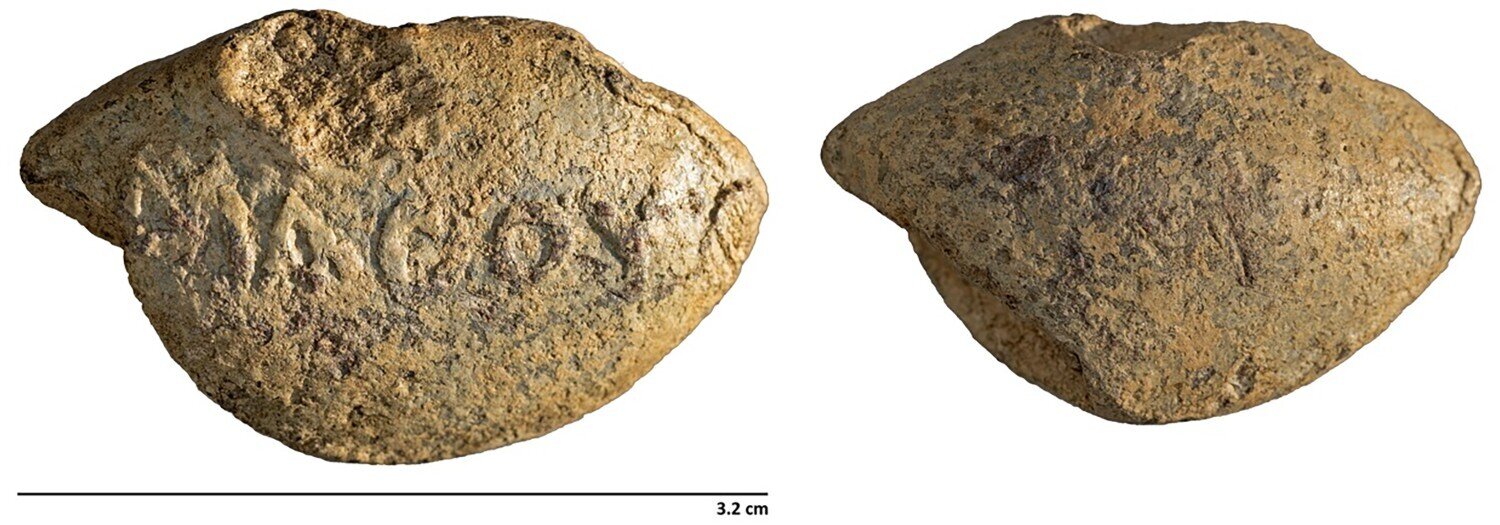
The first inscribed sling bullet recovered at the ancient city of Hippos bears a single Greek word that appears to mean “Learn your lesson!” Found in 2025 near the Sussita Stream, the small lead projectile also carries an impact scar that indicates it was used.
The sling bullet, identified as B19655, was recovered in 2025 with a metal detector near the riverbed of the Sussita Stream. The location would have provided besiegers with a useful position for attacking Hippos’ main eastern gate, particularly forces using heavy siege machinery.
The find is one of more than 70 lead sling bullets recovered at Hippos and its surroundings. Many of the others are uninscribed, while some depict scorpions or thunderbolts.
Hippos was part of the Roman Decapolis. The city was founded after the Battle of Paneion around 199 BCE and later became part of Provincial Syria after Pompey’s conquest in 64 BCE.
The inscription is a single Greek word
The newly found bullet carries the letters ΜΑΘΟΥ on one side. The researchers read this as the Greek word μαθοῦ, meaning “Learn your lesson!”
Sling bullets were used for thousands of years as hand-thrown projectiles. A sling consisted of a long rope with a leather pouch holding the projectile. The thrower would swing the sling before releasing the bullet.
Lead eventually became widely used for such projectiles from the Classical period onward. Its relatively high mass, low cost and low melting point made it suitable for casting in stone molds. The bullets were generally almond-shaped and measured about 3 by 2 centimeters, with masses ranging from about 20 to 55 grams.
At distances of up to about 100 meters, they could be used against individual targets. At greater distances, they could be used against groups of enemies.
The wording appears to be a taunt
Inscriptions on sling bullets are not unusual. They can name deities, cities or military units, celebrate victory, or sometimes identify an individual connected with the projectile.
But the Hippos bullet is inscribed on only one side, making a personal name less likely. Instead, the researchers interpret the word as a taunt directed at the enemy.
Other inscribed sling bullets have carried taunts such as “take a taste,” “receive this,” or “take it.”
The form of the Hippos inscription is especially unusual. The word uses the Greek middle voice, a grammatical form that the researchers say could intensify its mocking character. Eisenberg suggested that the bullet could, in effect, be telling itself to learn and strike the enemy well.
The reading itself is considered highly secure because the inscription is clear and no letters are missing. Its interpretation took longer because this particular word has not previously been found on a sling bullet.
The projectile had been used
The lead bullet also carries an impact scar. Lead generally does not suffer much erosion over time and instead develops a patina, which can be gently removed during conservation.
Because sling bullets were soft and thrown at high power, they often do not retain clear marks from impacts or even lose part of their original form. The scar on this example therefore provides evidence that the projectile was used.
The researchers think it was probably thrown by defenders from Hippos’ city walls toward enemy forces below. Hippos experienced several battles during the Hellenistic period, including fighting before the city’s establishment under Ptolemaic rule, the Battle of Paneion around 199 BCE, an attempted conquest by Alexander Janneus around 101 BCE, and the city’s eventual conquest around 83 BCE.
Which particular battle involved the inscribed bullet remains uncertain.
The study was published in Palestine Exploration Quarterly.